
Table of Contents
Table of Contents
A Kafka to BigQuery pipeline can look healthy while the warehouse is quietly behind. The connector task is running, Kafka consumer lag is flat, and queries return rows, yet a burst of retries or a schema change has moved the data outside the freshness target. When an analyst asks for a historical correction, the same pipeline may have no safe way to replay a bounded range without competing with live traffic.
Treat the pipeline as two related contracts: a freshness contract for the live path and a replay contract for backfills. The first tells you how old a record may be when it becomes usable in BigQuery. The second says which offsets can be replayed, how duplicates are identified, and how the corrected result is reconciled. A connector choice follows from those contracts; it cannot define them for you.
1Define freshness before choosing a connector
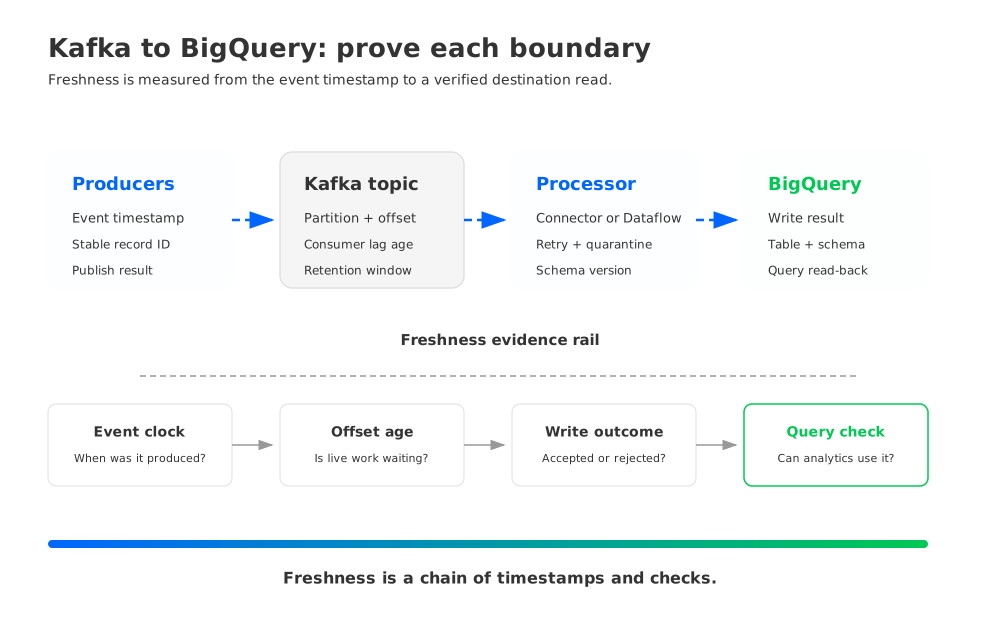
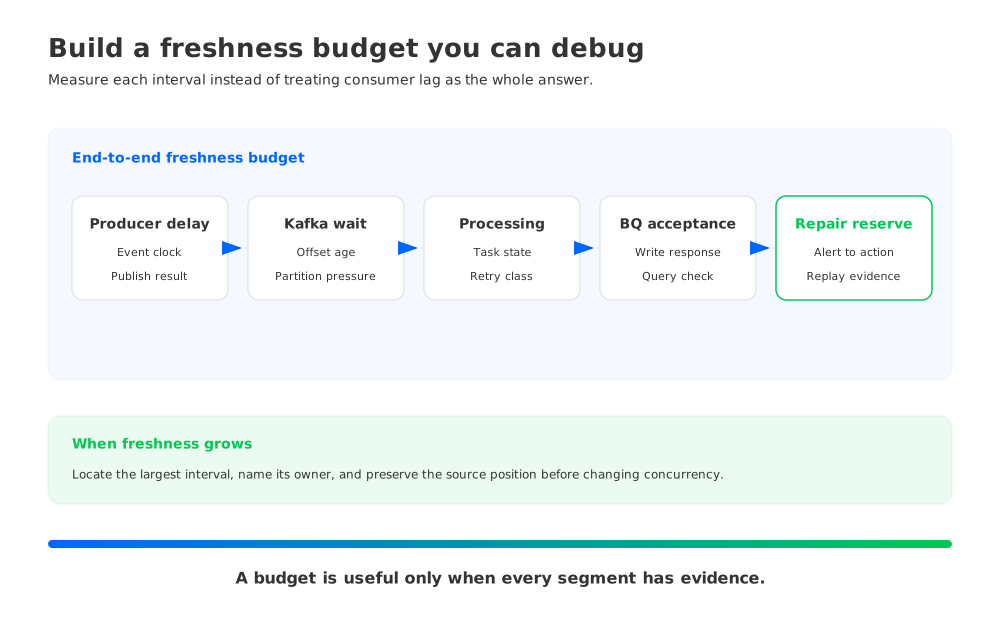
Freshness is an end-to-end measure, not a Kafka metric. A useful budget names each interval between the source event and the queryable row:
Freshness budget = source and producer delay + Kafka waiting time + connector processing + BigQuery acceptance and visibility + monitoring and repair reserve.
The terms are workload-specific. A Dataflow pipeline may read Kafka with the Kafka to BigQuery template, while a Kafka Connect deployment may use a BigQuery sink connector. The runtime changes, but the questions stay the same: where is time measured, which component owns each interval, and which signal proves that the row crossed the boundary?
Write the contract as an operational table rather than a single promise:
| Boundary | Evidence to capture | Owner when it grows |
|---|---|---|
| Producer to Kafka | Event timestamp, producer result, topic and partition | Application or producer team |
| Kafka to processing runtime | Consumer offset, record timestamp, lag age, task state | Connector or Dataflow owner |
| Processing to BigQuery | Batch or stream write result, rejected records, retry state | Data pipeline owner |
| BigQuery acceptance to query | Destination write mode, table visibility check, query timestamp | Analytics platform owner |
| Repair reserve | Alert time, replay window, runbook duration, verification result | On-call and data owner |
This table avoids a common error: treating “consumer lag is zero” as proof that BigQuery is fresh. A consumer can advance after handing records to a buffer, or a sink can accept a request while a downstream table check still fails. Capture a source event time and a destination observation time so an incident can be measured from the same record.
The BigQuery Storage Write API documentation describes a streaming write surface with its own stream and commit behavior. The BigQuery quotas documentation lists limits that can affect write throughput and request shape. Neither page supplies a universal freshness target. Select a target from the workload, then verify it under the quota and retry behavior of the chosen path.
2Map the live data path and its failure edges
A GCP Kafka feed usually has more boundaries than the diagram in a connector quickstart. Producers publish records to Kafka. A consumer runtime reads partitions and maintains offsets. It transforms records, chooses a destination table, and submits writes. BigQuery applies schema and partition rules before the row can be used by a query or downstream scheduled job.
For each boundary, record the state that can be resumed. A minimal runbook includes:
- the Kafka topic, partition, offset, event timestamp, and stable record identifier;
- the processing runtime, task or worker identity, and offset storage location;
- the destination project, dataset, table, write mode, and schema version;
- the retry class, dead-letter or quarantine location, and operator action; and
- the query or reconciliation check that proves acceptance.
A BigQuery sink connector has implementation-specific choices for batching, retries, schema handling, and delivery semantics. A Dataflow pipeline has a different operational surface. Keep those choices in the design record instead of using “Kafka to BigQuery connector” as if it described one behavior.
Separate transient destination pressure from a bad record. A quota response or temporary service error should pause or retry according to the runtime’s policy while preserving the source position. A malformed payload, incompatible schema, or missing permission needs a quarantine path and a human decision. If both cases are sent through the same retry loop, a poison record can hold fresh data behind it and turn a local error into a freshness incident.
3Make schema changes visible to the freshness budget
Schema changes affect both the live path and the replay path. Adding a nullable field may be accepted by the destination configuration, while a type change or a changed nested structure may require an explicit migration. The sink’s behavior depends on its implementation and configuration, so test it with the exact connector or pipeline version selected for production.
Keep schema state next to the record contract. For each change, capture the schema identifier, the first Kafka offset that uses it, the destination table or staging table, and the rollback action. During a rollout, monitor both write errors and freshness age. A pipeline can keep accepting records while a subset is rejected or routed to a dead-letter path.
Backfills should read the schema that belongs to the historical range. Do not decode old records with the latest schema by assumption. If a table is rebuilt from a bounded range, write to a staging table first, validate row identity and counts against Kafka evidence, and then merge into the serving table using the destination’s supported write pattern. A staging table also gives an operator a place to quarantine records that need manual repair.
4Treat backfill as a separate consumer workload
A backfill is a controlled replay, not a second copy of the live connector. Start with a source range that can be named precisely: topic, partitions, offsets or event-time bounds, schema versions, and the expected destination slice. Use a separate consumer group or an equivalent isolated cursor so the live path keeps its own progress. The isolation boundary must be explicit in the runbook.
The replay write needs an identity rule. An event ID, source offset tuple, or domain key plus version can be used when it is stable and available. Pick the rule that matches the destination operation:
- Append history: preserve every source event and record the replay run ID so a reader can distinguish original and repair loads.
- Idempotent upsert: merge on a stable key and reject an older version when a later one is already present.
- Correction table: write the replay result separately, then swap or merge only after reconciliation passes.
Do not promise pipeline-wide exactly-once delivery because one component supports a transactional or committed write mode. Kafka offsets, a connector offset store, and a BigQuery write can fail at different moments. The acceptance test should inject a failure after the destination accepts a batch and before the source offset is committed. The replay must show whether a duplicate is produced and how the destination handles it.
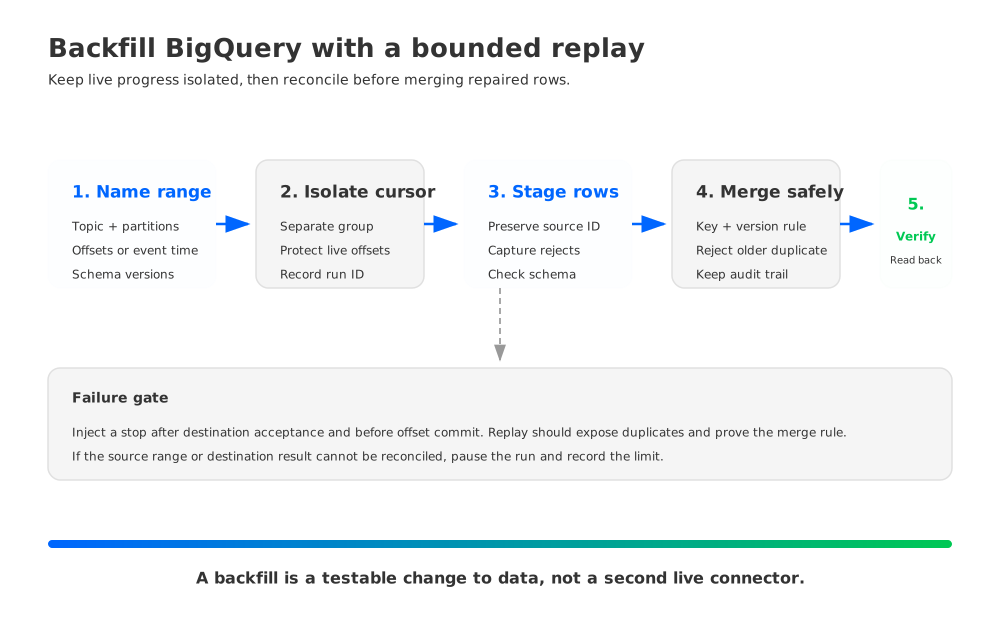
A backfill run is complete only when its evidence is stored. Keep the requested range, consumer group, schema versions, write results, rejected records, destination query, and operator approval together. Compare the destination with a source-side count or checksum that is meaningful for the workload. If the comparison cannot be made, record that limit rather than reporting the backfill as verified.
5Watch quotas, cost, and concurrency as one decision
BigQuery quotas and Kafka consumer capacity interact. Increasing parallelism can reduce connector lag until the destination quota becomes the limiting boundary. A replay can consume the same write budget as live traffic, and a retry storm can multiply requests without increasing useful rows. The right control may be a pause, a smaller batch, a separate table, or a scheduled replay window rather than more workers.
Track three signals together:
- Freshness age: the age of the oldest unprocessed live record, measured from an event timestamp or another documented clock.
- Destination acceptance: accepted, rejected, and retried writes, with the error class and table identity.
- Replay reserve: capacity held for a bounded repair, including the time needed to validate and merge its result.
Use the quota documentation for the target project and region, and record the verification date. Avoid publishing a fixed throughput or cost claim from a sample workload. Storage, query, network, and processing charges depend on the selected path, retention, data shape, and workload mix.
6Where AutoMQ fits in the evaluation
Once the freshness and replay contracts are explicit, the Kafka storage layer can be evaluated on the work it must support: retaining a replayable range, serving catch-up reads, and absorbing live traffic while a historical read is in progress. AutoMQ is a Kafka-compatible cloud-native streaming platform built on a Shared Storage architecture. Its storage design separates broker compute from durable object storage through S3Stream, while preserving Kafka-facing clients and protocol semantics. The AutoMQ architecture overview describes those layers.
That separation does not make BigQuery writes fresh by itself, and it does not define sink idempotency. It gives a team another Kafka storage path to test against the same workload: live connector lag, bounded offset replay, catch-up reads, and failure injection. For a GCP deployment, the AutoMQ GKE deployment guide provides the infrastructure boundary to verify. Keep the BigQuery connector or Dataflow contract unchanged while comparing the storage layer, so the result is attributable.
7FAQ
7.1Is a Kafka to BigQuery connector enough to guarantee freshness?
No. Freshness depends on producer time, consumer lag, processing retries, destination acceptance, table visibility, and the repair reserve. Measure the path with a record-level timestamp and destination check.
7.2Should a backfill share the live consumer group?
Usually not. Use an isolated cursor or consumer group for a bounded replay, and define how its writes are merged with live data. Sharing state without a documented pause and resume procedure can move the live cursor unexpectedly.
7.3How should schema changes be handled during a replay?
Record the schema versions and offsets in the replay range. Decode historical records with their applicable schema, write to staging when the destination contract is uncertain, and merge only after row identity and rejection checks pass.
7.4Does BigQuery provide one universal streaming SLA?
Do not assume one. The selected write API, connector or Dataflow path, table design, quotas, and workload shape determine what you can observe. Set a workload-specific target and verify it in the target project.
A reliable Kafka to BigQuery design makes time and recovery visible. Start with one live record and follow it from producer timestamp to destination query, then run a bounded backfill with an injected failure. If you want to compare a Kafka-compatible shared-storage path on GCP, request an AutoMQ evaluation using the same freshness budget and replay evidence.


