
Table of Contents
Table of Contents
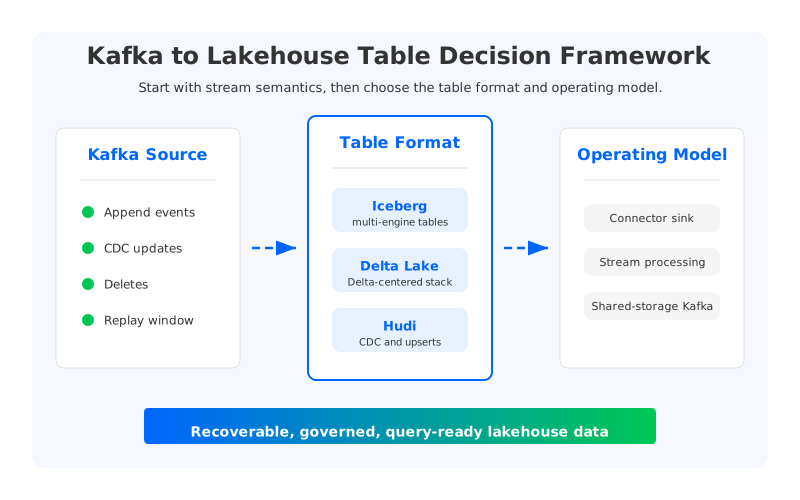
Teams search for "Kafka to data lake tables" when the log is no longer the only system that matters. Kafka is still the fast, ordered integration backbone, but analytics, AI feature generation, regulatory retention, and cost controls increasingly depend on open table formats in object storage. The architectural question is not whether Kafka or a lakehouse is better. The harder question is where the boundary should sit between an event log, a streaming transformation layer, and a table format such as Apache Iceberg, Delta Lake, or Apache Hudi.
That boundary shapes recovery behavior, query freshness, schema governance, and the operational budget of the platform. A sink connector that writes files every few minutes may be enough for append-only observability events. A customer profile table with late updates, deletes, and replay requirements needs stronger table semantics. A real-time AI pipeline may need predictable freshness without forcing the Kafka cluster to become a permanent historical store for every downstream use case.
1Why Kafka to Data Lake Tables Is a Platform Decision
Kafka is optimized around ordered records, partitions, offsets, consumer groups, and replay. The data lakehouse is optimized around files, metadata, snapshots, partition pruning, compaction, and query engines. Moving data from one to the other is a translation between two operating models, not a file-copy task.
That translation usually has four goals:
- Preserve the business meaning of event time, ordering, deletes, and schema changes.
- Make fresh data queryable without creating too many small files.
- Keep replay and backfill possible when a table writer, schema, or transformation is wrong.
- Control who owns governance: the streaming team, the data platform team, or the lakehouse catalog.
The wrong design often works in the first month because the data volume is still small and the consuming teams are patient. It becomes expensive later when the table has millions of small files, the Kafka retention window is too short for a clean replay, and every schema evolution requires coordination across producers, stream processors, connectors, catalogs, and query engines.
2The Production Constraints Behind the Search
A Kafka-to-table pipeline has more state than it first appears. Kafka tracks offsets per consumer group. Connectors or stream processors track their own checkpoints. The table format tracks snapshots, manifests, transaction logs, commit timelines, or file groups. The catalog tracks the table pointer that query engines see. Each layer can be correct on its own and still produce surprising behavior when combined.
For platform teams, the critical constraints are usually these:
| Constraint | Why it matters in production | Design question |
|---|---|---|
| Freshness | AI features, dashboards, and operational analytics may need minute-level or lower latency. | How often can writers commit without creating file and metadata pressure? |
| Replay | Bad code, bad schema, or partial outages require deterministic recovery. | Can Kafka retention and table snapshots cover the same rollback window? |
| Deletes and updates | CDC streams carry tombstones, before/after images, and key-level changes. | Does the table format handle row-level changes efficiently for this workload? |
| Governance | Lakehouse tables need schema, lineage, access control, and catalog ownership. | Which team approves schema changes and table evolution? |
| Cost | Kafka broker storage, cross-zone traffic, object storage requests, compaction, and query scans all contribute. | Where should long-lived data reside, and where should fast transient state reside? |
This is why the decision cannot be reduced to "write Kafka into S3." Object storage is the substrate, but the table format decides how readers see a consistent table, how changes are represented, and how older versions can be queried or cleaned up.
3Iceberg, Delta, and Hudi in Plain Architectural Terms
Apache Iceberg, Delta Lake, and Apache Hudi all solve the problem of making large data lake files behave more like reliable tables. They differ in their metadata models, ecosystem fit, and update patterns. The practical choice often depends less on feature checklists and more on the shape of the event stream.
Iceberg is a strong default when the platform needs an open table format with explicit snapshot metadata, schema evolution, hidden partitioning, and broad engine interoperability. It is especially attractive when many engines need to read the same table and the platform team wants the table format to be independent of one compute framework.
Delta Lake is often a natural fit where the organization already standardizes around Delta-compatible engines and wants transaction-log-based table management with mature batch and streaming integration patterns. Its strength is operational consistency inside ecosystems that have already adopted Delta as the lakehouse table contract.
Hudi is especially relevant when the workload is CDC-heavy and record-level upserts, incremental pulls, and table services are central to the design. Hudi's Copy-on-Write and Merge-on-Read table types give teams explicit choices around write amplification, read cost, and compaction timing.
The clean way to compare them is by workload:
| Workload pattern | Iceberg | Delta Lake | Hudi |
|---|---|---|---|
| Append-heavy event facts | Strong fit, especially for multi-engine analytics | Strong fit in Delta-centered stacks | Works, though may be more capability than needed |
| CDC with frequent upserts | Good when engine support and merge planning fit | Good in Delta-native processing stacks | Strong fit because upsert and incremental patterns are central |
| Broad query engine interoperability | Strong fit | Depends on the deployed ecosystem | Good, but verify engine maturity for required features |
| Operational incremental consumption | Snapshot and metadata features help | Streaming integration depends on stack choices | Strong incremental consumption model |
| Table ownership by central data platform | Strong fit | Strong fit in Delta-oriented lakehouses | Strong fit for ingestion teams that own CDC semantics |
No table format removes the need to design the Kafka side carefully. If producers emit incompatible schemas, if keys are unstable, or if deletes are ambiguous, the table writer can only encode confusion with better metadata.
4Architecture Patterns Teams Usually Compare
There are three common ways to move Kafka data into lakehouse tables.
The first pattern is a connector-based sink. Kafka Connect or a managed equivalent reads topics, converts records to files, and commits them into a table or storage layout. This works well when transformations are light, ownership is clear, and the team values operational simplicity over custom processing logic.
The second pattern is a stream processing job. A Flink, Spark Structured Streaming, or similar job reads Kafka, applies event-time logic, handles deduplication or joins, and writes to Iceberg, Delta, or Hudi. This pattern is stronger when table correctness depends on processing semantics rather than only delivery semantics.
The third pattern is a platform-native bridge between streaming topics and lakehouse tables. This is where the streaming platform itself exposes a stronger abstraction for table-oriented consumption, reducing the number of separate moving parts the team has to operate.
Each pattern has a failure mode. Connector sinks can produce too many small files or encode weak schema assumptions. Stream processing jobs can become the hidden owner of business logic that no team wants to touch. Platform-native bridges can be attractive, but only if they preserve open formats and do not trap the organization in a narrow control plane.
5Stateful Brokers vs Stateless Brokers
The Kafka cluster's own storage architecture affects how comfortable teams feel using Kafka as the replay source for table pipelines. In a traditional shared-nothing Kafka deployment, brokers own local disks and partitions. Replication improves durability, but it also means broker replacement, scaling, and partition movement are tied to data movement. When lakehouse pipelines depend on long replay windows, that operational model can force teams to overprovision broker storage even when most historical access belongs in object storage.
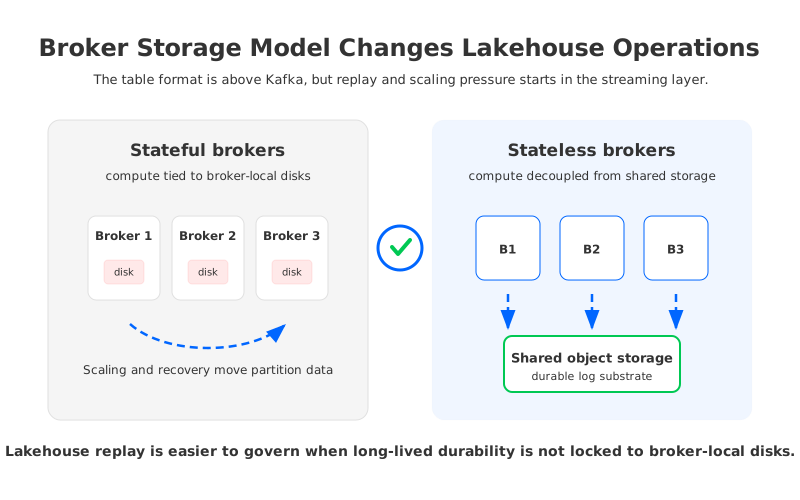
This does not mean local-disk Kafka is wrong. It means the platform team should be explicit about the split:
- Kafka is the low-latency event log and integration layer.
- The table format is the analytical and governance layer.
- Object storage is the durable historical substrate.
- The pipeline is the contract that preserves event meaning across those layers.
When that split is unclear, teams often compensate by extending Kafka retention indefinitely, adding more broker disks, and treating lakehouse tables as secondary copies. That increases operational pressure on the streaming platform without necessarily improving table correctness.
6Evaluation Checklist for Platform Teams
Before picking Iceberg, Delta, or Hudi, decide what must be true about the pipeline. A useful checklist is more concrete than a generic feature matrix:
- Define the source semantics. Are records immutable events, compacted key-value changes, CDC rows, tombstones, or mixed streams?
- Define the freshness target. Is the acceptable delay seconds, minutes, or hourly batches?
- Define the replay window. How long must Kafka retain enough source data to rebuild a table after a writer bug?
- Define the update model. Are late updates rare corrections, or is upsert the normal path?
- Define the catalog boundary. Which catalog and access-control model will readers use?
- Define compaction ownership. Who monitors small files, metadata growth, and table services?
- Define rollback behavior. Can the team roll back the writer, the table snapshot, and the consumer offset independently?
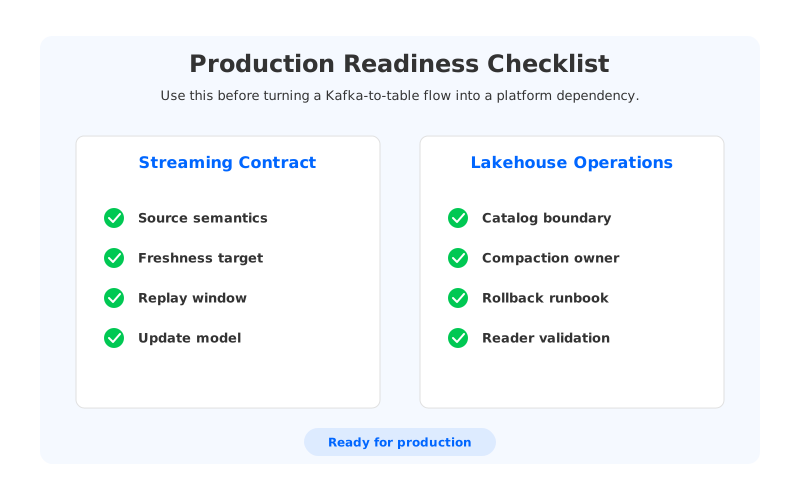
This checklist also protects the organization from an overly tool-first decision. If the workload is append-only, start with the simplest table path that preserves schema and replay. If the workload is CDC-heavy, select the table format and writer together because the merge model determines cost and correctness. If many engines must query the same data, interoperability and catalog behavior may matter more than the writer API.
7Where AutoMQ Changes the Operating Model
After the neutral design questions are clear, the streaming platform itself becomes part of the answer. AutoMQ fits this discussion as a Kafka-compatible, cloud-native streaming system that separates broker compute from durable storage and uses a shared-storage architecture. In practical terms, the goal is to keep Kafka APIs and client behavior familiar while reducing the operational coupling between brokers and long-lived data.
For Kafka-to-data-lake-table pipelines, that separation matters in three places.
First, replay becomes less entangled with broker-local disk capacity. If the platform can use object storage as the durable storage layer behind Kafka-compatible topics, teams have more room to align replay windows with lakehouse recovery needs without treating every broker as a long-term storage appliance.
Second, scaling becomes less tied to partition data movement. Stateless or more storage-decoupled brokers can reduce the operational cost of adding compute capacity for ingestion bursts, table backfills, or catch-up reads. That is relevant when a lakehouse writer falls behind and the platform needs to recover without a large partition-reassignment event.
Third, table-oriented features can live closer to the streaming platform. AutoMQ's Table Topic direction is aimed at connecting streaming topics with table formats such as Iceberg, which can simplify the architecture when teams want Kafka-compatible ingestion and lakehouse-ready data without stitching together every component from scratch.
This is not a reason to skip evaluation. It is a reason to evaluate the storage architecture underneath Kafka alongside the table format above it. A team choosing between Iceberg, Delta, and Hudi should also ask whether the Kafka layer is optimized for the retention, elasticity, and replay patterns that the table pipeline will require.
8Decision Table: When to Use Which Path
The decision below is intentionally practical. It assumes the team already has Kafka or Kafka-compatible ingestion and is deciding how to land the data as lakehouse tables.
| Situation | Recommended direction | Watch out for |
|---|---|---|
| Append-only events with many SQL engines | Start with Iceberg and a simple connector or stream writer. | Small files, schema drift, and unclear replay ownership. |
| Delta-centered analytics platform | Use Delta Lake if the reader, catalog, and governance stack already standardize on it. | Avoid making the table format choice depend on one job team only. |
| CDC with frequent upserts and incremental reads | Evaluate Hudi early, especially when Merge-on-Read or incremental consumption is valuable. | Compaction scheduling and reader performance expectations. |
| Heavy transformation before table write | Use a stream processor and treat the job as a governed data product. | Hidden business logic, checkpoint recovery, and deployment ownership. |
| Kafka retention is becoming expensive because tables need replay | Revisit Kafka storage architecture and retention policy; consider shared-storage Kafka-compatible options such as AutoMQ. | Do not move retention pressure into lakehouse tables without a recovery plan. |
| Multiple teams disagree on table format | Decide from workload semantics, query engines, catalog strategy, and operational ownership. | Avoid a compromise that nobody can operate in production. |
9References
- Apache Kafka Documentation: Replication and the log
- Apache Kafka Documentation: Kafka Connect
- Apache Iceberg Table Spec
- Delta Lake Documentation: Batch reads and writes
- Delta Lake Documentation: Updates, deletes, and merges
- Apache Hudi Documentation: Table and query types
- AutoMQ Documentation: Architecture overview
- AutoMQ Documentation: Table Topic overview
10FAQ
10.1Should Kafka be replaced by Iceberg, Delta, or Hudi?
No. Kafka and table formats solve different problems. Kafka is the event streaming and replay layer. Iceberg, Delta Lake, and Hudi are table formats for lakehouse storage and query. Production architectures often need both, with a clear contract between the log and the table.
10.2Which table format is best for Kafka CDC?
Hudi is often strong for CDC because upserts and incremental processing are central to its model, but Iceberg and Delta Lake can also work depending on the engine, catalog, and merge support in your stack. Choose based on update frequency, reader expectations, and operational ownership rather than the format name alone.
10.3How fresh can Kafka data be in lakehouse tables?
Freshness depends on writer commit frequency, file sizing, table metadata overhead, compaction strategy, and downstream query behavior. Lower latency is possible, but pushing every record immediately into table commits can create small-file and metadata pressure. Define the freshness target before choosing the writer pattern.
10.4Where does AutoMQ fit in this architecture?
AutoMQ fits at the Kafka-compatible streaming layer. It is relevant when teams want Kafka APIs with a shared-storage, cloud-native operating model, especially where retention, replay, scaling, and table-oriented integration are becoming operational bottlenecks.
10.5What is the most common mistake in Kafka-to-table projects?
The most common mistake is treating the project as a sink connector setup rather than a recovery and governance design. The pipeline must define offsets, checkpoints, schema evolution, table commits, rollback, and ownership before it becomes a production platform dependency.


