
Table of Contents
Table of Contents
Kafka-to-Iceberg pipelines usually start with a reasonable design. Kafka holds operational streams, Flink or Kafka Connect moves records into object storage, Iceberg gives query engines a table abstraction, and Spark or Trino turns the data into analysis. The architecture is familiar enough that it can feel solved.
The trouble starts when that bridge becomes production infrastructure. A connector cluster needs capacity planning, schema handling, retries, checkpointing, table commits, small-file control, and operational ownership. The streaming team owns part of it. The lakehouse team owns another part. During an incident, everyone discovers that "Kafka to Iceberg" was not a feature; it was a distributed system between two platform contracts.
That is why Tencent Cloud EMR's AutoMQ integration is interesting. The public case is not a classic migration story where one company replaced a Kafka vendor. It is a product-platform story: Tencent Cloud EMR integrated AutoMQ as a first-party service so EMR users could add Kafka-compatible streaming and Table Topic capabilities inside a managed big data environment.
1Why Kafka-to-Lake Pipelines Become Operationally Expensive
Data platform teams rarely object to Kafka or Iceberg in isolation. Kafka is strong at absorbing operational events and feeding stream processors. Iceberg makes object storage behave like a table system, with metadata, snapshots, schema evolution, and query-engine interoperability. The friction appears between them, where live events need to become table data without losing meaning.
A traditional Kafka-to-lake pipeline has several moving parts:
- Kafka retains the operational stream. Producers and consumers depend on topic semantics, offsets, replay, and delivery behavior.
- A writer turns records into table files. This might be Kafka Connect, Flink, Spark Structured Streaming, or a custom service.
- A catalog publishes table state. Query engines need a consistent view of snapshots, schemas, partitions, and locations.
- Maintenance keeps the table usable. Small files, compaction, schema drift, late events, deletes, and retention policies all need a clear owner.
None of those responsibilities are optional. A connector can hide some of them, but it cannot remove them. If a team treats the bridge as "move bytes from Kafka to object storage," it eventually pays for that simplification in query correctness, freshness ambiguity, or operational toil.
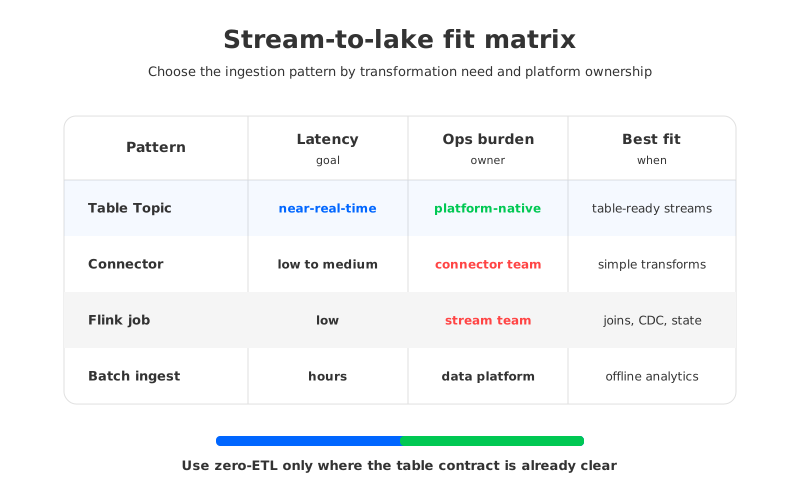
This is where restraint matters. Connectors are often the right answer when records need enrichment, filtering, CDC normalization, or joins before they become tables. Connector-based ingestion still has a tax, and the tax is highest when every Kafka topic that matters to the business also needs to become an analytical table.
2Tencent Cloud EMR's Cloud-Native Data Stack
Tencent Cloud Elastic MapReduce is positioned as an elastic, open-source, cloud-based Hadoop service. Its product page lists engines and ecosystem components such as Hadoop, Hive, Spark, HBase, Presto, Flink, and Iceberg, and describes scenarios including data lakes, offline analytics, interactive queries, and streaming. That gives the AutoMQ case its context: EMR is already where compute engines and data lake workloads live.
The public AutoMQ case says Tencent Cloud EMR provides a highly elastic environment for Spark, Flink, and Trino, but traditional Apache Kafka architecture created a mismatch because brokers rely on local disks and stateful data placement. A stateful Kafka cluster has to think about partitions, storage, and data movement before it can scale with the same rhythm.
That mismatch matters inside a managed big data platform. If a customer can elastically scale Spark or Flink but has to treat Kafka as the rigid layer in front of the lakehouse, the whole stack inherits Kafka's operational ceiling.
Tencent Cloud EMR's integration addresses that problem by making AutoMQ selectable from the EMR console as a first-party service, according to the public case. The same page states that users can provision a storage-compute separated AutoMQ cluster in under 2 minutes and manage scaling, configuration updates, and monitoring through console actions. Those are product claims about the EMR integration, not universal guarantees for every deployment pattern, but they explain why this case belongs in a Kafka-to-Iceberg discussion.
3Where Kafka Fits with Spark, Flink, Trino, and Iceberg
In a lakehouse stack, Kafka is usually the front door for fresh operational data. Spark and Flink process the data. Trino and Spark SQL query it. Iceberg gives the lakehouse a table layer that multiple engines can understand. The goal is not to eliminate Kafka; it is to make Kafka's output easier to use without turning the platform into a chain of fragile jobs.
AutoMQ's role in the Tencent Cloud EMR story starts with Kafka compatibility and storage-compute separation. The customer page says AutoMQ offloads data to Tencent Cloud Object Storage, making brokers stateless. That aligns the messaging layer with an EMR environment where compute and storage can scale independently.
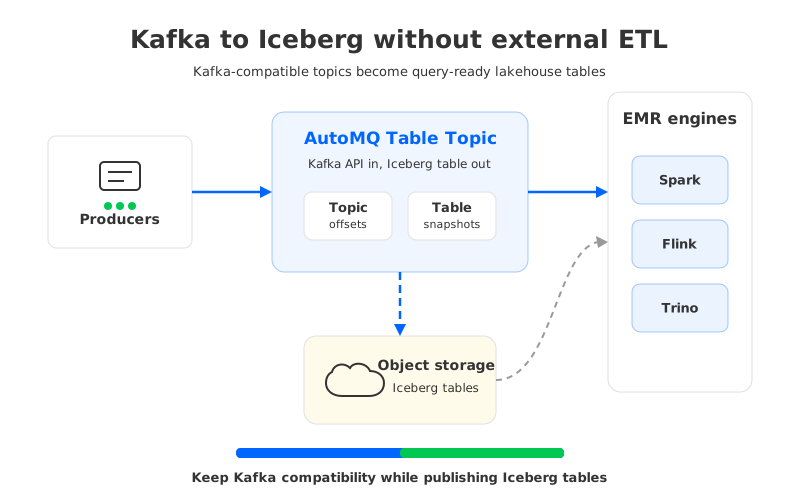
The second part is Table Topic. The public case describes AutoMQ's ability to expose Kafka topics directly as Iceberg tables so EMR engines such as Spark and Trino can query real-time streams. AutoMQ's Table Topic documentation describes the feature as built-in Iceberg integration for flowing streaming data into a data lake for analysis and querying, with ETL-free ingestion and catalog requirements.
That wording needs a careful reading. A Table Topic does not make table design disappear. Teams still need schema discipline, catalog access, security boundaries, query expectations, and lifecycle policies. The architecture changes where some ingestion work lives. Instead of operating a separate connector tier for every stream-to-table path, the platform can evaluate a native stream-table path inside the Kafka-compatible layer.
| Layer | Traditional pipeline question | Table Topic-oriented question |
|---|---|---|
| Stream | How do producers and consumers keep using Kafka? | Can Kafka-compatible clients continue unchanged? |
| Writer | Which connector or Flink job owns materialization? | Can the platform materialize a topic as a table natively? |
| Storage | Where do Kafka logs and table files live? | Can streaming and lakehouse data share object-storage foundations? |
| Catalog | Who publishes the table contract? | Which supported catalog owns discovery and governance? |
| Operations | Who watches retries, lag, commits, and compaction? | Which responsibilities move into the platform, and which remain with data owners? |
"Zero ETL" is useful only when the operational contract becomes clearer. If the phrase hides ownership, it becomes marketing. If it removes a connector tier while keeping table contracts explicit, it becomes architecture.
4Table Topic and the Zero-ETL Stream-to-Lake Pattern
AutoMQ's product page for Kafka to Iceberg describes Table Topic as a broker-embedded streaming table engine that materializes Kafka topics as Iceberg tables in object storage without external ETL pipelines. It also states that Spark, Trino, Flink, and other lakehouse-compatible engines can query table topics directly. The Tencent Cloud EMR case shows how that direction fits a managed lakehouse environment.
The useful mental model is not "Kafka becomes Iceberg." Topics are ordered streams with offsets and retention. Iceberg tables are snapshot-based analytical datasets with schema and metadata. The Table Topic pattern creates a managed bridge between those abstractions while preserving the Kafka interface for applications.
That bridge fits workloads where the event stream is already close to the analytical table shape. Examples include operational events, append-heavy analytics streams, metrics-like facts, and data products where producers can commit to a schema contract. It is less appropriate when records need heavy enrichment, joins, deduplication, CDC merge logic, or complex event-time processing before they become queryable. In those cases, Flink or another processing layer still has a job to do.
The Tencent Cloud EMR integration also shows why cloud-provider context matters. The case describes security integration through EMR role-based services that dynamically acquire temporary security keys for object storage access, plus Tencent Cloud VPC isolation and TencentOS hardening. For platform engineers, those details are not decoration. Kafka-to-Iceberg data paths touch object storage, catalogs, compute engines, and network boundaries.
5What Teams Should Validate Before Adopting This Architecture
Evaluate Table Topic from the table contract, not from the ingestion mechanism. Define what downstream users expect to query, then work backward to the Kafka topic and platform controls. If the source events cannot support the table contract, native materialization will only make bad data available faster.
Before adopting a zero-ETL stream-to-lake pattern, validate these areas:
- Schema and evolution rules. Decide which schema changes are compatible, who approves them, and how downstream tables represent optional fields, renamed fields, and type changes.
- Catalog compatibility. Confirm that the chosen catalog works with the query engines, governance model, and disaster-recovery expectations of the wider lakehouse.
- Freshness and commit behavior. Define how query users should interpret snapshots during continuous ingestion.
- Security and object-storage access. Test temporary credentials, bucket policies, VPC routing, audit logs, encryption, and cross-service permissions in the real environment.
- Fallback path. Keep a clear answer for workloads that still need Flink, Kafka Connect, or batch ingestion because they require transformation.
This is where the Tencent Cloud EMR case is useful without invented details. The public story says EMR integrated AutoMQ as a first-party service, supports streaming to a data lake via Iceberg, provisions clusters in under 2 minutes, and uses object-storage-backed separation of compute and storage. It does not disclose topic schemas, table design, query workload, or operational incidents.
6The Engineering Lesson from Tencent Cloud EMR
The lesson is not that every Kafka-to-Iceberg pipeline should remove connectors. Lakehouse platforms are pulling Kafka closer to the analytical layer, and the old boundary between "streaming system" and "data lake ingestion job" is getting less stable.
Tencent Cloud EMR's AutoMQ integration points to a different platform shape. Kafka-compatible streaming becomes a first-party component inside the managed data stack. Brokers become stateless because durable stream data lives in object storage. Table Topic provides a native path from topics to Iceberg tables for workloads that fit that model.
That is a better story than "no ETL required" by itself. When the stream is already table-ready, the platform should not force teams to operate a separate ingestion tier only to make the same data visible to the lakehouse. The bridge should be part of the platform contract, with compatibility, catalog integration, security, and ownership designed together.
Return to the original Kafka-to-Iceberg pipeline. If the connector tier is doing real transformation work, keep it and operate it well. If it is mostly there because Kafka and the lakehouse live on opposite sides of an old architectural boundary, Tencent Cloud EMR's integration with AutoMQ is a useful signpost.
7FAQ
7.1What did Tencent Cloud EMR integrate with AutoMQ?
AutoMQ's public customer case says Tencent Cloud EMR integrated AutoMQ as a first-party service selectable from the EMR console. The integration provides Kafka-compatible streaming, storage-compute separation with Tencent Cloud Object Storage, and Table Topic capabilities for streaming data to Iceberg.
7.2What is AutoMQ Table Topic?
Table Topic is AutoMQ's stream-table capability for materializing Kafka topics as lakehouse tables such as Iceberg. AutoMQ's documentation describes it as built-in Iceberg integration for ETL-free data lake ingestion and real-time query analysis, subject to version, deployment-time configuration, and catalog requirements.
7.3Does Table Topic replace Flink or Kafka Connect?
Not for every workload. Table Topic is a fit when the Kafka topic is close to table-ready and the platform wants native materialization. Flink or Kafka Connect remains useful when records need enrichment, joins, CDC normalization, custom routing, or transformation before they become Iceberg tables.
7.4Why does storage-compute separation matter for EMR?
EMR environments are built around elastic compute engines and cloud object storage. If Kafka brokers remain tied to local disks and partition data placement, the streaming layer can scale more slowly than Spark, Flink, or Trino. AutoMQ's COS-backed stateless broker model is designed to make Kafka-compatible streaming fit that elastic operating model.
7.5Can Spark and Trino query AutoMQ Table Topics?
The Tencent Cloud EMR case says Table Topics allow EMR engines like Spark and Trino to query real-time data streams as Iceberg tables. Teams should still validate catalog support, permissions, and query behavior in their own EMR environment before production use.
7.6When is a traditional connector pipeline still enough?
A traditional connector or Flink pipeline is still a good choice when the ingestion path requires transformation, deduplication, CDC merge semantics, enrichment, complex event-time logic, or custom operational controls. Zero-ETL is valuable when it removes unnecessary moving parts, not when it hides necessary processing.


