
Table of Contents
Table of Contents
A Kafka migration usually starts with a symptom, not a target. The cluster takes too long to rebalance, broker storage keeps forcing capacity work, cloud cost grows faster than traffic, or the team wants a cleaner operating model. Redpanda and AutoMQ can both appear on the shortlist because both speak to Kafka users without asking every application team to learn a new API. That similarity is useful, but it can hide the real decision: are you replacing Kafka's engine, or changing the storage and operating model underneath Kafka-compatible workloads?
Redpanda is a Kafka API-compatible streaming platform with its own implementation, a Raft-based design, and an operational story that appeals to teams looking for simpler deployment and strong low-latency behavior. AutoMQ is a Kafka-compatible cloud-native streaming platform that keeps Kafka protocol and ecosystem expectations while moving durable storage toward shared object storage and stateless broker operations. Neither path should be treated as a generic "Kafka alternative." Each path solves a different class of Kafka pain.
1Start With The Reason You Are Leaving Kafka
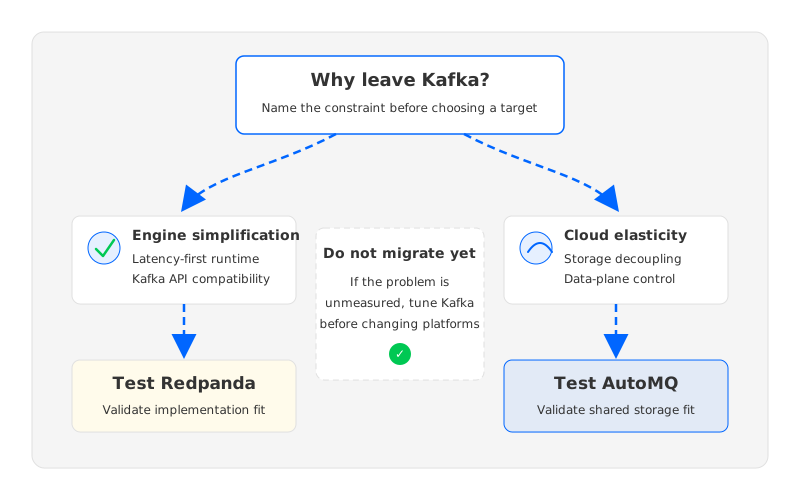
The least useful migration question is "Which platform is better?" The useful question is "Which part of Kafka is costing us the most?" Kafka's power comes from a mature ecosystem, a durable log, consumer groups, transactions, Kafka Connect, Kafka Streams, and operational knowledge. Its cloud friction often comes from the same architecture: brokers own local log segments, replication happens at the Kafka layer, and capacity changes can become data movement events.
That does not mean every Kafka cluster should be replaced. A stable estate with predictable retention and strong automation may be better served by tuning producers, fixing partitions, or upgrading. Migration adds a second system, data copy, offset validation, rollout work, and rollback. The new platform has to remove a named constraint large enough to pay for that risk.
Teams usually evaluate Kafka-to-Redpanda or Kafka-to-AutoMQ paths for five reasons:
- Compatibility pressure: teams want to preserve Kafka clients, consumer groups, offsets, and ecosystem tools while reducing operational pain.
- Architecture pressure: local-disk ownership, partition reassignment, and broker recovery have become too tightly coupled to storage movement.
- Cost pressure: compute, attached disks, replication, network transfer, and overprovisioned headroom no longer track business usage cleanly.
- Operations pressure: upgrades, balancing, failure recovery, and scaling consume too much platform time.
- Data-control pressure: security or procurement teams require clearer control over where data-plane resources and telemetry live.
Those pressures do not point to one answer. A team leaving Kafka because it wants a compact, performance-oriented Kafka API-compatible engine may test Redpanda first. A team leaving Kafka because broker-local storage makes cloud elasticity painful should test a shared-storage Kafka-compatible target such as AutoMQ. The same source cluster can produce different migration targets depending on which constraint matters most.
2Kafka To Redpanda: What Changes
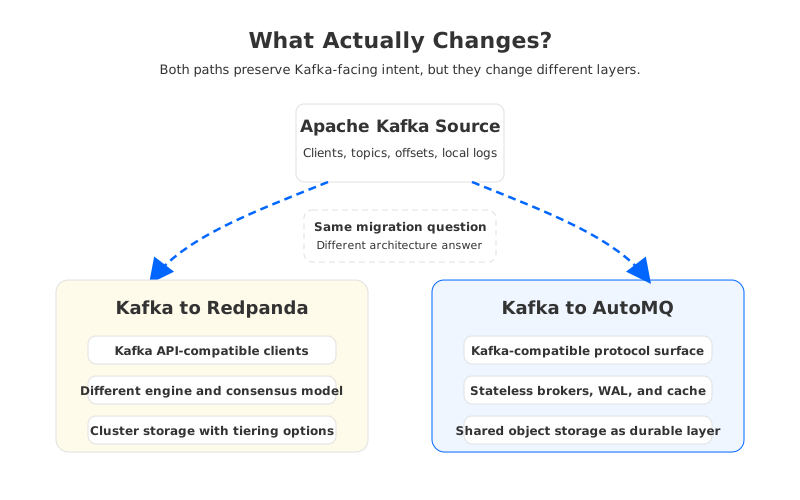
Moving from Apache Kafka to Redpanda is a move from the Apache Kafka broker implementation to a Kafka API-compatible platform implemented differently. Redpanda's documentation emphasizes Kafka client compatibility, and its architecture uses Redpanda's own engine and consensus model. For teams with Kafka applications, the attraction is clear: keep much of the Kafka client surface while evaluating a different runtime and operational profile.
That makes Redpanda a candidate when the source Kafka problem is tied to broker management complexity, JVM tuning, or the desire for a simpler engine footprint. It can also be attractive when the workload is latency-sensitive and the team wants to benchmark a Kafka-compatible target. The migration conversation should be concrete. Kafka API compatibility is not identical to Apache Kafka identity, and production estates are rarely limited to a producer and a consumer that send plain messages.
A Redpanda proof of concept should validate the whole compatibility surface:
- Client libraries and versions, including non-JVM clients and framework-managed clients.
- Idempotent producers, transactions, ordering assumptions, retries, and delivery timeouts.
- Consumer groups, offset commits, rebalances, lag monitoring, and replay workflows.
- Admin APIs, topic configuration, ACLs, authentication, automation scripts, Kafka Connect, stream processors, and observability integrations.
Storage deserves special attention. Redpanda supports Tiered Storage, which can move older log segments into object storage for retention and read-path economics. That is valuable, but it is not the same move as making object storage the primary durable layer behind stateless brokers. In a Kafka-to-Redpanda migration, tiering is part of the retention strategy rather than the whole operating model.
The strongest case for Redpanda is narrower than "Kafka is bad." If the team wants Kafka-style application behavior while testing a non-Apache implementation optimized for operational simplicity and latency, Redpanda belongs in the evaluation. The risk is that this may not address cloud cost elasticity or broker-state coupling if those were the actual reasons Kafka became painful.
3Kafka To AutoMQ: What Changes
Kafka-to-AutoMQ is a different kind of migration. AutoMQ keeps Kafka compatibility as the application-facing contract. Below that contract, object-storage-backed shared storage, a WAL layer, cache, and stateless broker behavior reduce the binding between broker compute and durable data. The target is still Kafka-compatible, but the operating center of gravity moves from local broker disks to cloud storage primitives.
That shift matters when the source Kafka pain is not the Java process itself but the cloud operating model around it. Traditional Kafka scales by adding brokers and then moving partition data or leadership until the cluster is balanced. Long retention increases local storage requirements. Failure recovery and reassignment require bandwidth and headroom planning. In cloud deployments, the platform team also has to reason about attached storage, cross-zone traffic, reserved capacity, and enough brokers for peak traffic and maintenance windows.
AutoMQ's shared-storage model changes the migration plan. Instead of asking only how many brokers the target needs, the team asks how much hot cache, WAL capacity, object storage throughput, and compute elasticity the workload requires. Broker replacement becomes less tied to a single machine's local disk because durable data lives in shared storage. That can fit bursty traffic, long retention, frequent scaling, and cloud environments where account-level isolation matters.
The trade-off is that shared storage is not magic. Small messages, low-throughput topics, high fan-out reads, compaction-heavy topics, and strict p99 requirements can stress different parts of any streaming platform. AutoMQ should be evaluated with the same seriousness as Redpanda: real producers, consumer groups, retention, failure drills, and rollback.
AutoMQ is most natural when the team wants three outcomes at once: preserve Kafka-facing behavior, reduce broker-local storage coupling, and keep data-plane resources under a cloud or private environment the customer controls. That is why it often enters Kafka migration discussions as a cloud-native shared-storage option rather than as a direct "engine swap" competitor to Redpanda.
4Migration Risk Comparison
The migration target decides which risks dominate. Redpanda risk is often about implementation compatibility and whether the new engine behaves the way your Kafka estate expects under production features. AutoMQ risk is often about whether the shared-storage architecture delivers the latency, throughput, and operational behavior your workload needs. Both paths require source-to-target replication, client cutover planning, and a rehearsed rollback strategy.
| Decision Area | Kafka To Redpanda | Kafka To AutoMQ |
|---|---|---|
| Compatibility | Validate clients, transactions, Connect, admin tooling, security, and monitoring. | Validate the same Kafka-facing surface against the AutoMQ target. |
| Architecture | Moves to Redpanda's Kafka API-compatible engine and storage model, with Tiered Storage for older data. | Moves to Kafka-compatible brokers with shared storage, WAL, cache, and stateless broker behavior. |
| Cost model | Evaluate compute, storage, tiering, support, and managed or self-managed responsibility. | Evaluate compute, WAL, object storage, cache, network placement, and lower broker-local overprovisioning. |
| Operations | Test deployment, upgrades, balancing, recovery, and Redpanda-specific observability. | Test elastic broker operations, object storage behavior, WAL health, cache behavior, and upgrades. |
| Data control | Depends on self-managed, Redpanda Cloud, Dedicated, or BYOC deployment. | Depends on open source, BYOC, or private software deployment. |
| Migration risk | Do not assume Kafka API compatibility covers every ecosystem dependency. | Do not assume shared-storage elasticity covers every workload without testing. |
Neither migration is a shortcut around due diligence. A target that looks clean on a product page can still fail on an old producer client, a connector that depends on a specific admin behavior, or a consumer group that cannot tolerate offset drift.
4.1Clients And Protocol
Start with clients because they are the part of Kafka that most directly touches application teams. Inventory language, library version, authentication, compression, batching, idempotence, transactions, consumer isolation level, and retry policy. Include frameworks that hide Kafka under abstractions, because those frameworks often control defaults such as acks, linger.ms, delivery.timeout.ms, and consumer poll behavior.
For Redpanda, the client test asks whether the Kafka API-compatible implementation is close enough for the application's behavior and tooling. For AutoMQ, it asks whether Kafka compatibility holds while the storage architecture changes underneath. The test cases look similar: produce, consume, rebalance, commit offsets, replay, fail a broker, restart clients, run stream processors, and verify monitoring.
4.2Storage And Retention
Kafka storage migration is where many plans become too optimistic. A cluster may have uneven partition sizes, compacted topics, retention rules for compliance, and consumers that occasionally replay days of data. Copying bytes is only one part of the job. The target must preserve the operational meaning of those bytes: offsets, ordering by partition, topic configuration, and retention behavior.
Redpanda's migration tooling includes Redpanda Migrator and documentation for moving data from Apache Kafka to Redpanda. AutoMQ documentation describes migration approaches using MirrorMaker 2 for open source scenarios and Kafka Linking for commercial migration workflows. These tools can reduce effort, but they do not eliminate validation. A serious test checks data copy progress, consumer catch-up, offset continuity, rollback behavior, and what happens when source traffic changes during migration.
4.3Operations And Scaling
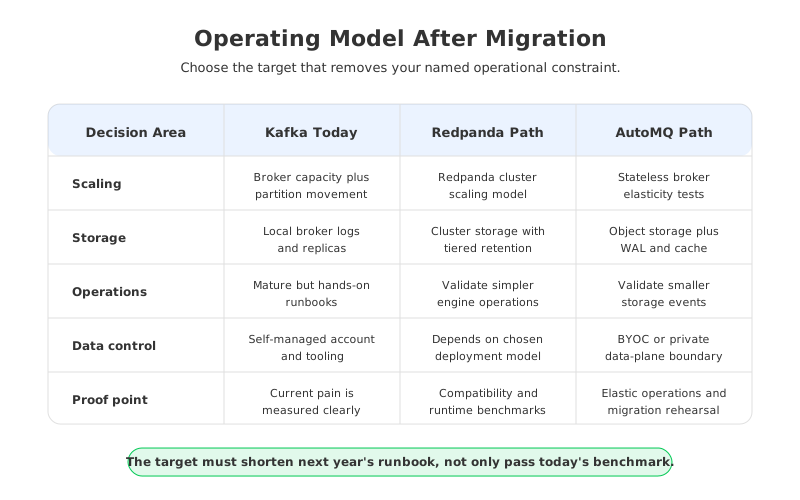
Operations are the reason many Kafka migrations happen, so test them early. Run the target through the actions that made the source cluster painful: add capacity, remove capacity, replace a failed node, increase retention, replay cold data, roll a version, rotate credentials, and recover from a bad deployment. A migration that improves steady-state latency but leaves the same scaling bottleneck may not be worth the risk.
Redpanda evaluation should focus on whether its operating model is simpler for the team's failure modes and staffing model. AutoMQ evaluation should focus on whether stateless broker behavior and shared storage turn scaling and recovery into smaller operational events. In both cases, the useful evidence is a runbook that becomes shorter, safer, and easier to execute under pressure.
5Decision Table
The fairest way to choose is to map the target to the problem, not to the brand. Redpanda and AutoMQ can both be reasonable Kafka migration targets, but they are not interchangeable.
| Your Main Reason For Leaving Kafka | Redpanda May Fit When... | AutoMQ May Fit When... |
|---|---|---|
| Simplify the broker engine | You want a different Kafka API-compatible implementation and compact operations. | The engine matters less than removing broker-local state from scaling. |
| Improve latency behavior | You need to benchmark a latency-oriented Kafka API-compatible target. | You need Kafka compatibility plus cloud elasticity, with latency proven by workload tests. |
| Reduce cloud storage friction | Tiered storage is enough to improve retention economics. | Shared object storage is central to cost, retention, scaling, and recovery goals. |
| Scale more elastically | Your scaling pattern fits Redpanda's cluster and storage model. | Frequent scale-out, scale-in, replacement, or burst handling is primary. |
| Strengthen data control | The chosen Redpanda deployment model satisfies account and support-access requirements. | BYOC or private deployment with customer-controlled data-plane resources is a major criterion. |
| Lower migration risk | Your Kafka feature surface validates cleanly against Redpanda tooling. | Your estate needs Kafka compatibility while changing architecture, with offsets and rollback proven. |
This table also protects against a false binary. Redpanda can be a rational choice for a team optimizing the streaming engine and runtime profile. AutoMQ can be a rational choice for a team optimizing cloud architecture, elastic operations, and data-control boundaries. The right answer depends on the constraint that remains after you remove vague preferences.
6A Practical Migration Plan
A safe migration plan has four phases. First, build an estate inventory: topics, partitions, retention, compaction, ACLs, schemas, producers, consumers, connectors, stream processors, dashboards, alerts, and runbooks. Second, run a compatibility proof with production-like clients, especially applications that use transactions, idempotent writes, non-default compression, older client versions, unusual authentication, high fan-out reads, or long replay windows.
Third, rehearse data movement and cutover. Run source and target in parallel, copy data, validate offsets, compare consumer lag, switch controlled clients, and test rollback. Fourth, test the future operating model. If Redpanda was selected for a simpler operational footprint, simulate the operations that used to be difficult. If AutoMQ was selected for shared-storage elasticity, simulate broker replacement, scale events, retention growth, and object-storage behavior.
7FAQ
7.1Is Redpanda a drop-in replacement for Kafka?
Redpanda is Kafka API-compatible and supports Kafka clients, but "drop-in" should be proven against your estate. Test client versions, authentication, idempotent producers, transactions, consumer groups, Kafka Connect, admin automation, topic configuration, and monitoring before treating migration as low risk.
7.2Is AutoMQ a Kafka replacement or a Kafka-compatible storage redesign?
AutoMQ is a Kafka-compatible streaming platform that changes the storage architecture underneath the Kafka-facing contract. Applications continue to use Kafka protocol expectations while the platform evaluates object storage, WAL, cache, and stateless broker operations.
7.3Which migration path has lower risk?
The lower-risk path changes fewer assumptions for the problem you need to solve. If the main issue is the Kafka broker implementation and your compatibility surface is narrow, Redpanda may be easier to validate. If the issue is broker-local storage coupling, cloud elasticity, or data-plane control, AutoMQ may reduce longer-term operational risk after a workload test.
7.4Can MirrorMaker 2 migrate Kafka to Redpanda or AutoMQ?
MirrorMaker 2 is a common Kafka-to-Kafka replication tool, but fit depends on topic configuration, offsets, authentication, throughput, and cutover requirements. Redpanda documents Redpanda Migrator for Kafka-to-Redpanda movement, and AutoMQ documents MirrorMaker 2 and Kafka Linking-based migration paths. Test the tool before production cutover.
7.5How should cost be compared?
Compare workload-linked cost components rather than headline price: compute, local or attached storage, object storage, WAL storage, cache, network traffic, support, managed-service fees, retention, overprovisioned headroom, and engineering time. The winning option is the one whose cost curve matches the workload after migration risk is included.
7.6When should a team avoid migrating?
Avoid migration when the problem is not measured, Kafka tuning would address the bottleneck, or the target has not passed compatibility and rollback tests. A stable Kafka cluster with predictable cost and mature runbooks is not automatically worse than a new platform.
If the reason you are leaving Kafka is engine simplification and a latency-oriented Kafka API-compatible runtime, Redpanda deserves a fair test. If the reason is cloud elasticity, storage decoupling, and customer-controlled data-plane boundaries, test AutoMQ with the same seriousness. Choose the migration target by the constraint it removes, not by how clean its first diagram looks. To evaluate the shared-storage path, start with the AutoMQ migration documentation and run the proof against your real topics, clients, and rollback requirements.
8References
- Redpanda Docs: Kafka clients
- Redpanda Docs: Architecture
- Redpanda Docs: Tiered Storage
- Redpanda Docs: Migrate data to Redpanda
- Apache Kafka: Official documentation
- AutoMQ Docs: What is AutoMQ
- AutoMQ Docs: Compatibility with Apache Kafka
- AutoMQ Docs: Architecture overview
- AutoMQ Docs: S3Stream shared storage
- AutoMQ Docs: Migration overview
- AutoMQ GitHub: AutoMQ repository


