
Table of Contents
Table of Contents
Kafka topic lifecycle management becomes painful when Kafka stops being a cluster and becomes a platform. A small team can create topics by convention, remember who owns them, and clean up old streams during a quarterly review. A large platform team cannot rely on memory. Hundreds or thousands of topics accumulate different retention policies, partition counts, ACLs, schema expectations, quotas, consumers, connectors, and compliance obligations. The topic name is no longer a string in an admin command; it is a contract between teams.
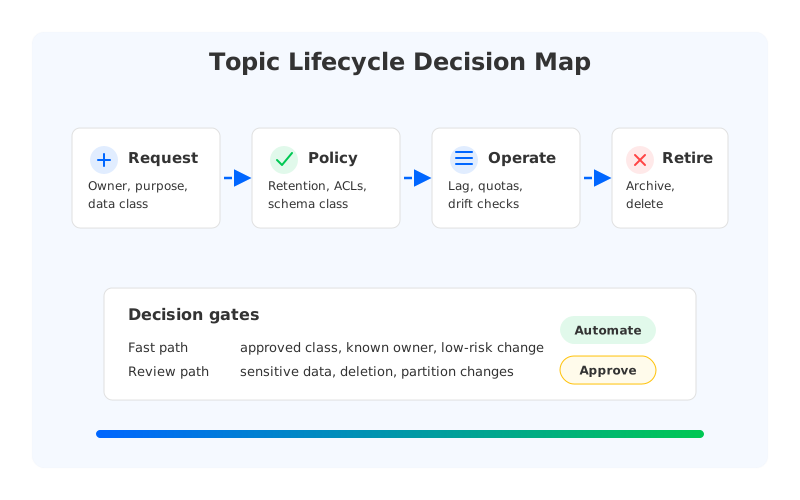
That contract has a lifecycle. A topic is requested, approved, created, scaled, observed, changed, migrated, deprecated, and eventually deleted or archived. Each stage carries a different kind of risk. Creation risk is usually about ownership and naming. Growth risk is about partitions, throughput, retention, and cost. Change risk is about compatibility, consumer lag, access control, and rollback. Deletion risk is about auditability and whether anybody still depends on the data.
Good lifecycle management does not mean every topic needs a governance meeting. It means the platform gives teams a predictable path for the common case and stronger guardrails for the risky case. Application teams want fast creation. Security teams want access boundaries. Data teams want discoverability. SREs want fewer incidents. Finance teams want to know why retention doubled on a topic nobody admits to owning.
1Why Topic Lifecycle Management Breaks at Scale
The first failure mode is uncontrolled creation. A platform team starts with naming standards, environment prefixes, and a few wiki examples. Then new product teams arrive, connectors create internal topics, experiments become permanent workloads, and temporary names become production dependencies. A topic without an owner becomes an infrastructure liability because nobody can safely decide when to change partitions, lower retention, rotate credentials, or delete it.
The second failure mode is configuration drift. Kafka topic settings such as retention.ms, retention.bytes, cleanup.policy, min.insync.replicas, segment.bytes, and related broker defaults create a large policy surface. Some settings are workload-specific, and some belong to platform standards. If every team gets full freedom, the cluster becomes hard to predict. If the platform locks down everything, teams route around the process. The useful middle ground is a catalog of approved topic classes: transactional event streams, compacted state topics, replay-heavy analytics topics, connector internal topics, audit topics, and short-lived test topics.
The third failure mode is capacity coupling. Topic lifecycle decisions are rarely governance decisions alone in traditional Kafka. A longer retention policy consumes broker-attached storage. More partitions increase metadata and recovery work. Reassigning partitions moves data between brokers. Topic changes therefore become infrastructure changes, and infrastructure changes get slower because they carry both policy risk and data movement risk.
2The Lifecycle Model Platform Teams Actually Need
A useful lifecycle model separates topic intent from topic mechanics. Intent answers why the topic exists, who owns it, what data class it carries, and which consumers or downstream systems depend on it. Mechanics answer how Kafka should store, replicate, compact, retain, authorize, and observe it. Both are necessary. When intent is missing, the platform cannot make safe decisions. When mechanics are inconsistent, the cluster becomes expensive and unreliable.
Large teams usually need five lifecycle states:
- Request and review. The requester declares ownership, purpose, data class, expected throughput, retention, schema strategy, access model, and environment.
- Provision and register. The topic is created through automation, added to a catalog, linked to ACLs and quotas, and tagged for cost allocation.
- Operate and evolve. The platform tracks lag, throughput, partition skew, retention usage, schema evolution, consumer groups, and quota pressure.
- Migrate or reshape. The topic may need partition expansion, retention changes, data backfill, connector movement, or a new naming boundary.
- Deprecate and delete. The owner proves consumers are gone, export or archive obligations are satisfied, and rollback windows have expired.
This model is deliberately boring. That is the point. Platform teams need a repeatable path that works for thousands of topics without turning every request into a custom design review.
| Lifecycle question | Platform owner needs | Application owner needs |
|---|---|---|
| Who owns the topic? | Escalation path, cost attribution, deletion approval | Clear responsibility boundary |
| What data does it carry? | Classification, retention policy, access model | Confidence that consumers understand the contract |
| How does it scale? | Partition, throughput, quota, storage forecast | A documented path to request growth |
| How does it change? | Compatibility checks, audit trail, rollback plan | Predictable lead time for changes |
| How does it end? | Consumer proof, archive status, deletion record | No surprise data loss |
The table looks procedural, but the effect is architectural. The platform is defining how topic-level contracts become infrastructure-level behavior. That is where many Kafka governance efforts run into the storage model underneath the cluster.
3Storage Architecture Shapes the Governance Burden
Traditional Kafka uses a shared-nothing model: brokers own local log segments, and replicas are distributed across brokers for durability and availability. This design keeps the log abstraction close to the broker that leads a partition, but it also means topic lifecycle actions often touch broker-local state. More retention means more disk. More partitions mean more broker resources. Rebalancing means moving bytes. Broker replacement means replica catch-up and operational care around data locality.
The governance implication is easy to miss. A platform team may start with a policy problem, such as "analytics topics need 14 days of replay." On shared-nothing Kafka, that policy becomes a capacity planning problem because retained bytes must fit broker storage with enough headroom for replication, growth, compaction, and recovery. A request for more partitions can become a data movement problem if placement or broker balance has to change.
Tiered storage changes part of that equation by moving older log data to remote storage while keeping the active log on local broker disks. Apache Kafka's tiered storage work was designed to reduce local storage pressure and improve elasticity for long retention workloads. That is a meaningful improvement, but it does not make brokers stateless. The active segment, write path, leadership, and operational control still depend on brokers that own part of the log lifecycle.
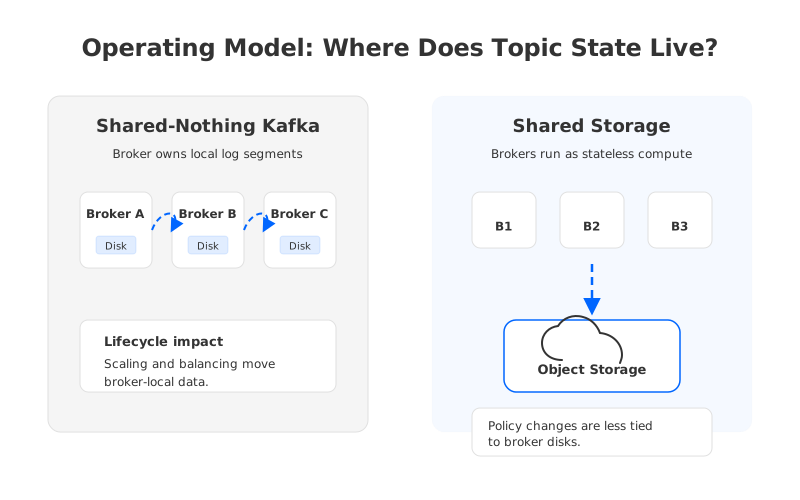
For topic lifecycle management, the important distinction is not whether object storage exists somewhere in the architecture. The question is which lifecycle actions still require moving or protecting broker-owned data. If topic growth, broker replacement, or workload rebalancing continues to depend on local disk placement, then governance automation still has to respect storage topology.
4Contracts, Ownership, Access, and Audit Trade-Offs
Topic lifecycle management should give application teams autonomy without letting them create invisible risk. The simplest way to do that is to define topic classes. Each class has a default configuration bundle and a review threshold. A payment authorization stream should not follow the same path as a debug log topic. The platform should make common safe choices fast and make risky choices explicit.
Access control belongs inside the same lifecycle, not in a separate security backlog. A topic request should identify producers, consumers, service accounts, environments, and whether access is temporary or permanent. ACLs, quotas, and catalog metadata should be provisioned together because they describe one operating contract. If these systems drift, the topic catalog says one thing, Kafka authorizes another, and incident responders have to reconstruct reality from logs.
Schema governance is similar. Internal telemetry may tolerate loose payloads, while cross-domain event streams usually need ownership, compatibility rules, field-level classification, and a process for breaking changes. The lifecycle system should not make every topic look the same. It should make differences visible, approved, and searchable.
There are a few lifecycle signals that platform teams should treat as first-class:
- A topic has no registered owner or owner group.
- Retention, compaction, partition count, or quota changed outside automation.
- Consumer lag or replay behavior no longer matches the declared topic class.
- A topic carries sensitive data but lacks matching access and retention controls.
- A deprecated topic still has active consumers after the planned sunset date.
These signals turn lifecycle management from documentation into control. They also reduce the emotional cost of governance. When the platform can show exactly which topics violate which contract, teams argue less about process and more about facts.
5Evaluation Checklist for Kafka Topic Lifecycle Management
The right platform architecture depends on workload and organizational maturity, so a useful evaluation starts with questions rather than vendor names. Ask how the platform behaves when topic count, data volume, team count, and compliance pressure all grow together.
| Evaluation area | What to verify | Why it matters |
|---|---|---|
| Kafka compatibility | Client behavior, admin APIs, consumer groups, transactions, compaction, Connect, Streams, and tooling expectations | Lifecycle automation depends on familiar Kafka semantics |
| Topic catalog and ownership | Required owner, data class, schema policy, environment, consumers, and deletion approver | Unowned topics create long-term operational risk |
| Policy automation | Standard topic classes, config templates, approval thresholds, drift detection | Manual reviews do not scale across large estates |
| Cost model | Retention growth, partition growth, cross-zone replication, broker storage, remote storage, and network traffic | Governance choices become bill changes |
| Elasticity and recovery | Broker replacement, scaling, partition balance, replay, and rollback behavior | Lifecycle changes should not require risky data movement |
| Security and audit | ACL lifecycle, quota assignment, access expiry, catalog history, and change records | Shared platforms need explainable control boundaries |
| Migration readiness | Topic-by-topic cutover, consumer offset strategy, rollback, dual write or mirroring, and observability | Lifecycle improvements often arrive during migration |
This checklist prevents a common mistake: evaluating topic governance as a user interface problem. Catalogs, request forms, and approval workflows are useful, but they are the visible edge. The deeper question is whether the Kafka runtime makes the approved lifecycle easy to execute.
6How AutoMQ Changes the Operating Model
Once the evaluation reaches storage coupling, a different architectural option becomes relevant: Kafka-compatible systems that separate compute from storage. AutoMQ is one example. It keeps the Kafka protocol and ecosystem surface while moving durable log storage into a shared-storage architecture backed by object storage, with brokers operating as stateless compute nodes. The practical question is not "does this replace governance?" It does not. The question is whether it removes enough broker-local data movement to make governance easier to automate.
In a shared-storage model, topic lifecycle decisions can be expressed closer to policy. Retention still consumes storage, but retained data is no longer trapped on individual broker disks. Scaling compute is less tied to moving log segments between brokers. Broker replacement no longer carries the same meaning because the broker is not the durable home of the data. For large platform teams, that changes the risk profile of capacity expansion, maintenance, and recovery.
AutoMQ's architecture also matters for cloud cost governance. Traditional Kafka replication across availability zones can turn durability into recurring network traffic. AutoMQ documents a design that avoids inter-zone traffic generated by cluster replication by using shared storage and zone-local access patterns. Teams still need to understand object storage, data transfer, and access patterns, but the lifecycle policy can be evaluated against a different cost model than "every retained byte must live on multiple broker disks."
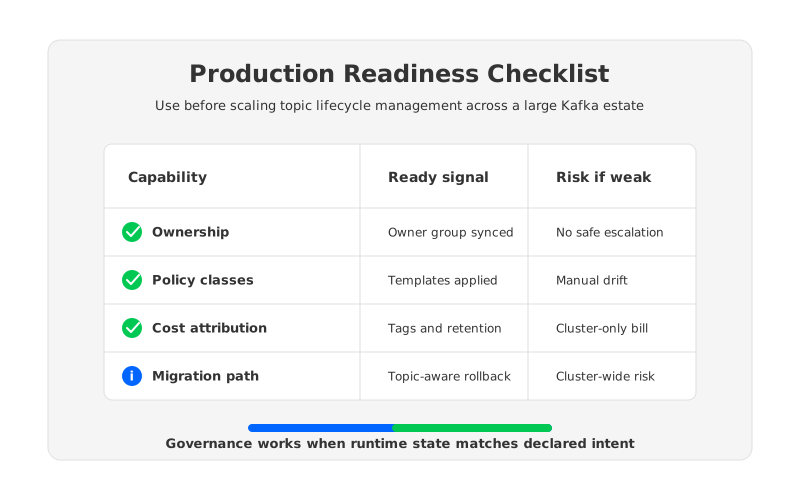
The useful way to introduce AutoMQ into a topic lifecycle program is to keep the governance model neutral. Define topic classes, ownership, access, retention, schema, quota, and deletion rules first. Then ask which runtime makes those rules more cost-effective and safer to execute. If your main pain is a missing request portal, fix the portal. If every lifecycle decision turns into broker capacity work, storage architecture belongs in the evaluation.
7A Practical Implementation Path
Platform teams can start without a full re-platforming project. Pick one domain with enough topic variety to expose real lifecycle pressure: a product event domain, a customer analytics domain, or a connector-heavy ingestion domain. Build the catalog fields, policy classes, and automation around that domain first.
The first version should capture owner, environment, purpose, data classification, expected throughput band, retention class, cleanup policy, schema policy, producers, consumers, quota class, and deletion approver. Keep custom fields limited. Every required field should drive an action or a decision.
Then connect the lifecycle record to Kafka state. The platform should reconcile declared policy with actual topic configs, ACLs, quotas, consumer groups, and observed traffic. A catalog that records intent becomes stale. A catalog that compares intent to runtime state becomes an operational tool.
For teams that want to reduce the broker-local storage burden while keeping the Kafka mental model, AutoMQ is worth evaluating as part of that operating model. Start from the open-source project, verify compatibility against your clients and tooling, and test costly lifecycle actions: retention growth, broker scaling, replacement, quota changes, and topic-domain migration. The cleanest governance process is the one your runtime can execute under production pressure. Explore the AutoMQ codebase and deployment model through the AutoMQ GitHub project.
8References
- Apache Kafka topic configuration documentation
- Apache Kafka documentation
- Apache Kafka tiered storage operations documentation
- KIP-405: Kafka Tiered Storage
- AutoMQ architecture overview
- AutoMQ S3 shared streaming storage
- AutoMQ cross-AZ traffic cost guidance
- AutoMQ Kafka client configuration tuning
- Amazon S3 pricing
9FAQ
9.1What is Kafka topic lifecycle management?
Kafka topic lifecycle management is the process of controlling how topics are requested, created, configured, owned, secured, scaled, observed, migrated, deprecated, and deleted. In large organizations, it combines platform engineering, data governance, cost management, and Kafka operations.
9.2Which topic metadata should a platform team require?
At minimum, require owner group, environment, purpose, data classification, expected throughput band, retention class, cleanup policy, schema policy, producer and consumer identities, quota class, and deletion approver.
9.3Is a Kafka topic catalog enough?
A catalog is necessary but not enough. It becomes useful when it reconciles declared intent with actual Kafka runtime state, including topic configs, ACLs, quotas, traffic, consumer groups, and policy drift.
9.4How does storage architecture affect topic lifecycle management?
In shared-nothing Kafka, many lifecycle actions are tied to broker-local storage and data movement. Shared-storage architectures reduce that coupling by moving durable data away from individual brokers.
9.5Does AutoMQ remove the need for governance?
No. AutoMQ changes the operating model by separating compute from storage while preserving Kafka compatibility, but platform teams still need ownership, access control, schema policy, retention rules, observability, and audit trails. The benefit is that some lifecycle decisions become less dependent on broker-local data movement.
9.6How should teams start improving Kafka topic lifecycle management?
Start with one production domain, define topic classes and required metadata, automate provisioning, and reconcile catalog intent with Kafka runtime state. Expand after drift detection, ownership, cost attribution, and deletion workflows work for that domain.


