
Table of Contents
Table of Contents
Kafka topic naming standards rarely fail on day one. They fail after the fifth team joins the cluster, after the first audit asks who owns orders_v2, or after a migration tool has to decide whether prod.customer.clicks and customer-clicks-prod represent the same data contract. The naming rule looked harmless when the platform had 20 topics. At 2,000 topics, the same rule becomes a control plane.
A good Kafka topic name carries operational information without turning into a paragraph. It should help a human identify the domain, environment, lifecycle stage, and compatibility boundary. It should also help automation enforce access control, route alerts, validate schema ownership, and plan migrations. That is why naming is not a cosmetic convention. It is one of the lowest-cost governance layers a platform team can add before the cluster becomes shared infrastructure.
The hard part is not choosing dots, hyphens, or underscores. The hard part is deciding which facts belong in the name, which facts belong in metadata, and which facts should be enforced by the platform.
1Why Teams Search for Kafka Topic Naming Standards
Most teams start looking for kafka topic naming standards after they feel one of three kinds of pain. Ownership is unclear, ACL patterns are too broad or too fragile, or the cluster is no longer owned by one application group. At that point every new topic becomes a shared contract between producers, consumers, data governance, and operations.
Kafka itself gives platform teams flexible primitives. Topics are named resources; producers write records to them; consumers read them through subscriptions or assigned partitions; administrators configure retention, compaction, partition count, and authorization around topic resources. That flexibility is useful, but it leaves the platform team responsible for a human-readable convention above the API.
A naming standard should answer practical questions quickly:
- Who owns this topic when a consumer reports corrupt data or lag?
- Is this topic part of a public data contract, an internal pipeline, or a transient processing step?
- Does the name align with ACLs, schema subjects, observability, and catalog entries?
- Can the topic be migrated, mirrored, archived, or deleted without asking every team in the company?
Those questions explain why naming standards become more important as Kafka usage expands. In a platform cluster, weak names push governance into spreadsheets, chat messages, and emergency runbooks.
2A Durable Topic Name Is a Contract Handle
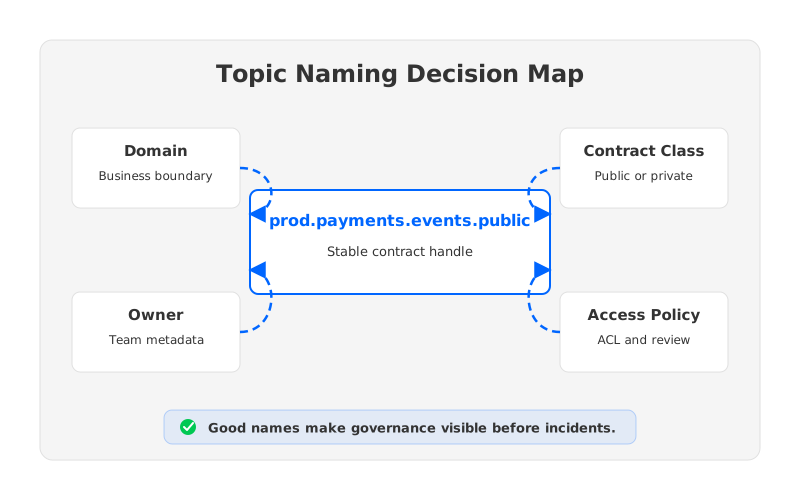
A Kafka topic name should not try to encode the entire contract. Schema version, field-level classification, retention policy, and compatibility rules belong in schema registries, catalogs, policy engines, and topic configuration. The name is the stable handle that lets those systems attach their own controls to the same resource.
That framing changes the standard. Instead of asking "what can we fit into the name," ask "what must be visible before another system opens?" The answer is usually a small set of durable facts: environment, domain, event family, ownership boundary, and lifecycle class.
One workable pattern looks like this:
<env>.<domain>.<entity-or-event>.<lifecycle>
For example, prod.payments.authorization-events.public tells the reader that the topic belongs to production, sits in the payments domain, carries authorization events, and is part of a public contract. It does not try to encode every consumer, schema field, or retention period.
| Segment | Good use | Avoid |
|---|---|---|
| Environment | dev, stage, prod when environments share tooling | Encoding environment when clusters are already separated |
| Domain | Business or platform domain such as payments, identity, risk | Team nicknames that change during reorgs |
| Event family | A durable noun or noun phrase such as authorization-events | Implementation steps such as tmp-output-2 |
| Lifecycle | public, private, replay, dlq, internal | Vague labels such as new, test, or misc |
Delimiter debates should be settled pragmatically. Kafka supports topic names with letters, numbers, dots, underscores, and hyphens, but many surrounding tools treat separators differently. Pick one primary hierarchy separator and one word separator, then document the reason. A common convention is dots between hierarchy segments and hyphens inside a segment, as in prod.fraud.card-events.public.
3Governance Pressure Behind Shared Streaming Platforms
The naming standard becomes more valuable when it is backed by platform rules. Without enforcement, it becomes a style guide that people follow when they remember. With enforcement, it becomes a safe path for self-service topic creation.
The platform should validate the name at creation time, not during a quarterly cleanup. Validation can be implemented in an internal portal, an infrastructure-as-code module, a CI check for topic manifests, or an admission workflow around the admin API. Renaming a Kafka topic is operationally expensive because producers, consumers, schema subjects, ACLs, dashboards, connectors, and replay jobs may all reference it.
A production naming standard needs rules for both names and adjacent metadata. The name provides the stable handle. Metadata provides the facts that should be queryable but not crammed into the handle.
- Required owner: every topic should have an owning team and escalation channel.
- Data classification: labels should map to access and retention policy.
- Contract status: distinguish public data products from private implementation streams.
- Lifecycle state: temporary or deprecated topics need expiration and review rules.
- Operational class: retention, compaction, partition policy, and alerting severity should be tied to named classes.
Once these fields exist, naming standards stop being a naming-only conversation. They become the front door for topic governance.
4Contracts, Ownership, Access, and Audit Trade-Offs
The easiest naming standard is the one that encodes everything. The most maintainable standard is the one that encodes only stable facts. Those goals conflict, so platform teams need explicit trade-offs.
Ownership is the first trade-off. Team names are useful during incidents, but they are risky inside topic names because teams rename, split, and merge. A domain name usually ages better than an org-chart name. Store the current owner in metadata and use the domain in the topic name.
Access control is the second trade-off. Kafka authorization can operate on topic resources and patterns, which makes prefix design important. A namespace such as prod.payments.* can map naturally to domain-level administration, while mixed patterns such as payments-prod-* become harder to reason about. The naming standard should be designed with the ACL model in mind.
Auditability is the third trade-off. Topic names can help identify regulated data flows, but sensitive labels should not become the sole enforcement point. A topic named prod.identity.login-events.public still needs policy-backed access controls, schema review, lineage records, and retention settings.
5Evaluation Checklist for Platform Teams
The standard should be evaluated like production infrastructure, not like a style preference. A useful test is to run the convention through common operational workflows before adopting it.
| Workflow | Naming question to test | What good looks like |
|---|---|---|
| Topic creation | Can developers predict the name? | Invalid structure is rejected before creation. |
| Incident response | Can SREs identify owner and domain? | The name shows domain; metadata gives escalation. |
| Access review | Can security map prefixes to permissions? | ACL patterns avoid broad wildcards. |
| Schema change | Is the topic a public contract? | Contract status is visible or required metadata. |
| Migration | Can tooling group topics safely? | Names and metadata support deterministic batches. |
This table exposes weak standards quickly. If the rule cannot answer incident response and access review questions, it is too developer-centric. If it requires eight segments before a producer can publish an event, it is too bureaucratic.
6Infrastructure Architecture Still Matters
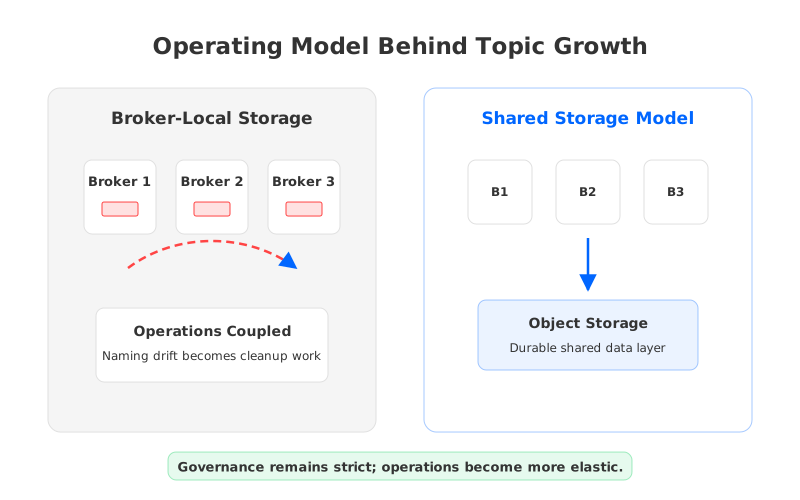
Topic naming standards live above Kafka, but they are affected by the infrastructure below Kafka. Traditional Kafka deployments couple broker compute with broker-local storage. That architecture makes topics operationally heavy: partitions live on brokers, replicas consume broker and disk capacity, and rebalancing or migration can move large amounts of data across the cluster. When topic growth is fast, governance debt shows up as infrastructure work.
This is why naming standards often become stricter in large clusters. A poorly named topic is not only a catalog problem. It can hide who owns retention growth, whether a topic should be compacted, and which partition policy applies. The platform team ends up paying for unclear ownership with manual capacity planning and slow cleanup.
A neutral evaluation framework should look at both layers:
- Governance fit: can the platform enforce names, metadata, ACLs, and schema rules early?
- Cost fit: can topic growth be attributed to owners and lifecycle classes?
- Elasticity fit: can the cluster absorb new topics without long broker-local data movement?
- Recovery fit: can incidents and rollbacks use deterministic topic groups?
- Compatibility fit: can Kafka clients and tools keep working while governance improves?
Only after those requirements are clear does the infrastructure choice become a fair conversation. A naming standard can make governance visible, but the platform still has to make growth manageable.
7How AutoMQ Changes the Operating Model
AutoMQ is a Kafka-compatible streaming system that keeps the Kafka protocol surface while redesigning the storage layer around shared object storage and stateless brokers. That matters for topic governance because many naming problems become painful when they trigger broker-local storage operations: hot partitions, retention surprises, topic migration, and cluster expansion.
In a shared-storage architecture, brokers no longer need to be treated as the long-term home of topic data. Durable data is stored in object storage, while brokers focus on serving traffic and coordinating the Kafka-compatible runtime. The result is not that naming standards become optional. The result is that platform teams can pair stronger governance with a more elastic operating model.
For a team building a self-service Kafka platform, this changes the shape of the work. The portal can still require names such as prod.risk.score-events.public, ownership metadata, ACL templates, and schema review. But capacity planning no longer has to assume every topic request permanently binds growth to broker-local disks. Compute and storage can be scaled more independently.
That distinction is important. Topic naming is not a product feature; it is a platform discipline. AutoMQ fits when the organization wants Kafka compatibility, object-storage-backed durability, stateless broker operations, and deployment boundaries that align with internal governance.
8A Practical Naming Standard Template
A standard that survives team growth should be short enough to remember and strict enough to automate. Start with a small grammar, then attach metadata requirements around it.
<environment>.<domain>.<event-family>.<contract-class>
Use lowercase ASCII names. Use dots between hierarchy segments. Use hyphens inside multi-word segments. Reserve suffixes such as dlq, replay, or internal for documented lifecycle classes. Ban temporary project codes, individual names, ticket numbers, and vague adjectives.
Then add creation rules:
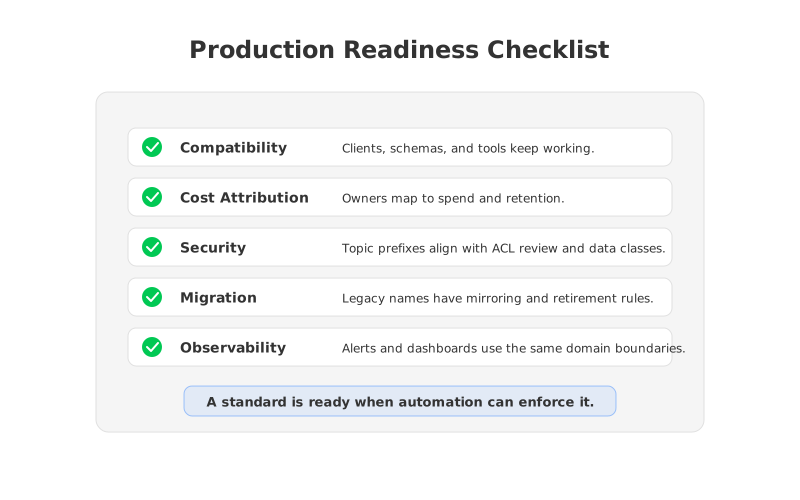
- The domain must exist in the platform catalog.
- The owner must be a group, not an individual.
- Public contract topics require schema compatibility review.
- Regulated data classes require access templates and retention policy.
- Temporary topics require expiration and cleanup ownership.
- Topic creation must produce catalog, ACL, observability, and schema records.
The last rule is the difference between a naming convention and a platform control. If topic creation also creates the surrounding records, the name becomes the first step in a repeatable contract lifecycle.
9Migration and Cleanup Without Breaking Consumers
Every naming standard eventually meets existing topics that do not follow it. Renaming them directly is usually risky because Kafka clients, connectors, schemas, dashboards, and runbooks may all reference the old name. Treat cleanup as a migration program.
The safer path is to classify existing topics first. Some topics can stay as legacy contracts with metadata added around them. Some can be mirrored into new names while consumers move gradually. Some are temporary topics that should be deleted after owner review.
Platform teams should also decide how the standard interacts with disaster recovery and cross-cluster movement. If environment or region is encoded in the topic name, mirroring may require translation rules. If environment is represented by cluster boundary instead, the topic name can remain stable across recovery targets.
10The Standard Is a Social Contract Backed by Automation
Kafka topic naming standards work when they reflect how teams actually build and operate streams. They fail when they are written as perfect taxonomies that no one can apply during delivery pressure. The goal is not beautiful names. The goal is to make ownership, contract boundaries, access rules, and lifecycle decisions visible before the cluster turns into a shared mystery.
Start small, enforce early, and keep the name focused on durable facts. Put fast-changing facts in metadata. Design the hierarchy with ACLs, schemas, catalogs, alerts, and migrations in mind.
If your Kafka platform is reaching the point where naming standards, self-service topic creation, and storage operations are becoming the same conversation, review how a Kafka-compatible shared-storage architecture changes that operating model. The AutoMQ BYOC streaming platform page is a practical next step: explore AutoMQ for Kafka-compatible streaming.
11References
- Apache Kafka Documentation: https://kafka.apache.org/documentation/
- Apache Kafka Topic Configuration: https://kafka.apache.org/documentation/#topicconfigs
- Apache Kafka Authorization and ACLs: https://kafka.apache.org/documentation/#security_authz
- AutoMQ Architecture Overview: https://docs.automq.com/automq/architecture/overview?utm_source=blog&utm_medium=reference&utm_campaign=aivk-0041
- AutoMQ Deployment Overview: https://docs.automq.com/automq/deployment/overview?utm_source=blog&utm_medium=reference&utm_campaign=aivk-0041
12FAQ
12.1What is a good Kafka topic naming standard?
A good Kafka topic naming standard uses a small, predictable grammar that identifies durable facts such as environment, domain, event family, and contract class. It should be easy for developers to apply and easy for platform automation to validate. Fast-changing facts such as owner contact, retention policy, and data classification should be stored in metadata and policy systems.
12.2Should Kafka topic names include environment names?
Include environment names when multiple environments share catalogs, automation, or operational views. If each environment is isolated by cluster, account, or namespace boundary, encoding the environment in every topic name may add noise. The decision should match how your tooling discovers, authorizes, and migrates topics.
12.3Should Kafka topic names use dots, hyphens, or underscores?
Choose one hierarchy separator and one word separator. A common pattern is dots between hierarchy segments and hyphens inside segment names, such as prod.payments.authorization-events.public. The important part is consistency across ACL patterns, schema subjects, catalog entries, and observability labels.
12.4How do naming standards affect Kafka security?
Naming standards help security teams define predictable ACL patterns and review access by domain or lifecycle class. They do not replace authorization, catalog metadata, schema governance, or data classification. Treat the name as a readable handle for policy, not as the policy itself.
12.5How should teams migrate legacy Kafka topic names?
Classify legacy topics before renaming anything. Add ownership and metadata first, then decide which topics can remain grandfathered, which should be mirrored into new names, and which can be deleted. Direct renames are risky because producers, consumers, connectors, schemas, dashboards, and runbooks may all depend on the existing name.


