
Table of Contents
Table of Contents
A Kafka upgrade is rarely scheduled like an ordinary service restart. It is scheduled like surgery: pick the window, freeze risky application changes, put the right people in the room, watch the monitors, restart one broker at a time, and keep a rollback line visible. The reason is not that Kafka cannot be upgraded safely. The reason is that a Kafka broker is not merely a process behind a load balancer.
In a traditional Kafka cluster, the broker is also a replica host, a log directory owner, a participant in leader election, a member of the controller-managed topology, and a dependency for producers, consumers, Kafka Connect, stream processors, exporters, and operational scripts. When that broker changes, many assumptions change with it. The practical goal of kafka maintenance is therefore not "restart cleanly." The goal is to preserve client behavior, replication health, controller stability, and disk safety while the cluster moves through a temporary mixed state.
That is why SRE and platform teams treat kafka upgrade work as a production-risk exercise. Version notes matter. Interoperability matters. ISR state matters. Disk headroom matters. Rolling restarts matter. And in clusters where brokers own large volumes of local data, replacement or scale-in can become a data movement project rather than a compute lifecycle task.
1Why Kafka Maintenance Feels Risky
The first source of risk is version sequencing. Apache Kafka upgrade guidance is version-specific because the broker binary, cluster metadata version, feature activation, client APIs, and runtime dependencies can change across releases. For example, Kafka 4.3 documentation describes a rolling broker upgrade path for supported KRaft clusters and finalizes the upgrade through feature version changes after broker behavior and performance are verified.
The second source is controller behavior. In KRaft-based Kafka, controller quorum health and metadata propagation are central to cluster stability. In older ZooKeeper-based clusters, the operational concerns are different, but the principle is the same: do not treat broker restarts as isolated process events. If the controller plane is already noisy, a maintenance window can turn background instability into visible outage symptoms.
The third source is ISR health. Under-replicated partitions, under-min-ISR partitions, offline replicas, ISR shrink events, and failed ISR updates are not maintenance footnotes. They tell you whether the cluster has enough replication safety to absorb another broker restart. A rolling restart that begins while the cluster is recovering can reduce fault tolerance further.
Disk pressure is the fourth source. Kafka's log directories are not passive storage. They are part of broker recovery, replication catch-up, retention, compaction, fetch performance, and reassignment behavior. If a replacement requires partition reassignment, free space and I/O headroom on target brokers become part of the maintenance plan.
Client compatibility completes the picture. A Kafka cluster usually has more clients than the platform team directly controls: producers, consumers, Connect workers, stream processing jobs, schema tooling, monitoring agents, command-line tools, and custom automation. A broker upgrade can be technically correct and still create production pain if clients depend on removed APIs, outdated protocol behavior, TLS settings, authentication behavior, deprecated tooling, or brittle retry assumptions.
2The Upgrade and Rolling Restart Checklist
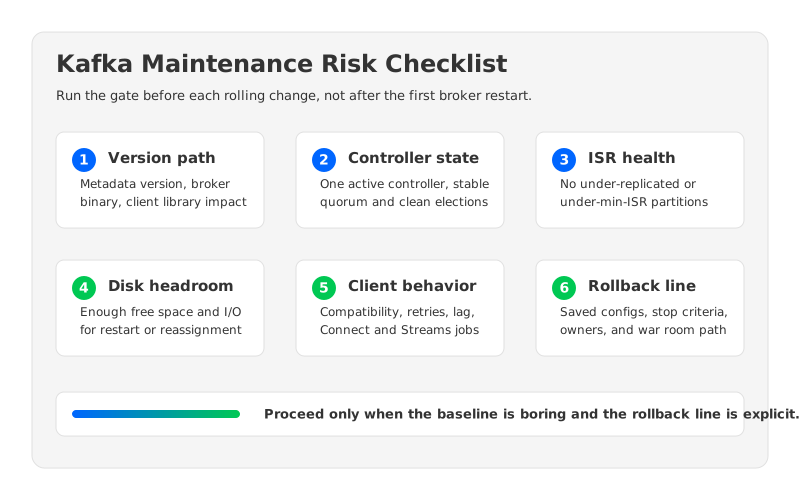
A good Kafka maintenance plan starts by making the cluster boring before the window. The point of a pre-flight checklist is not paperwork. It is to prevent the team from discovering baseline instability while a broker is already down.
At minimum, the gate should cover these areas:
- Version path. Confirm the supported source and target versions, Java/runtime requirements, KRaft or ZooKeeper prerequisites, metadata version steps, and whether feature finalization can be delayed until after validation.
- Client inventory. Identify critical producers, consumers, Connect clusters, Streams applications, MirrorMaker or replication jobs, admin clients, exporters, and automation scripts that interact with brokers.
- Controller and metadata health. Check controller quorum health, controller event queues, active controller expectations, leader election behavior, and metadata propagation symptoms.
- Replication baseline. Confirm no unexpected under-replicated partitions, under-min-ISR partitions, offline replicas, ISR shrink storms, or follower lag patterns.
- Disk and I/O headroom. Check free space, log directory status, disk service time, page cache behavior, compaction pressure, and whether any reassignment or recovery work is active.
- Traffic and lag baseline. Compare produce latency, fetch latency, request queue time, consumer lag, Connect task health, and end-to-end freshness against normal windows for the same workload.
- Rollback criteria. Define what stops the rollout, who decides, which broker is next, which changes are reversible, and which feature or metadata changes should not be finalized before validation.
The most useful checklist item is often the stop condition. A rolling restart should have explicit guardrails: no unexpected ISR degradation, no sustained request latency regression, no consumer lag pattern outside the agreed budget, no controller instability, and no disk alerts that indicate recovery or reassignment is consuming the safety margin.
The upgrade order should also preserve learning. Restart one broker, wait for it to rejoin, verify partition leadership and ISR recovery, watch client error rates, then continue. In a busy cluster, rushing between broker restarts can hide whether each step actually settled.
3Broker Replacement and Disk-State Risk
Patching an instance in place is one kind of kafka broker maintenance. Replacing a broker, changing instance families, scaling down a cluster, or decommissioning a failed node is a more difficult class of work because the broker may own local replicas that must be moved. This is where stateful architecture expands the blast radius.
Kafka's basic operations documentation describes partition reassignment as a planned workflow: generate or provide a reassignment, execute it, verify status, and use throttling when data migration needs to be limited. Broker decommissioning also requires moving partitions away from the broker before it is removed. These are normal operational tools, but they reveal the coupling: infrastructure lifecycle is tied to replica placement.
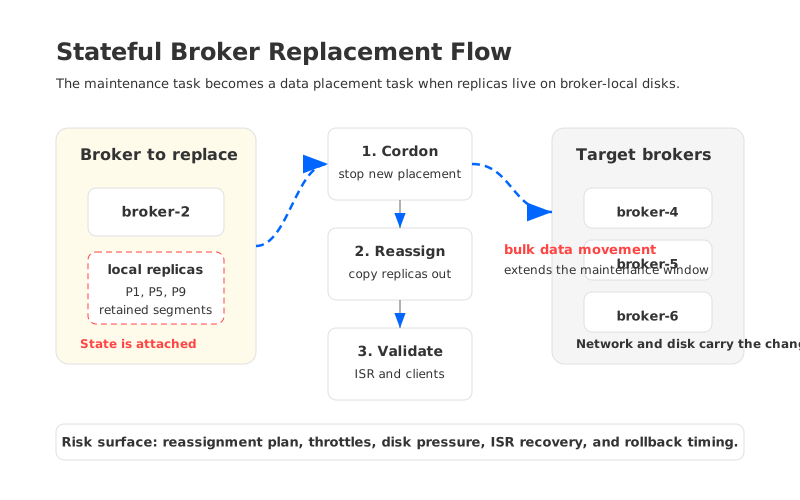
The operational risk is not the existence of reassignment. Kafka provides the machinery to do it. The risk is that reassignment consumes the same cluster resources production traffic needs: network, disk reads, disk writes, controller coordination, and follower catch-up. If the cluster is near throughput or disk limits, a replacement can stretch into a long window or force aggressive throttling.
This also changes rollback thinking. If a broker binary upgrade fails before feature finalization, the rollback path may be relatively clear for that broker. If a replacement or scale-in has already moved large amounts of data, rollback may involve restoring assignment, reversing placement, or living with an intermediate topology until the cluster is safe.
Stateful broker replacement becomes tense when several factors overlap:
- hot partitions are concentrated on the broker being replaced;
- target brokers have uneven disk or leader load;
- replication factor or rack awareness limits placement choices;
- consumer lag budgets are tight during business hours;
- the operation overlaps with retention, compaction, or recovery pressure;
- the team lacks a tested reassignment throttle policy.
This is why mature Kafka teams separate "restart a broker" from "remove a broker." The latter can be a data placement and capacity exercise that deserves its own plan.
4What to Monitor During Maintenance
Kafka monitoring during maintenance should answer a narrow question: is the cluster returning to a safer state after each step? A dashboard with hundreds of metrics is less useful than a small panel tied to decisions.
For the broker and replication layer, track under-replicated partitions, under-min-ISR partitions, offline replicas, ISR changes, leader distribution, follower fetch lag, failed requests, and request latency. The exact metric names vary by Kafka version and monitoring stack, but the categories are stable.
For the controller and metadata plane, watch active controller expectations, controller event queues, leader election rate, unclean leader election rate, controller request queues, and any KRaft quorum metrics relevant to your deployment. An upgrade window is a poor time to discover that the controller path was already unstable.
For clients, watch error rate, produce latency, fetch latency, consumer lag, group rebalance behavior, Connect task status, Streams health, and end-to-end freshness. Broker dashboards can look acceptable while critical applications are retrying, rebalancing, or falling behind.
The maintenance channel should translate metrics into decisions:
| Signal | Why it matters | Typical decision |
|---|---|---|
| Under-replicated partitions increase and do not recover | The cluster is losing replication safety | Pause the rollout and investigate before the next broker |
| Request queue time rises across brokers | Maintenance is competing with production load | Slow the rollout, reduce reassignment pressure, or reschedule |
| Controller events back up | Metadata or leadership churn may be unsafe | Stop rolling changes until controller health settles |
| Disk alerts fire on target brokers | Replacement may be overloading placement capacity | Revisit reassignment plan or add capacity |
This decision focus also keeps expectations honest. Kafka maintenance can be low-impact, but production teams should avoid promising that a window needs no coordination.
5How Stateless Brokers Change Maintenance Planning
After the checklist, the architectural question becomes clear. Much of the operational friction comes from the broker carrying both compute responsibility and durable local replica ownership. Separate durable storage from broker lifecycle, and maintenance changes shape.
AutoMQ is a Kafka-compatible streaming platform built around shared storage and stateless brokers. Its public architecture documentation describes separating storage and compute, offloading Kafka's storage layer to object storage, and using broker nodes primarily for serving, caching, and protocol handling. For platform teams, the relevant point is not a marketing slogan. It is that broker maintenance no longer has to mean moving long-lived local partition data in the same way.
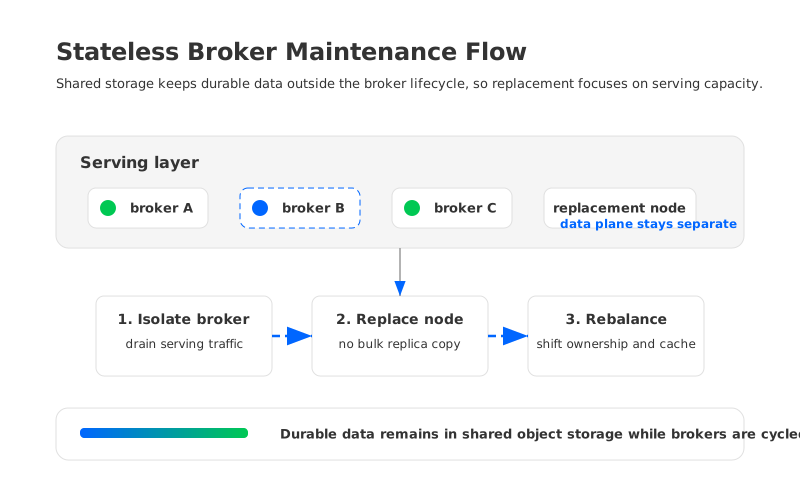
In a stateless broker model, replacing or scaling broker nodes is closer to changing serving capacity. Operators still need a controlled rollout, observability, client compatibility checks, and storage-layer awareness. The difference is that durable data is not trapped on the node being replaced, which can reduce data-movement-heavy maintenance and shorten the list of broker-local failure modes.
This is also where AutoMQ's continuous self-balancing story fits naturally. If the platform can rebalance serving responsibility without relying on bulk local replica movement as the primary maintenance mechanism, routine operations can become less dependent on specialist-led reassignment windows. That does not remove the need for coordination. It changes what the coordination is about: workload safety, compatibility, and capacity, rather than moving large volumes of retained data before an instance can leave service.
The decision framework is practical:
- If upgrade pain is mostly caused by missing runbooks, poor client inventory, or weak monitoring, fix those first.
- If maintenance pain repeatedly comes from broker-local disk, long reassignments, replacement risk, and scale-in friction, evaluate whether stateful broker architecture is the bottleneck.
- If Kafka ecosystem compatibility is required, compare architectures that preserve Kafka protocol behavior while reducing broker-local state. AutoMQ belongs in the conversation when a team wants Kafka compatibility but is tired of treating every broker lifecycle event as a data movement project. It is not a substitute for production discipline. It is an architectural way to reduce one of the recurring sources of kafka operational overhead.
6A Practical Maintenance Runbook Shape
A concise runbook is more useful than a long document nobody reads during a window. It should name the target version or maintenance action, the exact cluster, the owners in the room, affected clients, expected risk, and criteria for continuing or stopping. Before the window, capture the baseline: broker list, controller status, partition and leader distribution, replication health, disk headroom, active reassignments, top client workloads, and known incidents. After the window, verify that the cluster is not merely "green" but balanced enough for the next failure.
The final review should ask what made the maintenance risky. If the answer is unclear ownership or poor monitoring, improve the operating process. If the answer is repeated reassignment work, disk pressure, and slow broker replacement, the platform team has learned something deeper: the pain is architectural.
Kafka can be maintained safely in production, but it rewards teams that respect the system's coupling. Treat the broker as a stateful participant, make the baseline boring before rolling changes, and monitor decision signals. When broker-local state keeps turning routine maintenance into surgery, consider whether a stateless broker architecture can remove some of the work from the operating model.
7References
- Apache Kafka 4.3 documentation: upgrading
- Apache Kafka 4.3 documentation: monitoring
- Apache Kafka 4.3 documentation: basic Kafka operations
- AutoMQ documentation: architecture overview
- AutoMQ documentation: Stateless Broker
- AutoMQ documentation: Continuous Self-Balancing
8FAQ
8.1Why are Kafka upgrades risky in production?
Kafka upgrades are risky because brokers are tied to replication, leadership, metadata, local storage, and client behavior. A rolling upgrade can be safe, but it needs version-specific sequencing, health checks, and clear stop criteria because the cluster temporarily moves through mixed states.
8.2What should I check before Kafka broker maintenance?
Check the supported version path, client compatibility, controller health, ISR health, disk and I/O headroom, consumer lag, request latency, active reassignments, and rollback criteria. The cluster should be stable before the first broker is restarted or replaced.
8.3Is a rolling restart enough for a Kafka upgrade?
A rolling restart is part of many Kafka upgrade procedures, but it is not the whole plan. Teams also need to verify version prerequisites, watch cluster behavior after each broker, delay irreversible feature or metadata finalization until validation, and confirm critical clients behave as expected.
8.4Why does broker replacement take longer than expected?
In traditional Kafka, a broker may host durable local replicas. Replacing or decommissioning it can require partition reassignment, replica copying, throttling, validation, and disk-capacity checks. That data movement can dominate the maintenance window.
8.5Does AutoMQ eliminate Kafka maintenance windows?
No. Production changes still require planning, monitoring, and coordination. AutoMQ's stateless broker and shared-storage architecture can reduce data-movement-heavy broker maintenance, but teams still need disciplined rollout procedures, client checks, and operational visibility.


