
Table of Contents
Table of Contents
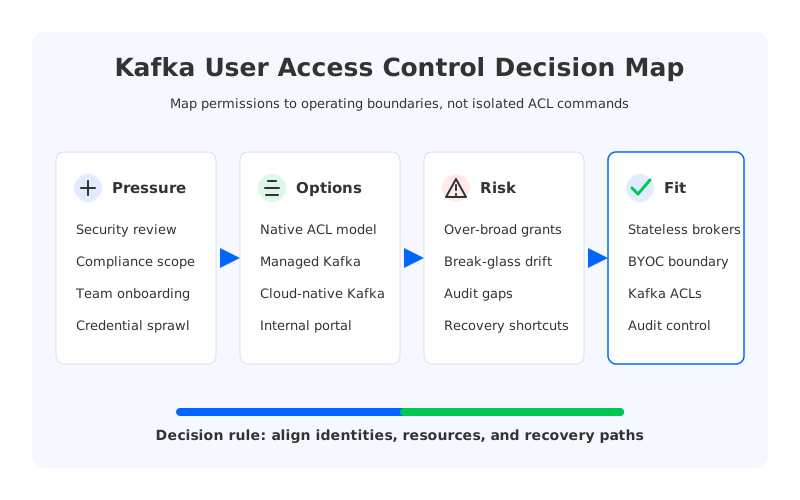
Teams rarely search for kafka user access control because they forgot how an ACL command works. They search for it when Kafka has become shared infrastructure, and the old habit of giving every service account broad access has started to look like a production risk. A payment service needs write access to one topic, an analytics job needs read access to another, a connector needs credentials that survive redeployments, and an auditor wants to know who can change cluster-level settings.
That is the real problem: Kafka access control is not a single security switch. It is a boundary-setting exercise across identities, topics, consumer groups, operations teams, deployment models, and failure recovery paths. If those boundaries are vague, ACLs become a pile of exceptions. If they are too strict, platform teams turn every onboarding ticket into a manual approval loop. The useful question is not "How do I add an ACL?" but "Where should access boundaries live so Kafka stays secure without becoming painful to operate?"
1Why Teams Search for kafka user access control
Kafka starts as a pipeline owned by one team. The first ACL policy is usually small: a producer can write, a consumer can read, and an administrator can create topics. The model holds until Kafka becomes the integration layer for many teams. At that point, access control has to describe more than who can connect. It has to describe who owns a topic, who can alter retention, who can join a consumer group, who can deploy a connector, and who can inspect operational metadata during an incident.
The pressure often arrives from three directions at once:
- Security reviews. Broad service accounts fail least-privilege checks because one compromised credential can read or write unrelated streams.
- Compliance boundaries. Regulated topics need stronger separation between application teams, platform operators, and audit roles.
- Operational scale. Manual ACL tickets become a bottleneck when new services, environments, and connectors appear every week.
Apache Kafka's ACL model is capable, but it is deliberately low-level. It grants or denies operations on resource types such as topics, consumer groups, transactional IDs, clusters, and delegation tokens. That precision is useful. It also means the platform team has to design a role model above the raw ACL layer, because most application owners do not think in terms of DescribeConfigs or IdempotentWrite.
2ACLs Are Precise, but Roles Carry the Operating Model
Kafka ACLs answer a narrow question: can this principal perform this operation on this resource? A production platform needs a wider answer: what job is this principal supposed to do, and what is the smallest set of permissions that job requires? The difference sounds semantic until an incident happens. A credential with Read on a topic may also need Describe to inspect metadata. A transactional producer may need access to a transactional ID. A consumer is usually tied to both a topic and a consumer group. The role is the human-readable contract; ACLs are the enforcement details.
A practical Kafka user access control model usually starts with a small number of roles rather than a sprawling list of one-off grants. The exact names vary by organization, but the underlying boundaries are familiar:
| Role pattern | Typical scope | Risk if over-permissioned |
|---|---|---|
| Producer identity | Write and describe one topic namespace | Unauthorized event injection or schema pollution |
| Consumer identity | Read topic namespace and join approved consumer groups | Data exposure across product or compliance boundaries |
| Connector identity | Read/write specific source or sink topics plus operational metadata | Lateral movement through integration infrastructure |
| Topic owner | Alter configs for owned topics, not the whole cluster | Retention, compaction, or partition changes outside ownership |
| Platform operator | Cluster-level administration under change control | Accidental broad changes during routine support |
The table matters because raw ACLs alone do not prevent role drift. A service account may start as a producer, gain read access for debugging, receive topic-alter privileges during a launch, and keep all of those grants after the original reason disappears. Good access control has a cleanup path. It should be possible to ask, "Which role is this identity supposed to have?" and immediately spot permissions that no longer match that role.
3The Production Constraint Behind the Problem
Access control feels like a security topic, but the harder constraints are operational. Traditional Kafka runs on a Shared Nothing architecture: each broker owns local log segments, and replication moves data between brokers to maintain availability. That design is proven, but it ties several administrative actions to broker-local state. Capacity planning, partition reassignment, disk pressure, broker replacement, and cross-Availability Zone traffic all become part of the operating surface around the same cluster that is enforcing ACLs.
This coupling shows up in subtle ways. If topic ownership is mapped cleanly but the cluster has limited spare disk, a team may need platform approval for partition growth even when the ACL policy says they own the topic. If a connector team has the right credentials but no safe boundary for deployment and rollback, access control cannot prevent operational mistakes. If a broker fails and recovery depends on moving local data, the platform team may temporarily widen permissions or bypass normal workflows to get the system stable again.
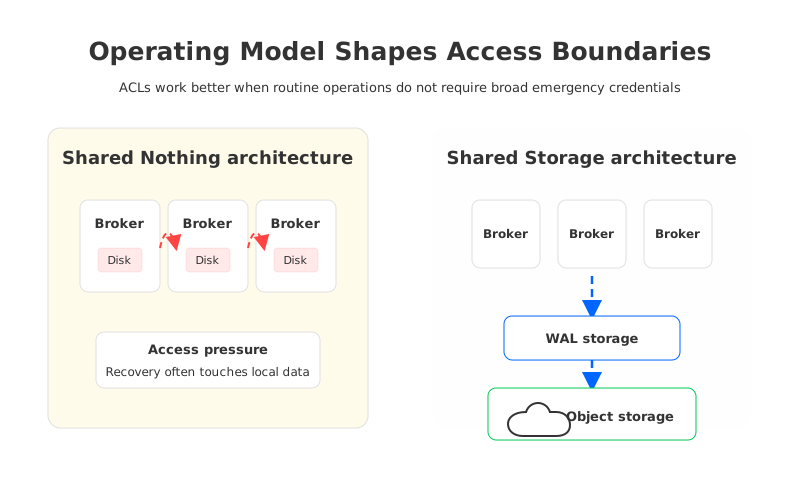
That is why Kafka user access control should be evaluated alongside the storage and deployment model. A cluster with strong ACLs but weak operational boundaries still creates risk. The access policy may say "application teams cannot alter cluster settings," while the on-call process quietly depends on a few senior engineers with broad credentials to fix disk, networking, and reassignment problems. Security teams see the credentials. Platform teams see the incident pressure. Both are looking at the same architecture from different angles.
4Architecture Options and Trade-Offs
There are three common ways to make Kafka access control manageable. The first is to build a thin internal role model over native Kafka ACLs. This works well when the platform team owns identity provisioning, topic naming, and lifecycle automation. The trade-off is discipline. If people can still add ad hoc ACLs outside the role model, the clean design erodes over time.
The second option is to use a managed Kafka service and rely on its integration with cloud identity, private networking, and operational guardrails. This reduces the burden of cluster maintenance, but it does not remove the need to define application roles, topic ownership, connector permissions, and environment boundaries. Managed services can also create a new boundary question: how much control remains inside the customer's cloud account, VPC, audit trail, and change process?
The third option is to change the Kafka-compatible operating model itself. If brokers no longer own durable local data, some administrative boundaries become easier to enforce because compute can be replaced, scaled, and isolated without moving partition data across disks. This does not replace ACLs. It reduces the amount of emergency work that tends to punch holes through otherwise well-designed access policies.
The evaluation should stay neutral. Native Kafka, managed Kafka, and Kafka-compatible cloud-native systems can all be valid choices. The deciding factor is whether the access model and the operating model agree with each other. If your security design assumes least privilege, but your recovery design assumes a small group of people can override everything during a bad day, the real boundary is the override path.
5Evaluation Checklist for Platform Teams
A useful access-control review should force the platform team to look past the ACL syntax. Start with the principals and work outward to the operating model. The goal is to find boundaries that are clear enough to automate and narrow enough to audit.
| Evaluation area | Question to ask | Healthy signal |
|---|---|---|
| Identity lifecycle | Who creates, rotates, and retires Kafka principals? | Every credential maps to an owner, environment, and role |
| Topic ownership | Who can create, alter, and delete topic resources? | Topic operations follow namespace or product ownership |
| Consumer groups | Can a reader join only approved groups? | Group IDs are scoped by service or team boundary |
| Connectors | Are connector identities separated from application identities? | Source and sink permissions are explicit and narrow |
| Cluster administration | Who can alter broker, cluster, and security settings? | Cluster-level grants are rare, logged, and time-bound |
| Recovery operations | What privileges are used during broker failure or migration? | Break-glass access is temporary and reviewed |
| Deployment boundary | Where do control plane, data plane, and audit logs live? | The customer can trace changes inside the required environment |
This checklist exposes a common anti-pattern: using Kafka ACLs as the only governance layer. ACLs enforce decisions; they do not create ownership, review cadence, rotation policy, naming discipline, or rollback procedure. Those pieces have to live in platform automation, Terraform, internal portals, or managed control planes. The important part is that they are treated as part of Kafka access control, not as paperwork around it.
6How AutoMQ Changes the Operating Model
Once the evaluation reaches operating boundaries, storage architecture becomes relevant. AutoMQ is a Kafka-compatible cloud-native streaming platform that uses Shared Storage architecture: brokers are stateless, and durable data is stored in S3-compatible object storage through S3Stream and WAL storage. The Kafka API surface remains familiar, but the broker's role changes from "owner of local durable log data" to "compute layer serving Kafka protocol traffic."
For Kafka user access control, that distinction matters in three ways. First, broker replacement and scaling have less reason to become security exceptions because the durable data is not trapped on the broker's local disk. Second, compute and storage boundaries can map more cleanly to cloud account, VPC, and object-storage policies. Third, the platform team can design access around stable resources such as topics, principals, and deployment environments instead of constantly accounting for where partition data happens to sit.
AutoMQ BYOC keeps both control plane and data plane components inside the customer's cloud account and VPC. That is relevant for regulated teams because identity, network, observability, and audit boundaries stay under the customer's operational control. AutoMQ also supports Kafka ACL management, so teams can keep the familiar Kafka authorization model while changing the infrastructure underneath it.
The more interesting effect is not a single feature. It is the reduction of operational shortcuts. In a Shared Nothing Kafka cluster, the platform team often treats broker operations as exceptional because local data movement can be slow and disruptive. In a Shared Storage architecture, stateless brokers make more routine operations look like compute lifecycle events. That gives governance teams a better chance of keeping access changes inside normal review, automation, and audit workflows.
7A Practical Rollout Model
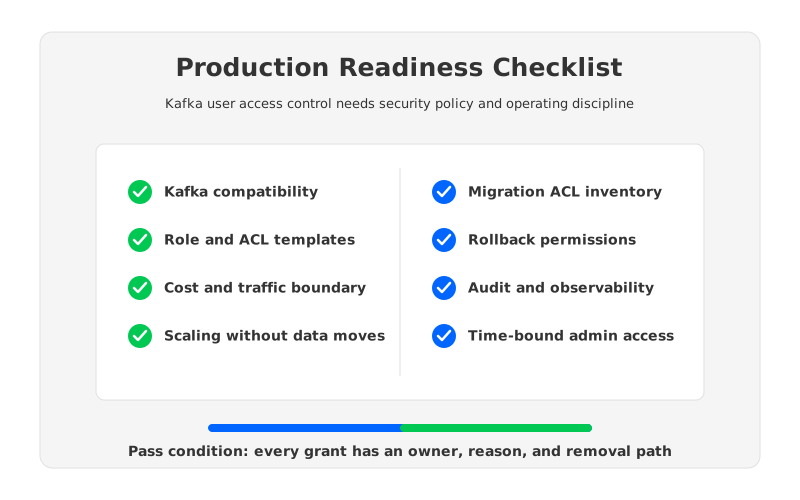
Do not begin by rewriting every ACL. Begin by naming the boundaries that already exist in practice. Which teams own which topic namespaces? Which credentials are attached to services rather than humans? Which connector identities can read from one domain and write to another? Which operators can use cluster-level privileges, and which of those privileges are needed every day?
Then turn those boundaries into policy templates. A producer role should generate the same ACL shape for every service in the same environment. A consumer role should bind topics and consumer groups together so a credential cannot read data with an unrelated group identity. A connector role should be treated as integration infrastructure, not as an application shortcut. Human administrator access should be separate from service access, logged, and reviewed on a schedule.
The final step is migration safety. If you are moving between Kafka-compatible platforms, access control has to travel with data, offsets, and client configuration. A clean migration plan includes a principal inventory, ACL export or recreation process, topic namespace mapping, consumer group validation, connector credential rotation, and rollback rules. The rollback rules matter because they define what happens when permissions work in the target environment but a client or network dependency does not.
8CTA
If your Kafka access model depends on broad operator credentials to survive scaling, broker replacement, or migration, the problem is larger than ACL syntax. Review the operating boundary first, then decide whether the infrastructure model still fits the governance model you need. To evaluate a Kafka-compatible architecture that keeps deployment control in your environment, start from AutoMQ Cloud: Try AutoMQ.
9References
- Apache Kafka documentation: Authorization and ACLs
- Apache Kafka documentation: Consumer configuration
- AWS documentation: Amazon MSK ACLs
- Google Cloud documentation: Managed Service for Apache Kafka ACLs
- AutoMQ documentation: Manage Kafka ACLs
- AutoMQ documentation: Architecture overview
- AutoMQ documentation: Save cross-AZ traffic costs with AutoMQ
10FAQ
10.1What is Kafka user access control?
Kafka user access control is the combination of authentication, authorization, identity lifecycle, and operational policy that determines who can perform Kafka operations. Native Kafka ACLs enforce permissions on resources such as topics, consumer groups, transactional IDs, and the cluster, but production teams usually need a role model above those ACLs.
10.2Are Kafka ACLs enough for least privilege?
Kafka ACLs are necessary, but they are not enough by themselves. Least privilege also depends on credential ownership, topic naming, consumer group scoping, connector isolation, change review, and removal of stale grants. ACLs enforce the decision after those boundaries are defined.
10.3How should producer and consumer permissions differ?
A producer identity usually needs write and describe permissions for a specific topic namespace. A consumer identity usually needs read permissions on approved topics and access to the consumer group IDs it is allowed to join. Keeping those identities separate limits the blast radius of a compromised credential.
10.4Why does storage architecture matter for access control?
Storage architecture shapes the operational work around the cluster. When brokers own local durable data, recovery, scaling, and reassignment can create pressure for broad operator privileges. In a Shared Storage architecture with stateless brokers, more operations can be handled as compute lifecycle events, which makes access boundaries easier to preserve.
10.5Can a Kafka-compatible platform keep existing ACL practices?
It can if it supports the Kafka authorization model and client protocol behavior your applications depend on. During evaluation, test the ACL patterns you use in production, including topic access, consumer group access, transactional IDs, connector credentials, and administrator workflows.


