
Table of Contents
Table of Contents
Kafka users often assume the protocol protects them from lock-in. The reasoning sounds sensible: producers and consumers use Kafka APIs, so changing platforms should be a matter of pointing clients at a different bootstrap server. That is partly true, and it is one reason Kafka became such a durable ecosystem. But protocol compatibility is only one layer of lock-in. The deeper risks live in licenses, proprietary control planes, data placement, platform-specific features, and the cost of leaving after years of operational dependence.
Lock-in is not automatically bad. A commercial platform can save engineering time, reduce operational risk, and give teams capabilities they would not build themselves. The problem appears when the exit cost is invisible at the time of purchase. By the time a team wants to leave, the platform may own too many workflows, too much data, or too much operational knowledge.
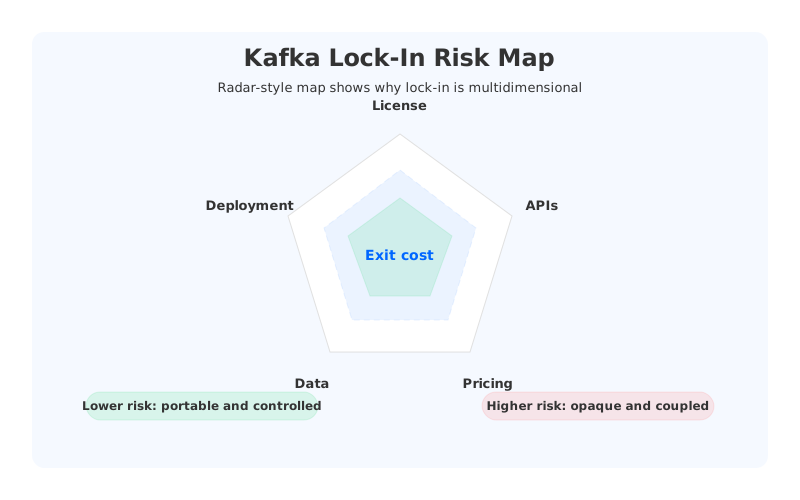
1Lock-in has more than one shape
The most visible form is licensing. Apache 2.0 gives broad rights to use, modify, and distribute software. Source-available licenses may let you read code while limiting how you run it or offer it as a service. Proprietary platforms may expose Kafka-compatible APIs while keeping critical features inside a vendor-controlled control plane. Those differences matter when a team needs a fallback path.
Licensing is only the first layer. A platform can be open source and still difficult to leave if it encourages heavy use of non-portable features. A managed service can use standard Kafka APIs and still create operational lock-in through networking, monitoring, IAM, topic automation, connectors, or billing commitments. A cloud service can feel safe because it is familiar, then become restrictive when the company moves to another cloud.
A practical evaluation should separate several questions:
- Can we run the software ourselves if the vendor relationship changes?
- Are the APIs we use portable Kafka APIs or platform-specific extensions?
- Where does retained data live, and how hard is it to export?
- Can we reproduce topic configuration, ACLs, quotas, and schemas elsewhere?
- Does the pricing model make exit financially painful during the transition?
- Does our team understand the system well enough to operate it without the vendor?
These questions are uncomfortable because they make procurement slower. They are also much less painful than discovering the answers during a forced migration.
2Open source is necessary, but not sufficient
Open source reduces lock-in because it preserves rights. If a project is Apache 2.0 and production-ready, the buyer has more leverage: the vendor can offer support, hosting, and operational expertise, but the software itself remains available. That is a meaningful difference from a platform where the only production path is a vendor-operated service.
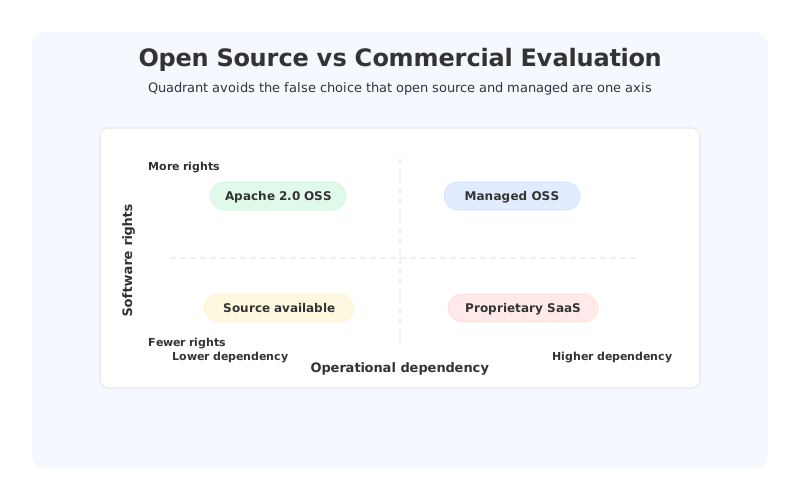
Still, open source should not be treated as a magic shield. A project can be open but immature. It can have missing Kafka semantics, weak tooling, or limited production references. A team can also create self-inflicted lock-in by building too many internal workflows around one deployment method. The right question is not “is it open source?” but “does open source reduce the specific exit risks we care about?”
| Dimension | What to inspect | Why it matters |
|---|---|---|
| License | Apache 2.0, BSL, proprietary, managed-only | Determines your rights if strategy changes |
| API surface | Standard Kafka vs platform-specific features | Determines application portability |
| Data control | Customer account, vendor account, cloud service | Determines export and compliance risk |
| Deployment model | SaaS, BYOC, self-managed | Determines operational control |
| Tooling | Connectors, monitoring, automation, IaC | Determines how much workflow must be rebuilt |
| Commercial terms | Commitments, egress, support dependency | Determines cost of transition |
This framing helps avoid two weak arguments. The first is that proprietary platforms are always wrong; they are not. They may be the right choice when the team values managed experience over control. The second is that open source automatically wins; it does not, especially if the project is not mature enough for the workload. The decision depends on how much control the business needs and what it is willing to operate.
3Kafka-compatible does not always mean portable
Kafka compatibility is a strong baseline, but portability depends on what the application actually uses. A simple producer and consumer using standard topics may move easily. A platform using proprietary stream processing, managed connectors, custom schema governance, private networking patterns, or vendor-specific monitoring may be more tightly coupled than the client API suggests.
This is where Confluent, MSK, Redpanda, WarpStream, and AutoMQ should be evaluated with the same lens. The question is not which platform has the longest feature list. The question is which features become dependencies that are hard to replace. A connector marketplace is useful until a migration requires rebuilding every connector pipeline. A managed control plane is useful until the team needs the same runtime across multiple clouds. A source-available codebase is useful until the license limits the way the business wants to use it.
4Data control is the lock-in layer teams notice late
Data is harder to move than clients. A bootstrap server change can be deployed in minutes. Moving retained logs, offsets, schemas, ACLs, and topic history can take days or weeks. Egress fees and migration overlap can make the financial cost visible at exactly the wrong time.
BYOC changes this part of the conversation. When data remains in the customer's cloud account and VPC, the vendor does not become the long-term owner of the bytes. That does not remove all migration work, but it changes the power balance. AutoMQ BYOC deployment model is important for this reason: it combines managed operations with customer-side data control. Its Software deployment option adds another path for teams that want to operate the runtime themselves.
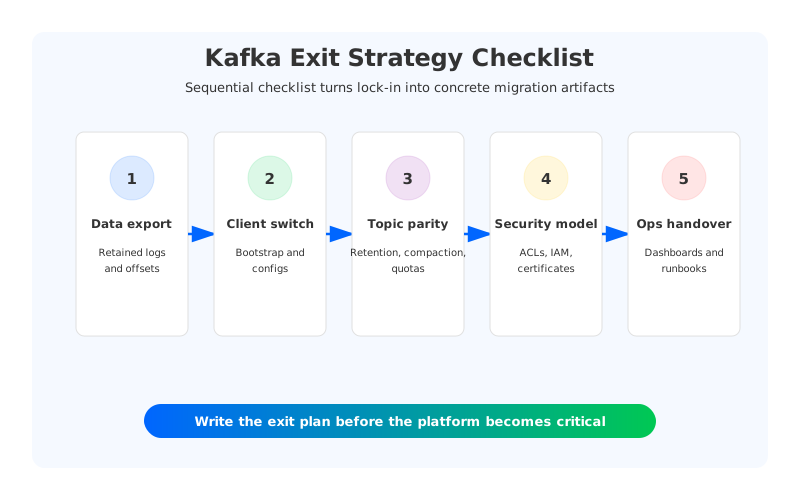
A credible exit strategy should be written down before the platform is adopted. It should identify how to export data, how to move clients, how to replicate topics, how to translate security configuration, and how to operate the target. If the plan is “we will figure that out later,” the team is accepting lock-in without pricing it.
5How AutoMQ fits the evaluation
AutoMQ's lock-in argument rests on several layers working together. The project is Apache 2.0 open source. It speaks Kafka APIs, so applications do not need a new client model. It supports BYOC, so production data can remain in the customer's cloud environment. It also supports AutoMQ Software deployments, which gives teams another operational path if their requirements change.
That does not mean every team should choose the lowest-lock-in option. Some teams should pay for a fully managed platform because speed and vendor accountability are more important than control. Some teams should stay with MSK because AWS-native integration is enough for their workload. Some teams should prioritize a performance-oriented engine if their latency target justifies the tradeoff. The value of a lock-in framework is that those choices become explicit.
The safest platform decision is not the one with no dependencies. Every production system creates dependencies. The safer decision is the one where the dependencies are understood, priced, and reversible enough for the business. For Kafka, that means looking beyond the protocol and asking who controls the software, the data, the operations, and the exit path.
6Questions to ask every Kafka vendor
A lock-in review works best when every vendor gets the same questions. Ask whether the data plane can run in your cloud account, whether the control plane is required for steady-state operation, and whether the product can keep running if the vendor relationship changes. Ask which features are standard Kafka and which are platform-specific. Ask how topic configs, ACLs, schemas, connectors, and monitoring would be exported during a migration. The answers do not need to be identical, but they should be explicit.
Commercial teams sometimes treat these questions as adversarial. They are not. They are part of responsible platform ownership. If a vendor has a strong managed service, it should be able to explain the value of that service while also describing what happens if the customer later needs a different deployment model. If a project is open source, it should be able to show production maturity, not only license freedom. If a service claims Kafka compatibility, it should explain where compatibility ends.
AutoMQ is strongest in this conversation when the evaluation values reversibility. Apache 2.0 licensing, Kafka API compatibility, BYOC deployment, and a self-managed option give teams several paths forward. Those paths do not eliminate dependency. They make dependency a choice the team can revisit instead of a trap it discovers after the system becomes critical.
The final signal is negotiation posture. A team with a credible exit plan negotiates differently from a team that cannot leave. That does not mean threatening vendors; it means understanding your own leverage. In Kafka platforms, leverage comes from portable clients, controlled data, reproducible configuration, and a team that knows how the system works.
A platform decision should leave future teams with options, not archaeology. If they can understand, operate, and exit the system, the dependency is manageable.


