
Table of Contents
Table of Contents
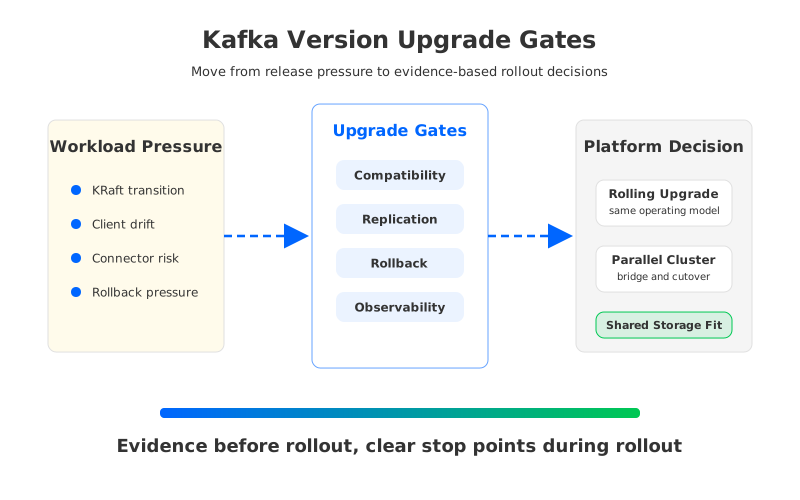
Teams usually search for kafka version upgrade gates when the upgrade no longer looks like a routine maintenance window. A broker release may be required for KRaft adoption, client compatibility, a security fix, connector support, tiered storage evaluation, or a platform migration. The question is whether producers, consumers, offsets, transactions, governance controls, and rollback behavior will still make sense after the version boundary is crossed.
That distinction matters because Kafka upgrades sit at the intersection of application behavior and infrastructure state. A minor client library drift can show up as a producer retry storm. A consumer group protocol change can expose old assumptions about offsets and rebalances. A connector that passed a smoke test can fail once schema evolution or task restarts enter the path. The upgrade gate keeps those risks from being discovered by customer traffic.
1Why Teams Search for kafka version upgrade gates
Kafka version planning often begins with a release note and ends with a risk register. Platform teams have to answer questions no version number can answer: which clients are supported, which applications use transactions, which consumer groups can tolerate a replay, which connectors depend on old plugins, and which teams can be reached during a rollback. The upgrade is visible as a broker change, but the blast radius is distributed across every workload that treats Kafka as a durable contract.
The pressure usually comes from several directions at once. A platform owner wants to retire ZooKeeper and standardize on KRaft. An SRE team wants fewer emergency patches. A data engineering team wants Kafka Connect or Streams behavior tied to the target version. Finance wants to know why the migration plan requires duplicate clusters, extra brokers, and a long dual-running period. None of these concerns is wrong. The problem is that they are often reviewed in separate meetings.
A useful gate turns the upgrade from a calendar event into a set of falsifiable conditions. It should say what must be true before the next phase starts. Staging proves that one environment survived one rehearsal. A gate proves that the team knows the accepted compatibility surface, the open rollback path, and the production signals that would stop the upgrade.
2The Migration Risk Behind the Workload
Traditional Kafka architecture makes version upgrades harder because brokers are more than stateless request handlers. They own local log data, participate in replication, hold partition leadership, coordinate with controllers, and expose protocol behavior that clients depend on. That shared-nothing model is proven, but it means an upgrade can become a storage, network, and capacity event rather than a binary replacement event. The more state a broker owns, the more careful the team has to be about drain order, leader movement, disk headroom, and recovery time.
This is why version gates should start with workload classification rather than cluster inventory. A topic with compacted records, transactional producers, Kafka Streams state, strict ordering expectations, and high fan-out consumers carries a different risk from a short-retention logging topic. Both may share the same broker version, but they do not share the same recovery contract. Treating them as one bucket gives the review a clean spreadsheet and a weak operating plan.
The first classification pass should separate workloads by behavior that can break during or after an upgrade:
- Client protocol and library age. Old producer, consumer, admin, and connector clients may remain compatible, but they should be tested against the target broker behavior rather than assumed safe.
- Consumer group sensitivity. Groups with strict lag SLOs, external offset stores, or manual commit patterns need more than a basic consume test.
- Transactional and idempotent writes. Producers using idempotence or transactions need explicit validation around retries, fencing, and failure recovery.
- Connector and stream processing dependencies. Kafka Connect, Debezium, Flink, Spark, and Kafka Streams workloads often depend on plugin versions, offset topics, and state recovery behavior.
- Governance and security coupling. ACLs, authentication, encryption, audit logging, and network controls must move with the upgrade, not after it.
The output is a map of where the upgrade can be automated, rehearsed, or tied to an application-owner rollback contract.
3Compatibility, Replication, Rollback, and Observability Trade-Offs
Compatibility is the first real gate because the Kafka ecosystem has several compatibility layers: broker-to-client protocol behavior, admin tooling, serializers, Connect workers, Streams applications, MirrorMaker 2, monitoring exporters, and security integrations. A broker upgrade that works for ordinary produce and consume calls may still fail if connector plugins cannot be rebuilt, admin scripts assume removed behavior, or consumer group tooling no longer returns fields an operations runbook expects.
Replication planning is the second gate when the upgrade uses a parallel cluster or migration bridge. MirrorMaker 2 and Kafka Connect are common tools for moving data across clusters, and they are valuable because they stay close to Kafka's operating model. They also add their own lifecycle: connector tasks, offset synchronization, topic mapping, lag monitoring, and error handling. If the plan depends on replication, the gate should prove that the replicated system can catch up after a pause, expose lag clearly, and support the intended cutover pattern.
Rollback is where optimistic upgrade plans usually become vague. Before a high-risk workload crosses the version boundary, the team should know whether rollback means moving clients back, replaying records, freezing writes, reconciling data, or accepting a one-way cutover. A rollback gate should identify the last reversible point. After that point, the work has changed from switching back to reconciling state.
Observability is the fourth gate because upgrade safety is measured through signals, not confidence. Broker health, controller stability, produce latency, consumer lag, group rebalances, under-replicated partitions, connector task failures, authentication errors, and client retry rates need pre-upgrade baselines. Without baselines, every graph during the rollout becomes a debate. With baselines, the team can decide which deviation pauses the upgrade and which deviation is acceptable noise.
| Gate | Production Question | Evidence Before Proceeding |
|---|---|---|
| Client compatibility | Which applications and tools can run against the target version without code changes? | Client version inventory, integration tests, authentication checks, admin tooling rehearsal |
| Data movement | Does the plan require in-place rolling upgrade, bridge replication, or cluster migration? | Topology decision, replication lag test, topic mapping, connector restart test |
| State continuity | Can offsets, transactions, and stream processing state survive the chosen path? | Consumer group rehearsal, transaction failure test, stateful workload replay notes |
| Rollback boundary | What is the last point where switching back is still safe? | Written rollback contract, producer routing plan, source-of-truth decision |
| Operations | Can the on-call team see and stop a bad rollout quickly? | Dashboards, alerts, runbooks, escalation owner, pause criteria |
The table is blunt. A gate that cannot be answered with evidence is a hope with a checkbox beside it.
4Evaluation Checklist for Migration Teams
The checklist should fit the way Kafka is actually operated. Start by splitting the estate into upgrade cohorts. Low-risk topics can move early and teach the team about tooling gaps. High-risk topics should move after the runbooks have been exercised and after the target version has handled enough traffic to expose ordinary friction.
Then decide which upgrade path is being evaluated. An in-place rolling upgrade preserves the existing cluster identity and may reduce application disruption, but it keeps the team inside the old storage and capacity model. A parallel-cluster path gives stronger isolation and cleaner rollback options early in the project, but it introduces replication, duplicate capacity, and cutover complexity. A broader platform migration can solve architectural issues that made the upgrade painful, but it requires stricter compatibility and governance review.
A practical readiness checklist looks like this:
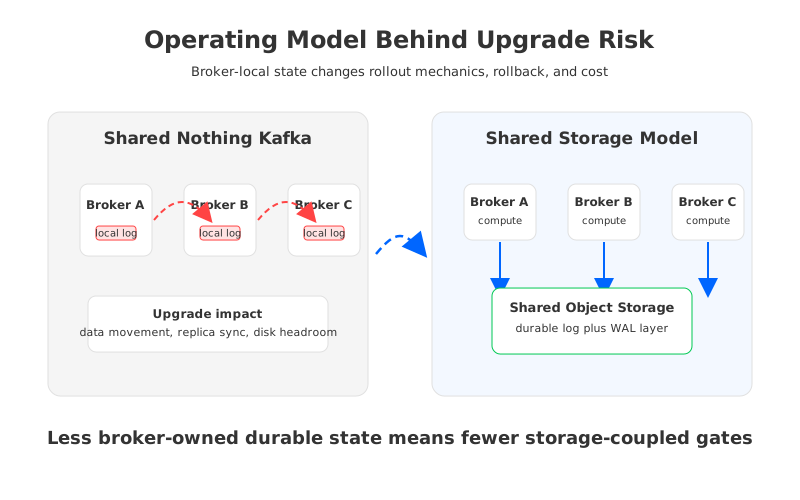
- Inventory gate. Every producer, consumer, connector, stream processor, admin script, authentication path, and monitoring integration has an owner and target-version test status.
- Rehearsal gate. At least one representative workload from each risk class has been upgraded or moved in a non-production environment using the same automation planned for production.
- Failure gate. The team has tested broker restart, connector restart, consumer rebalance, authentication failure, and replication pause scenarios.
- Cost gate. Any duplicate cluster, bridge replication, extra storage, cross-AZ traffic, or extended retention has a budget owner and removal condition.
- Governance gate. ACLs, encryption, audit logging, regional placement, and access approvals are part of the rollout plan rather than a post-upgrade cleanup task.
- Exit gate. The team knows when the old path will be decommissioned and what evidence proves that the target path is the source of truth.
This checklist protects platform teams from a common executive shortcut: "Can we do the upgrade this weekend?" The honest answer may be yes for one cohort and no for another. A gate-based plan makes that answer defensible because it connects schedule to risk.
5How AutoMQ Changes the Operating Model
When a Kafka version review exposes broker-local storage, slow scaling, long reassignment windows, and expensive duplicate capacity as the hardest parts, the target architecture should be part of the decision. AutoMQ is a Kafka-compatible, cloud-native streaming system that keeps Kafka protocol compatibility while replacing the broker-local storage layer with shared storage. In this model, brokers become more stateless, durable data is backed by object storage, and compute and storage can be scaled with fewer assumptions tied to local disks.
That change does not remove the need for upgrade gates. It changes what the gates ask. In a shared-nothing Kafka cluster, a version or platform move often has to reason about disk placement, replica movement, broker headroom, and recovery from local storage failures at the same time. In a shared storage architecture, the review can focus more sharply on compatibility, workload behavior, routing, governance, and rollback.
AutoMQ's architecture also changes the cost conversation around parallel upgrades. Traditional Kafka migrations can create a temporary cost spike from duplicate brokers, replicated storage, and cross-AZ data movement. AutoMQ's Shared Storage architecture and Zero cross-AZ traffic design are intended to reduce that pressure by removing broker-to-broker replica traffic from the steady-state data path. The financial impact still depends on cloud region, workload throughput, read fan-out, retention, and network topology.
Migration mechanics matter as much as steady-state architecture. AutoMQ's migration documentation describes Kafka Linking for moving from Apache Kafka and other Kafka-compatible distributions, including byte-to-byte data copy, synchronized consumer progress, and producer switching support in supported scenarios. For version upgrade gates, those capabilities target the awkward part of a migration: keeping offsets, write paths, and cutover control understandable while the infrastructure changes underneath.
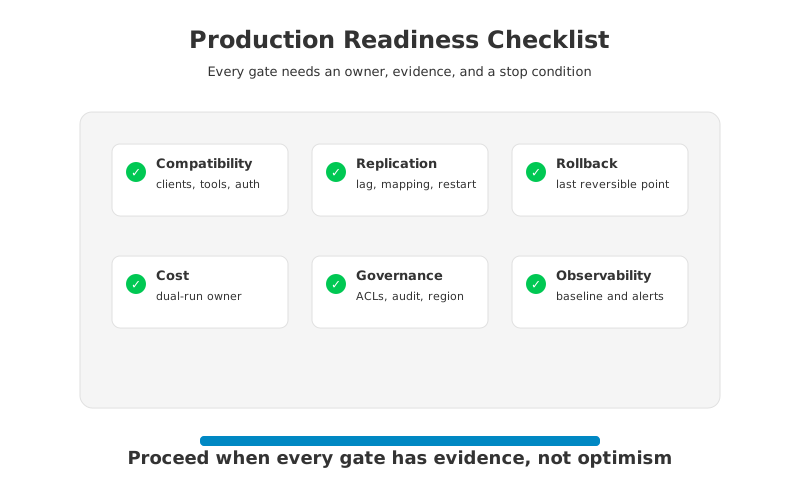
The decision is not "traditional Kafka or AutoMQ" in the abstract. The decision is whether the upgrade is a narrow version change or a chance to reduce the operating model that made the version change risky. If the current pain is mostly release hygiene, a conservative rolling upgrade may be enough. If the pain comes from storage-coupled brokers, slow elasticity, cross-zone traffic, and difficult rollback planning, a Kafka-compatible shared storage architecture deserves review.
6Decision Matrix for Platform Owners
A decision matrix prevents the review from collapsing into a tool preference. The same organization may choose different answers for different clusters, especially when some workloads are stable compliance systems and others are fast-growing AI, observability, or data lake pipelines.
| Signal | Stay Close to Existing Kafka When | Evaluate Shared Storage When |
|---|---|---|
| Compatibility risk | Client and connector behavior is well understood, and the target is a routine broker release. | The upgrade is tied to a platform migration, KRaft transition, or broad client cleanup. |
| Storage pressure | Disk capacity, retention, and reassignment windows are predictable. | Broker-local data movement is a major cause of downtime, cost, or rollout delay. |
| Rollback expectations | A rolling rollback remains practical within the maintenance window. | The team needs a staged migration path with clearer source-of-truth control. |
| Cost profile | Duplicate capacity during migration is small and short-lived. | Long dual-running periods, cross-AZ traffic, or retained data dominate the migration budget. |
| Team boundary | One platform team owns the whole Kafka estate. | Application, security, FinOps, and infrastructure teams need cleaner ownership boundaries. |
The matrix should end in a written decision record: target version, upgrade path, accepted risks, rollback boundary, owner for every gate, and evidence still missing. That record is more useful than a long slide deck because it can be used during the rollout. When a signal crosses a threshold, the plan is already written.
The search for kafka version upgrade gates usually begins with fear of a bad weekend. It should end with a better operating contract. If your gates point toward a Kafka-compatible shared storage model, review AutoMQ's architecture and migration path as part of the same process: start with the AutoMQ GitHub repository.
7References
- Apache Kafka documentation: Apache Kafka Documentation
- Apache Kafka documentation: KRaft
- Apache Kafka documentation: Kafka Connect
- Apache Kafka documentation: MirrorMaker
- Apache Kafka wiki: KIP-405: Kafka Tiered Storage
- Apache Kafka wiki: KIP-1150: Diskless Topics
- AutoMQ documentation: Compatibility with Apache Kafka
- AutoMQ documentation: Architecture overview
- AutoMQ documentation: Eliminate inter-zone traffic
- AutoMQ documentation: Migrate to AutoMQ
- AutoMQ documentation: Table Topic overview
8FAQ
8.1What are Kafka version upgrade gates?
Kafka version upgrade gates are production readiness checks that must pass before an upgrade moves to the next phase. They usually cover client compatibility, broker and controller health, consumer group behavior, connector readiness, rollback boundaries, observability, and ownership.
8.2Are Kafka version upgrade gates only needed for major upgrades?
No. Major upgrades deserve the most scrutiny, but smaller upgrades can still expose old clients, connector assumptions, authentication drift, or monitoring gaps. Gate depth should match workload risk, not the release label alone.
8.3How should teams test client compatibility before a Kafka upgrade?
Start with an inventory of producer, consumer, admin, connector, and stream processing clients. Test representative applications against the target broker version, including authentication, retries, transactions where used, consumer group rebalances, and incident scripts.
8.4Is MirrorMaker 2 enough for a version upgrade migration?
MirrorMaker 2 can be useful when a parallel-cluster path is part of the upgrade, but it is not the whole plan. Teams still need topic mapping, lag monitoring, offset strategy, rollback rules, connector operations, and a clear cutover decision.
8.5When should a Kafka upgrade become a platform migration?
Consider a broader migration when the upgrade risk is driven less by the version itself and more by the operating model: broker-local storage, slow reassignment, cross-AZ traffic, duplicate capacity, difficult rollback, or governance boundaries.


