
Table of Contents
Table of Contents
Kafka and Google Pub/Sub both move events between producers and consumers, so the comparison looks straightforward from a distance. It is not. Kafka is a partitioned event log with offsets, consumer groups, replay, and a large ecosystem around Kafka Connect, Kafka Streams, Flink, schema registries, and observability tools. Pub/Sub is a Google Cloud-native messaging service built around topics, subscriptions, acknowledgements, delivery controls, and managed elasticity.
The expensive mistake is treating this as a generic feature checklist. An application that depends on Kafka offsets and ordered partition reads does not become Pub/Sub-native because both services use the word "topic." A greenfield microservice that needs elastic fan-out inside Google Cloud may not need Kafka's broker and partition model at all. The sharper question is which event streaming model your workload already assumes.
1Short Answer
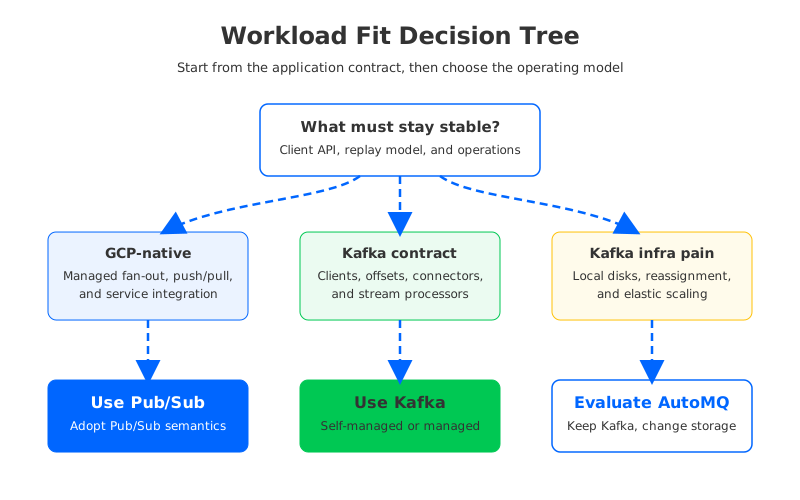
Choose Pub/Sub for Google Cloud-native messaging, elastic fan-out, push or pull delivery, and managed operations. Choose Kafka when the workload depends on Kafka protocol compatibility, partition-level ordering, consumer groups, offset replay, Kafka Connect, Kafka Streams, or the broader Kafka ecosystem. Choose a Kafka-compatible architecture such as AutoMQ when Kafka semantics still matter, but traditional Kafka's broker-local storage, scaling, reassignment, and operational cost are the real pain.
That framing creates a useful first-pass filter:
| Requirement | Kafka | Google Pub/Sub |
|---|---|---|
| Existing Kafka clients and tools | Native fit | Migration or bridges |
| Ordered log with offsets | Core abstraction | Subscription and ack model |
| Google Cloud-native integration | Connectors or services | Native design center |
| Broker-level control | Deployment-dependent | Low by design |
| Operational ownership | Team or provider | Mostly service-owned |
| Replay and backfill workflows | Natural fit when designed well | Retention and seek features |
The table is intentionally blunt. It does not decide the architecture, but it prevents the common category error: using Pub/Sub to avoid Kafka operations, then discovering that the migration also changed the application contract.
2Core Architecture Differences
Kafka's model begins with the log. A topic is split into partitions, producers append records, and consumers read records by offset. Ordering is scoped to a partition, not a whole topic, so parallelism and ordering are designed together. Consumer groups coordinate which members read which partitions, and committed offsets let applications resume, rewind, or replay in a controlled way.
Pub/Sub starts with topics and subscriptions. Publishers send messages to a topic, and subscribers receive messages through subscriptions that manage delivery, acknowledgement, retry, dead-letter behavior, filtering, and related controls. This model is strong for decoupling services because each subscription can represent a separate consumption path. It is also a different mental model from Kafka: the durable service boundary is not a broker-owned partition log exposed through offsets.
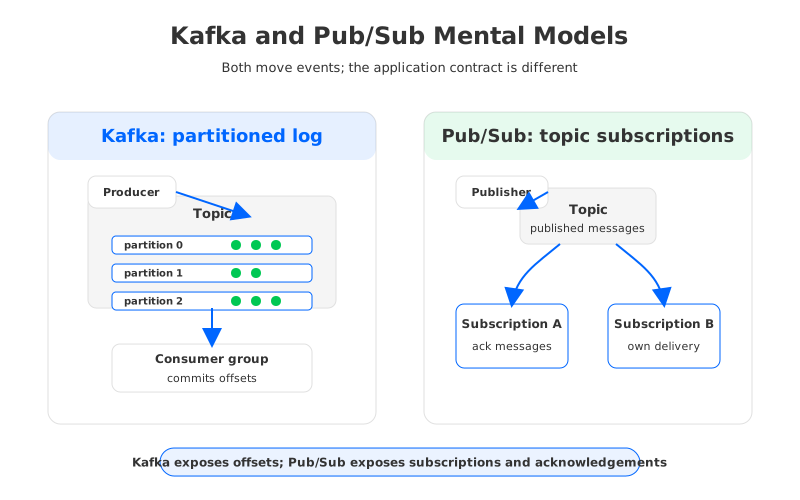
Google's comparison between Pub/Sub and Managed Service for Apache Kafka frames the trade-off as operational simplicity versus portability. Pub/Sub removes cluster management and integrates with Google Cloud services. Kafka preserves an open ecosystem and the application contract that many streaming platforms already use. The migration impact hides in the details: clients, connectors, stream processors, dashboards, incident procedures, and replay tools all encode assumptions about one model or the other.
2.1Topics, Partitions, and Ordering
Kafka ordering is partition ordering. If all events for an entity use the same partition key, consumers can process that entity's events in order while the topic still scales across many partitions. This is why Kafka fits CDC pipelines, transaction event streams, and stateful stream processing jobs. The trade-off is design discipline: weak partition keys create hotspots, too many partitions increase overhead, and changing partition strategy after production traffic arrives is rarely painless.
Pub/Sub supports ordered delivery with ordering keys when ordering is enabled and publishers use those keys. That is useful, but it is not a copy of Kafka partition semantics. Pub/Sub applications need to reason about ordering keys, subscriptions, acknowledgement behavior, retries, and delivery constraints in the Pub/Sub model. For greenfield Google Cloud workloads, that can be a cleaner design. For Kafka migrations, it means ordering must be revalidated instead of assumed.
The practical test is simple: write down what "in order" means for the workload. If it means entity-level processing plus replay from a known offset, Kafka fits naturally. If it means ordered delivery by key while the service handles fan-out and retries, Pub/Sub may fit well. If nobody can define the ordering scope, the comparison is not ready for production design.
2.2Subscriptions, Offsets, and Replay
Kafka replay is one of the main reasons teams keep it. A consumer can read from committed offsets, reset position, backfill historical data, or let another consumer group process a topic from an earlier point subject to retention. Kafka becomes more than a transient queue; it becomes a shared event history for multiple applications.
Pub/Sub also supports retention and replay-oriented operations, including message retention and seek on subscriptions, but the controls map to Pub/Sub concepts rather than Kafka offsets. A Pub/Sub subscriber acknowledges messages; a Kafka consumer commits offsets. Those are related operational ideas, not interchangeable APIs, and they produce different incident runbooks.
For architecture reviews, replay should be tested with production-like data volume:
- Backfill pressure. Can old data be read while producers keep writing and live consumers stay healthy?
- Consumer isolation. Can one team replay history without disrupting another team's consumption path?
- Retention economics. How does the service behave when retention moves from hours to days or weeks?
- Operational clarity. Can SREs explain the recovery command and its blast radius during an incident?
Replay support does not mean the operating model is the same.
3Ecosystem and Application Compatibility
Kafka's ecosystem has gravity. Kafka Connect gives teams a common framework for source and sink connectors. Kafka Streams and Flink jobs often assume Kafka topics as the durable input and output boundary. Monitoring stacks track lag, partitions, request latency, broker capacity, and rebalances. Security, schema governance, and data contracts are frequently built around Kafka interfaces.
Pub/Sub has its own ecosystem, especially inside Google Cloud. It integrates naturally with Dataflow, Cloud Run, Cloud Functions, BigQuery-oriented pipelines, and other Google Cloud services. For GCP-native teams, this can reduce platform code. For teams migrating a Kafka estate, the same strength can become a rewrite surface because surrounding tools need Pub/Sub-native equivalents or bridges.
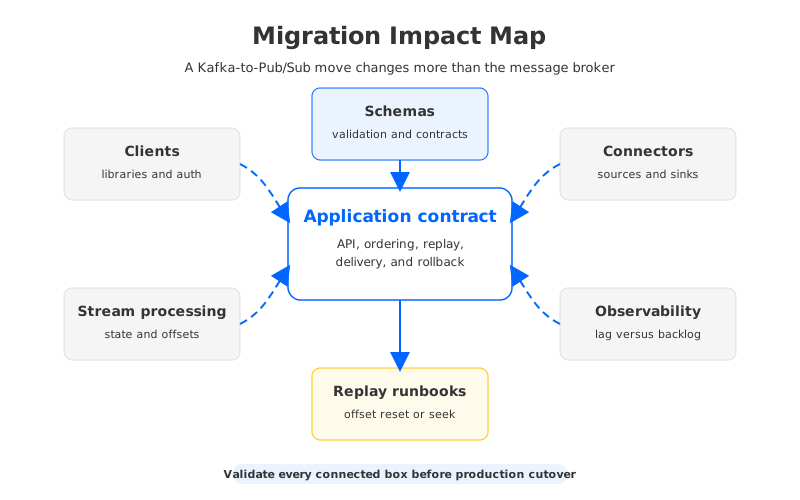
Compatibility work usually appears in five places:
- Client libraries. Kafka clients use Kafka protocols and configuration; Pub/Sub clients use Pub/Sub APIs and delivery controls.
- Connectors. Kafka Connect pipelines need replacement connectors, custom bridges, or a Kafka-compatible target.
- Stream processing. Jobs that depend on Kafka topics, offsets, and transactions need redesign or compatibility testing.
- Schemas and governance. Schema validation may exist in both worlds, but workflows and enforcement points can differ.
- Observability. Kafka lag and Pub/Sub backlog are not the same operational signal.
This is why a Kafka-to-Pub/Sub migration should be treated as an application migration, not a service swap. Even a small producer change can spread into deployment, monitoring, replay, rollback, and ownership.
4Operations and Scaling
Pub/Sub is attractive because it removes most cluster operations from the application team. There are no brokers to size, disks to attach, partitions to rebalance, or controller quorum to operate. Teams still design subscriptions, retry policies, dead-letter topics, acknowledgement deadlines, quotas, and IAM, but the infrastructure lifecycle is service-owned.
Kafka operations depend on how Kafka is deployed. Self-managed Kafka on GKE or Compute Engine gives maximum control and maximum responsibility. Managed Service for Apache Kafka reduces cluster lifecycle work while preserving Kafka semantics. Traditional Kafka still requires capacity thinking around partitions, throughput, retention, replication, storage, and client behavior. Even when a provider manages the cluster, the application-facing Kafka model remains visible to platform teams.
The scaling difference is really about where state lives. Kafka brokers serve partition data and often hold durable log segments on broker-attached storage. Scaling, failure recovery, and reassignment can become data movement events. Pub/Sub hides those internals. A Kafka-compatible shared-storage system such as AutoMQ takes a third path: keep Kafka protocol semantics while moving durable data away from broker-local disks.
That distinction matters for SREs. Frequent scale events, large retained logs, and unpredictable backfills make broker-local state part of every operational decision. Cloud-native fan-out with moderate per-message state often points toward Pub/Sub. Kafka compatibility plus disk-bound operations points toward a shared-storage proof of concept.
5Cost and Retention Considerations
Pricing comparisons between Kafka and Pub/Sub are dangerous when they stop at unit prices. Kafka cost is shaped by compute, storage, replication, network traffic, over-provisioned capacity, managed service fees, observability, and operations. Pub/Sub cost is shaped by message volume, throughput, retention, delivery patterns, and optional features. The same workload can look efficient in one model and awkward in the other depending on replay, fan-out, payload size, and retention.
Retention is the pressure test. Kafka can retain large logs and let many consumers replay from their own positions, but broker-local storage can drive disk provisioning and recovery complexity. Pub/Sub can retain messages and support replay operations, but retention is configured through Pub/Sub concepts. For audit logs, CDC, and ML feature pipelines, retention is part of the product contract.
Before choosing based on cost, build a small cost model with these variables:
| Cost driver | Kafka question | Pub/Sub question |
|---|---|---|
| Write volume | How many replicas receive each record? | What publish volume is billed? |
| Read fan-out | How many groups read the log? | How many subscriptions deliver it? |
| Retention | How much storage is required? | How long is replay needed? |
| Backfills | Can old reads coexist with live traffic? | How do seek settings affect recovery? |
| Operations | Who handles scaling and incidents? | Which quotas and settings matter? |
The point is not that one service is always lower cost. It is that cost follows semantics. A workload with dozens of independent replay consumers is different from a notification service with short-lived messages. A platform with hundreds of Kafka Connect pipelines has a different migration cost from a small set of GCP-native services.
6When AutoMQ Is a Kafka-Compatible Path on GCP
AutoMQ belongs in the conversation after the team has decided that Kafka semantics still matter. If the real requirement is Pub/Sub's managed messaging model, AutoMQ is not the answer. If the requirement is Kafka clients, ecosystem compatibility, replay behavior, and lower operational drag on cloud infrastructure, AutoMQ is a different category from Pub/Sub.
AutoMQ is a Kafka-compatible cloud-native streaming platform that separates compute from storage. In a cloud deployment, durable log data can live in object storage such as Google Cloud Storage, while brokers focus on Kafka protocol handling and traffic processing. This changes the infrastructure model behind Kafka without asking application teams to rewrite around Pub/Sub APIs.
That difference is narrow, but important:
- It keeps the Kafka contract. Existing Kafka clients and ecosystem tools remain the evaluation baseline.
- It changes broker statefulness. Scaling and recovery are less tied to moving large volumes of partition data between broker disks.
- It fits BYOC-oriented control. Teams can evaluate deployment patterns where infrastructure and data stay under their cloud account and network controls.
- It does not remove validation. Latency, throughput, durability, security, compatibility, and failure recovery still need workload-specific testing.
This does not mean every Kafka workload should move to AutoMQ. Some teams should choose Pub/Sub for Google Cloud-native messaging. Some should choose Google's managed Kafka service because managed operations are enough. AutoMQ is strongest when the team wants Kafka semantics with a different cloud cost and elasticity profile.
7Workload-Based Recommendation
Use the workload to route the decision:
| Workload pattern | Stronger fit | Why |
|---|---|---|
| New GCP microservice events | Pub/Sub | Native subscriptions and managed elasticity fit service decoupling. |
| Existing Kafka estate moving to GCP | Kafka-compatible option | Clients, connectors, offsets, and dashboards are Kafka-shaped. |
| CDC and stream processing platform | Kafka | Partition ordering, replay, offsets, and ecosystem compatibility matter. |
| Serverless event fan-out | Pub/Sub | Push or pull subscriptions reduce platform work. |
| Long-retention Kafka with scaling pain | AutoMQ or shared-storage Kafka | Kafka semantics remain useful, while broker-local storage is the pressure point. |
| Apache Kafka with fewer cluster tasks | Managed Service for Apache Kafka | It preserves Kafka while shifting lifecycle work to Google Cloud. |
The final decision should come from a proof of concept that tests the uncomfortable cases, not a happy-path demo. Test ordering keys or partition keys, replay after a failed downstream release, consumer lag or subscription backlog, schema changes, connector behavior, IAM, observability, and rollback. The system you choose will be judged during incidents and migrations, not during the first sample message.
The original question, "Kafka vs Google Pub/Sub," is too broad to answer safely. Reframe it as "which application contract do we want to preserve?" If the answer is Google Cloud-native messaging, Pub/Sub is a strong default. If the answer is Kafka semantics and ecosystem compatibility, stay inside Kafka-compatible options first. If the answer is Kafka compatibility without traditional Kafka's storage and scaling burden, review AutoMQ's architecture and GCP deployment path in the same evaluation.
8References
- Google Cloud: Choose between Pub/Sub and Managed Service for Apache Kafka
- Google Cloud Pub/Sub overview
- Google Cloud Pub/Sub ordering messages
- Google Cloud Pub/Sub message retention and replay
- Google Cloud Pub/Sub exactly-once delivery
- Google Cloud Pub/Sub schemas
- Apache Kafka documentation
- Apache Kafka Connect documentation
- Apache Kafka Streams documentation
- Google Cloud Managed Service for Apache Kafka overview
- AutoMQ architecture overview
- AutoMQ deployment on Google Cloud GKE
9FAQ
9.1Is Google Pub/Sub a drop-in replacement for Kafka?
No. Pub/Sub uses different client APIs, subscription semantics, acknowledgement behavior, ordering controls, and replay operations. Treat existing Kafka applications as semantic migrations.
9.2When should I choose Kafka instead of Pub/Sub on GCP?
Choose Kafka or a Kafka-compatible service when the workload depends on Kafka clients, partitions, offsets, consumer groups, Kafka Connect, Kafka Streams, replay, or lag.
9.3When is Pub/Sub a better fit than Kafka?
Pub/Sub often fits GCP-native applications that need managed messaging, elastic fan-out, service decoupling, push or pull delivery, and native Google Cloud integration.
9.4Does Pub/Sub support ordering and replay?
Yes. Pub/Sub supports ordered delivery with ordering keys, plus retention and seek-oriented replay features. These follow Pub/Sub's subscription model, not Kafka offsets.
9.5Where does AutoMQ fit in a Kafka vs Pub/Sub decision?
AutoMQ fits when the team wants Kafka semantics and ecosystem compatibility with less traditional Kafka infrastructure burden. It is a Kafka-compatible shared-storage path, not a Pub/Sub replacement.


