
Table of Contents
Table of Contents
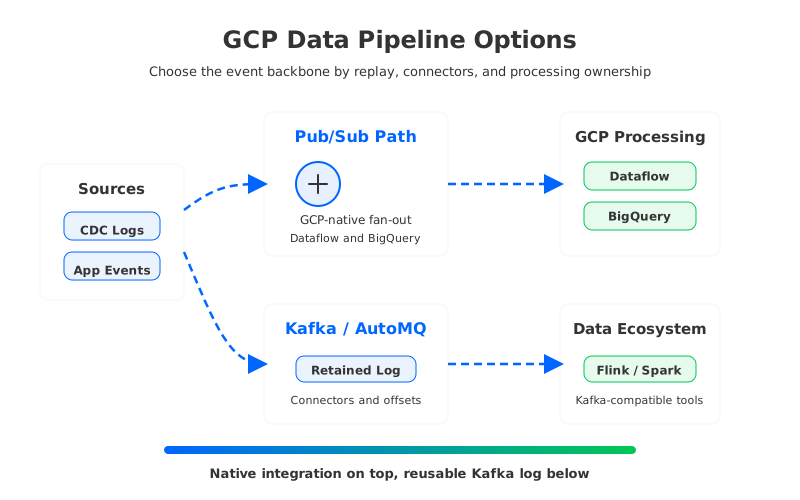
The Pub/Sub versus Kafka decision gets blurry when the workload is a data pipeline rather than application messaging. A notification event can usually be retried, acknowledged, and forgotten. A CDC stream from a production database is different: downstream consumers may need to replay a time range, rebuild a table, preserve ordering within a key, validate schemas, or feed both Flink jobs and warehouse ingestion paths. The infrastructure choice becomes a contract about history, not only a way to move messages.
That is why many Google Cloud teams end up with a mixed answer. Pub/Sub is deeply integrated with GCP services and is often the fastest route into Dataflow, BigQuery, Cloud Run, or operational eventing. Kafka brings a durable log model, offsets, a large connector ecosystem, and portability across clouds and processing engines. The right choice depends less on whether one system is more powerful and more on which system should own replay, backpressure, schema evolution, and downstream independence.
1What Data Pipelines Need From Event Infrastructure
CDC, ETL, and stream processing pipelines put pressure on message infrastructure in a way that ordinary service-to-service events often do not. A pipeline is not done when a message is delivered once. It is done when multiple downstream systems can consume the same source of change, recover from failure, and reprocess history without asking the source database to emit the same changes again.
Five requirements usually decide the architecture:
- Replay control. Data teams need to rewind a consumer, rebuild a derived table, or rerun a processor after a bug fix. The important question is not only whether replay exists, but who controls it and how long retained history remains useful.
- Connector depth. CDC and ETL depend on source and sink connectors for databases, warehouses, object stores, SaaS systems, and stream processors. A narrow connector surface can push teams into custom pipelines.
- Ordering and partitioning semantics. Pipelines often require stable ordering per entity, such as account, device, order, or primary key. The infrastructure must make the ordering boundary explicit.
- Schema handling. A pipeline needs a disciplined way to evolve payloads. Schema support is useful only when it matches the producer, consumer, and governance model.
- Backpressure behavior. When BigQuery loads slow down, a Flink job restarts, or a sink connector falls behind, the event backbone must absorb lag without hiding operational risk.
These are architectural requirements, not feature checklist items. A GCP-native eventing team may value service integration above replay depth. A data platform team that standardizes on Debezium, Kafka Connect, Flink, and Spark may value Kafka compatibility above native triggers. Both positions are rational.
2Pub/Sub for GCP-Native Data Pipelines
Pub/Sub is a strong default when the pipeline is centered on Google Cloud services. It provides a global messaging service for publishing and subscribing to events, and its operational model fits teams that want to avoid broker management. If producers are Cloud Run services, sinks are Dataflow jobs, and the analytics endpoint is BigQuery, Pub/Sub keeps the architecture close to the rest of GCP.
The strongest Pub/Sub pattern is event ingestion into managed processing. Dataflow has first-class Pub/Sub streaming support, and Google documents Dataflow pipelines that consume Pub/Sub messages for streaming workloads. Pub/Sub also supports schemas for topics, which helps teams validate message shape when they use Avro or Protocol Buffers. For application events, operational events, and GCP-native fan-out, this combination can be enough.
Where Pub/Sub becomes more nuanced is CDC. Google Cloud Datastream can stream change data from supported sources into destinations such as BigQuery or Cloud Storage, and that is often a clean path for database replication into GCP analytics. But if the requirement is a general-purpose CDC backbone that feeds many non-GCP systems, stream processors, connectors, and replaying consumers, Pub/Sub is no longer the entire answer. It can be part of the answer, especially when Dataflow owns transformation, but the architecture has to define how replay and downstream independence work.
| Pipeline need | Pub/Sub fit | Watch carefully |
|---|---|---|
| GCP service events | Strong fit because publishers and subscribers integrate naturally with Google Cloud services | Ordering keys and subscription design |
| Dataflow streaming ETL | Strong fit when Dataflow owns transforms and sink writes | Pipeline state, retry behavior, and sink throttling |
| BigQuery-centered ingestion | Good fit when the path is mostly GCP-native | Data model evolution and replay windows |
| Multi-engine CDC fan-out | Possible, but usually needs Dataflow or another bridge | Connector coverage and consumer-owned replay |
The practical rule is simple: Pub/Sub is compelling when the pipeline's center of gravity is GCP-managed processing. It becomes less direct when the event log itself must be the reusable data product.
3Kafka for CDC and Stream Processing Ecosystems
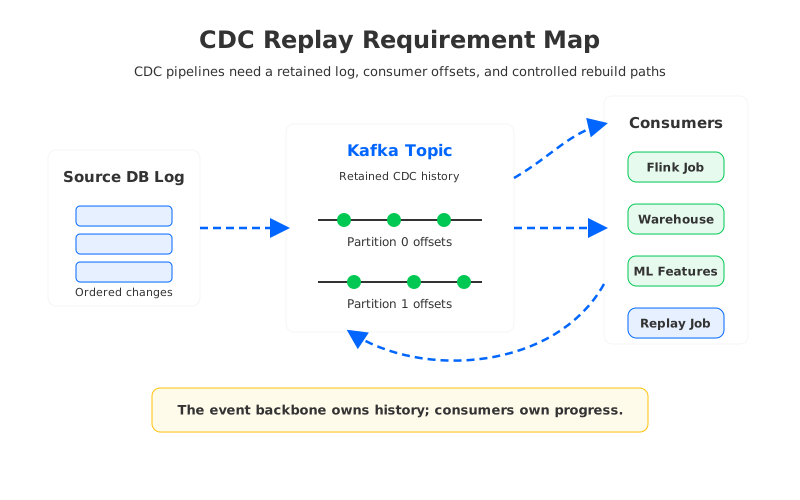
Kafka's value in data pipelines comes from treating the event stream as a retained log with explicit consumer offsets. Producers write records to topics, topics are split into partitions, and consumers decide where they are in the log. That model is why Kafka became common for CDC fan-out: the database emits changes once, while many downstream consumers read at their own pace.
The ecosystem around that log model matters. Kafka Connect defines a framework for source and sink connectors, which gives teams a standard way to move data between Kafka and external systems. Debezium uses Kafka Connect for database CDC. Apache Flink, Spark Structured Streaming, Kafka Streams, and many lakehouse ingestion tools understand Kafka as an input. Once a company standardizes on that ecosystem, Kafka is more than a queue; it becomes the compatibility layer between data capture, transformation, and serving.
Kafka also gives data platform teams direct control over replay. A consumer group can process from committed offsets, and operators can reset offsets for a group when they need to reprocess retained records. Topic retention is managed by Kafka configuration, which can be time-based, size-based, or both depending on the cluster design. This is not automatically easier than Pub/Sub replay; it is more explicit and more familiar to Kafka-centric data teams.
The tradeoff is operations. Traditional Kafka on GCP still needs brokers, disks, partitions, replication, monitoring, upgrades, and capacity planning. A long-retention CDC topic can turn storage into the dominant design concern. A high-throughput ETL backbone can make partition rebalancing and broker replacement operationally expensive. Kafka is attractive for the pipeline contract, but the classic broker-local storage model can be a poor fit for elastic cloud infrastructure.
4Connectors, Replay, Schema, and Ordering
The cleanest comparison is not "Kafka or Pub/Sub." It is a set of ownership questions. If you can answer these questions, the infrastructure choice becomes much less emotional.
| Decision area | Pub/Sub-oriented answer | Kafka-oriented answer |
|---|---|---|
| Who owns replay? | Subscription seek, snapshots, and configured retention patterns inside Pub/Sub | Consumer offsets and topic retention in Kafka |
| Who owns transforms? | Dataflow or another Beam pipeline often owns parsing, enrichment, and sink writes | Kafka Streams, Flink, Spark, Connect SMTs, or application consumers |
| Where do connectors run? | GCP-native services and Dataflow integrations | Kafka Connect workers and Kafka-compatible connector ecosystem |
| How is ordering represented? | Ordering keys with subscription-level behavior | Partition key and per-partition ordering |
| How portable is the pipeline? | Strongest inside Google Cloud | Strong across Kafka-compatible tools and clouds |
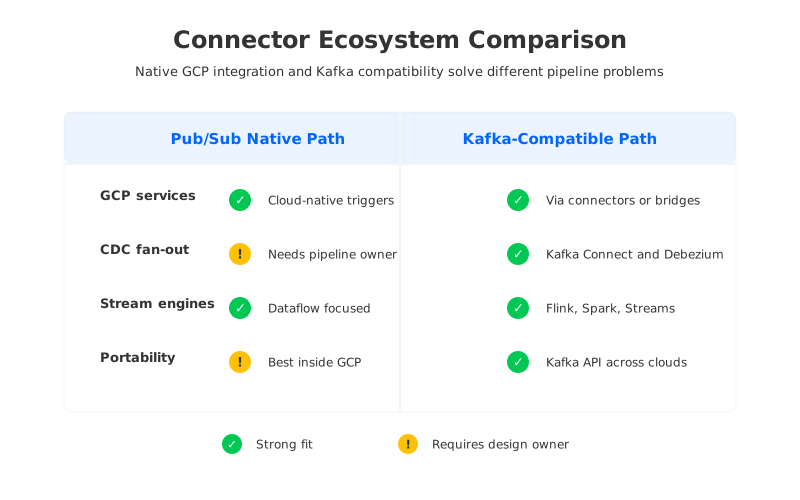
This table hides a hard truth: portability has a cost, and native integration has a cost. Pub/Sub can reduce infrastructure burden when the pipeline lives inside GCP. Kafka can reduce ecosystem friction when multiple teams, clouds, connectors, and processors need the same stream. The cost shows up in different places: managed service design on one side, cluster and storage operations on the other.
Schema handling follows the same pattern. Pub/Sub schemas are useful when you want topic-level validation for supported schema formats. Kafka teams often use schema registries and serialization conventions that span producers, consumers, and stream processors. Neither approach removes the need for governance. The question is whether schema governance should be anchored in GCP messaging or in a Kafka-centered data platform.
Ordering is another area where vague claims create bad designs. Pub/Sub ordering keys can preserve ordered delivery for messages with the same key when ordering is enabled and the application follows the required publish and subscribe behavior. Kafka preserves order within a partition, so the partition key is the ordering boundary. For CDC, the key is usually the primary key or aggregate identifier. If a pipeline needs global ordering across an entire table, neither system makes that painless at scale; the design should usually narrow the ordering requirement.
5Where AutoMQ Fits on GCP
Some teams want Kafka's data-pipeline contract on GCP but do not want to keep operating Kafka as a fleet of stateful brokers tied to local disks. This is where a Kafka-compatible cloud-native streaming layer becomes relevant. AutoMQ keeps Kafka protocol and ecosystem compatibility while moving the storage architecture toward shared object storage and stateless brokers. On GCP, that means teams can use Kafka clients, Kafka Connect, and stream-processing tools while changing the operational profile underneath the cluster.
The reason this matters for pipelines is retention and elasticity. CDC and ETL workloads often have uneven traffic: a database migration, a warehouse backfill, a month-end analytics job, or a downstream outage can create bursts of catch-up reads and retained data. In traditional Kafka, these events translate into broker disk pressure, reassignment work, and careful capacity planning. With a shared-storage architecture, the long-lived stream data is not coupled to a specific broker's local disk in the same way, so scaling compute and retaining history can be reasoned about separately.
AutoMQ should not replace Pub/Sub when the workload is a GCP-native application event path and the team is happy with Pub/Sub semantics. It becomes more interesting when the team is already choosing Kafka for CDC, Kafka Connect, Flink, or multi-cloud standardization. In that case, the decision is not Pub/Sub versus AutoMQ; it is Pub/Sub-native pipeline versus Kafka-compatible pipeline, with AutoMQ reducing the operational penalty of choosing the Kafka side.
6Choosing by Pipeline Type
For GCP data pipelines, the best architecture usually comes from naming the pipeline type before choosing infrastructure. A team building an operational event bus for Cloud Run services has a different problem from a team building a CDC backbone for Snowflake, BigQuery, Flink, and a fraud detection service.
Use Pub/Sub first when the pipeline is GCP-native, the subscribers are mostly Google Cloud services, and Dataflow or BigQuery is the main processing path. Pub/Sub will usually give the fastest operating model and the cleanest service integration. Keep the design honest by documenting replay expectations, ordering keys, dead-letter handling, and schema enforcement.
Use Kafka first when the pipeline is a reusable event log for CDC, stream processing, or multi-cloud data products. Kafka is usually the stronger fit when you need Kafka Connect, Debezium, Flink, Kafka Streams, consumer-owned offsets, and a broad ecosystem of sinks. Keep the design honest by budgeting for broker operations, storage growth, partition planning, and retention.
Use both when the organization has two legitimate centers of gravity. Pub/Sub can remain the GCP application event layer, while Kafka or a Kafka-compatible platform becomes the data pipeline backbone. Bridges should be explicit and observable. They should not be treated as invisible glue, because acknowledgments, offsets, duplicates, and replay ownership do not disappear at the boundary.
For teams that choose Kafka semantics on GCP, the next question is whether traditional Kafka operations are worth the cost for this workload. If the answer is no, evaluate Kafka-compatible systems that preserve the pipeline ecosystem while changing the storage and scaling model. AutoMQ is one option in that category, especially when long retention, bursty processing, and connector-heavy pipelines make broker-local storage feel like the wrong primitive.
The decision is not about declaring a universal winner. It is about choosing where history lives. Pub/Sub is excellent when GCP-native services should own the event path. Kafka is excellent when the stream itself must become a durable, replayable data product. When that data product needs Kafka compatibility without old-style storage operations, a cloud-native Kafka-compatible layer is the design worth testing next.
7References
- Google Cloud Pub/Sub overview
- Google Cloud Pub/Sub replay overview
- Google Cloud Pub/Sub schemas
- Dataflow: read from Kafka
- Google Cloud Managed Service for Apache Kafka overview
- Apache Kafka documentation
- AutoMQ compatibility with Apache Kafka
- AutoMQ shared storage architecture
8FAQ
8.1Is Pub/Sub better than Kafka for GCP data pipelines?
Pub/Sub is often better for GCP-native pipelines that publish from and subscribe to Google Cloud services, especially when Dataflow owns stream processing. Kafka is often better when the pipeline needs CDC fan-out, Kafka Connect, consumer-owned offsets, broad stream-processing ecosystem support, or multi-cloud portability.
8.2Can Pub/Sub replace Kafka for CDC?
It can replace Kafka for some GCP-centered CDC paths, especially when Google Cloud services such as Datastream, Dataflow, BigQuery, or Cloud Storage form the core architecture. It is less direct when the CDC stream must become a reusable event log consumed by many Kafka-compatible tools and external systems.
8.3Should a GCP team use both Pub/Sub and Kafka?
Yes, if each system owns a clear role. Pub/Sub can handle GCP application eventing, while Kafka or a Kafka-compatible platform can serve as the CDC and stream-processing backbone. The bridge between them must define ordering, duplicate handling, replay ownership, and failure recovery.
8.4Where does AutoMQ fit in this comparison?
AutoMQ fits when the team wants Kafka compatibility for CDC, ETL, and stream processing on GCP but wants a cloud-native storage and scaling model. It is not a replacement for every Pub/Sub use case; it is an option for teams that have already decided Kafka semantics and ecosystem compatibility matter.


