
Table of Contents
Table of Contents
Kafka teams usually do not start a Pulsar evaluation because they dislike the Kafka protocol. They start because something around the cluster has become too heavy: broker disks fill at the wrong time, partition reassignment drags on, cross-zone replication inflates the cloud bill, and every scaling event feels like a storage migration wearing a compute hat. Pulsar looks attractive because it separates serving from storage more explicitly and brings built-in concepts such as multi-tenancy, namespaces, and flexible subscription modes.
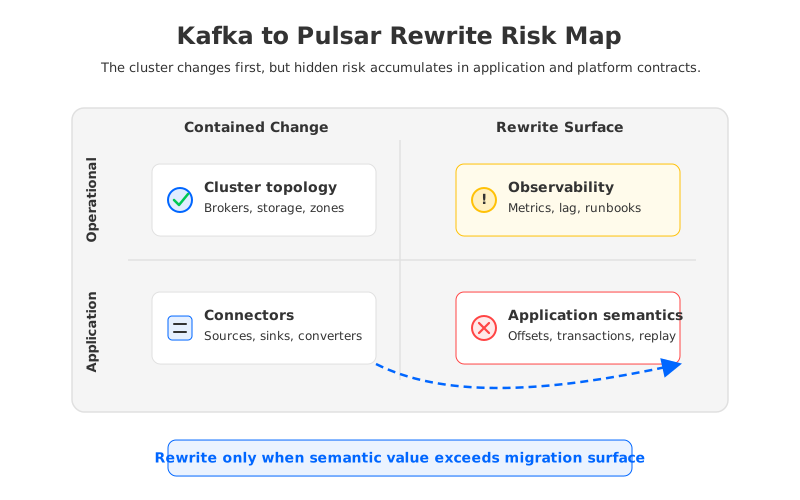
The hard question is whether that difference is worth rewriting production Kafka workloads. A Kafka estate is rarely only producers and consumers. It is clients, schemas, connectors, stream processors, ACLs, dashboards, alert rules, runbooks, replay practices, and teams that know Kafka failure modes. Moving to Pulsar may solve the right problem, but it also changes the operational and application contract.
1Why Kafka Teams Consider Pulsar
The strongest argument for Pulsar is architectural. Apache Pulsar brokers serve traffic while Apache BookKeeper stores persistent messages as ledgers, and Pulsar's managed ledger abstraction sits between topics and BookKeeper storage. That split changes how capacity, retention, and serving nodes are reasoned about compared with classic Kafka deployments that bind partition replicas to broker-local storage. For teams struggling with long retention, tenant isolation, or region-level topology, Pulsar gives them a different model rather than another Kafka distribution with a different logo.
Pulsar also has semantics that appeal to teams whose workloads do not fit neatly into Kafka's consumer group model. Pulsar supports subscription modes such as exclusive, shared, failover, and key_shared, which can make queue-like and pub-sub patterns feel more native in one system. Its tenant and namespace model can help platform teams organize many applications with separate policies. If the problem is a mismatch between Kafka semantics and the application model, Pulsar deserves a serious look.
The mistake is assuming every Kafka pain point is a Kafka API problem. Many Kafka teams are not angry at KafkaProducer, KafkaConsumer, Kafka Connect, or Kafka Streams. They are angry at data movement, over-provisioned disks, slow broker replacement, and replication costs in the cloud. Those are storage architecture problems. Replacing the API and ecosystem may be more change than the problem requires.
2What Changes When You Move From Kafka to Pulsar
The first migration surface is the client contract. Kafka's official API set spans producers, consumers, Streams, Connect, and Admin operations. That surface is why Kafka becomes embedded across application code, integration pipelines, and platform automation. Even when teams use only the producer and consumer APIs, details such as partitioning behavior, offsets, commits, transactions, headers, security configuration, and error handling become part of application expectations.
Pulsar has Kafka-facing options, but the official Pulsar adaptor documentation should make teams cautious about the phrase "Kafka compatible." The documented Kafka wrapper approach uses Pulsar-specific producer and consumer classes, such as PulsarKafkaProducer and PulsarKafkaConsumer, instead of the standard Kafka classes. That may be perfectly acceptable for controlled Java applications, but it is not the same operational promise as pointing an unchanged Kafka fleet at a new bootstrap address. Compatibility exists on a spectrum, and migration risk sits in the gaps.
The second surface is the ecosystem around Kafka:
- Connectors: Kafka Connect is not a side feature for many estates. It is the integration layer for databases, warehouses, object stores, search systems, and SaaS sinks. A migration needs to account for connector availability, connector-specific configuration, converter behavior, error topics, and operational ownership.
- Stream processing: Kafka Streams, Flink jobs that rely on Kafka offsets, ksqlDB-style applications, and custom processors all carry assumptions about topic naming, partitioning, offset commits, and replay. Replatforming a broker can become a stream-processing migration.
- Security and governance: Kafka ACLs, SASL, TLS, service accounts, quotas, audit logs, and platform approvals are often wired into internal controls. Equivalent controls must be mapped and tested, not assumed.
- Observability: Teams already alert on consumer lag, broker saturation, under-replicated partitions, connector failures, and request latency. Pulsar has its own metrics and failure modes, so the SRE runbook changes with the platform.
This is why "Kafka vs Pulsar" is the wrong first question for an existing Kafka estate. The sharper question is: which parts of Kafka are you trying to preserve, and which parts are you intentionally replacing?
3The Migration Risk Checklist
A rewrite decision should pass through gates before a team commits. The gates are less glamorous than architecture diagrams, but they are the difference between a controlled migration and a long-running platform fork.
| Migration surface | What to verify | Failure mode if skipped |
|---|---|---|
| Application clients | Producer, consumer, admin, transaction, partitioning, and commit behavior | Hidden semantic drift in business services |
| Integration layer | Kafka Connect alternatives, Pulsar IO options, custom connectors, converters, and error handling | Pipelines migrate slower than the core cluster |
| Stream processing | Kafka Streams, Flink offsets, replay, state recovery, and exactly-once assumptions | Jobs restart from the wrong position or require redesign |
| Security | Authentication, authorization, ACL mapping, secrets, certificates, and audit controls | Migration blocked by compliance or access changes |
| Observability | Metrics, dashboards, lag semantics, alert thresholds, and incident runbooks | SRE teams lose confidence during cutover |
| Rollback | Dual-write, mirroring, offset mapping, DNS/proxy strategy, and backout criteria | The team can move forward but cannot safely move back |
The table has a blunt implication: a Kafka-to-Pulsar migration is a platform program, not a broker swap. That does not make it a bad idea. It means the business case must pay for application testing, ecosystem remapping, operational retraining, and rollback design.
3.1Client and API Compatibility
Client compatibility is the gate most teams underestimate. A small set of Java applications with well-understood producer and consumer usage is one thing. A polyglot estate with Python, Go, Java, Kafka Connect, Kafka Streams, internal frameworks, and generated platform templates is another. The more Kafka has become a shared internal contract, the more expensive it becomes to replace that contract.
The work is not limited to compiling code against another library. Partition keys affect ordering. Offset behavior affects replay. Transactions affect exactly-once pipelines. Admin APIs affect automation. Security settings affect every service template. If the migration changes those assumptions, call it a rewrite and fund it like one.
3.2Connectors and Stream Processing
Connectors are where optimistic migration plans often slow down. A Kafka topic may be easy to mirror, but a production pipeline also has source connectors, sink connectors, transformations, converters, schemas, dead-letter handling, retry policy, and dashboards. Pulsar has Pulsar IO and its own ecosystem, but equivalence must be checked connector by connector.
Stream processing raises the same issue at a deeper layer. Kafka Streams applications are built around Kafka topics, state stores, changelog topics, and consumer group behavior. Flink jobs may persist Kafka offsets in checkpoints and expect those offsets to mean the same thing after migration. If offsets, topics, or partitioning semantics change, the migration plan must explain how stateful jobs resume without double-processing or gaps.
A safe migration plan does not begin with "the new platform can ingest the data." It begins with "every application can prove where it resumes."
3.3Operations and Observability
Pulsar's architecture changes the operator's mental model. Kafka operators think in brokers, partitions, replicas, leaders, ISR, disk usage, and controller behavior. Pulsar operators think in brokers, bookies, ledgers, namespaces, subscriptions, cursors, and message acknowledgements. Both systems can be operated at scale, but they do not fail in the same language.
That language matters during incidents. When consumer lag spikes, a Kafka SRE may check partition leadership, fetch latency, throttling, ISR health, or Connect task status. In Pulsar, the equivalent investigation may involve subscription backlog, dispatcher behavior, BookKeeper latency, managed ledger state, or namespace policy. The learning curve is part of the migration cost.
4When Pulsar Is a Good Fit
Pulsar is most compelling when the target state is not "Kafka with fewer disk headaches" but a broader messaging and streaming platform with Pulsar-native semantics. If a team wants multi-tenant namespaces, flexible subscription behavior, geo-replication patterns, and a broker/storage split built into the project, Pulsar can be a strong architectural fit. It can also make sense when an organization is early enough in its streaming adoption that Kafka ecosystem lock-in is still limited.
The fit becomes weaker when Kafka is already deeply embedded. A mature Kafka estate usually has hundreds of small dependencies that are invisible in a high-level architecture review. Build scripts assume Kafka clients. Platform templates assume Kafka properties. Dashboards assume Kafka metrics. Data teams assume offset-based replay. Procurement assumes a Kafka support model. None of these details individually blocks a migration, but together they create a large blast radius.
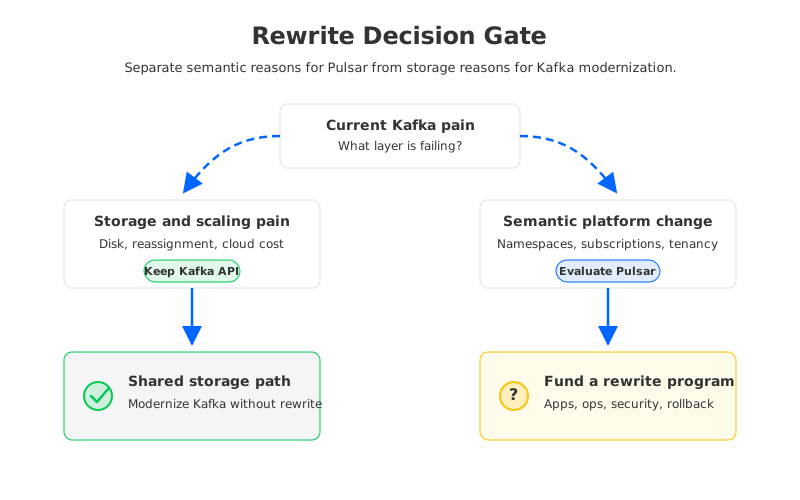
A useful rule is to separate "I need Pulsar semantics" from "I need Kafka to be less painful in the cloud." The first points toward a platform change. The second points toward a Kafka-compatible architecture upgrade.
5When Kafka-Compatible Shared Storage Is the Safer Path
If the pain comes from broker-local storage, the architectural answer does not have to be a protocol rewrite. Kafka-compatible shared storage keeps the Kafka-facing contract while changing how data is stored, scaled, and recovered underneath. The design goal is to preserve clients, topics, consumer groups, Connect jobs, and operational practices where possible, while reducing the amount of broker-local data movement that makes traditional Kafka hard to run in cloud environments.
This is where AutoMQ naturally enters the decision. AutoMQ is a Kafka-compatible cloud-native streaming platform that redesigns Kafka storage around shared object storage and stateless brokers. The point is not that every Pulsar evaluation should become an AutoMQ evaluation. The point is that many Kafka teams are trying to fix storage economics and elasticity, not abandon the Kafka ecosystem. For those teams, a Kafka-compatible shared-storage path can be a smaller organizational change with a clearer rollback story.
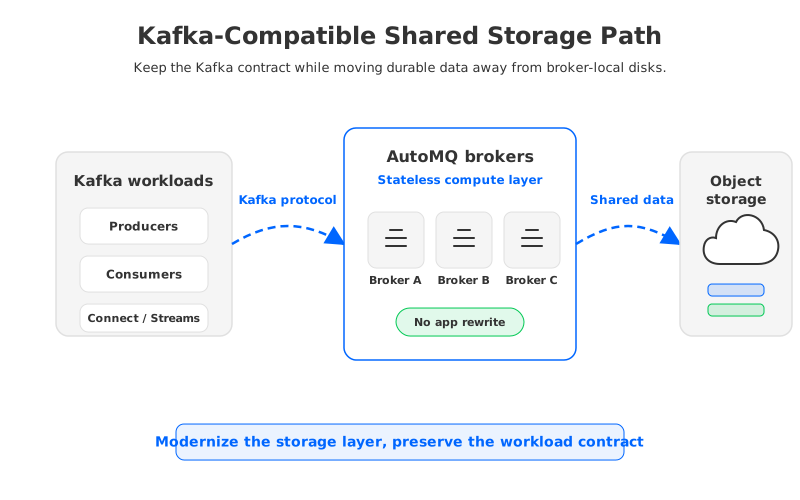
The difference shows up in migration planning. AutoMQ's migration documentation describes MirrorMaker2 for open source migrations, and its commercial Kafka Linking path is designed around byte-to-byte synchronization, consistent offsets, consumption progress synchronization, and producer cutover support. Those details target the riskiest part of a Kafka migration: keeping applications and stream processors aligned while the cluster changes underneath.
This path will not satisfy every Pulsar requirement. If you need Pulsar-native subscription modes, namespaces, or platform semantics, keeping the Kafka contract may preserve the wrong thing. But if your current applications are happy with Kafka and your infrastructure team is not happy with Kafka's storage model, rewriting to Pulsar may turn a storage problem into an application migration.
6A Practical Decision Framework
The decision becomes clearer when teams write down what they are trying to optimize. Use four questions before starting a proof of concept:
- Is the core pain semantic or operational? If Kafka's API and ecosystem are the problem, evaluate Pulsar deeply. If disk, scaling, reassignment, or cloud cost is the problem, evaluate Kafka-compatible storage modernization first.
- How much Kafka surface area do you own? Count applications, languages, connectors, stream processors, ACLs, dashboards, and automation. A large surface area makes rewrite risk compound.
- Can every stateful workload prove continuity? Producers are usually easier than consumers. The hard part is offsets, checkpoints, replay, and rollback for consumers and stream processors.
- What does rollback look like? If the target platform cannot be exited cleanly during cutover, the migration plan is not ready.
For a CTO, this is a risk allocation problem. Pulsar may create long-term architectural value, but it spends migration budget across application teams, data engineering, SRE, security, and governance. Kafka-compatible shared storage spends more of that budget in the platform layer. The right path is the one that changes the layer where the problem actually lives.
7FAQ
7.1Is Pulsar a drop-in replacement for Kafka?
Not for most production Kafka estates. Pulsar has Kafka-facing adaptor options, but official documentation still describes Pulsar-specific wrappers for Kafka producer and consumer classes. A production migration should verify client behavior, connectors, stream processing, security, observability, and rollback rather than treating Pulsar as a bootstrap-server replacement.
7.2When should a Kafka team seriously consider Pulsar?
Consider Pulsar when you want Pulsar-native capabilities, such as its broker and BookKeeper architecture, namespace and tenancy model, flexible subscription modes, or specific geo-replication patterns. It is also easier to adopt when your Kafka footprint is still small or when you are willing to redesign application and platform contracts.
7.3When is rewriting Kafka workloads to Pulsar too risky?
Risk rises when Kafka is embedded across many languages, Connect pipelines, Kafka Streams applications, Flink jobs, ACL policies, dashboards, and runbooks. In that situation, the migration is not only about data transfer. It is a cross-team change to application semantics and operations.
7.4Can Kafka-compatible shared storage avoid a Pulsar rewrite?
It can when the main pain is Kafka's cloud infrastructure model rather than Kafka's protocol or semantics. A Kafka-compatible shared-storage platform such as AutoMQ keeps Kafka clients and ecosystem tools relevant while moving durable storage away from broker-local disks. That gives teams a way to modernize Kafka architecture without rewriting every workload.
7.5What should be tested first in a Kafka-to-Pulsar proof of concept?
Start with the workloads that are hardest to roll back: stateful stream processors, connector pipelines with error handling, consumers with strict replay requirements, and security-sensitive applications. A proof of concept that only tests producer throughput will miss the migration risks that usually decide the project.
If your gate points toward keeping Kafka compatibility while fixing storage, review the AutoMQ migration overview and compare that scope with a full Kafka-to-Pulsar rewrite plan. The useful next step is a proof of concept that tests the layer where your risk actually sits.
8References
- Apache Kafka documentation: APIs
- Apache Kafka documentation: MirrorMaker configs
- Apache Kafka documentation: Security
- Apache Pulsar documentation: Pulsar adaptor for Apache Kafka
- Apache Pulsar documentation: Architecture overview
- Apache Pulsar documentation: Messaging concepts
- AutoMQ documentation: Technical advantages
- AutoMQ documentation: Migration overview
- AutoMQ documentation: Kafka Linking overview


