
Table of Contents
Table of Contents
Most Kafka write-throughput plans start with a familiar question: how many brokers do we need? That question is useful, but it is too narrow for cloud production. Broker count tells you how much compute and local capacity you have provisioned. It does not tell you how much of the write path is being paid for again as replication traffic, block storage, cross-zone transfer, rebalancing time, or operational risk.
The difference matters when Kafka becomes shared infrastructure. A single product team can overprovision a cluster and move on. A platform team serving payments, telemetry, data lake ingestion, and AI feature pipelines has to explain why throughput growth turns into multiple cloud bill lines. The write path is a capacity model, a cost model, and a failure-recovery model at the same time.
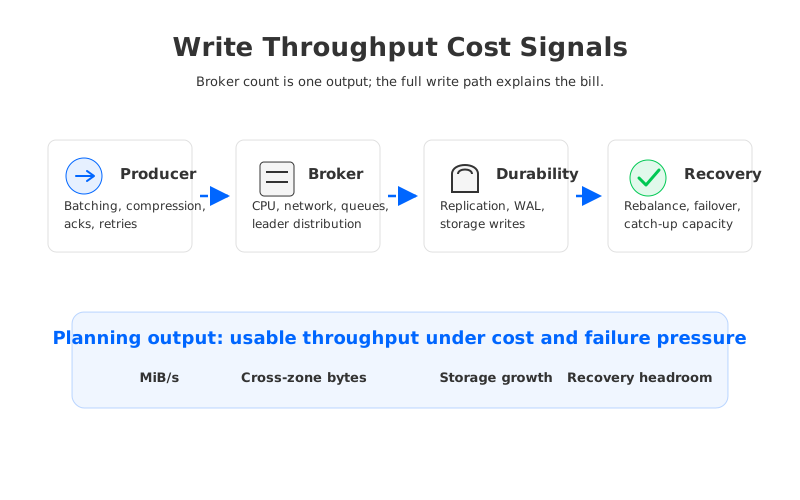
Kafka write throughput planning should therefore begin with cost signals rather than broker arithmetic. The right planning unit is not "brokers per MiB/s." It is the full path from producer batching to broker admission, replication, durable storage, leader distribution, consumer replay, and recovery after the system loses a node or zone.
1Why teams search for kafka write throughput planning
The search intent usually appears after the first production surprise. Producers have been tuned with better batching and compression. Partitions have been increased. The broker fleet has been scaled. Yet the cluster still hits a constraint that cannot be solved by adding the next instance type. Sometimes the bottleneck is network throughput. Sometimes it is disk flush behavior. Sometimes it is the cost of moving the same write across zones before the event can be considered durable.
Apache Kafka's producer configuration gives teams levers such as acks, batch.size, linger.ms, compression.type, and max.in.flight.requests.per.connection. Those settings shape throughput and latency, but they do not erase the infrastructure path underneath them. Larger compressed batches may reduce request overhead, while the cluster still has to replicate accepted records, write them durably, update metadata, and keep headroom for retries and leader changes.
That is why a write-throughput plan needs two layers. The client layer answers whether producers can generate efficient requests. The platform layer answers whether the cluster can absorb those requests without turning normal growth into a storage or network project. Treating these layers separately helps teams avoid a common trap: optimizing producers until the broker side becomes harder to operate.
2The production constraint behind write throughput
In broker-local Kafka, writes are not counted once. A record accepted by the leader is replicated to followers according to the topic's replication and acknowledgement settings. In a multi-AZ cloud deployment, that replication supports availability, but it also couples write throughput to east-west network traffic and local broker storage. A planning spreadsheet that counts producer traffic without modeling replication and recovery misses the cost center that usually grows fastest.
The constraint becomes more visible during scaling and failure handling. If a broker is added, partition leadership and replica placement may need rebalancing before the cluster benefits from the extra capacity. If a broker fails, replacement capacity has to catch up with partition data and ISR health. If a hot topic grows, the team may have to repartition, rebalance clients, or move leaders around storage that already exists on specific brokers.
The important point is not that broker-local Kafka is flawed. It is that the architecture bundles several decisions together:
- Write admission and compute. Brokers need enough CPU, memory, page cache, and network capacity to accept producer traffic and serve replication traffic at the same time.
- Durability and local storage. The same broker fleet that handles writes also owns durable log segments, so retention and throughput compete for disk planning attention.
- Availability and cross-zone movement. Replication can protect availability, but the replicated bytes may cross availability-zone boundaries before the platform can consider the write safe.
- Recovery and operational windows. Scaling events, broker replacement, and partition movement consume capacity that would otherwise serve business traffic.
Those signals turn engineering choices into recurring spend. They also show how background movement can reduce producer headroom during a surge.
3Architecture options and trade-offs
Most teams compare three broad approaches when write throughput starts dominating the plan: broker-local Kafka, Kafka with Tiered Storage, and Kafka-compatible shared storage. The names are easy to blur together, but their operating models are different.
| Planning model | What improves | What still needs proof |
|---|---|---|
| Broker-local Kafka | Familiar semantics, mature tools, direct local I/O, and a clear replica model. | Cross-zone replication cost, disk growth, broker replacement time, partition movement, and hot leader distribution. |
| Kafka with Tiered Storage | Retention pressure can move away from broker disks by offloading older segments to remote storage. | Hot write path sizing, local tier capacity, remote-read behavior, metadata load, and tiering maturity for the workload. |
| Kafka-compatible Shared Storage | Durable stream data can live below the broker fleet, allowing compute and storage to scale more independently. | Write-ahead log behavior, object storage access, cache efficiency, producer latency, migration process, and observability coverage. |
Tiered Storage is an important step because it reduces the amount of older data that must remain on broker-local disks. Apache Kafka's Tiered Storage work describes this as a way to move log segments to remote storage while preserving Kafka's core log abstraction. For write-throughput planning, though, it is not the same as making the broker fleet stateless. The hot path still needs enough local capacity and coordination to handle active writes, replication, and immediate reads.
Shared storage changes a different part of the model. Instead of asking each broker to remain the durable home for its partition data, the broker becomes more of a serving and coordination layer above a storage system built for cloud durability. That can reduce data movement during scale events, but it shifts evaluation toward the WAL, cache, storage backend, and metadata behavior.
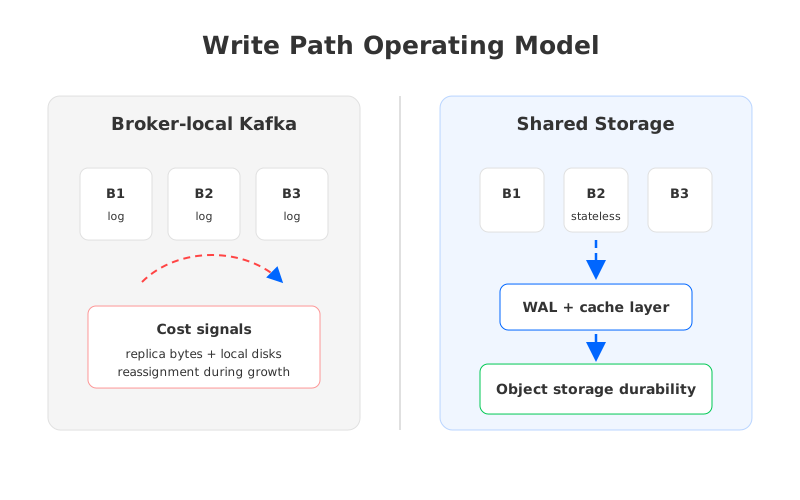
The conclusion is practical: do not plan write throughput from a benchmark alone. A benchmark validates a specific configuration. A production plan has to explain what happens when traffic is uneven, a zone has issues, retention grows, producers retry, and the team needs capacity during the incident.
4Evaluation checklist for platform teams
A useful throughput plan combines producer settings, cluster topology, cloud pricing, and operational controls. The checklist below is intentionally concrete because vague capacity language hides the hard work.
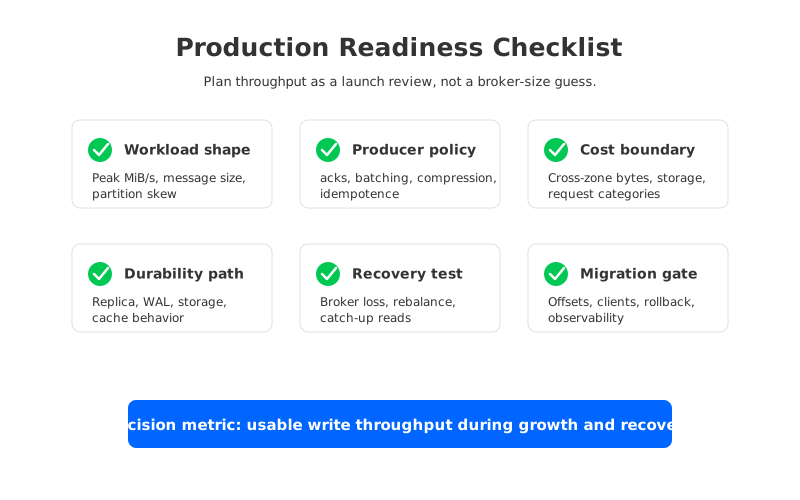
Start with the workload shape. Measure sustained and peak write throughput, message size distribution, compression ratio, key distribution, partition count, and producer retry behavior. The same MiB/s can mean very different broker pressure depending on whether it arrives as many small messages, a few large batches, or a hot keyed stream.
Then separate the write path into four budget lines:
- Producer-side efficiency. Batching, linger, compression, idempotence, and acknowledgement settings determine how many requests the platform must process for the same business volume.
- Broker-side admission. CPU, network, memory, page cache, and request queues determine whether the cluster can absorb traffic without increasing tail latency.
- Durability path. Replica placement, WAL behavior, storage medium, fsync policy, and object storage access determine how quickly accepted records become recoverable.
- Background operations. Reassignment, catch-up reads, broker replacement, leader balancing, and monitoring pipelines determine whether growth steals capacity from production writes.
The next step is to model cloud boundaries. Availability zones are not an implementation detail in a Kafka cost plan. Producer placement, broker placement, follower replication, and consumer placement all influence how many bytes cross a priced boundary. AWS documents Availability Zones as distinct locations within a Region, and cloud pricing pages separate storage, requests, and data transfer into different categories. A Kafka plan that ignores those boundaries can pass a load test and still surprise finance later.
Finally, define a failure budget for throughput. If the cluster is planned for a nominal peak, ask what percentage remains available while one broker is being replaced, one rack is degraded, or a large topic is being rebalanced. A write path that looks efficient at steady state may become fragile when recovery traffic competes with producers.
5How AutoMQ changes the operating model
Once the evaluation has separated compute, durability, storage, and recovery, AutoMQ becomes relevant as an architecture category rather than a late-stage product pitch. AutoMQ is a Kafka-compatible streaming system that uses a Shared Storage architecture: brokers remain compatible with Apache Kafka clients, while S3Stream and a WAL-based storage layer move durable stream data away from broker-local disks.
That distinction changes the write-throughput planning conversation. Instead of adding brokers because storage and compute are fused together, teams can evaluate broker capacity as serving capacity and shared storage as the durable data layer. AutoMQ's documentation describes stateless brokers, S3-backed stream storage, and Kafka protocol compatibility as core parts of this model. For write-heavy workloads, the planning question becomes whether the WAL, cache, object storage, and network placement match the workload's latency and durability requirements.
This is also where cost signals become easier to reason about. Traditional Kafka often scales the same unit for several reasons: more write throughput, more retention, more recovery headroom, or more local disk. A shared-storage architecture can let those reasons be planned separately. Compute can follow producer and consumer pressure. Object storage can absorb retention growth. Recovery can focus on reattaching serving capacity to durable data instead of copying large volumes of partition data between brokers.
AutoMQ also matters for cross-AZ planning. Its documentation describes inter-zone traffic reduction by using S3-based storage architecture and zone-aware routing. That does not remove the need to design producer and consumer placement carefully, but it gives platform teams a different cost-control surface than broker-local replication alone. The team can evaluate where data is written, where it is durably stored, and how clients read it without assuming every durability decision must be paid for as broker-to-broker movement.
The migration implication is equally important. A write-throughput platform cannot be replaced with a whiteboard diagram. Teams need compatibility testing, mirrored traffic where appropriate, consumer offset validation, rollback criteria, and observability that compares producer latency, broker saturation, error rates, consumer lag, and cost before and after cutover. AutoMQ's Kafka compatibility and migration documentation are useful inputs, but production teams should still test their own client versions, security controls, and workload peaks.
6A practical planning sequence
The cleanest way to run a Kafka write-throughput planning exercise is to make every assumption testable. Start with one representative workload, then expand after the model survives real data.
- Baseline the current write path. Capture producer throughput, request rate, p50 and p99 produce latency, broker network in and out, disk write rate, replication traffic, ISR changes, and reassignments during peak windows.
- Normalize by business volume. Convert the results into cost per GiB written, cost per million records, or cost per workload tier. This makes storage and network effects visible to non-Kafka stakeholders.
- Stress the recovery path. Repeat the model while a broker is replaced, a topic is rebalanced, or a consumer group is catching up. The useful number is not steady-state throughput; it is usable throughput under maintenance pressure.
- Compare architecture families. Test broker-local, tiered-storage, and shared-storage options against the same producer profile, retention policy, security boundary, and failure scenario.
- Document the migration boundary. Identify which topics move first, which remain where they are, which clients need configuration changes, and what signal causes rollback.
This sequence keeps the discussion grounded. It also prevents the team from treating write throughput as one metric owned by one group. Producers, SREs, FinOps, security, and application owners all influence the path from event creation to durable recovery.
7The cost signals to watch after launch
Planning does not end at go-live. Kafka clusters drift because workloads drift. A topic that starts as a small integration stream can become a replay source for analytics. A producer that starts with good batching can change when a service team adds headers, retries, or a different serializer. A retention policy that was reasonable for incident replay can become expensive when every topic inherits it by default.
The post-launch dashboard should therefore include both Kafka metrics and cloud-cost proxies. Track broker network egress by zone, disk or WAL write pressure, object storage request patterns, producer error rates, produce latency, partition skew, leader movement, consumer lag during backfills, and the cost categories that map to those behaviors. The goal is to catch the moment when write growth changes shape.
For many teams, the most useful governance move is a throughput review before topic creation or major producer changes. It can ask a few questions: expected peak MiB/s, message size, partition key, retention, replay needs, zone placement, and owner. Those answers prevent the platform from absorbing every workload as if it had the same write profile.
When write throughput is planned this way, broker count becomes the output of the model rather than the model itself. The team can still provision brokers, tune producers, and run benchmarks, but those actions sit inside a broader explanation of cost, durability, and operations.
If you are evaluating whether a Kafka-compatible shared-storage model fits your next write-heavy workload, start with AutoMQ's architecture overview and run it against your own throughput, retention, and cross-zone cost assumptions: Explore AutoMQ's Shared Storage architecture.
8References
- Apache Kafka Producer Configurations
- Apache Kafka Design Documentation
- Apache Kafka Tiered Storage Documentation
- AWS Availability Zones documentation
- AWS S3 user guide
- AWS S3 pricing
- AutoMQ Architecture Overview
- AutoMQ Kafka Compatibility
- AutoMQ Inter-Zone Traffic Overview
- AutoMQ and Kafka Tiered Storage Differences
9FAQ
9.1Is broker count still useful for Kafka write throughput planning?
Yes. Broker count is a useful capacity output, but it should not be the first planning model. A strong plan also accounts for producer efficiency, replication traffic, durable storage, cross-zone movement, recovery headroom, and operational work such as partition reassignment.
9.2How is Tiered Storage different from shared storage for write-heavy Kafka?
Tiered Storage can move older log segments to remote storage, which helps with retention pressure. Shared storage changes more of the operating model by placing durable stream data below the broker fleet, so compute and storage can be evaluated more independently. Both approaches still need workload-specific latency, recovery, and observability testing.
9.3Which producer settings matter most for throughput planning?
The most common settings to review are acks, batch.size, linger.ms, compression.type, enable.idempotence, and max.in.flight.requests.per.connection. They influence request efficiency, durability expectations, retry behavior, and ordering guarantees. The right values depend on the application's latency tolerance and data-loss tolerance.
9.4Where does AutoMQ fit in a Kafka write-throughput plan?
AutoMQ fits when the platform team wants Kafka API compatibility while reducing the operational coupling between brokers and durable stream storage. Its Shared Storage architecture is most relevant when throughput growth, retention growth, and cross-zone traffic make broker-local planning hard to explain or hard to control.


