
Table of Contents
Table of Contents
"Zero downtime" is one of the most dangerous phrases in a Kafka migration plan. It sounds like a tool capability, but in production it is a contract across producers, consumers, connectors, schemas, offsets, observability, and rollback. A replication job can copy records while the old cluster is still running. That is useful. It does not prove that every consumer can resume at the right position, every producer can tolerate the route change, and every downstream system can survive duplicate or reordered events.
The right question is not whether a Kafka cluster migration can be performed with no visible outage. Many teams do it. The right question is what your organization means by downtime. Is it a failed produce request, a consumer pause, duplicate delivery, delayed downstream processing, missing records after cutover, or a rollback that takes longer than the business can tolerate? Until those definitions are explicit, "no downtime" is mostly optimism with a project plan attached.
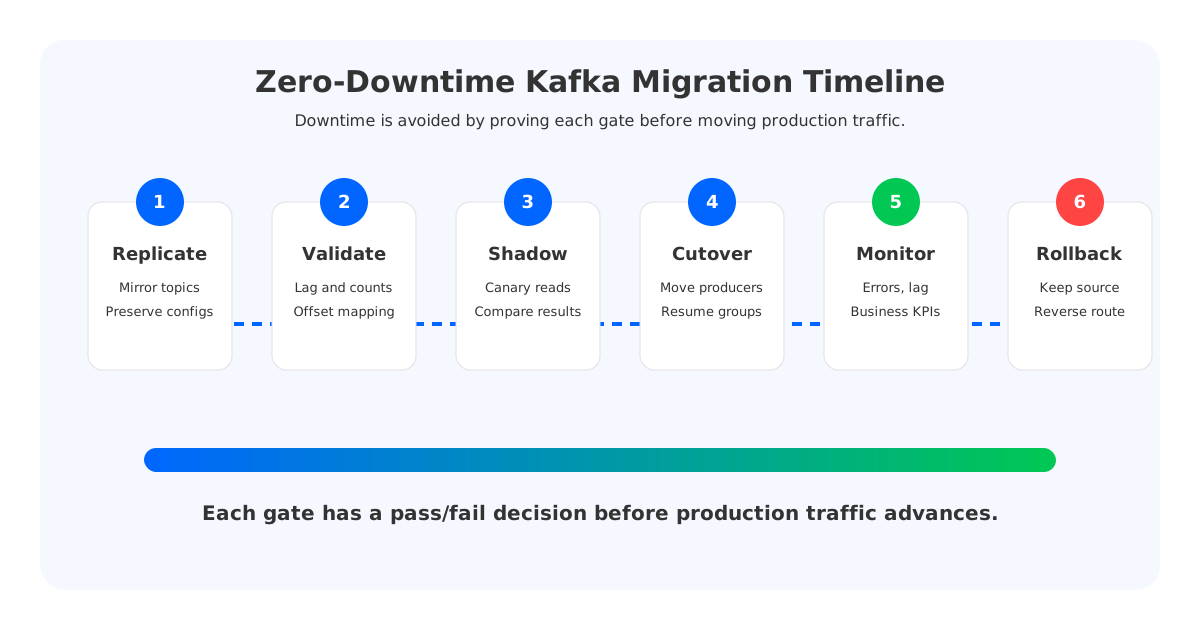
A credible Kafka zero-downtime migration separates the project into gates. First, replicate data. Then validate topic configuration, record flow, and consumer progress. Then run canary or shadow consumers against the target cluster. Only after those gates pass should producers and consumers move in controlled waves. The source cluster should remain available until the team has enough production evidence that the target is healthy and rollback is still possible.
1Define Zero Downtime Before Choosing a Tool
Kafka makes migration subtle because availability, durability, and processing correctness are different promises. A producer may receive successful acknowledgments while a consumer group is still lagging. A consumer may resume from a translated offset while the application produces duplicate side effects. A connector may write correctly while its schema registry, dead-letter queue, or external sink still points to the old environment.
Before selecting MirrorMaker 2, a managed replication service, a vendor linking feature, or a custom migration pipeline, define the four terms that usually get blurred:
- Downtime: the externally visible interruption you are trying to avoid. For some teams this means no failed writes; for others it means no pause in downstream business processing.
- Data loss: acknowledged records that cannot be recovered at the target recovery point. This must be measured by topic and partition, not by aggregate throughput.
- Duplicate delivery: records processed more than once by a consumer or downstream system. Kafka's at-least-once patterns make this a normal risk unless applications are idempotent.
- Ordering guarantee: the scope in which ordering must hold. Kafka orders records within a partition, but migrations can disturb assumptions when producers, partition counts, or topic mappings change.
These definitions turn a vague migration objective into testable engineering work. A payment authorization stream may require no acknowledged record loss, strict partition ordering, and carefully controlled duplicate handling. A metrics pipeline may accept a short consumer delay and tolerate replays. Both workloads can be called "Kafka," but they should not share the same cutover policy.
2The Live Replication Architecture
A zero-downtime migration almost always starts with a period where source and target clusters run at the same time. The source remains the system of record while a replication mechanism copies topics into the target. That mechanism may be Apache Kafka MirrorMaker 2, a cloud-provider replication feature, Confluent Cluster Linking, AutoMQ Kafka Linking in supported commercial migration paths, or another tool that fits the source and target platforms. The tool matters, but the architecture around it matters more.
A practical live replication design tracks several surfaces at once:
| Surface | What to validate | Why it matters |
|---|---|---|
| Topic configuration | Partitions, retention, compaction, cleanup policy, min ISR, compression | A topic that exists is not necessarily equivalent |
| Security | TLS, SASL, ACLs, certificates, service accounts | Client cutover fails fast when auth is incomplete |
| Record flow | Per-partition lag, bytes, message counts, timestamp skew | Aggregate lag can hide one stuck hot partition |
| Consumer progress | Source commits, checkpoint topics, translated target positions | Consumers must resume where the business expects |
| Ecosystem dependencies | Schema registry, Connect, Streams state, monitoring, alert routing | Kafka is rarely the only moving part |
The safest migrations make the target cluster boring before it becomes critical. Create the topics. Apply security. Mirror representative traffic. Run canary consumers that read but do not produce side effects. Compare counts, payload shape, timestamps, application-level checksums where available, and downstream behavior. Low replication lag is comforting, but it is not a complete migration test.
3Offset, Consumer, and Producer Cutover Risks
Consumer offsets are where many Kafka migrations get their surprise bill. Offsets are not global record identifiers; they are positions inside partitions for a given topic. If the target topic has different partitioning, a different record set, a different start point, or a replication tool that maps offsets through checkpoints, then "resume from the same offset" may be wrong or impossible. Even when offset translation is supported, the team still has to validate that the translated position matches the intended recovery point.
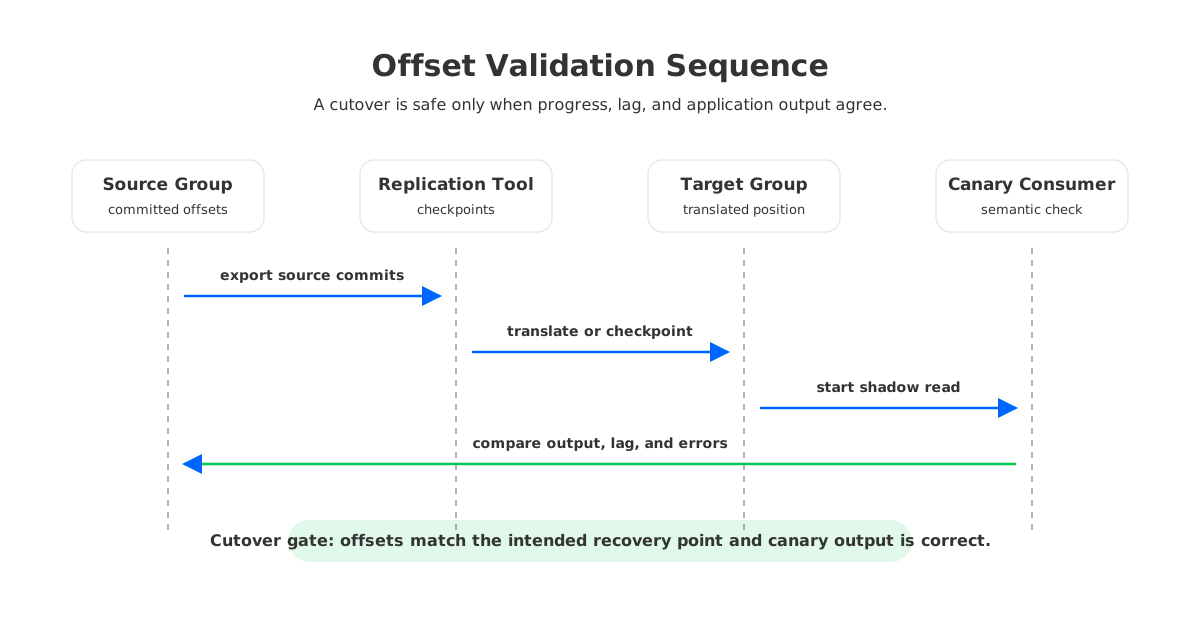
Consumer groups also have behavior beyond the offset number. Rebalancing, static membership, long processing loops, batch commits, transactional reads, retry topics, and dead-letter queues all affect cutover. A group that commits every few seconds is different from one that commits after external writes complete. If the latter moves at the wrong moment, it may replay a large unit of work or skip work that was only partially completed outside Kafka.
Producer cutover has its own traps. Idempotent producers, transactions, partition keys, batching, retry configuration, DNS caching, bootstrap server refresh, and client library versions all influence what happens when the write path moves. A blue/green endpoint switch looks clean on an architecture diagram, but clients are not identical. Some services keep long-lived connections. Some embed bootstrap servers in configuration that ships slowly. Some have retry behavior that can write to the old and target clusters during a partial deployment.
The production runbook should therefore define the order of movement:
- Move low-risk producers first, preferably those with idempotent downstream semantics and clear owners.
- Freeze configuration changes that would change partitioning, schemas, or routing during the migration window.
- Move consumers only after their target offsets and application outputs have been validated.
- Keep a clear boundary between read-only shadow consumers and consumers that create external side effects.
- Record the exact moment when each producer domain changes write ownership.
This level of detail can feel heavy, but it is lighter than discovering after cutover that one service wrote to both clusters for twenty minutes while another consumer resumed from the beginning of a compacted topic.
4Connector and Schema Migration Risks
Kafka Connect is often treated as a side task because connectors are "outside" the brokers. In real migrations, connectors frequently carry the most business risk. A JDBC sink, Elasticsearch sink, CDC source, object-storage sink, or custom connector may maintain its own offsets, task state, schemas, retry queues, and external write semantics. Moving the Kafka cluster without understanding those states can create duplicates in a database, gaps in a warehouse, or a CDC stream that appears healthy while its source position is wrong.
Schema migration deserves similar discipline. If producers and consumers use Avro, Protobuf, or JSON Schema with a registry, the migration plan must account for registry compatibility, subject naming strategy, access control, and schema ID behavior. The target Kafka cluster can be healthy while a consumer fails because it cannot resolve a schema or because a connector points at the wrong registry endpoint. That failure may not appear in broker metrics until consumer lag starts to grow.
For connector-heavy estates, the migration checklist should include a separate connector rehearsal:
| Dependency | Rehearsal question |
|---|---|
| Source connectors | Can the connector restart from the intended source position without duplicating a large historical range? |
| Sink connectors | Are writes idempotent, or will replay create duplicate rows, files, or documents? |
| DLQ topics | Are dead-letter queues mirrored, retained, and monitored on the target cluster? |
| Schema registry | Do all migrated clients resolve schemas through the target path? |
| Monitoring | Do connector task failures alert the new on-call path during the rehearsal? |
The pattern is simple: anything that owns progress needs its own validation gate. Kafka offsets are only one kind of progress marker. Connectors, stream processors, state stores, databases, and downstream APIs may all have independent notions of "already processed."
5Cutover Patterns and Where They Hide Risk
There is no universal cutover pattern for Kafka migration. Blue/green works well when clients can switch endpoints in a coordinated way and rollback is still available. Dual write can reduce dependence on replication lag, but it pushes consistency into the application and often creates duplicate or divergent data unless the business domain is designed for it. Phased topic cutover is slower, yet it usually gives platform teams the best control over blast radius.
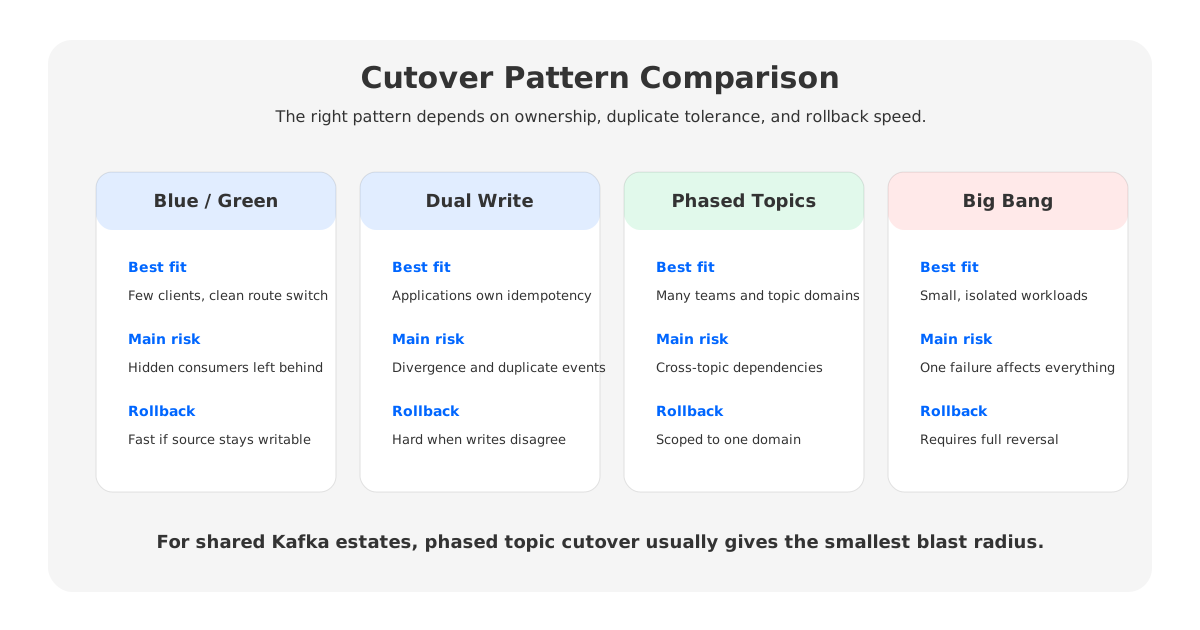
The most common patterns look like this:
| Pattern | Use when | Risk to manage |
|---|---|---|
| Blue/green cluster switch | The workload has a small number of clients and clear routing control | Hidden clients continue reading or writing the old cluster |
| Dual write | The application already handles idempotency and divergence checks | Source and target become inconsistent under partial failures |
| Phased topic or domain cutover | Many teams share the Kafka estate | Cross-topic dependencies are discovered late |
| Shadow consumers | You need target validation before side effects | Shadow results may look correct while external writes are untested |
| Big bang migration | The workload is small, isolated, and easy to reverse | One mistake affects the entire estate |
For shared Kafka platforms, phased topic cutover is usually the adult choice. It is not glamorous. It requires inventory, owner coordination, dependency mapping, and repeated rehearsals. But it also gives the migration team a way to learn from a low-risk domain before touching a critical one. A project that cannot safely move one topic family is not ready to move the entire cluster.
6Rollback Design and Validation Gates
Rollback is not the opposite of cutover. It is a separate design. If producers have written to the target cluster for an hour, rolling back may require replaying target-only records into the source, accepting data loss, or declaring the source read-only while consumers drain the target. The right answer depends on whether the source stayed writable, whether bidirectional replication exists, whether duplicate writes are acceptable, and whether the business can tolerate a temporary split-brain period.
Good rollback plans define objective triggers. Examples include sustained produce error rate above a threshold, consumer lag that does not recover, schema resolution failures, connector task failures, elevated end-to-end latency, missing business events, or downstream error budgets being consumed too quickly. The runbook should also define who has authority to call rollback. In a tense migration window, unclear ownership costs more time than the technical command itself.
A pre-production rehearsal should prove these gates before the real event:
- Replication catches up for representative high-volume and compacted topics.
- Target consumers start from the intended recovery point.
- Canary consumers produce the same business result as source consumers.
- Producers can switch endpoints and recover from connection churn.
- Connectors and schema registry dependencies work through the target path.
- Observability dashboards show source, replication, target, and downstream health in one place.
- Rollback has been exercised, not only documented.
This is where the phrase "zero downtime" earns or loses credibility. It is credible when every gate has evidence. It is not credible when the team relies on a tool name, a vendor promise, or a single replication-lag chart.
7How AutoMQ Fits as a Migration Target
After the migration mechanics are clear, the target architecture deserves scrutiny. Moving from one Kafka-compatible cluster to another should not require application teams to relearn the event model. The hard work should stay in replication, offset validation, cutover sequencing, and operational proof, not in rewriting every producer and consumer around a different API.
AutoMQ fits this category as a Kafka-compatible, object-storage-backed streaming system with stateless broker architecture. That positioning matters for migration planning because it keeps the Kafka protocol and ecosystem expectations familiar while changing the infrastructure layer that often creates long-term pain: broker-attached durable data, slow scaling, and heavy data movement during capacity changes. It does not remove the need for a careful zero-downtime design. It changes what the team is migrating toward after the cutover succeeds.
For teams evaluating AutoMQ as a target, the proof-of-concept should still use the same migration rigor:
- Validate client compatibility with real producer and consumer versions, not only a sample client.
- Test the chosen migration path, such as MirrorMaker 2 or supported AutoMQ Kafka Linking, against the exact source cluster, authentication mode, and networking path.
- Verify offset behavior for stateful consumers and long-running consumer groups.
- Include connector, schema, ACL, and monitoring parity in the acceptance criteria.
- Measure post-cutover operations such as scaling, broker replacement, and recovery, because those are often the reasons for migrating in the first place.
The healthiest framing is practical: Kafka compatibility reduces application migration pressure, but it does not make production migration automatic. A platform team still needs a staged plan, validation gates, and a rollback path. That discipline is what lets a migration improve the architecture without turning the cutover into an outage story.
8References
- Apache Kafka Consumer configuration
- Apache Kafka MirrorMaker 2 documentation
- Confluent Cluster Linking documentation
- Confluent Cluster Linking offset sync behavior
- AutoMQ migration overview
- AutoMQ Cloud Kafka Linking overview
9FAQ
9.1Can Kafka migration really be zero downtime?
Yes, but only when "zero downtime" is defined and validated for the workload. A migration may avoid visible application outage while still allowing brief consumer lag, duplicate processing, or controlled replays. Critical systems should define downtime, data loss, duplicate tolerance, ordering scope, and rollback criteria before choosing a migration tool.
9.2Is MirrorMaker 2 enough for a zero-downtime Kafka migration?
MirrorMaker 2 can be part of the answer because it replicates topics and supports migration-related flows, but it is not the whole migration plan. Teams still need to validate topic configuration, offset behavior, client routing, schemas, connectors, monitoring, and rollback. Managed replication or linking tools have the same requirement: the tool moves data, while the migration design proves correctness.
9.3How should consumer offsets be handled during Kafka cluster migration?
Treat offsets as a validation target, not a file to copy blindly. Check the source group's committed position, the replication tool's checkpoint or offset translation behavior, target topic contents, and canary consumer output. The correct position is the one that preserves business processing semantics for that workload.
9.4What is the safest Kafka cutover strategy?
For shared production estates, phased topic or domain cutover is usually safest because it limits blast radius and lets the platform team learn before moving critical traffic. Blue/green can work for smaller workloads with strong routing control. Dual write should be used carefully because it moves consistency risk into the application.
9.5Where does AutoMQ help in Kafka migration planning?
AutoMQ helps when the goal is to keep Kafka-compatible APIs while moving toward a cloud-native architecture with stateless brokers and object-storage-backed durability. That can reduce post-migration scaling and data-movement pain, but the migration itself still needs replication, offset validation, staged cutover, and rollback proof.


