
Table of Contents
Table of Contents
KIP-1150 changes the Kafka roadmap conversation from "can Kafka use object storage?" to "which topics should move first, and when?" That timing question is harder than the architecture headline. The Apache Kafka KIP page lists KIP-1150 as accepted, and its direction is clear: diskless topics should reduce the dependence on broker-local disks for user data and give operators a per-topic cost and latency trade-off. Acceptance, however, is not the same as a completed production rollout plan for every Kafka estate.
Platform teams need a decision model that sits between two weak extremes. One extreme waits for every upstream detail, managed-service implementation, and runbook to be fully mature before doing any analysis. The other treats "accepted KIP" as a migration trigger and starts redesigning topic estates before the operational evidence exists. The useful middle ground is to classify workloads now, quantify the cost and recovery pressure, and decide which topic classes should be first in line when a diskless or shared-storage implementation is ready for your environment.
1Why Teams Search for KIP-1150
Most searches for KIP-1150 are not academic. A Kafka platform owner usually arrives there after seeing the same pressure from several directions: broker disks are expensive to size for retention, cross-zone replication is difficult to ignore in cloud bills, and recovery operations become slower as retained data grows. Tiered storage already helps with historical segments, but it does not remove the active-log replication model that drives much of the multi-AZ operating cost.
KIP-1150 responds to that problem by introducing diskless topics as a separate topic type. The important word is "topic." The KIP does not argue that every Kafka workload should abandon the classic log model. It explicitly keeps classic topics because some use cases still need the lowest latency profile and the established operational model. Diskless topics are meant to give operators another placement option for workloads where durable retention, elasticity, and cloud cost structure matter more than squeezing every millisecond from the active write path.
That distinction turns the search into a migration timing question. A CTO may read KIP-1150 as a strategic sign that object-storage-backed streaming is becoming mainstream. An SRE may read the same page as a warning that the failure and recovery model will change. A FinOps team may care less about the internal design and more about whether the architecture can remove recurring cross-AZ data movement. These are all valid readings, but they lead to different next steps.
2The Migration Clock Has Three Hands
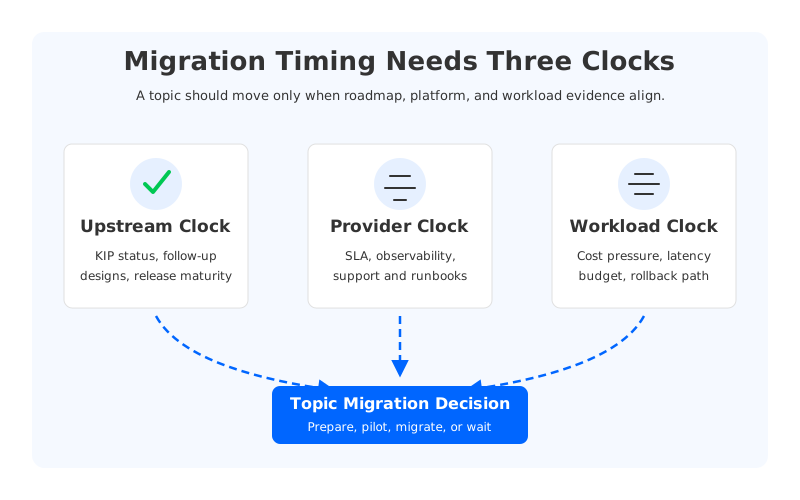
Timing a migration around KIP-1150 requires three clocks, not one. The first is the upstream Kafka clock: which KIPs are accepted, which follow-up designs define the actual behavior, and which Kafka versions expose production-ready functionality. The second is the provider clock: when your managed Kafka service, self-managed distribution, or Kafka-compatible platform supports the storage model with the SLAs, observability, and failure handling you need. The third is your workload clock: when a specific topic class has enough cost pressure and enough tolerance for the changed latency or recovery profile to justify movement.
Those clocks rarely align perfectly. A feature can be directionally validated by the community before it is packaged in the exact product you operate. A provider can expose an implementation before your governance, test data, and rollback plan are ready. A workload can become economically painful before the platform team has decided whether to use upstream Apache Kafka, a managed service, or a Kafka-compatible shared-storage system.
The practical answer is to separate "prepare now" from "migrate now":
- Prepare now when the architecture direction changes procurement, capacity planning, or topic classification. KIP-1150 already does that because it formalizes diskless topics as a Kafka community direction.
- Pilot now when the candidate implementation supports your required Kafka semantics, failure tests, and observability in a non-critical workload class.
- Migrate now when the workload has a clear economic or operational driver, a measured latency budget, a rollback path, and an owner who accepts the revised storage model.
This framing prevents a common mistake: asking whether KIP-1150 is "ready" without naming the topic. A low-latency trading command topic and a seven-day observability retention topic should not be judged by the same migration date.
3Production Questions the KIP Does Not Answer for You
The KIP establishes the problem and the end-user requirement, but a production migration still needs local answers. Kafka topics are not storage buckets with offsets attached. They carry application contracts: ordering, idempotent producers, transactions for some estates, consumer-group behavior, ACLs, quotas, compaction assumptions, lag dashboards, backup policies, and disaster recovery procedures. A diskless topic can preserve Kafka semantics at the API level while still changing how the platform behaves under pressure.
The first unanswered question is latency class. Diskless topics target a cost and elasticity trade-off, and the KIP itself frames this as a per-topic decision. That means every migration candidate needs a latency profile based on measured producer acknowledgments and consumer lag, not a generic label like "analytics" or "critical." Some analytical topics have tight freshness requirements; some operational topics can tolerate a slower write path if durability and replay are strong.
The second question is recovery traffic. Traditional Kafka recovery often means replacing a broker, moving replicas, and pulling data back into local storage ownership. A shared-storage or diskless design changes that picture, but it does not remove recovery planning. You still need to know where metadata lives, how consumers catch up, what happens during a zone fault, and whether recovery creates an additional network or object-storage request pattern that surprises the cost model.
The third question is governance. If diskless behavior is configurable per topic, topic creation becomes an architecture decision. Someone must decide which teams can choose the storage class, which defaults apply, how exceptions are approved, and how auditors or incident responders can see why a topic was placed in one class rather than another. Without this policy layer, the platform can drift into a mixed state that no one intentionally designed.
4A Migration Timing Framework
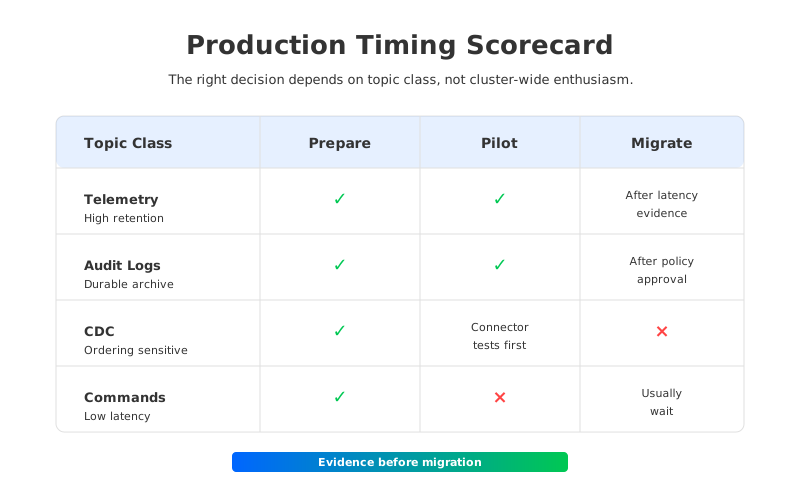
The cleanest way to plan is to score topic classes, not individual topics one by one. Topic-by-topic review is too slow for large estates, while cluster-wide migration is too coarse. Group topics by workload shape, then decide which groups deserve pilots, which should wait, and which should remain on classic Kafka topics for the foreseeable future.
| Topic class | Strong signal to prepare | Strong signal to wait |
|---|---|---|
| High-retention telemetry | Retained volume and fan-out dominate the cost model. Replay is common and write latency has a known budget. | Dashboards depend on a very tight p99 ingest budget that has not been measured under the candidate architecture. |
| Event archive and audit logs | Durability and long retention matter more than immediate consumption. Recovery simplicity is valuable. | Compliance process requires a storage and deletion model the team has not validated. |
| CDC pipelines | Cross-zone replication and retention cost are material, and downstream consumers can absorb modest latency variance. | Transactional ordering, compaction, or connector behavior has not been tested with the target implementation. |
| User-facing command streams | Current platform pain is operational rather than economic, and latency is business-critical. | The team lacks a rollback path or cannot tolerate changed write-path behavior. |
This table does not choose the architecture for you. It keeps the migration discussion honest. The first candidates should be topics where the current architecture is visibly expensive or operationally heavy and where the business contract is explicit enough to test. The worst candidates are topics whose owners cannot state their latency budget, recovery objective, or consumer behavior.
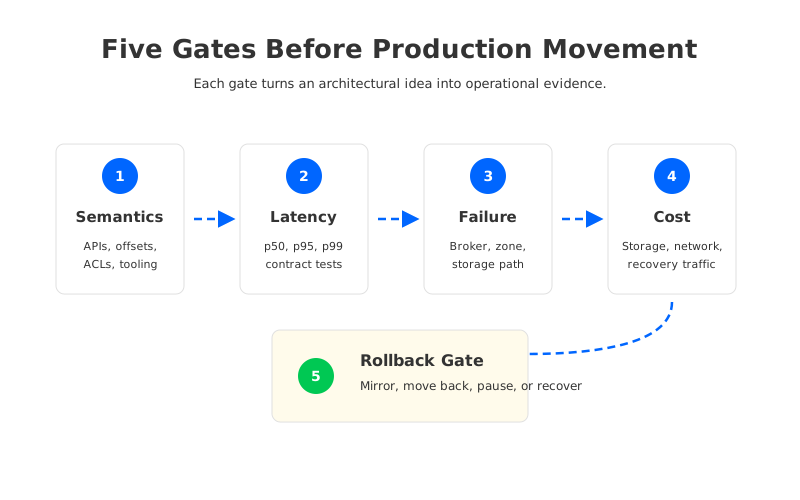
A useful readiness review has five gates:
- Semantics gate: verify the actual APIs your workload uses, including producer idempotence, transactions if present, consumer groups, offset behavior, ACLs, quotas, and admin tooling.
- Latency gate: replay production-like traffic and compare p50, p95, and p99 behavior against the topic's contract. Avoid averages; they hide the tail risk that application owners remember.
- Failure gate: test broker loss, zone impairment, storage-path errors, and consumer catch-up. The runbook should name who acts and what signal tells them the system is healthy again.
- Cost gate: model producer ingress, durability writes, object-storage operations, consumer egress, and recovery traffic together. A lower-cost storage layer can still disappoint if the network path is misunderstood.
- Rollback gate: define how the topic moves back, mirrors in parallel, or pauses migration. A migration with no credible reversal path is not a production migration; it is a bet.
The gates should be applied before procurement locks in a platform choice. KIP-1150 may influence an upstream Kafka plan, a managed Kafka roadmap, or a Kafka-compatible alternative evaluation. The framework is useful precisely because it works across those options.
5How AutoMQ Fits the Evaluation
Once the decision is framed around topic classes, durability placement, and cloud data movement, AutoMQ becomes relevant as a concrete Kafka-compatible shared-storage architecture to evaluate. AutoMQ keeps Kafka protocol compatibility while using object storage as the durable data layer and designing brokers to be more stateless than traditional Kafka brokers. That architecture is close to the operational question KIP-1150 raises: how much of Kafka's broker-local storage responsibility should move into shared cloud storage, and which workloads benefit first?
AutoMQ should not be treated as a shortcut around validation. The same readiness gates apply. The difference is that a platform team can test a production-oriented shared-storage model now, rather than only debating the future shape of upstream diskless topics. For teams under pressure from cross-AZ replication cost, broker-local disk sizing, or slow recovery after broker changes, this can make the evaluation concrete: run representative topics, measure cost boundaries, and compare operational behavior with the existing Kafka baseline.
The useful proof of concept is narrow. Pick one high-retention topic class, one replay-heavy topic class, and one latency-sensitive control topic that is expected to remain classic. That mix tells you whether the architecture improves the workloads it should improve without encouraging a blanket migration. It also gives procurement and governance teams a realistic map: not "replace Kafka," but "place the right Kafka-compatible storage model under the right topic class."
6A 30-Day Readiness Plan
The first month should produce evidence, not a grand migration program. In week one, export topic metadata, retention settings, partition counts, write throughput, consumer lag, and current cost signals where available. Classify the estate into a small number of topic classes and mark the topics that have unclear ownership or unclear latency contracts. Those unclear topics are not ready for migration, even if their current cost looks attractive.
In week two, choose two or three candidates and create workload replay plans. The replay should include producer behavior, consumer fan-out, retention, and failure tests. If the candidate architecture is upstream Kafka, track the specific KIPs and versions that define the behavior. If it is a managed service or Kafka-compatible system, require the same evidence in product form: compatibility matrix, observability, recovery documentation, and support boundaries.
In weeks three and four, run the gates and write down the placement rule. A strong outcome might say: "High-retention telemetry topics above this retained-volume threshold can pilot shared-storage Kafka-compatible architecture when p99 produce latency remains inside the team contract and rollback mirroring is enabled." That sentence is more useful than a broad architecture slogan because it connects cost, performance, and operations in one rule.
KIP-1150 is a signal that Kafka's storage model is moving toward more explicit workload placement. The teams that benefit first will not be the ones that wait passively for a final checkbox or migrate blindly because object storage sounds lower cost. They will be the teams that know which topics are expensive for the wrong reason, which ones are latency-sensitive for the right reason, and which architecture can prove the difference. To compare this model with a Kafka-compatible shared-storage implementation, review the AutoMQ architecture documentation: AutoMQ Shared Storage Architecture.
7References
- Apache Kafka Wiki: KIP-1150: Diskless Topics
- Apache Kafka Documentation: Tiered Storage Overview
- AWS: Amazon EC2 On-Demand Pricing, Data Transfer
- AWS: Amazon MSK Pricing
- AutoMQ Documentation: Architecture Overview
- AutoMQ Documentation: Eliminate Inter-Zone Traffics
- AutoMQ Documentation: Difference with Apache Kafka
8FAQ
8.1Is KIP-1150 already accepted?
Yes. The Apache Kafka KIP page lists KIP-1150 as accepted. That means the community accepted the need and end-user direction for diskless topics, while follow-up KIPs and implementations define the production details.
8.2Does acceptance mean platform teams should migrate immediately?
No. Acceptance is a strategic signal, not a universal migration date. Platform teams should start classifying topics and building readiness gates now, then migrate only when a specific implementation satisfies compatibility, latency, failure, cost, and rollback requirements.
8.3How is this different from Kafka tiered storage?
Tiered storage moves inactive log segments to remote storage while active segments still depend on the broker-local log. KIP-1150 goes deeper by proposing diskless topics, where broker disks are no longer the primary durable storage for user data on those topics.
8.4Which topics are the safest early candidates?
High-retention telemetry, replay-heavy analytics, and audit-style topics are often stronger first candidates because they expose storage and replication cost clearly. Ultra-low-latency command streams usually deserve a slower path unless the candidate implementation proves it can meet the contract.
8.5Where does AutoMQ fit in a KIP-1150 evaluation?
AutoMQ is a Kafka-compatible shared-storage system that can be evaluated against the same readiness gates. It is useful when a team wants production evidence for object-storage-backed streaming architecture while still preserving Kafka protocol compatibility.


