
Table of Contents
Table of Contents
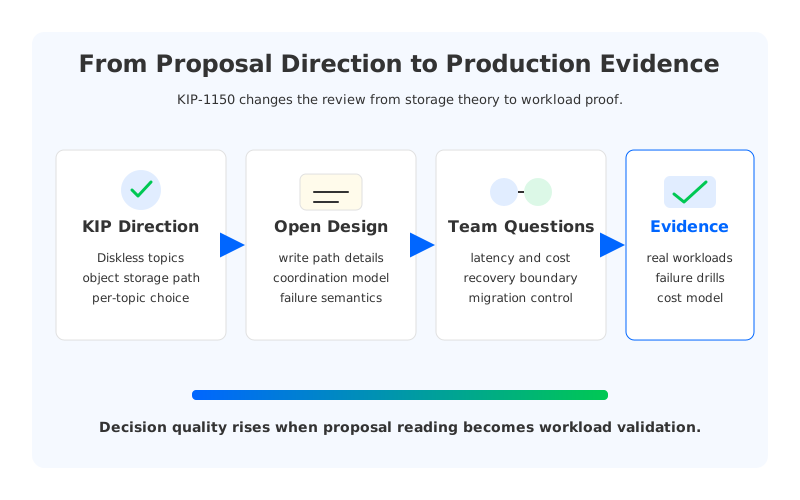
KIP-1150 matters because it turns a familiar Kafka pain into an upstream design question: should Kafka keep treating broker-attached disks as the primary home for active log data, or should object storage become part of the write path? That is not a narrow storage feature. It changes how platform teams think about replication, availability zones, recovery, scaling, cost allocation, and the boundary between Kafka semantics and cloud infrastructure.
The important operational detail is that KIP-1150 has been accepted as a Kafka Improvement Proposal, but the accepted page is explicit about scope. Acceptance establishes consensus on the need for diskless topics and their user-facing requirements; implementation details are delegated to follow-up KIPs. For a platform team, that distinction is the whole story. The direction is no longer speculative, yet production planning still needs a separate checklist.
1Why Teams Search for KIP-1150
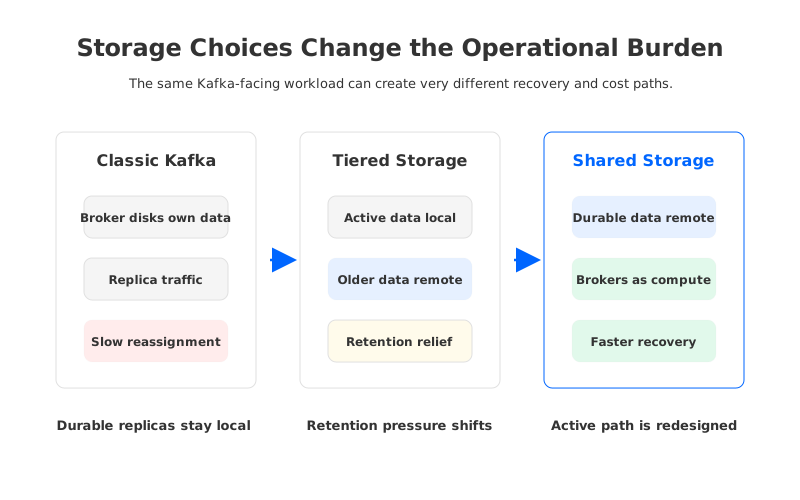
Most teams arrive at KIP-1150 after a cost review or a scaling incident. Traditional Kafka stores active segments on broker disks and replicates those segments across brokers for durability and availability. In a cloud deployment, that means the Kafka data plane can consume block storage, cross-zone bandwidth, recovery bandwidth, and operational time whenever partitions move. Tiered Storage helps by moving older segments to object storage, but it does not remove the need to durably handle active segments on brokers.
KIP-1150 addresses that exact gap. It proposes diskless topics, where broker disks stop being the primary durable store for user data. The proposal keeps the Kafka protocol goal intact while changing the storage path beneath it. Operators would be able to choose diskless behavior per topic, so latency-sensitive workloads and cost-sensitive workloads could coexist in the same administrative environment.
That is why the search intent is rarely academic. A platform owner does not read KIP-1150 because they want another feature name. They want to know whether an object-storage-backed Kafka design can reduce infrastructure pressure without breaking the parts of Kafka their applications depend on: ordering, consumer groups, idempotent producers, transactions, ACLs, monitoring, and the operational habits built around them.
2What KIP-1150 Settles, and What It Leaves Open
KIP-1150 settles the strategic direction: Kafka should pursue a storage model where object storage can replace block storage as the durable home for active topic data in suitable workloads. It also clarifies that diskless does not mean brokers have no disks at all. Brokers may still cache data, buffer writes, store metadata, or use local resources as part of the processing path. The shift is about durable ownership of user data, not the physical disappearance of every disk.
For buyers and operators, the proposal is most useful when separated into settled and unsettled questions:
| Area | What KIP-1150 clarifies | What platform teams still need to validate |
|---|---|---|
| Storage direction | Object storage becomes part of the active topic design | Exact write path, metadata design, and failure behavior |
| Topic model | Diskless topics can coexist with classic topics | Topic conversion, workload placement, and mixed-mode operations |
| Kafka semantics | Diskless topics are intended to preserve external Kafka behavior | Edge-case compatibility for transactions, compaction, quotas, tooling, and observability |
| Cost drivers | Active-segment replication and cross-zone traffic are target problems | Region-specific pricing, cache hit rates, read amplification, and object API costs |
| Migration | Existing clusters should remain backward compatible | Cutover workflow, rollback plan, offset continuity, and operational ownership |
This table is the difference between reading the KIP and making a production decision. The KIP gives the direction of travel. Your architecture review has to translate that direction into workload-specific evidence.
3The Production Questions the Proposal Cannot Answer for You
The first question is latency. Object storage has attractive durability and cost properties, but Kafka’s write path is not a passive archive. Producers expect acknowledgments, ordering, retry behavior, and predictable tail latency. Any diskless implementation has to explain how it absorbs object storage latency, how it batches or pipelines writes, what happens during object-store throttling, and how producers see backpressure. A benchmark with average latency is not enough; the review needs p95 and p99 behavior under failure, catch-up reads, and bursty producers.
The second question is recovery ownership. Traditional Kafka recovery is painful, but the model is legible: partitions belong to brokers, replicas catch up, and reassignment moves data between machines. Diskless topics change the recovery boundary. If durable data is in object storage, broker replacement should become faster, but metadata correctness becomes more important. Platform teams should ask where offsets, batch metadata, object references, and compaction state live, and how those pieces recover after a broker, zone, controller, or object-storage outage.
The third question is cost shape, not headline cost. Diskless topics target some of Kafka’s most expensive cloud behaviors, especially active-segment replication and zone-crossing data movement. Still, the full bill depends on write volume, read fanout, retention, object requests, cache strategy, networking, and compute headroom. A platform team that compares block storage dollars against object storage dollars misses the point. The right model follows each byte from producer acknowledgment through retention and replay.
The fourth question is migration. A storage architecture can be technically compelling and still be operationally risky if migration requires a large application freeze. Kafka teams need to preserve client behavior, ACLs, offsets, connector tasks, schema workflows, topic configuration, monitoring, and rollback. The most practical evaluation asks which topics move first, how consumer groups are coordinated, and what signal proves the target platform can own production traffic.
4A Technical Evaluation Framework
A good KIP-1150 review starts with workload classification rather than vendor comparison. Some topics are latency-sensitive command streams with short retention. Others are high-volume observability streams where retention and replay dominate the bill. A third group may be connector-heavy, with operational risk concentrated in offsets and downstream side effects. Diskless storage will not have the same value for each group, and the first architecture mistake is pretending that it should.
Use five questions to keep the review grounded:
- What is the critical Kafka semantic surface? Test producer idempotence, transactions, ordering, consumer group behavior, compaction, ACLs, quotas, and admin APIs that your applications use. Compatibility has to be proven by workload, not inferred from protocol branding.
- Where does durable state live? Map user records, offsets, metadata, cache, WAL, compaction state, and recovery checkpoints. The design should make it clear which state survives a broker loss and which state is rebuilt.
- Which network paths carry paid or constrained traffic? Track producer ingress, consumer egress, replication, remote reads, object storage access, and cross-zone paths. Diskless design is valuable when it removes expensive internal replication rather than hiding it behind a different component.
- How does the system degrade? Object storage throttling, zone loss, controller failover, and cache misses are normal production events. The platform should describe backpressure and recovery in operator language.
- How will migration be reversed if needed? A serious plan includes topic selection, dual-running boundaries, consumer group handling, offset validation, observability, and rollback criteria.
This framework also clarifies the difference between Tiered Storage and diskless architecture. Tiered Storage extends classic Kafka by moving older log segments away from broker disks. Diskless architecture changes the active data path so broker-local storage is no longer the durable center of the system. Both can use object storage, but they answer different operational problems.
5How AutoMQ Fits the Evaluation
Once the evaluation is framed this way, AutoMQ belongs in the discussion as a Kafka-compatible, shared-storage streaming system rather than as a shortcut around the review. AutoMQ keeps the Kafka protocol surface while using S3Stream shared storage, WAL storage, and object storage to decouple durable stream data from broker-local disks. That architecture is relevant to the same questions KIP-1150 raises: what happens when brokers become more stateless, how active data moves to object storage, and how operators reduce broker reassignment and cross-zone replication pressure.
The fit is strongest when a team wants the diskless direction but needs production evidence before upstream Kafka completes every implementation detail. AutoMQ documentation describes Kafka compatibility, shared storage, WAL options, inter-zone traffic reduction, and migration workflows. Those are the exact dimensions a platform review should test: client behavior, latency, recovery, network placement, and cutover mechanics.
AutoMQ should not be treated as a magic replacement for due diligence. A proof of concept still needs representative producers, consumers, retention, replay, compaction, and failure drills. The value is that the proof of concept can evaluate a working shared-storage architecture now, using Kafka-facing applications, instead of waiting for all follow-up KIPs to converge before the organization learns whether the model fits its workloads.
6A Practical Readiness Checklist
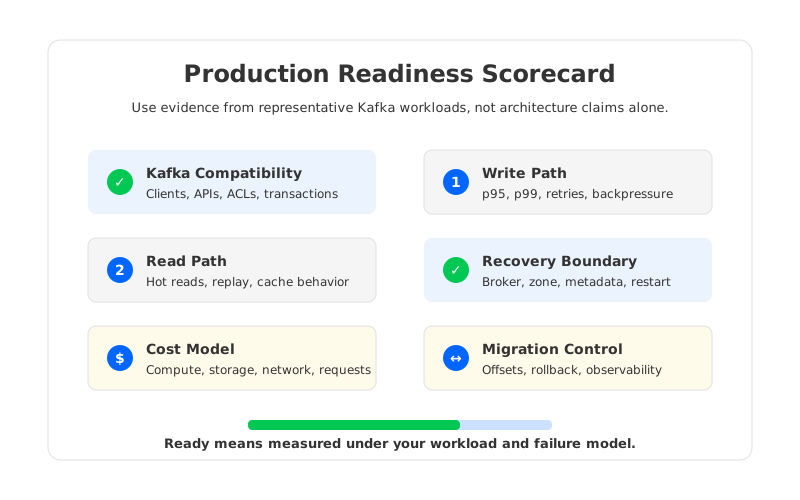
The strongest production reviews create evidence instead of debating architecture in the abstract. A small, realistic test beats a large spreadsheet. Pick one high-volume topic, one latency-sensitive topic, and one connector-heavy topic. Replay real traffic patterns where possible, preserve the same client libraries, and run the same dashboards that the on-call team uses today.
For each workload, collect evidence in a simple scorecard:
| Dimension | Evidence to collect | Why it matters |
|---|---|---|
| Client compatibility | Producer, consumer, admin, security, and connector tests | Prevents surprises after cutover |
| Write path | p95/p99 latency, backpressure behavior, retry impact | Shows whether the hot path fits the workload |
| Read path | Hot reads, cold catch-up reads, fanout, cache behavior | Avoids hidden replay cost and latency |
| Recovery | Broker loss, zone loss, restart time, metadata repair | Tests whether shared storage improves operations |
| Cost model | Compute, storage, object requests, network, support | Turns architecture into a FinOps decision |
| Migration | Offset continuity, rollback, observability, ownership | Reduces cutover risk |
This checklist should be owned jointly by platform engineering, SRE, FinOps, and application representatives. KIP-1150 is not a storage-team topic in isolation. It changes how the organization pays for streaming, recovers from failure, and governs the data plane.
7Where the Decision Lands
KIP-1150 is a strong signal that the Kafka ecosystem is moving toward object-storage-backed active data paths. That does not make every workload a diskless workload, and it does not remove the need for careful migration planning. It does mean platform teams can stop treating diskless Kafka as a fringe idea and start treating it as an architecture path that needs evidence.
The decision should land in one of three buckets. If your current Kafka estate is stable, low-cost, and latency constrained, track KIP-1150 and test later. If your main pain is long retention on older data, Tiered Storage may be enough. If your main pain is active-segment cost, broker reassignment, zone-crossing traffic, or slow recovery, evaluate a shared-storage Kafka-compatible system now and use KIP-1150 as the architectural checklist.
To run that evaluation with a production-oriented shared-storage design, start with the AutoMQ BYOC console and validate one representative Kafka workload against your own latency, cost, and migration criteria.
8References
- Apache Kafka KIP-1150: Diskless Topics
- Apache Kafka KIP-1163: Diskless Core
- Apache Kafka KIP-1164: Diskless Coordinator
- Apache Kafka documentation: Tiered Storage
- AWS EC2 pricing: data transfer within the same AWS Region
- AutoMQ documentation: S3Stream shared streaming storage
- AutoMQ documentation: Compatibility with Apache Kafka
- AutoMQ documentation: Difference with Tiered Storage
- AutoMQ documentation: Inter-zone traffic overview
- AutoMQ migration page: Kafka Linking
9FAQ
9.1What is KIP-1150?
KIP-1150 is an Apache Kafka Improvement Proposal for diskless topics. It proposes a topic mode where broker disks are no longer the primary durable store for user data, with object storage becoming part of the active data path.
9.2Is KIP-1150 production-ready in Apache Kafka?
The KIP page lists KIP-1150 as accepted, but it also says acceptance establishes consensus on requirements rather than implementation details. Follow-up KIPs define the core implementation and coordination work, so platform teams should separate directional acceptance from production availability.
9.3Is diskless Kafka the same as Tiered Storage?
No. Tiered Storage moves inactive log segments to remote storage while the active write path still depends on broker-local durable storage. Diskless architecture changes the active topic path so object storage can become the durable center for suitable workloads.
9.4Should every Kafka topic become diskless?
No. The better model is workload placement. Latency-sensitive topics, high-retention topics, replay-heavy topics, and connector-heavy topics have different risk and cost profiles. KIP-1150 is designed around per-topic choice, which reflects that reality.
9.5How should a team evaluate AutoMQ in relation to KIP-1150?
Use the same operational checklist: Kafka compatibility, write latency, read behavior, recovery, network paths, cost model, and migration workflow. AutoMQ is relevant because it already implements a Kafka-compatible shared-storage architecture, but each team should validate it with representative workloads.


