
Table of Contents
Table of Contents
KRaft readiness is not a checkbox for whether a Kafka cluster can start without ZooKeeper. That is the visible part. The harder question is whether the team understands how controller quorum, metadata recovery, client behavior, operational tooling, and rollback boundaries change when ZooKeeper leaves the architecture.
That is why kraft readiness questions kafka is a useful search phrase. The person asking it is probably past the tutorial stage. They are preparing a production decision: when to upgrade, what to test, how to communicate risk, and how to avoid turning a control-plane migration into a data-plane incident.
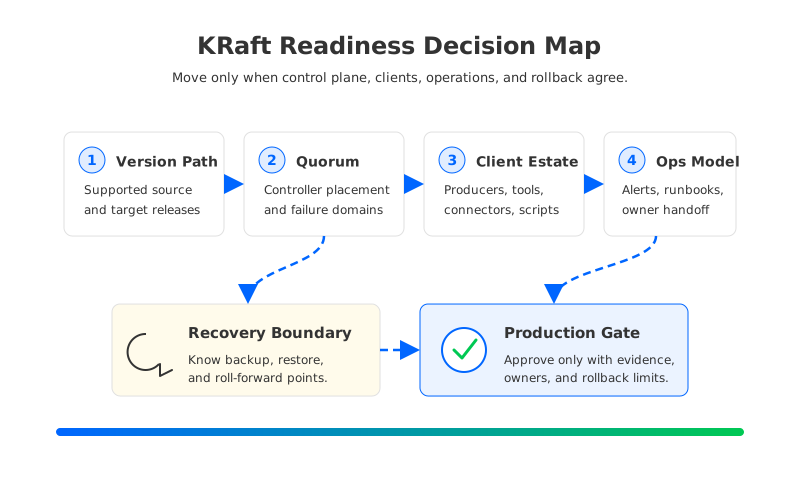
The safest framing is not "Are we ready for KRaft?" It is "Which assumptions in our current Kafka operating model were quietly delegated to ZooKeeper, and which of those assumptions need a fresh runbook before production traffic moves?"
1Why teams search for kraft readiness questions kafka
ZooKeeper gave Kafka operators a familiar separation of concerns. Brokers handled logs and client traffic. ZooKeeper held cluster metadata, controller election state, broker membership, topic configuration, and other coordination data. Many teams did not interact with ZooKeeper every day, but their scripts, dashboards, incident playbooks, and upgrade habits were built around its presence.
KRaft changes that boundary by moving Kafka metadata management into a Kafka-managed quorum. The controller role becomes part of the Kafka architecture rather than an external coordination service. That design removes a major operational dependency, but it also means the Kafka cluster owns more of its own recovery story. Teams need to know how controller nodes are placed, how metadata snapshots are backed up, how quorum health is monitored, and how failures are diagnosed when the old ZooKeeper mental model no longer applies.
The readiness work therefore has two layers. The first layer is version and feature compatibility: can the target Kafka release and client estate support the migration path? The second layer is operational maturity: can the team run, secure, observe, and recover the post-ZooKeeper cluster under production pressure?
2The production constraint behind the problem
A control-plane change is often underestimated because no application team asked for it. Producers still call the Kafka protocol. Consumers still track offsets. Topics still have partitions. Most application owners will ask why the migration matters if their code and connection strings barely change.
The answer is that Kafka reliability depends on metadata as much as it depends on bytes stored in partition logs. Controller state determines who leads a partition, how topic changes are applied, how broker membership is recognized, and how the cluster converges after failure.
This is where KRaft readiness becomes a platform engineering problem instead of a version upgrade task. The team has to align release planning, infrastructure placement, access control, monitoring, backup policy, and rollback expectations. If those areas remain split across separate tickets, the migration can look complete while the operating model stays unfinished.
3Architecture options and trade-offs
Teams usually approach KRaft from one of three starting points. Some run self-managed Kafka with ZooKeeper and need a direct migration plan. Some are evaluating a managed Kafka service and want to know whether the provider has already absorbed the KRaft transition. Others are using the migration as a moment to reconsider the entire Kafka-compatible streaming platform: storage model, cloud cost, elasticity, and governance.
Those paths have different risk profiles, but the evaluation questions overlap. A readiness review should separate the control plane, data plane, and team operating boundary.
| Area | Readiness question | What a weak answer looks like |
|---|---|---|
| Metadata quorum | Where do controller nodes run, and what failure domains do they span? | "The default layout should be fine." |
| Upgrade path | Which source and target versions are supported by the official Kafka documentation? | "We can skip through releases because the cluster starts in staging." |
| Client estate | Which producers, consumers, connectors, and admin tools depend on version-specific behavior? | "Applications should not notice." |
| Operations | Which alerts replace ZooKeeper health checks, and who owns them? | "The old broker dashboard is enough." |
| Recovery | How are metadata snapshots, broker state, and rollback decisions handled? | "We can restore from backup if needed." |
| Governance | How do authentication, authorization, audit, and environment boundaries change? | "Security is the same as before." |
The weak answers are common because KRaft removes an obvious external system, which can make the architecture feel smaller. In production, responsibility has moved.
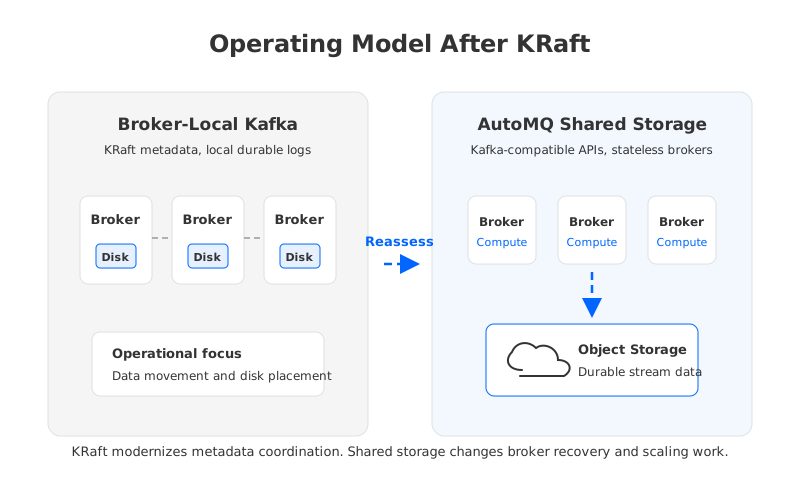
Storage architecture also matters during this decision. Traditional Kafka stores durable partition data on broker-local disks and relies on replication across brokers for availability. KRaft changes metadata coordination, but it does not by itself remove the operational burden of broker-local storage: partition reassignment, disk capacity planning, data movement during broker replacement, and cloud networking pressure can still dominate large clusters.
That distinction prevents a common planning mistake. KRaft readiness is not the same as cloud-native Kafka readiness. KRaft addresses the metadata plane. Cloud-native operations also require a plan for elastic capacity, storage durability, cross-zone traffic, and failure recovery. A team can be ready for KRaft and still be stuck with a storage model that makes scaling and recovery expensive to operate.
4Evaluation checklist for platform teams
The readiness review should start with the official migration path, not with tribal memory. Apache Kafka documentation is the source of truth for supported versions, KRaft configuration, upgrade behavior, and operational constraints. Internal runbooks should reference those requirements directly, then add environment-specific checks for network, automation, monitoring, and ownership.
The first group of questions belongs to cluster architecture. How many controllers will the cluster run? Are controllers dedicated or combined with brokers? Which failure domains do they span? How does the deployment system prevent accidental quorum loss during maintenance? How are metadata snapshots retained, protected, and tested? These questions sound ordinary until a routine rollout restarts the wrong nodes in the wrong order.
The second group belongs to compatibility. Kafka clients are usually tolerant across supported version ranges, but production estates include more than producers and consumers. They include Kafka Connect workers, stream processors, MirrorMaker or replication tools, admin scripts, ACL automation, schema registry integration, observability agents, and custom tooling that calls Kafka admin APIs. Readiness means each of those paths has been tested against the target cluster behavior, not merely compiled against a library.
The third group belongs to incident response. ZooKeeper incidents often had their own diagnostics: znodes, sessions, ensemble health, latency, and quorum status. KRaft incidents need a Kafka-native view of controller health, metadata propagation, leader election, broker registration, and quorum availability. If the on-call engineer still reaches first for ZooKeeper commands after the migration, the runbook is not ready.
Use this scorecard before approving a production window:
- Version path: the source release, target release, and migration sequence match official Kafka guidance, including any required intermediate states.
- Controller placement: quorum nodes are placed across intended failure domains and protected from unsafe simultaneous maintenance.
- Client and tool inventory: producers, consumers, connectors, stream processors, admin scripts, and monitoring agents have owners and test evidence.
- Metadata recovery: backup, snapshot, restore, and validation procedures are written and exercised outside the production window.
- Observability: dashboards and alerts distinguish broker health, controller health, quorum health, partition leadership, and request impact.
- Rollback boundary: the team knows which steps are reversible, which are not, and when the decision must become roll-forward.
- Business communication: application owners know which symptoms matter, which are expected during the window, and where to report validation failures.
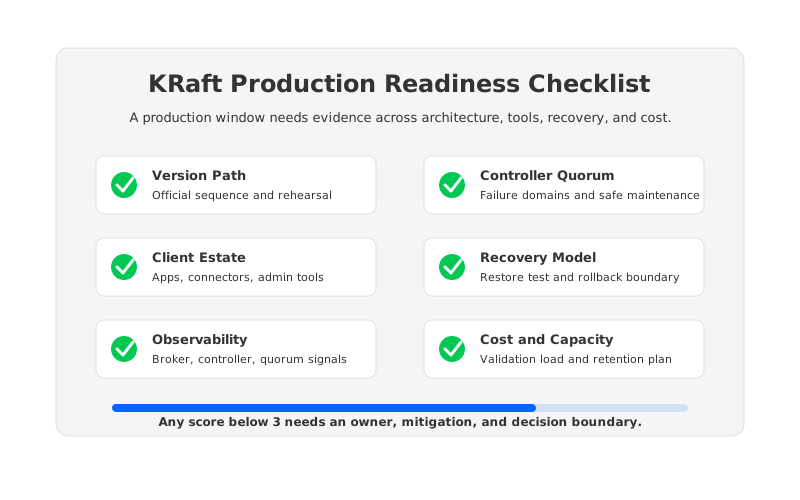
The value of the checklist is not paperwork. It forces teams to say which evidence is missing before the maintenance window starts.
5Migration risk: the questions that catch hidden dependencies
The hidden dependencies usually live outside Kafka itself. A cluster may be technically ready for KRaft while the surrounding platform is still wired for ZooKeeper-era assumptions. Deployment automation may template ZooKeeper connection strings. Security scanners may expect ZooKeeper ports. Dashboards may treat ZooKeeper latency as the control-plane health signal. Disaster recovery exercises may assume a separate ZooKeeper backup procedure.
These dependencies are often missed because they are boring and rarely have product owners. A good migration review asks about them directly.
One useful technique is to walk through a familiar incident under the post-migration model. Imagine a broker fails during peak ingest. Who detects it? Which metrics prove the controller quorum is healthy? How does the team verify partition leadership has converged? Which automated repair action is allowed to run, and which one must wait? If the answers depend on a ZooKeeper concept, translate the runbook before the migration.
Another technique is to rehearse administrative operations, not only failure cases. Create and delete topics, alter configs, rotate credentials, change quotas, rebalance partitions, restart controller nodes, and inspect metadata health. Production pain often appears later, when a routine admin task behaves differently and the team discovers that the migration test covered traffic but not operations.
KRaft readiness should also include cost awareness. The migration itself may not be a cost project, but extra clusters, duplicated traffic, cross-zone replication, prolonged retention, and temporary validation pipelines can all add cloud spend. Budget those costs explicitly so reliability decisions are not quietly shortened by surprise infrastructure pressure.
6How AutoMQ changes the operating model
Once the KRaft questions are clear, the next architectural question is whether the team wants to keep operating Kafka-compatible infrastructure with broker-local storage as the center of gravity. KRaft modernizes Kafka metadata management, but it does not remove the coupling between brokers and durable partition data in a traditional shared-nothing deployment.
AutoMQ fits this part of the evaluation as a Kafka-compatible streaming system that separates compute from storage and uses shared object storage for durable stream data. The important point is not that AutoMQ replaces KRaft readiness work. Teams still need compatibility tests, security reviews, operational runbooks, and migration gates. The difference is that stateless broker operation changes what the platform team must plan around after metadata coordination is under control.
With broker-local storage, capacity events tend to become data placement events. Adding brokers may require partition reassignment, replacing brokers can involve large data movement, and retention growth can force disk planning. In a shared-storage model, durable data is backed by object storage, and brokers can be treated more like elastic compute. That changes the operational focus from "Where is the data sitting on this broker?" to "Does the service have the compute, network, and governance boundary required for this workload?"
For KRaft migrations, that difference matters when the team is already reassessing infrastructure. If the target state is still traditional Kafka, the readiness plan should include both metadata migration and ongoing broker-local storage operations. If the target state is a Kafka-compatible shared-storage platform, the readiness plan can evaluate whether stateless brokers, independent compute and storage scaling, object-storage durability, and deployment boundaries reduce the operational work around scaling and recovery.
AutoMQ should enter the conversation after the neutral review, not before it. A team that has mapped KRaft requirements can compare architectures with clearer criteria: Kafka API compatibility, cloud cost model, cross-zone traffic behavior, elastic scaling, governance, and recovery procedures.
7A readiness scorecard you can use in review
The final readiness decision should be a scored review, not a binary opinion. A scorecard exposes which areas are strong, which need mitigation, and which block production movement.
Use a 1 to 5 score for each category:
| Category | Score 1 means | Score 5 means |
|---|---|---|
| Version path | The upgrade path is assumed from experience. | The path follows official documentation and has been rehearsed. |
| Quorum design | Controller placement is inherited from defaults. | Controller quorum has explicit failure-domain design and maintenance rules. |
| Tooling | Scripts and dashboards are mostly unchanged. | All ZooKeeper-era assumptions have been removed or replaced. |
| Client estate | Key apps tested, long tail unknown. | Producers, consumers, connectors, stream processors, and admin clients have owners and results. |
| Recovery | Backups exist but restore is unproven. | Metadata and data recovery procedures have been tested under a realistic failure. |
| Cost and capacity | Temporary migration load is not budgeted. | Test, validation, dual-running, retention, and network costs are planned. |
A production window should not depend on an average score. A 5 in compatibility does not offset a 1 in recovery. Treat any category below 3 as a blocker or an explicit risk acceptance with an owner, mitigation, and rollback boundary.
The strongest readiness reviews also define the end of the migration. KRaft migration is not complete when the cluster restarts successfully. It is complete when old ZooKeeper automation is removed, dashboards reflect the target architecture, and on-call engineers can diagnose controller health.
8Conclusion
Leaving ZooKeeper behind is a control-plane migration, an operating model change, and a chance to clean up years of accumulated Kafka assumptions. The teams that handle it well do not ask whether KRaft works in the abstract. They ask whether their version path, controller quorum, tooling, recovery model, and cloud operating costs are ready for the architecture they are about to run.
That is the difference between a successful upgrade and a durable platform decision. KRaft removes a major external dependency from Kafka, but it also makes Kafka's own operating model more important. If your team is using the KRaft transition to evaluate Kafka-compatible infrastructure, review AutoMQ's architecture and deployment model or talk with the AutoMQ team: contact AutoMQ.
9References
- Apache Kafka documentation: KRaft mode and operations
- Apache Kafka documentation: Upgrade guidance
- AutoMQ documentation: AutoMQ overview
- AutoMQ documentation: Technical advantage overview
- AWS documentation: Amazon S3 user guide
10FAQ
10.1Is KRaft readiness the same as Kafka upgrade readiness?
No. A Kafka version upgrade checks whether the cluster can move from one supported release to another. KRaft readiness also checks whether the team can operate Kafka metadata quorum, controller placement, monitoring, backup, and incident response after ZooKeeper is removed.
10.2Should application teams need code changes for KRaft?
Usually the goal is no application rewrite when clients are compatible with the target Kafka environment. The readiness review should still inventory producers, consumers, connectors, stream processors, and admin tools because operational tooling can depend on behavior outside the main produce and consume path.
10.3What is the biggest production risk in a KRaft migration?
The biggest risk is an incomplete operating model. A cluster can pass a staging migration while dashboards, automation, recovery procedures, and on-call habits still assume ZooKeeper. That gap becomes visible during maintenance or failure.
10.4Where does AutoMQ fit in a KRaft readiness discussion?
AutoMQ fits when teams use the migration moment to reassess Kafka-compatible infrastructure more broadly. KRaft addresses Kafka metadata coordination. AutoMQ's shared-storage architecture addresses a different operating concern: reducing broker-local storage coupling while preserving Kafka-compatible APIs.


