
Table of Contents
Table of Contents
Teams rarely search for kraft migration readiness kafka because they want a textbook definition of KRaft. They search for it when a production Kafka estate is about to cross a line: metadata management changes, client behavior must stay stable, rollback has to be credible, and the platform owner is expected to explain why the upgrade will not turn into a storage, networking, or governance incident. The hard part is not knowing that KRaft replaces ZooKeeper for Kafka metadata. The hard part is deciding which gates must be passed before that change is allowed near production.
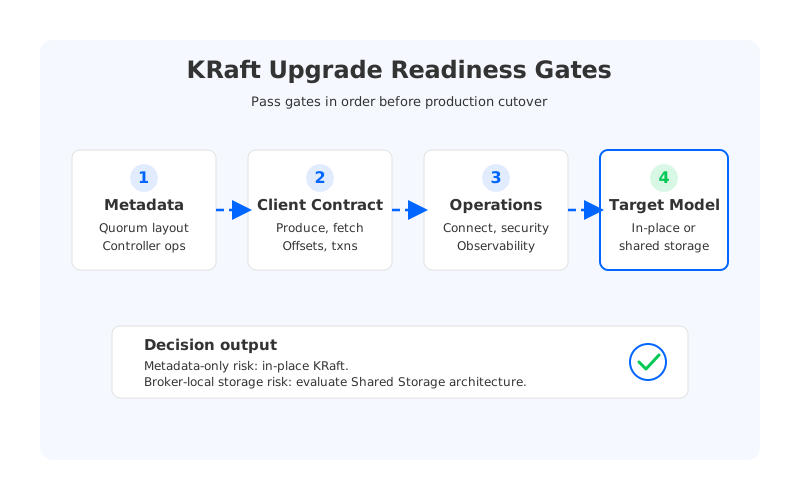
That distinction matters because a KRaft upgrade is easy to underestimate. It looks like a metadata project, but the risk inventory quickly expands into clients, Connect workers, consumer offsets, transactional workloads, security automation, dashboards, and the broker storage model that still determines recovery and scaling pain. A useful readiness plan asks two questions: can the Kafka estate move safely to KRaft, and is this the right moment to revisit the operating model underneath Kafka?
1Why teams search for kraft migration readiness kafka
The search phrase has a nervous shape. It is not "what is KRaft," and it is not "Kafka upgrade guide." It usually comes from a platform team that already understands Kafka well enough to know that a metadata migration touches more than controller processes. Topic configuration, broker registration, ACL behavior, client metadata refresh, rebalancing, partition leadership, and operational tooling all depend on a consistent view of the cluster.
Apache Kafka's own documentation is the right starting point because it separates the major surfaces: KRaft operations, ZooKeeper-to-KRaft migration, consumer behavior, transactions, Kafka Connect, Tiered Storage, and upgrade compatibility. Those surfaces map directly to ownership. Application teams care about client compatibility and offsets. SREs care about controller quorum placement and recovery. Security teams care about listener, authentication, and authorization behavior. FinOps teams care about whether the platform will still need the same over-provisioned broker storage after the migration.
A readiness review should make those owners visible before it talks about tools. If one team owns brokers, another owns Connect, another owns identity, and another owns workload cutover, the upgrade is not one change. It is a set of gates that must close in the right order. Even a clean technical plan can fail if no one owns freeze windows, rollback approval, and client restarts.
2The production constraint behind the problem
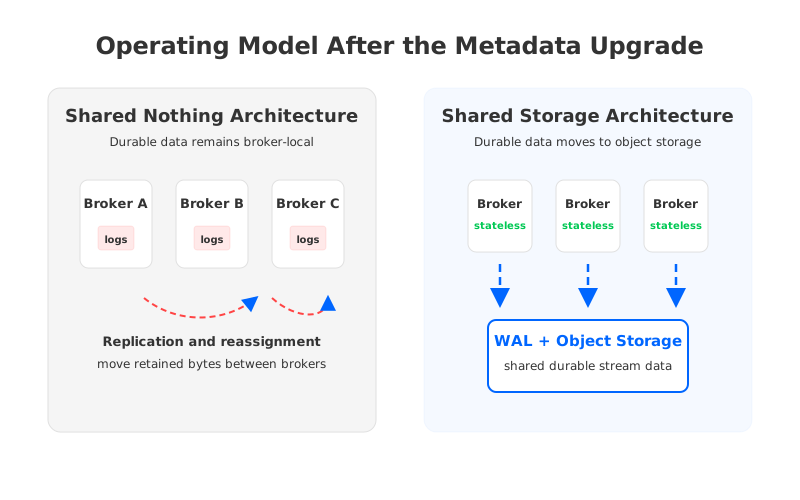
KRaft removes ZooKeeper from Kafka's metadata path, but it does not make traditional Kafka brokers stateless. In a Shared Nothing architecture, each broker still owns local or attached log storage, leaders still append to broker-held log segments, followers still replicate data through ISR (In-Sync Replicas), and retained data still has to live somewhere. The metadata system can change while the data plane remains anchored to broker-local storage.
That is why KRaft readiness is not only a controller checklist. A platform owner should separate metadata readiness from data-plane readiness:
- Metadata readiness asks whether controller quorum design, voter configuration, broker registration, ACL behavior, and automation scripts work under KRaft.
- Client and ecosystem readiness asks whether producers, consumers, Kafka Connect, Kafka Streams, schema tooling, admin scripts, and observability keep their expected behavior.
- Operating-model readiness asks whether storage growth, partition movement, broker replacement, and cross-Availability Zone traffic will still dominate the platform after the migration.
The third category is where many upgrade plans get too narrow. A team can pass every KRaft migration test and still keep the same expensive failure modes: large reassignments, long broker replacement windows, disk capacity pressure, and scaling plans that require moving retained partition data. KRaft simplifies metadata ownership. It does not by itself change where durable records live.
That does not make KRaft a small improvement. Removing an external coordination system can reduce operational surface area and simplify cluster architecture. The mistake is treating that benefit as if it also solved storage elasticity. Kafka's metadata and Kafka's durable log are related, but they are not the same layer.
3Upgrade gates that should block production
The most useful readiness plan is written as gates, not as a loose checklist. A checklist invites teams to mark items as "reviewed." A gate forces a decision: pass, fail, or defer. For a production Kafka estate, five gates deserve explicit sign-off before the upgrade is scheduled.
| Gate | What must be proven | Evidence to collect |
|---|---|---|
| Controller quorum | KRaft controllers are placed, sized, monitored, and recoverable across the intended failure domains. | Quorum layout, voter configuration, controller metrics, replacement runbook |
| Client contract | Existing clients keep expected produce, fetch, commit, rebalance, transaction, and admin behavior. | Client version inventory, staging test matrix, known incompatibility list |
| Ecosystem continuity | Connectors, Streams jobs, schema tooling, exporters, and automation do not depend on ZooKeeper-era assumptions. | Tooling audit, dry-run output, connector restart plan, metrics validation |
| Rollback control | The team knows which rollback paths are supported, which are not, and who can call the stop condition. | Upgrade rehearsal notes, decision owner, recovery time objective, freeze criteria |
| Data-plane risk | Storage, replication, retention, cross-zone traffic, and broker replacement are understood after the upgrade. | Capacity model, reassignment plan, retention forecast, failure-drill results |
The last gate is often the most revealing. If the only unresolved concern is ZooKeeper retirement, an in-place KRaft upgrade may be the right answer. If the unresolved concerns are actually disk growth, broker-local data movement, or cloud elasticity, the KRaft project is exposing a deeper architecture question. That is a useful discovery, not scope creep, as long as the team names it early.
4Architecture options and trade-offs
There are three common paths once a KRaft readiness review exposes the full risk surface. The first is an in-place upgrade of the existing Kafka estate. This keeps the current operational model mostly intact and is often the lowest-change path when the cluster is healthy, automation is mature, and the main goal is to remove ZooKeeper from the metadata path. The trade-off is that broker-local storage, replica movement, and capacity coupling remain largely the same after the migration.
The second path is to move to a managed Kafka service. This can shift operational responsibility away from the platform team, especially around patching, monitoring, and infrastructure lifecycle. The trade-off is the service boundary: teams must validate networking, governance, pricing meters, client compatibility, region availability, and the degree of control they still have over cluster behavior. For some organizations that boundary is welcome. For others, it conflicts with data residency, private connectivity, or infrastructure ownership requirements.
The third path is to keep Kafka semantics while changing the storage architecture. In a Shared Storage architecture, durable stream data moves out of broker-local disks and into shared object storage, while brokers become closer to stateless compute workers. This does not remove the need for KRaft, client validation, or migration planning. It changes which layer owns durable data and therefore changes the operational meaning of broker replacement, scaling, and partition movement.
The architecture decision is easiest to discuss when each option is judged against the same questions:
- What changes for applications? A lower-risk path preserves Kafka protocol behavior, offset semantics, producer guarantees, and ecosystem tooling.
- What changes for operators? A better operating model reduces manual data movement, broker snowflake behavior, and capacity planning tied to retained bytes.
- What changes for governance? The deployment boundary should match the organization's cloud account, VPC (Virtual Private Cloud), identity, audit, and compliance requirements.
- What changes for cost ownership? The team needs to see storage, compute, network, and migration work as separate cost drivers rather than one blended broker bill.
This framing keeps the discussion honest. KRaft is a metadata architecture change. Managed services change the responsibility boundary. Shared storage changes the data-plane operating model. They can overlap, but they should not be treated as interchangeable.
5Evaluation checklist for platform teams
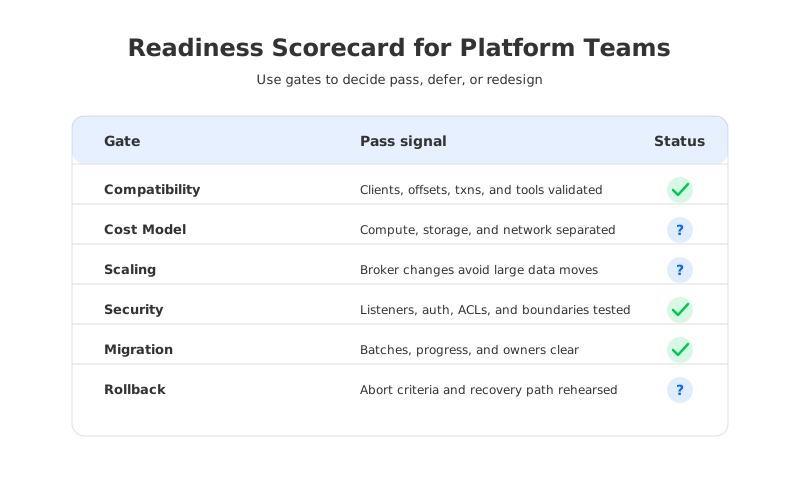
A KRaft migration readiness review should produce a short artifact that an architecture review board, SRE lead, and application owner can all read. The artifact does not need every broker config. It needs the decisions that would change the go/no-go call.
Start with compatibility. Inventory client versions, producer settings, consumer group patterns, transactional workloads, Connect workers, Streams applications, admin tools, exporters, and security integrations. The goal is not to prove that every Kafka feature exists in a lab. The goal is to prove that the subset your organization depends on keeps working under the target architecture. Pay special attention to old clients, custom admin scripts, and tools that assumed ZooKeeper access or parsed broker metadata in brittle ways.
Then model the cutover. A safe plan defines a freeze window for topic creation and configuration changes, identifies which workloads move first, and sets objective abort criteria. Consumer offsets deserve direct attention because they are where application correctness and operational timing meet. A producer cutover that looks clean can still create confusion if consumers restart against the wrong position or if downstream stateful jobs cannot reconcile progress.
Finally, make the post-upgrade operating model explicit. If KRaft is the only change, say so. If the team is also evaluating a Kafka-compatible shared-storage platform, separate that evaluation into its own gates. Mixing both changes without separate acceptance criteria makes every failure ambiguous.
6How AutoMQ changes the operating model
This is the right point to introduce AutoMQ, not at the top of the article. The readiness framework has already shown the gap: KRaft addresses metadata coordination, while many platform teams also need a different answer for broker-local storage, data movement, and customer-controlled deployment boundaries. AutoMQ fits that second category as a Kafka-compatible, cloud-native streaming platform built around Shared Storage architecture and stateless brokers.
AutoMQ keeps the Kafka protocol and ecosystem contract while replacing the broker-local log storage layer with S3Stream. Durable data is written through WAL (Write-Ahead Log) storage and S3-compatible object storage, while brokers handle Kafka protocol work, leadership, caching, and request processing. In practical terms, broker replacement and scaling are less dominated by copying retained partition data, because durable records are no longer owned by one broker's local disks.
That shift matters during migration planning. Kafka Linking, AutoMQ's migration capability, is designed around byte-to-byte data synchronization, offset consistency, consumer progress synchronization, and a producer proxy path for rolling access-point migration. Those are not decorative features; they correspond to the gates platform owners worry about most: application continuity, cutover control, and rollback clarity. The migration still needs inventory, network validation, capacity planning, and batch design, but the target operating model is different from another broker-local Kafka cluster.
Deployment boundaries are part of the evaluation as well. AutoMQ BYOC runs the control plane and data plane in the customer's cloud account and VPC, while AutoMQ Software targets private data center or private cloud environments. That matters for teams that want Kafka-compatible streaming without moving the data plane into a vendor-operated service boundary. It also keeps the conversation grounded: the product decision is not "managed versus self-managed" in the abstract. It is a choice about who owns the cloud resources, where durable data lives, and how much broker-local storage should shape daily operations.
AutoMQ is not the automatic answer to every KRaft project. If a healthy Kafka estate only needs to retire ZooKeeper, the team may choose an in-place KRaft migration and revisit storage later. If the readiness review shows that storage growth, partition movement, cross-zone traffic, and broker replacement are the recurring pain, evaluating a Kafka-compatible Shared Storage architecture during the same planning cycle is rational.
7A practical gate sequence
The cleanest migration plans avoid heroic cutovers. They divide the work into gates that can be rehearsed, measured, and stopped. A workable sequence looks like this:
- Inventory the contract. List clients, APIs, authentication modes, consumer groups, transactional producers, connectors, Streams jobs, admin scripts, quotas, and monitoring dependencies.
- Validate metadata behavior. Build a staging cluster that reflects controller quorum placement, listener design, security, topic scale, and operational automation under KRaft.
- Classify workloads. Group topics and consumer groups by business chain, statefulness, retention, replay sensitivity, and restart tolerance.
- Rehearse cutover and abort. Test the exact procedure for producer movement, consumer progress, rollback decision-making, and observability verification.
- Decide the target operating model. Choose in-place KRaft, managed Kafka, or a Kafka-compatible shared-storage path based on the constraints the review actually found.
This sequence gives platform owners a useful language for executive and application-team conversations. It turns "KRaft readiness" from a vague upgrade concern into a set of production decisions. More importantly, it prevents the team from solving a metadata problem while silently carrying forward a storage problem.
8FAQ
8.1Does KRaft make Kafka brokers stateless?
No. KRaft replaces ZooKeeper for Kafka metadata management, but traditional Kafka brokers still store partition log data on local or attached storage. Stateless broker behavior requires a different storage architecture, such as a Kafka-compatible Shared Storage architecture where durable records live in shared object storage.
8.2What is the most important KRaft migration readiness gate?
The controller quorum gate is required, but it is not sufficient. Platform teams should also validate client behavior, consumer offsets, transactions, Connect and Streams workloads, security automation, observability, rollback criteria, and the post-upgrade storage model.
8.3Should a KRaft upgrade be combined with a Kafka platform migration?
Only when the gates are separated. Combining changes can make sense if the team is already validating clients, cutover, and rollback, but metadata migration and platform migration should have different evidence, owners, and stop conditions.
8.4When should AutoMQ be evaluated in a KRaft project?
Evaluate AutoMQ when the readiness review shows that the main pain is not only ZooKeeper retirement. Signals include storage growth, slow broker replacement, expensive partition movement, cross-Availability Zone traffic, retention-heavy workloads, and a requirement to keep Kafka compatibility inside a customer-controlled cloud or private environment.
If your KRaft readiness review is pointing beyond metadata and into storage architecture, evaluate the next platform model before the migration window is already fixed. You can start with the AutoMQ trial console and map its Kafka-compatible migration path against your own readiness gates.
9References
- Apache Kafka documentation: KRaft
- Apache Kafka documentation: ZooKeeper to KRaft migration
- Apache Kafka documentation: upgrading Kafka
- Apache Kafka documentation: Kafka Connect
- AutoMQ documentation: compatibility with Apache Kafka
- AutoMQ documentation: architecture overview
- AutoMQ documentation: migration overview


