
Table of Contents
Table of Contents
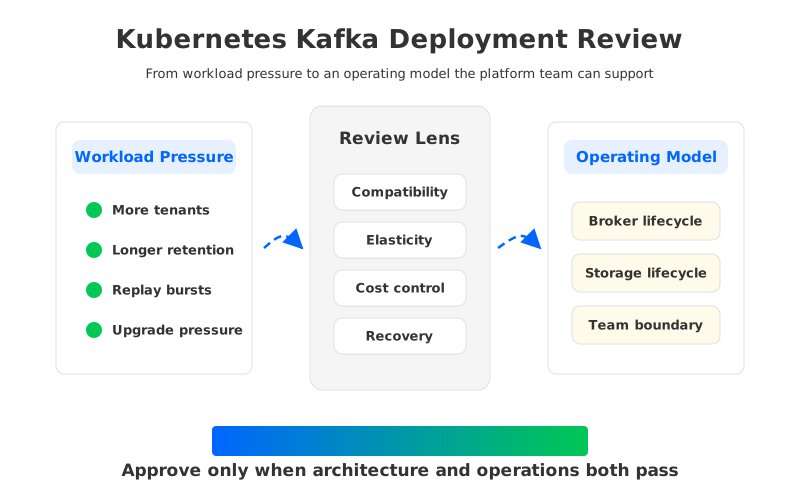
A search for kubernetes kafka deployment review usually starts when a cluster has moved past the proof-of-concept stage. The Helm chart installs, clients can produce and consume, dashboards show broker health, and the first platform team is preparing to bless the deployment for more applications. That is the moment when a Kafka-compatible workload stops being "a thing running on Kubernetes" and becomes shared production infrastructure.
The review is rarely about one YAML field. It is about whether the deployment model can carry durable event streams, compatibility expectations, predictable cloud cost, security boundaries, upgrade paths, and recovery operations. Kubernetes can schedule pods and attach volumes; it does not remove the architectural constraints of the streaming system inside those pods.
That distinction matters because Kafka-style workloads are stateful and sit on a critical path. A deployment review has to respect both. If reviewers only check whether StatefulSets, storage classes, probes, and anti-affinity rules exist, they miss the more important question: what happens when storage grows, brokers fail, partitions move, or a migration has to be rolled back under pressure?
1Why teams search for kubernetes kafka deployment review
The search intent is practical. Platform engineers want a checklist more useful than "use persistent volumes." SREs want to know which failure modes will wake them up. Architects want to compare self-managed Kafka, managed Kafka, and Kafka-compatible alternatives without flattening everything into a feature table. Application teams want a stable target that behaves like Kafka and does not make every capacity change a migration project.
Kubernetes adds useful primitives to this discussion. StatefulSets give stable network identities. PersistentVolumes attach durable storage to pods. PodDisruptionBudgets help control voluntary disruption. Operators and Helm charts make day-two automation repeatable. Those primitives are necessary, but Kafka-compatible streaming has its own operating model layered on top: topics, partitions, replicas, consumer groups, offsets, controller metadata, broker network paths, and retention policies.
A serious review therefore starts by naming the production promises the platform must keep:
- Kafka compatibility: Existing clients, protocol expectations, delivery semantics, consumer groups, and ecosystem tools should work without forcing every application team into a rewrite.
- Operational elasticity: Capacity should scale in a timeframe that matches demand, not in a timeframe dictated by large broker-local data movement.
- Cost visibility: Storage, compute, inter-zone networking, object storage requests, and support labor should be visible before the deployment becomes a shared dependency.
- Governance: Access controls, auditability, tenant boundaries, schema practices, and change ownership should survive growth beyond the first team.
- Recovery: The platform should define how broker failure, zone loss, bad releases, corrupted configuration, and migration rollback are handled.
These promises are not Kubernetes features. They are system-level outcomes. Kubernetes can help enforce placement, restart policies, and automation, but the streaming architecture decides how much state must move, how expensive durability becomes, and how quickly operators can recover from a bad day.
2The production constraint behind the problem
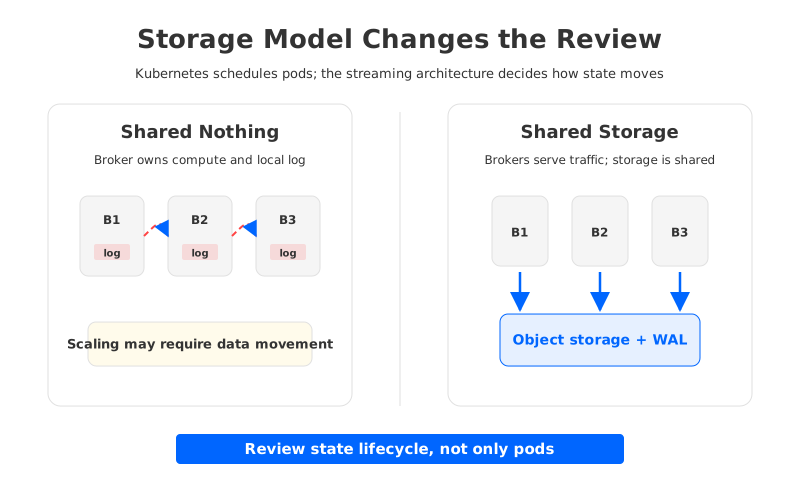
Traditional Apache Kafka was designed around a shared-nothing broker model. Each broker owns local log segments for its assigned partitions, and replication copies data across brokers for durability and availability. That design is coherent and battle-tested, but it turns durable storage into broker-local state. In Kubernetes, the state usually sits behind PersistentVolumes attached to broker pods.
This is where many deployment reviews become too shallow. A reviewer may confirm that each broker has a volume, each pod has resource requests, and each zone has placement rules. Those checks matter, yet they do not answer the harder capacity question. If a broker fails, a node pool changes, or partition ownership shifts, the cluster may need to move data before it reaches a healthy and balanced state.
The same constraint appears during growth. More brokers can add network and compute capacity, but they do not magically redistribute historical log data. Retention growth increases disk pressure. Repartitioning and reassignment can produce long-running operational work. Larger volumes can reduce the frequency of resizing events, but they also increase the amount of state tied to each broker. Kubernetes automates placement; it does not make broker-local storage stateless.
That does not mean Kafka on Kubernetes is wrong. It means the review has to be honest about the operating burden. The platform team should know which workloads are latency-sensitive, which topics are retention-heavy, which consumers replay frequently, and which data paths cross availability zones. Otherwise the deployment can look healthy during onboarding and still fail the first real scaling or recovery event.
3Architecture options and trade-offs
The most useful deployment review compares operating models instead of vendor labels. A Kubernetes-native posture can mean several different things: self-managed Kafka on StatefulSets, a Kafka operator, a managed Kafka service outside the cluster, or a Kafka-compatible platform that uses Kubernetes for compute while moving durable stream storage to shared cloud storage. Each model changes the review boundary.
| Deployment model | What Kubernetes owns | What the streaming platform still owns | Review pressure |
|---|---|---|---|
| Self-managed Kafka on StatefulSets | Pod identity, scheduling, volumes, disruption control | Broker-local logs, partition placement, replication, upgrades, rebalancing | Highest operational ownership for the platform team |
| Kafka operator | Reconciliation, rolling changes, some lifecycle automation | Architecture constraints, data movement, capacity planning, client compatibility | Automation quality and failure handling become central |
| Managed Kafka outside Kubernetes | Client connectivity, network policy, secrets, workload integration | Broker operations and storage handled by provider | Networking, cost, governance, and service limits dominate |
| Kafka-compatible shared-storage platform | Stateless broker scheduling and platform automation | Kafka semantics, storage architecture, WAL, object storage, control plane | Architecture fit, compatibility, object-storage path, and governance |
The table is not a shortcut to a decision. Self-managed deployments can be right when a team needs deep control and has Kafka operational expertise. Managed services can reduce day-two burden when provider constraints match the workload. Operators can make repeatable operations less error-prone. Shared-storage Kafka-compatible systems change the economics and recovery model, but still require careful network, security, and compatibility review.
The review should also separate storage architecture from Kubernetes maturity. A polished operator does not erase the fact that broker-local logs are still broker-local. A managed endpoint does not remove data transfer cost or governance questions. A shared-storage design does not remove the need to test Kafka client behavior, quota policies, and recovery runbooks. The goal is not to find the architecture with no trade-offs; it is to choose the trade-offs the organization can operate.
4Evaluation checklist for platform teams
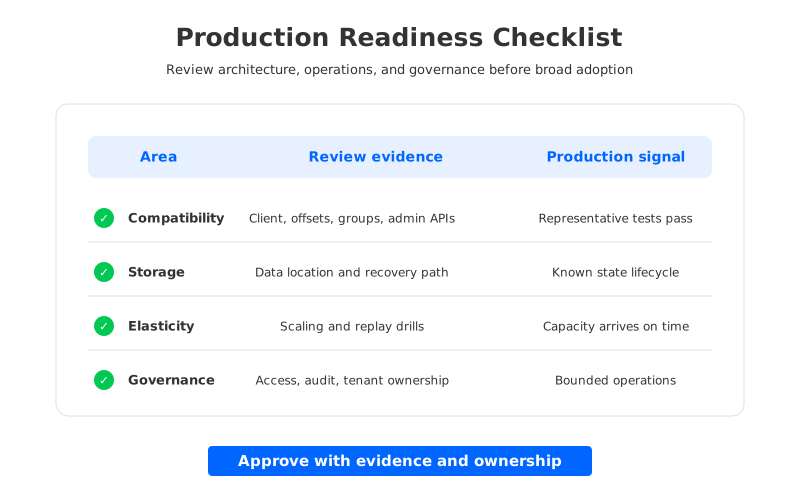
A strong checklist follows the lifecycle of the workload: design, deploy, scale, upgrade, recover, migrate, and govern. It should be specific enough that two reviewers would reach the same conclusion from the same evidence.
- Compatibility surface: Confirm the Kafka protocol version expectations, client libraries, producer idempotence, transactions if used, consumer group behavior, offset management, admin APIs, schema registry integration, Kafka Connect requirements, and monitoring tools. Compatibility is a workload contract, not a marketing label.
- State placement: Identify where durable log data lives, how it is replicated, how it is recovered, and what happens when pods, nodes, zones, or volumes fail. The review should include the slow path, not only the happy path.
- Capacity changes: Test how the platform adds brokers, expands storage, reassigns partitions, handles hot topics, and absorbs replay traffic. A cluster that scales only after a long rebalance may not meet business elasticity expectations.
- Network path: Map producer, broker, consumer, controller, connector, object storage, and observability traffic. Kubernetes service discovery is only one layer; cloud networking, private endpoints, inter-zone transfer, and firewall rules shape the actual path.
- Security boundary: Review authentication, authorization, secret rotation, network policies, encryption, administrative access, audit logs, and break-glass procedures. A platform shared by many application teams needs tenant-aware operations.
- Upgrade and rollback: Define how broker version changes, operator upgrades, Kubernetes upgrades, storage class changes, and client compatibility checks are staged. The rollback plan must name the point where rollback stops being safe.
- Observability: Require metrics for broker health, controller health, consumer lag, request latency, under-replicated partitions, storage use, object-storage access if applicable, network throughput, throttling, and cost signals.
The checklist should be executed against a production-shaped environment. A tiny topic and one test producer will not reveal whether the system can handle large partitions, many consumer groups, connector bursts, or a node drain during peak traffic. Reviewers need at least one failure drill and one scaling drill before they can trust the deployment model.
5How AutoMQ changes the operating model
Once the review separates Kubernetes mechanics from streaming architecture, AutoMQ becomes relevant for a specific reason: it keeps Kafka compatibility while changing how durable stream storage is operated in the cloud. AutoMQ is a Kafka-compatible cloud-native streaming platform built around Shared Storage architecture and stateless brokers. Instead of treating every broker as the long-term home for local log data, AutoMQ places durable stream storage on cloud object storage and uses a WAL layer for the write path.
That architectural shift changes several Kubernetes review questions. Broker pods become more like elastic compute serving Kafka traffic than long-lived owners of large local logs. Capacity planning can focus on compute, network, and workload shape, while durable data remains in shared storage. Broker replacement and scaling events have a different profile because the platform is not trying to move large volumes of partition history between brokers.
This is especially important for Kubernetes platform teams that support many internal tenants. A traditional broker-local design often forces them to reserve for peak storage, peak replay, and peak failure recovery at the same time. In a shared-storage design, retention and compute capacity can be reasoned about more independently. The review still has to validate object-storage access, WAL configuration, latency behavior, security boundaries, and observability, but it is no longer the same local-disk capacity exercise.
AutoMQ also fits teams that want customer-controlled deployment boundaries. In BYOC or self-managed deployment models, the data plane can run in the customer's cloud environment, using that environment's networking and object storage controls. That matters for architects reviewing Kubernetes workloads because the platform decision is not only "who operates brokers." It is also "where does durable event data live, who controls access, and how does the streaming layer align with cloud governance?"
The product should not be treated as a waiver for review discipline. Kafka compatibility still needs workload testing. Kubernetes scheduling still needs resource and disruption policies. Security still needs identity, network, and audit design. The difference is that the review can evaluate a cloud-native operating model where broker compute and durable storage are not fused into the same lifecycle.
6A deployment review scorecard
A scorecard turns the review into a repeatable decision instead of a debate about preferences. Use a simple scale such as strong, acceptable, weak, and unknown. Unknown is useful because it tells the team where to run a drill before approving broader adoption.
| Dimension | Strong signal | Weak signal |
|---|---|---|
| Kafka contract | Client, consumer group, offset, admin, and connector behavior tested with representative workloads | Compatibility assumed from a short smoke test |
| Storage model | Data location, replication, retention, recovery, and scaling paths are documented | Review stops at PersistentVolume existence |
| Elasticity | Capacity can be added without long surprise data movement or unclear ownership | Scaling depends on manual reassignment under pressure |
| Cost model | Compute, storage, networking, object storage, and operational labor are visible to owners | Cost appears only as node and volume spend |
| Governance | Access, audit, tenant boundaries, and change approval are explicit | Emergency admin access is the real operating model |
| Migration safety | Dual-write, mirror, cutover, rollback, and offset validation are rehearsed | Migration plan assumes clients switch once and stay switched |
The most valuable part of the scorecard is the conversation it forces. Data engineering may care most about connector compatibility and replay. SREs may care most about broker replacement, alerts, and incident ownership. Security may care about tenant boundaries and audit logs. Finance may care about retention, network paths, and overprovisioning. A review that ignores any of these groups can produce a technically correct cluster that still fails the organization.
Migration deserves special attention because Kafka-compatible workloads often arrive with existing producers, consumers, topics, ACLs, schemas, and operational habits. The safest migration plan treats compatibility as something to prove, not assume. Run representative clients, validate ordering and offsets, test consumer group behavior, stage connector workloads, compare lag and error metrics, and define the rollback window. If the review cannot explain how to return traffic to the original platform, the cutover plan is incomplete.
The final approval question is direct: can this platform absorb growth, failure, and organizational pressure without making every change a bespoke operation? Kubernetes gives teams a common control plane, but the streaming architecture decides the answer for durable event workloads.
If your kubernetes kafka deployment review is moving from checklist to architecture decision, evaluate AutoMQ against the same scorecard. Its Kafka-compatible shared-storage model is designed for teams that want cloud-native operations, customer-controlled deployment boundaries, and less broker-local storage coupling. Review the deployment model on the AutoMQ BYOC page and use the scorecard above as the baseline.
7References
- Apache Kafka documentation: Consumers and consumer groups
- Apache Kafka documentation: Kafka Connect
- Apache Kafka documentation: Message delivery semantics
- Apache Kafka documentation: KRaft
- Kubernetes documentation: StatefulSets
- Kubernetes documentation: Persistent Volumes
- Kubernetes documentation: Pod Disruption Budgets
- AutoMQ documentation: What is AutoMQ
- AutoMQ documentation: Compatibility with Apache Kafka
- AutoMQ documentation: Architecture overview
- AutoMQ documentation: Deployment overview
8FAQ
8.1Is Kubernetes enough to run Kafka-compatible workloads in production?
Kubernetes is a strong control plane for scheduling, automation, and platform standardization, but it does not remove the stateful behavior of Kafka-compatible systems. Reviewers still need to evaluate storage architecture, partition movement, client compatibility, recovery, networking, cost, and governance.
8.2What should a Kubernetes Kafka deployment review include?
It should include compatibility tests, storage and recovery design, capacity-change behavior, network path mapping, security boundaries, observability, upgrade procedures, and migration rollback. The review should also include at least one scaling drill and one failure drill in a production-shaped environment.
8.3How is a Kafka operator different from a cloud-native streaming architecture?
A Kafka operator automates deployment and lifecycle actions on Kubernetes. A cloud-native streaming architecture changes how the streaming system uses cloud primitives such as object storage, elastic compute, and managed networking. The two can overlap, but automation does not by itself change the underlying storage model.
8.4Where does AutoMQ fit in a Kubernetes review?
AutoMQ fits after the team has defined its Kafka compatibility, governance, cost, and recovery requirements. It provides a Kafka-compatible shared-storage architecture with stateless brokers, which can reduce broker-local storage coupling while keeping Kafka-facing workload contracts central to the design.


