
Table of Contents
Table of Contents
Searches for kubernetes kafka operations usually start after the easy part is already done. The cluster deploys. The pods are visible. The team has a Custom Resource that looks cleaner than a folder of shell scripts. Then the real questions arrive: what happens during a broker restart, a node drain, a storage expansion, a certificate rotation, a partition reassignment, or an urgent version upgrade?
Kubernetes is excellent at declaring desired state and reconciling workloads toward it. Apache Kafka is excellent at durable ordered logs, consumer coordination, and replay. Running Kafka on Kubernetes can be productive when those two models are aligned. It becomes painful when Kubernetes thinks it is replacing compute while Kafka is actually moving state.
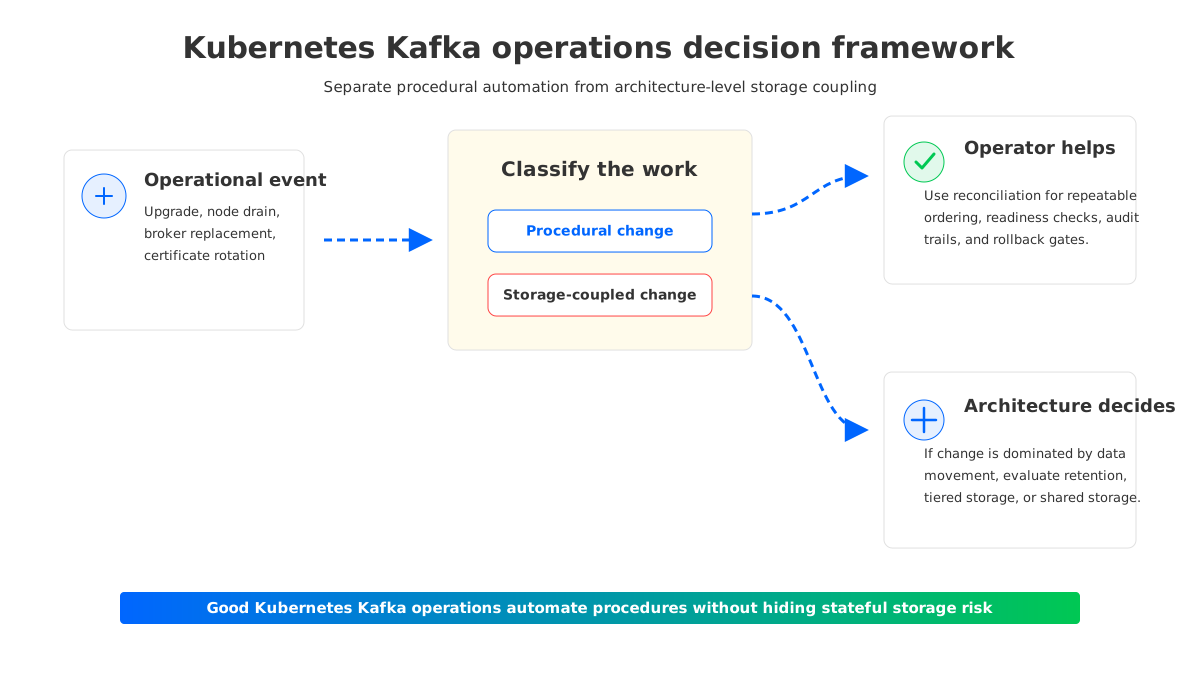
That is the tension operators expose. A Kafka operator can remove repetitive work, encode safe defaults, and make cluster lifecycle more auditable. It cannot erase the architecture underneath the cluster. If brokers own large local volumes, many Kubernetes operations remain storage operations in disguise.
1The Operator Is Not the Architecture
Kubernetes operators extend the Kubernetes control plane with domain-specific automation. An operator watches custom resources, compares declared intent with actual state, and applies changes. For Kafka, that can include broker configuration, listeners, certificates, rolling updates, topic resources, users, and supporting components.
That model is valuable because Kafka operations are full of order-dependent work. A safe rolling restart is not the same as deleting all pods and waiting for them to come back. A certificate rotation has to keep clients, brokers, and inter-broker communication aligned.
Operators help most when the operational procedure is known, repeated, and observable. They are less helpful when the hard part is the cost of the underlying state transition. If resizing a cluster requires moving large amounts of partition data, the operator can coordinate the process, but it cannot make that data movement disappear.
This is why "Kafka on Kubernetes" should not be evaluated as one question. It is three questions sitting on top of each other:
- Can Kubernetes represent the deployment cleanly? StatefulSets, persistent volumes, services, secrets, disruption budgets, and custom resources all need a coherent ownership model.
- Can the operator automate the lifecycle safely? Rolling updates, listener changes, certificate rotation, broker replacement, and topic operations need guardrails and clear rollback behavior.
- Can the Kafka architecture tolerate Kubernetes-style change? Broker-local storage, partition placement, replication traffic, and controller behavior determine whether a routine platform action becomes a recovery event.
The third question is the one teams tend to discover late. Kubernetes makes change frequent; Kafka's traditional storage model can make the same change expensive.
2Where Operators Help
A good Kafka operator standardizes the interface between application teams and the streaming platform. It also moves operational knowledge out of private runbooks and into a reconciled control loop that can be reviewed, versioned, and tested.
The strongest use cases are lifecycle tasks with well-defined safety conditions. Creating a cluster, updating broker configuration, rolling a patch version, rotating TLS certificates, reconciling listener settings, or managing users and topics are all good fits.
Operators also improve governance. A Custom Resource can be reviewed in Git before it changes production, and Kubernetes events provide an audit trail that is easier to inspect than one-off maintenance commands.
The operational benefit is clearest in these areas:
| Operation area | How an operator helps | What still needs human design |
|---|---|---|
| Cluster lifecycle | Creates and reconciles brokers, listeners, secrets, and supporting resources | Topology, availability targets, version policy, and failure-domain strategy |
| Rolling change | Orders pod restarts and waits for readiness conditions | SLO impact, maintenance windows, and rollback criteria |
| Security rotation | Coordinates certificates, users, and listener configuration | Trust model, client rollout sequencing, and emergency access |
| Topic and user management | Provides declarative resources and repeatable updates | Naming, quota policy, retention strategy, and ownership |
| Observability | Emits controller status and Kubernetes events | Kafka metrics, client impact, and business-level alert thresholds |
The table has a pattern: the operator handles repeatable mechanics, while the platform team still owns architecture and policy. Confusing those responsibilities creates automated fragility: the change runs faster, but the blast radius remains.
3Where Operators Hurt
Operators start to hurt when the abstraction hides a stateful operation behind a neat Kubernetes object. A Kafka custom resource might show replicas: 6, but changing that field is not equivalent to scaling a stateless web service. Kafka broker count, partition assignment, leader distribution, disk utilization, replication traffic, and client load are connected.
The same problem appears during node maintenance. Kubernetes node drains are routine for many workloads. For Kafka, draining a node can mean moving or restarting a broker that owns local log replicas.
Version upgrades create another trap. An operator may make upgrades look like a controlled rolling workflow, and that is useful. But Kafka upgrades also involve protocol compatibility, inter-broker versions, client behavior, feature flags, and controller metadata.
The risk is not that operators are bad. The risk is that they make some operations look more uniform than they really are.
A Kafka operator should reduce the number of manual steps. It should not reduce the number of architectural questions asked before those steps run.
Kubernetes rewards declarative changes. Kafka rewards careful respect for state. A reliable operating model has to satisfy both.
4The Stateful Broker Problem on Kubernetes
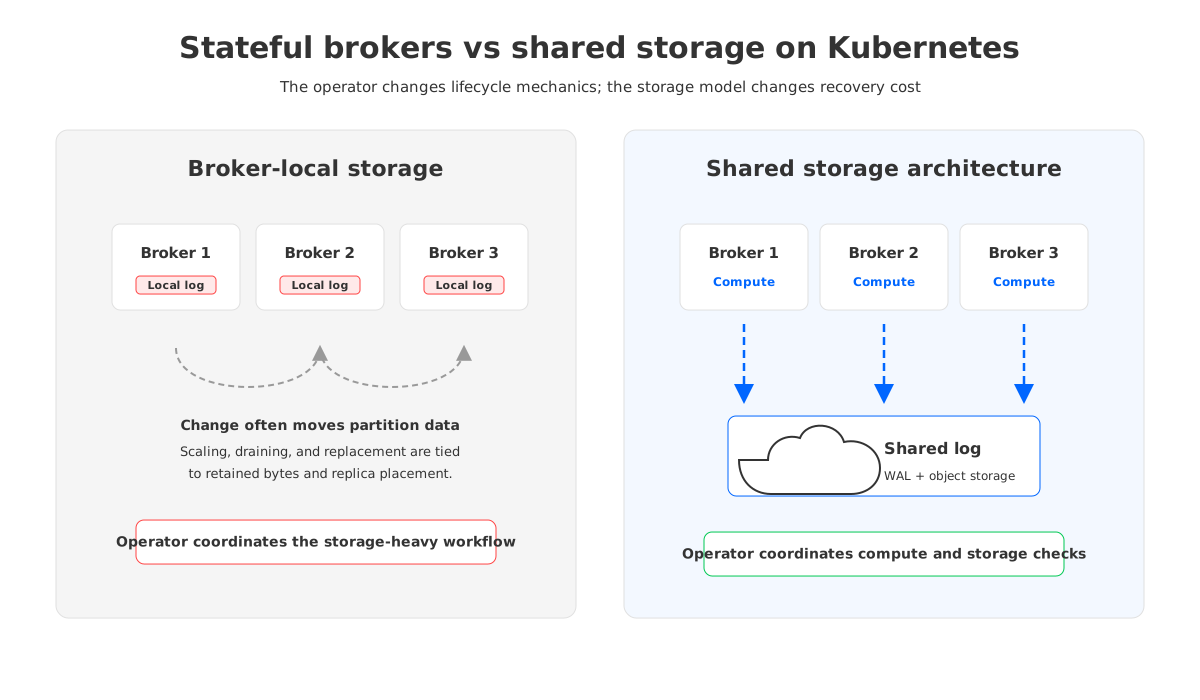
Traditional Kafka is a Shared Nothing system: brokers store partition replicas on local or attached disks, and replication distributes copies across brokers. This design has served Kafka well because it makes the broker a self-contained unit of serving and storage. It also means the broker is part of the durable data layout, not merely a replaceable compute pod.
Kubernetes can run stateful systems, but stateful systems do not become stateless because they run in a container. StatefulSets give stable network identities. Persistent volumes give storage continuity. Pod disruption budgets can limit voluntary disruption. These controls matter, but broker-local data ownership still couples scheduling, recovery, and scaling.
That coupling shows up in everyday platform work:
- Scaling out adds capacity slowly when partitions must be redistributed. New brokers do not help evenly until partitions and leaders move.
- Scaling in is a data safety event. Removing brokers requires reassignment, drain logic, and replica validation.
- Node replacement is not just pod replacement. The platform has to preserve or rebuild the broker's storage role.
- Long retention increases operational inertia. More retained bytes means more to protect, copy, rebalance, or recover.
This is why some teams are happy with Kafka operators while others feel trapped by them. If the workload has bounded retention and mature reassignment automation, the operator may be enough. If the business expects elastic capacity or frequent node turnover, broker-local storage can dominate the operating model.
5A Practical Evaluation Framework
The most useful Kubernetes Kafka evaluation starts by separating automation fit from architecture fit. Automation fit asks whether an operator can make the current operating model safer. Architecture fit asks whether the current model can support future workload growth, platform standardization, and governance.
Start with the failure and change events your team actually expects. A cluster that changes during quarterly maintenance has a different risk profile from a platform sharing Kubernetes nodes with critical services and aggressive patching windows. A cluster with 24-hour retention has a different storage profile from one retaining weeks of high-volume event history.
Use this decision sequence before choosing a tool or redesigning the platform:
- Inventory operational events. Include upgrades, certificate rotation, node drains, broker replacement, storage growth, scaling, topic changes, and rollback.
- Classify each event. If the work is mostly ordering and validation, an operator is a strong fit. If the work is dominated by data movement, architecture needs attention.
- Measure production-shaped impact. Test under realistic produce, consume, backfill, compaction, and rebalance conditions.
- Define ownership boundaries. Decide who owns Kubernetes resources, Kafka resources, cloud networking, storage policy, IAM, dashboards, and SLOs.
- Keep compatibility in the test plan. Kafka clients, consumer groups, transactions, ACLs, schemas, connectors, and monitoring integrations matter more than a clean infrastructure demo.
This framework prevents a common buying mistake: selecting an operator to solve a storage problem. Operators are often necessary, but they are rarely sufficient when every meaningful platform change is tied to broker-local data.
6Where Shared Storage Changes the Conversation
Once the evaluation reaches storage coupling, the architecture discussion becomes more interesting. Apache Kafka Tiered Storage can reduce pressure from long historical retention by moving older closed segments to remote storage. That helps when local disk growth is the main pain. It does not automatically make brokers stateless, because active logs and broker placement still matter.
A Kafka-compatible Shared Storage architecture goes further by moving durable stream data outside broker-local disks. The broker still handles Kafka protocol requests, leadership behavior, metadata participation, caching, and runtime coordination. The difference is that retained log data is not permanently owned by a specific broker's local volume.
That design changes the Kubernetes conversation. Scaling broker compute can be treated more like scaling a service tier, with storage-layer safety checks rather than large partition data relocation as the dominant concern. Broker replacement focuses on scheduling, metadata, WAL safety, object storage access, and cache warm-up.
AutoMQ belongs in this part of the evaluation as a Kafka-compatible, cloud-native streaming option built around Shared Storage architecture. It keeps Kafka protocol compatibility while using WAL storage and S3-compatible object storage underneath the broker layer. In AutoMQ BYOC and AutoMQ Software deployment models, teams can evaluate that architecture while keeping the data plane in a customer-controlled cloud or Kubernetes boundary.
Shared storage shifts the failure modes; it does not remove the need for operational proof. Platform teams still need to test WAL interruption, object storage latency, IAM policy mistakes, credential rotation, metadata scale, cache behavior, and client compatibility. The value is that common operations can stop being proportional to how much durable log data sits on a broker.
7Production Readiness Checklist
Kubernetes Kafka operations should be released like a platform capability, not installed like a package. A working operator is one input. The production test should prove that common changes are safe, observable, reversible, and compatible with dependent applications.
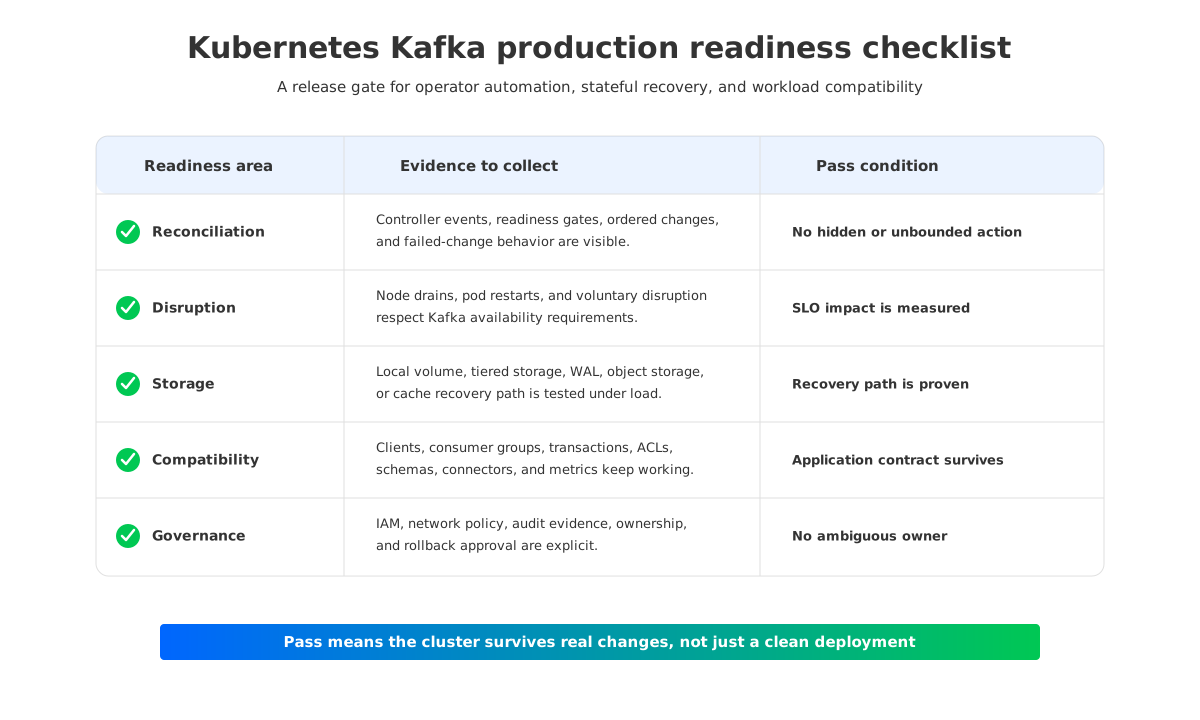
| Readiness area | What to prove | Why it matters |
|---|---|---|
| Reconciliation safety | Operator actions are ordered, observable, and bounded by readiness checks | Automation should reduce surprise, not accelerate it |
| Disruption control | Node drains and restarts respect Kafka availability requirements | Kubernetes maintenance can otherwise become a streaming incident |
| Storage behavior | Local volumes, tiered storage, WAL storage, or shared storage recovery paths are tested | Storage model determines the real cost of change |
| Compatibility | Clients, consumer groups, ACLs, schemas, and connectors behave as expected | Infrastructure success is irrelevant if applications break |
| Rollback | Failed upgrades and bad configs have clear stop or reverse paths | The middle of a change is where runbooks are tested |
| Governance | Resource ownership, IAM, network policy, audit evidence, and SLO ownership are explicit | Kafka on Kubernetes crosses platform, security, and data teams |
The checklist also clarifies when an operator is the right next investment. If failures come from manual drift or undocumented lifecycle steps, operator-driven reconciliation can produce immediate value. If failures come from data movement, storage growth, or long broker recovery, architecture needs to be evaluated alongside the operator.
8Decision Table
Use the table below to make the next step explicit before a proof of concept.
| Situation | Likely next step | Evidence to collect |
|---|---|---|
| Manual runbooks are inconsistent | Adopt or improve a Kafka operator workflow | Change history, rollback steps, and reconciliation events |
| Node drains frequently create incidents | Review disruption budgets, storage placement, and broker replacement design | Drain tests under load and recovery time |
| Scaling is blocked by partition movement | Evaluate storage architecture together with operator features | Reassignment traffic, retained bytes, and rebalance impact |
| Data plane must stay in your environment | Compare self-managed, BYOC, and software deployment boundaries | IAM model, network path, storage ownership, and audit evidence |
| Kafka compatibility is non-negotiable | Test real workloads before migration | Client versions, transactions, offsets, schemas, connectors, and ACLs |
Returning to the original search intent, kubernetes kafka operations is bigger than choosing an operator. The real decision is which parts of Kafka operations belong in Kubernetes reconciliation and which parts belong in architecture design. Operators help when the procedure is the problem. They hurt when they make a storage problem look like a YAML problem.
If your team is standardizing Kafka on Kubernetes, treat the operator as one layer of the platform, then test the storage and recovery model underneath it. For teams evaluating Kafka-compatible shared storage, the AutoMQ architecture overview and GitHub project are practical starting points for a workload-specific proof.
9References
- Kubernetes documentation: Operator pattern
- Kubernetes documentation: StatefulSets
- Kubernetes documentation: Disruptions
- Apache Kafka documentation
- Strimzi documentation: Operators overview
- AutoMQ Architecture Overview
- AutoMQ Compatibility with Apache Kafka
10FAQ
10.1Is running Kafka on Kubernetes a good idea?
It can be a good idea when the team has strong Kubernetes operations, clear storage policy, tested disruption controls, and a Kafka operator that matches the lifecycle model. It is risky when the team treats Kafka like a stateless service and ignores broker-local storage, partition placement, and client compatibility.
10.2What does a Kafka operator do?
A Kafka operator uses Kubernetes custom resources and reconciliation logic to automate lifecycle tasks such as cluster creation, configuration changes, listener management, certificate rotation, rolling updates, and sometimes topic or user management. The exact scope depends on the operator.
10.3Can a Kafka operator solve partition reassignment and broker scaling pain?
It can coordinate and standardize the workflow, but it cannot remove the cost of moving partition data in a broker-local storage architecture. If scaling pain is dominated by reassignment traffic, storage architecture should be evaluated alongside operator automation.
10.4How do StatefulSets help Kafka on Kubernetes?
StatefulSets provide stable pod identity and ordered deployment behavior, which are useful for stateful systems such as Kafka. They do not make brokers stateless. Persistent volumes, disruption budgets, and Kafka-level recovery still need explicit testing.
10.5Where does AutoMQ fit in Kubernetes Kafka operations?
AutoMQ fits when a team wants Kafka compatibility but is evaluating a more cloud-native operating model based on shared storage and more stateless brokers. In Kubernetes environments, that can reduce coupling between broker scheduling and retained data, but teams should still test workload compatibility, WAL behavior, object storage access, and recovery.


