
Table of Contents
Table of Contents
A platform team searching for kubernetes operator migration kafka is usually past the point of asking whether Kafka can run on Kubernetes. The harder question is whether the current operator, cluster layout, storage model, and migration runbook can survive a production cutover. Kafka workloads carry client compatibility, topic configuration, consumer group state, connector dependencies, security policies, and retention guarantees. Kubernetes adds another control plane: custom resources, reconciliation loops, StatefulSets, persistent volumes, scheduling rules, and upgrade automation.
The risk is not that an operator applies the wrong YAML once. The risk is that the operator keeps doing exactly what it was designed to do while the migration changes the meaning of that desired state. A broker restart, PVC replacement, rack constraint, or storage expansion can be routine in one environment and disruptive in another. When the team is also moving from broker-local Kafka to a Kafka-compatible target, the migration needs gates that prove the workload contract, not only the Kubernetes objects.
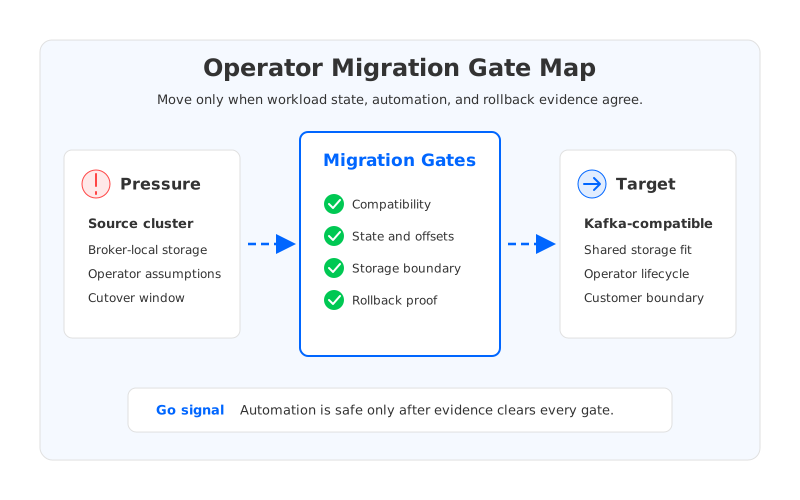
The useful framing is not "which operator should we use?" It is "what has to be true before the operator becomes a safe automation layer for this workload?" The migration plan then becomes a sequence of gates: compatibility, state, storage, network, governance, recovery, and rollback.
1Why Teams Search for kubernetes operator migration kafka
Kubernetes operators are attractive because they turn a complex system into a declarative resource. A team can describe a Kafka cluster, topic policy, listener, storage class, or upgrade target, and the operator reconciles the running system toward that desired state. That model works well when the desired state is stable and the operator's assumptions match the cluster's architecture.
Migration breaks that comfort. The source and target environments may use different operators, storage classes, networking models, broker identities, listener formats, or topic management patterns. A resource that looks familiar in YAML may represent a different operational contract underneath. For example, a broker replica backed by a persistent volume is not the same operational object as a Kafka-compatible broker whose durable data lives in shared storage. Treating both as interchangeable pods hides the migration risk rather than reducing it.
Kafka also resists shallow migration checks. Producers care about acknowledgments, idempotence, TLS, ACLs, and broker addresses. Consumers care about group coordination, committed offsets, fetch behavior, rebalances, and lag. Connectors care about internal topics, task state, credentials, schemas, and sink idempotency. A Kubernetes operator can manage cluster lifecycle, but it cannot declare that all these contracts are equivalent without workload-specific evidence.
Operator migration should start with gates instead of a manifest diff. The manifest tells the team what Kubernetes will attempt. The gates tell the team whether the attempt is safe for Kafka.
2The Production Constraint Behind the Problem
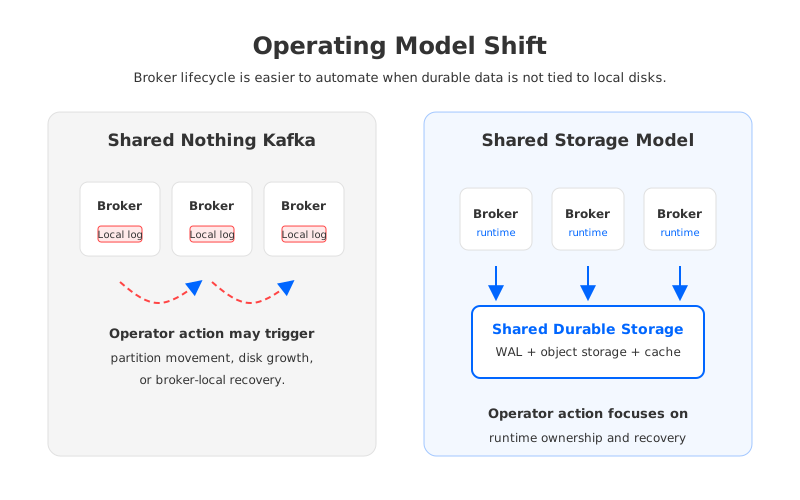
Traditional Kafka's Shared Nothing architecture binds durable log data to broker-local storage. That design has served production systems for years, but it makes Kubernetes migration more complicated because broker identity, local disks, partition leadership, and retained data are tied together. When the operator changes a broker pod, volume, or node placement, the Kafka cluster may need to move data or recover replicas before the workload is steady again.
Kubernetes makes this visible through objects that look clean but hide expensive work. A StatefulSet ordinal can preserve identity, while the underlying volume still has to be attached, expanded, rebuilt, or replaced. A PodDisruptionBudget can limit simultaneous disruption, while a broker-local log can still be the long pole in recovery. A storage class can provision capacity, while partition growth and retention policy decide whether that capacity is actually enough. The operator reconciles objects; Kafka reconciles data.
This is also where cloud cost enters the migration. Broker-local Kafka often pays for storage headroom, cross-zone replication paths, and capacity reserved for data movement during failure or reassignment. During migration, those costs can rise because teams run source and target paths in parallel, increase retention windows, or replay consumers for validation. A plan that works only when validation is short is not a strong plan.
The production constraint is broader than Kubernetes readiness. A serious migration must prove that automation will not amplify state movement. The operator should make lifecycle work repeatable, while the architecture keeps durable data, broker replacement, and workload cutover from becoming one coupled event.
3Architecture Options and Trade-offs
Platform teams usually evaluate three operating models for Kafka on Kubernetes. The first is self-managed Apache Kafka with an operator that controls brokers, volumes, topics, users, and upgrades. This keeps strong ownership and familiar Kafka semantics, but the team owns storage sizing, partition reassignment, broker failure behavior, and operational dependencies.
The second model is a managed Kafka service or externally managed Kafka-compatible platform with Kubernetes applications connecting through private networking. This can reduce Kafka lifecycle work inside the Kubernetes cluster, but it may move governance, network routing, cost visibility, and migration control into another service boundary. For some teams that is a good trade; for others it weakens the platform team's ability to enforce workload gates.
The third model is a Kafka-compatible cloud-native platform where the Kubernetes operator manages compute and lifecycle while durable stream data is separated from broker-local disks. Broker pods become closer to replaceable runtime units. The model still has to prove Kafka compatibility, latency, durability, observability, and governance, but storage growth and broker replacement are no longer treated as the same problem by default.
| Operating model | What Kubernetes manages | Main migration risk |
|---|---|---|
| Broker-local Kafka on Kubernetes | Stateful broker pods, PVCs, listeners, topics, upgrades | Operator actions may trigger data movement, storage pressure, or long broker recovery. |
| External managed Kafka service | Client connectivity, secrets, network policy, application deployment | Platform teams may lose direct control over lifecycle, cost drivers, and rollback evidence. |
| Kafka-compatible shared storage | Broker compute, lifecycle, metadata, storage integration | Teams must validate compatibility, WAL behavior, object storage policy, and recovery semantics. |
No model removes the need for a migration runbook. The practical difference is what the runbook spends its energy on. If most of the work is protecting local disks and moving partitions, the operator is managing a stateful storage estate. If most of the work is validating client behavior, governance, and recovery boundaries, the operator is closer to a platform automation layer.
4Evaluation Checklist for Platform Teams
The migration gates should be written before the target operator is trusted with production. A gate is not a task. A task says "apply the target manifest." A gate says "the target manifest may be applied only after these workload properties have been proven." Operators are good at repetition and poor at judgment.
Use the following checklist to turn the migration from a deployment event into a controlled platform decision:
- Compatibility gate: producers, consumers, admin clients, security settings, topic configuration, consumer groups, transactions, and connector behavior have been tested against the target Kafka-compatible environment.
- State gate: topic metadata, offsets, consumer group ownership, internal connector topics, ACLs, and secrets have a named source of truth for each phase.
- Storage gate: the team knows where durable log data, WAL data, object storage, caches, and local volumes live, and which component owns each failure mode.
- Network gate: listeners, DNS, private connectivity, cross-zone paths, ingress policy, and egress cost are mapped before dual-running begins.
- Governance gate: Kubernetes RBAC, cloud IAM, encryption keys, audit logs, data residency, and operational access are reviewed as one boundary.
- Recovery gate: broker failure, node drain, operator restart, storage degradation, and controller failure have been rehearsed in the target model.
- Rollback gate: the team can state the rollback position, data invariant, traffic switch, and owner without relying on memory during an incident.
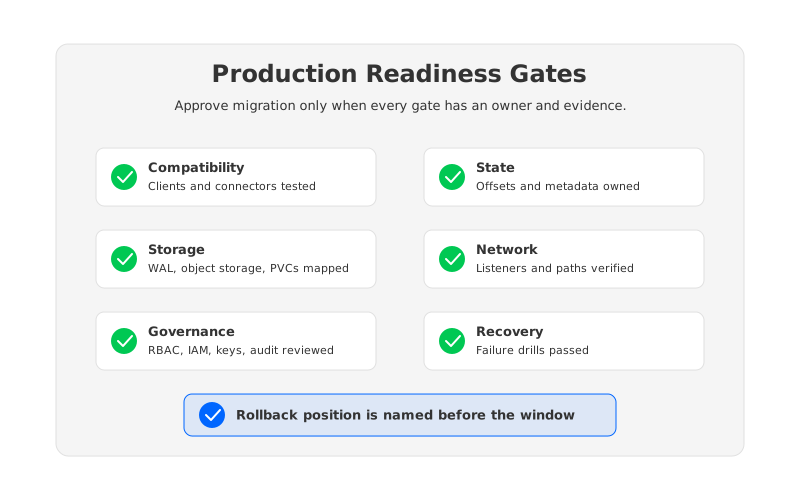
The strongest checklist has evidence attached. A compatibility gate should point to client test results, not an assumption that "Kafka-compatible" means every workload behaves the same. A storage gate should include storage classes, object buckets, WAL choice, and encryption policy. If a gate cannot produce evidence, it is still a hypothesis.
5How AutoMQ Changes the Operating Model
After the neutral gates are clear, AutoMQ becomes relevant as a Kafka-compatible streaming platform built around Shared Storage architecture and stateless broker operation. It keeps the Kafka protocol surface while moving durable stream storage away from broker-local disks and into an object-storage-backed design with WAL storage on the write path. From a Kubernetes operator perspective, that changes what broker lifecycle automation has to protect.
In a broker-local model, a broker pod is both compute and the owner of local persistent log replicas. The operator may restart or replace the pod, but the data consequences are still bound to local storage and partition placement. In AutoMQ's shared-storage model, brokers handle Kafka-facing compute, partition leadership, caching, and request routing, while durable data is backed by shared storage. Broker replacement becomes less about rebuilding the authoritative log from a specific local disk and more about restoring runtime ownership and traffic placement.
That difference matters during migration gates. The storage gate can focus on object storage policy, WAL configuration, encryption, and access boundaries instead of sizing every broker disk for retained data. The recovery gate can test broker replacement without making local log movement the center of the exercise. The elasticity gate can evaluate compute scaling separately from retained storage growth. The governance gate can review a customer-controlled deployment boundary when AutoMQ BYOC or AutoMQ Software fits the organization's cloud or private infrastructure model.
AutoMQ Linking is also relevant when the migration is from an existing Kafka or Kafka-compatible cluster. Migration tooling still has to respect producers, consumers, offsets, and cutover sequencing, but the platform can provide a coordinated path rather than leaving teams to stitch replication, client switching, and offset handling into separate scripts. The gates still matter; they now have a more precise implementation target.
The most important discipline is to keep AutoMQ evaluation tied to workload proof. Test the clients that matter, not a sample producer. Rehearse a broker failure while traffic is flowing, not after the demo is idle. Validate the operator's behavior during node drain, scaling, and failed reconciliation. Check observability for Kafka metrics, Kubernetes events, storage signals, and business-level freshness together. A shared-storage architecture changes the operating model, but production confidence still comes from evidence.
6Migration Gate Matrix
A migration gate matrix helps keep the discussion out of vendor language and inside operational proof. Each row should have an owner, an evidence source, and a go/no-go rule. If a gate has no owner, it is not a gate. If the evidence is "we expect it to work," it is not evidence.
| Gate | Evidence to collect | Go/no-go signal |
|---|---|---|
| Client contract | Producer, consumer, admin, and connector tests using production-like configs | No application rewrite is required for the approved workload slice. |
| Operator lifecycle | Upgrade, restart, scale, and reconciliation tests under traffic | Operator actions do not violate workload SLOs or recovery invariants. |
| Storage boundary | WAL, object storage, PVC, encryption, and retention review | Durable data ownership is documented and matches governance policy. |
| Cost boundary | Dual-running, replay, retention, and network path estimate | Validation can run long enough without forcing a risky short window. |
| Rollback | Offset position, traffic route, validation query, and owner | The old path can resume from a named state without uncontrolled duplicates or gaps. |
The matrix is stricter than a deployment checklist because Kafka migrations fail in the spaces between systems. An operator may report healthy reconciliation while a consumer group is unstable. A target cluster may accept writes while a downstream sink is applying duplicates. The matrix forces those differences into the open before the production window.
7Practical Cutover Sequence
A safe operator migration usually moves in slices. Start with a non-critical topic family, keep producers and consumers separate in the plan, and avoid changing connector runtime, schema policy, and cluster architecture in the same step without a strong reason. The goal is to create a narrow proof loop: one workload, one target environment, one rollback path, and one set of validation signals.
The sequence should begin with target readiness under synthetic and replayed traffic. Then the team can mirror or link data where appropriate, validate consumer behavior, and move producers only after the read side has a known recovery position. For connector-heavy workloads, internal Connect topics and sink idempotency need their own gate. For regulated workloads, IAM, encryption keys, bucket policy, and audit logging should be reviewed before data enters the target environment.
The last step is the holdback window. Do not dismantle the source path as soon as the target looks green. Keep the old path, offsets, retention, and traffic route available for an agreed period while downstream owners validate freshness and correctness. The holdback window is not indecision. It is the period where rollback remains a real option instead of a sentence in a runbook.
If your team is planning a Kubernetes operator migration for Kafka-compatible infrastructure, start by writing the gates before choosing the window. Then test one workload against the architecture that will carry production. To evaluate a shared-storage Kafka-compatible operating model in your own environment, start with AutoMQ Cloud and compare operator lifecycle, storage boundaries, rollback behavior, and client compatibility against your current Kafka plan.
8References
- Kubernetes documentation: Operator pattern
- Kubernetes documentation: StatefulSets
- Apache Kafka documentation: KRaft mode
- Apache Kafka documentation: Kafka Connect
- Apache Kafka documentation: Tiered Storage
- AutoMQ documentation: Compatibility with Apache Kafka
- AutoMQ documentation: Architecture overview
- AutoMQ documentation: WAL storage
- AutoMQ: Kafka Linking for migration and replication
- AWS documentation: Amazon S3 user guide
9FAQ
9.1What is a Kubernetes operator migration for Kafka?
A Kubernetes operator migration for Kafka is the process of moving Kafka cluster lifecycle management, or the Kafka-compatible cluster itself, from one operator or operating model to another. It should cover Kafka client compatibility, topic and consumer state, broker lifecycle, storage ownership, networking, governance, observability, and rollback.
9.2Why are migration gates more useful than a YAML checklist?
YAML shows desired Kubernetes state, but Kafka safety depends on workload behavior. Migration gates require evidence that producers, consumers, offsets, storage, security, and recovery behavior are safe before the operator applies production changes.
9.3Does shared storage remove the need for Kafka migration testing?
No. Shared storage can reduce the coupling between broker lifecycle and durable data, but teams still need compatibility tests, failure rehearsals, governance review, and rollback validation. The architecture changes what must be tested; it does not remove the testing requirement.
9.4Where does AutoMQ fit in a Kubernetes operator migration?
AutoMQ fits when the team wants Kafka-compatible APIs with a shared-storage operating model, stateless broker behavior, and customer-controlled deployment options. It should be evaluated after the team defines migration gates for compatibility, storage, governance, recovery, and rollback.


