
Table of Contents
Table of Contents
The hard part of lakehouse CDC ingestion is not getting one database change into one table. Most teams can do that in a lab with a connector, a Kafka topic, and a sink job. The hard part starts when the same path has to serve many databases, many downstream engines, evolving schemas, security boundaries, replay requirements, and a freshness target that the business has already started treating as normal. At that point, "CDC to the lakehouse" stops being a connector decision and becomes a platform decision.
Kafka usually sits in the middle because it gives teams a durable event log, replay, ordering within partitions, mature client libraries, and an ecosystem around Kafka Connect and stream processing. The lakehouse side brings a different set of expectations: table formats such as Apache Iceberg, catalog integration, schema evolution, query engines, governance, and batch-plus-stream consumption.
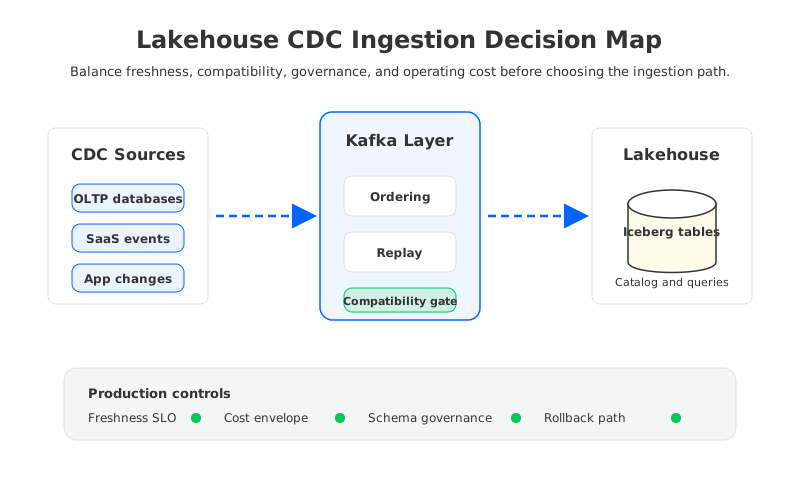
That is why the search query lakehouse cdc ingestion kafka is more interesting than it looks. It is not only asking how to wire components together. It is asking how a data platform team should design an ingestion path that remains operable after the prototype becomes shared infrastructure.
1Why lakehouse CDC changes the Kafka conversation
Traditional Kafka architecture discussions often begin with broker sizing, partition count, retention, and replication factor. Those are still important, but CDC-to-lakehouse workloads add a second clock. Kafka measures whether records are accepted, replicated, retained, and consumed. The lakehouse user cares whether a change is visible in a table, discoverable through the catalog, readable by a query engine, and consistent with downstream governance rules.
That difference matters because a healthy Kafka cluster can still produce an unhealthy lakehouse ingestion experience. Brokers may have normal request latency while the sink job is falling behind. Consumer lag may look acceptable while table commit conflicts are slowing down visibility. A schema change may be valid for a topic but invalid for a table contract.
The first design move is to define freshness as an end-to-end service level objective. For CDC ingestion, the clock starts when the source change becomes available and stops when the corresponding table state is queryable under the expected catalog and access policy. That definition forces teams to include the connector, Kafka topic, transformation job, table writer, catalog operation, object storage behavior, and query engine visibility in the same operating model.
There are several consequences:
- The Kafka topic is a recovery boundary. If the table writer fails, the topic should preserve enough history to rebuild or replay without going back to the source system.
- The table format is a governance boundary. Schema evolution, delete handling, partition strategy, and snapshot behavior belong in the design, not in an afterthought runbook.
- The connector is a contract boundary. The source connector, sink connector, and transformation job need clear ownership because each one can change the meaning of a record.
- The cloud bill is an architecture signal. Broker-local disks, replication traffic, object storage requests, cross-zone traffic, and compute headroom all scale with workload shape.
The point is not that every team needs a complex architecture. A small operational database feeding one analytics table can tolerate a simple path. A multi-domain CDC platform feeding fraud, personalization, financial reporting, and AI feature pipelines needs stronger controls.
2Stream-to-table architecture options
Most lakehouse CDC designs start from one of three patterns. The names vary by organization, but the trade-off is stable: how much logic stays in the streaming layer, how much moves into the table writer, and how much the platform team is willing to own centrally.
| Pattern | Where it fits | Main risk to test |
|---|---|---|
| Source connector to Kafka, then sink to table | Teams want Kafka as the durable buffer and replay layer between operational systems and lakehouse tables. | The sink path can become the hidden bottleneck if table commits, schema evolution, or object storage behavior are not monitored. |
| Stream processing job to table | Teams need enrichment, filtering, joins, deduplication, or format normalization before table writes. | The job becomes a stateful production service, so checkpointing, backfill, and rollback need explicit ownership. |
| Kafka-compatible stream table integration | Teams want Kafka ingestion and lakehouse table access to be closer parts of the same platform. | Compatibility, table semantics, and operational tooling must be verified against real producers, consumers, and query engines. |
The first pattern is often the easiest to adopt because it separates source capture, streaming buffer, and table write. The weakness is that the sink path can look small while carrying the table's freshness and correctness guarantee. The second pattern gives data engineers more control over enrichment and validation, but job state, checkpoints, backpressure, and releases become part of the SLO. The third pattern can reduce moving parts, but it raises the bar for due diligence around client behavior, table semantics, catalog integration, object storage permissions, and rollback.
3The evaluation checklist platform teams actually need
The right architecture is the one whose failure modes your team can operate. That sounds obvious until a lakehouse ingestion project is evaluated only by throughput in a benchmark. Throughput matters, but CDC workloads are usually constrained by the slowest responsible boundary: source database impact, connector stability, partition design, table commit cadence, schema governance, cloud network path, or organizational ownership.
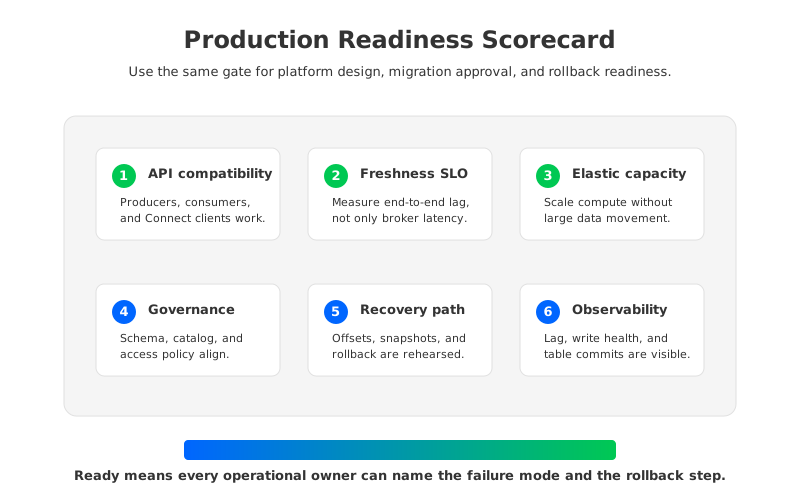
Start with compatibility. Producers, consumers, Kafka Connect tasks, schema registry usage, admin operations, security settings, and client versions all need to behave as expected. Kafka compatibility is not a slogan; it is a test plan covering writes, consumer group rebalances, offset commits, backfills, connector restarts, topic configuration changes, and failure recovery.
Then test freshness using the real end-to-end clock. Broker metrics are necessary, but they are not sufficient. The platform should know how much time is spent in source capture, Kafka buffering, transformation, table write, catalog commit, and query visibility. When freshness slips, the on-call engineer should be able to say where the delay is accumulating. Without that breakdown, every incident becomes a hunt through loosely connected dashboards.
Cost deserves the same mechanical treatment. Avoid broad claims such as "object storage makes this low cost" or "managed Kafka is expensive." The useful question is where the workload spends money as volume increases: retained data, write throughput, replication paths, multi-zone traffic, object storage requests, table maintenance, and compute headroom.
Governance is the row teams underweight most often. CDC records can carry deletes, personally identifiable information, masked columns, schema drift, and operational metadata. The ingestion platform should define who can add a source, who approves schema evolution, how delete semantics are represented, and how sensitive fields are protected before broad analytics access.
Recovery is where platform maturity shows. A credible design can answer what happens when a connector writes malformed records, a table writer commits a bad schema, a source database changes a column type, or a consumer offset moves past the last correct point. The answer should include offsets, snapshots, table metadata, source capture position, and rollback ownership.
4Where traditional Kafka operations become expensive
Kafka's Shared Nothing architecture is a proven model: brokers own local log segments, replication creates durable copies, and partitions move by moving data between brokers. That model works, but it couples compute, storage, and data ownership. For lakehouse CDC ingestion, the coupling becomes visible because retained history, replay safety, and freshness all pull on the same broker fleet.
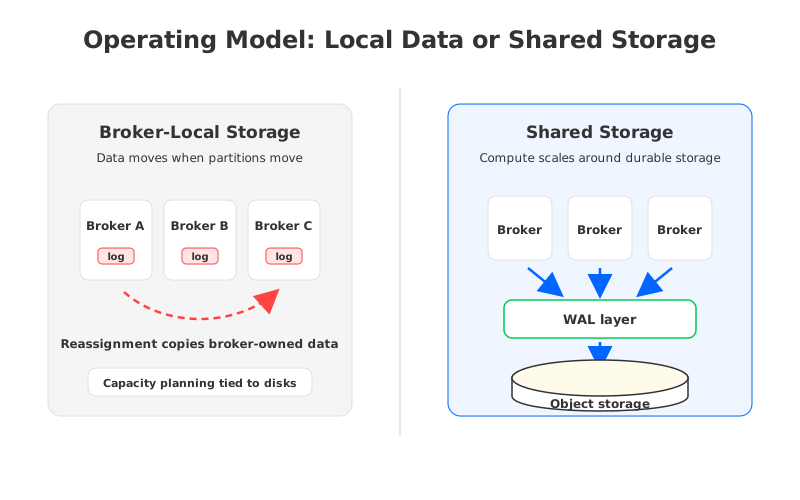
The first pressure is capacity planning. CDC topics often keep enough retention to survive downstream outages, rebuild tables, or replay late-discovered transformations. With broker-local storage, that retained data sits inside the broker sizing problem. More retention means more disk, more throughput often means more brokers, and partition movement means data movement across the cluster.
The second pressure is operational recovery. Broker replacement, partition reassignment, and cluster expansion are not only scheduling operations; they are data movement operations. When the cluster is also serving lakehouse CDC ingestion, those operations compete with the same network, disk, and broker resources the workload depends on.
The third pressure is cloud topology. Multi-zone deployments are usually necessary for production availability, but they make data movement visible in both architecture and cost. Exact charges depend on cloud provider, region, and topology, yet the architectural lesson is stable: if durability depends on broker-to-broker movement, the network path is part of the storage design.
Tiered Storage can help with long retention by moving colder data to object storage, but it does not automatically make brokers stateless. Hot data, partition leadership, local disks, and reassignment behavior still matter. If the pain is mostly historical retention, Tiered Storage may be enough. If the pain is elastic scaling, broker replacement, cross-zone data movement, and storage ownership, evaluate Shared Storage architecture.
5How AutoMQ changes the operating model
Once the evaluation is framed around compatibility, freshness, cost, governance, recovery, and ownership, a different architectural category becomes relevant: Kafka-compatible streaming with Shared Storage architecture. The goal is not to replace the Kafka API that applications already use. The goal is to remove broker-local retained storage as the center of the operating model while keeping producers, consumers, Kafka Connect, and ecosystem tools familiar.
AutoMQ fits in that category. AutoMQ is a Kafka-compatible streaming platform that uses Shared Storage architecture: brokers focus on compute and protocol-serving responsibilities, while durable stream data is backed by object storage through S3Stream and WAL storage handles the low-latency write path. Broker replacement and scaling are less tied to moving retained log data from one broker's disks to another broker's disks.
This matters because the ingestion layer is often asked to do two jobs at once. It must behave like Kafka for applications and connectors, and it must support cloud-native economics and recovery behavior for the platform team. Kafka compatibility protects the application surface. Object-storage-backed durability and stateless brokers change the infrastructure surface.
AutoMQ also matters when deployment boundaries are part of the decision. AutoMQ BYOC is designed for customer cloud accounts, and AutoMQ Software is designed for customer-managed environments. For CDC workloads that carry sensitive operational data, security teams want to know where data, credentials, metadata, logs, and control operations live.
Table-oriented integration is the other reason AutoMQ belongs in the lakehouse conversation. AutoMQ Table Topic is designed to connect streaming data with Apache Iceberg table workflows. That does not remove the need for Iceberg governance, catalog design, schema review, compaction planning, and query engine validation. It changes where the platform team can simplify the ingestion path after the basic operating gates are satisfied.
Evaluate AutoMQ with one representative CDC domain: a source database, a few tables, a target Iceberg catalog, an expected freshness SLO, one backfill case, one schema evolution case, and one rollback case. If the bottleneck is broker-local storage ownership, slow scaling, cross-zone movement, or hard-to-govern data-plane boundaries, AutoMQ belongs on the shortlist.
6Migration and rollout pattern
Migration should be staged by data domain. A team that moves every CDC topic at once learns too many things during the same incident window. Start with a source that is realistic but bounded enough to rehearse rollback.
A practical migration plan has four gates. Inventory source tables, keys, delete semantics, topics, consumer groups, downstream tables, access policies, and freshness expectations. Shadow the new path long enough to compare record counts, snapshots, lag, schema behavior, and query results. Cut over one consumer or table family while preserving the rollback point, then clean up duplicate jobs, temporary retention, and ownership documents.
During rollout, watch for the boring signals: stable connector restarts, expected offset movement, regular table commits, explainable freshness spikes, and cost drivers that match the design. A CDC platform that produces no surprises after cutover has done its job.
7Decision matrix
The final decision is less about which component looks strongest in isolation and more about where the organization's constraint actually sits.
| Constraint | Traditional Kafka may be enough when... | Evaluate Shared Storage architecture when... |
|---|---|---|
| Freshness | The workload is small, stable, and table commits are the dominant source of delay. | Broker scaling, reassignment, or retention pressure repeatedly affects ingestion stability. |
| Cost | Storage and network movement are not major cost drivers. | Retained CDC history, multi-zone traffic, or peak provisioning dominate the platform bill. |
| Governance | A small team owns both source capture and lakehouse publication. | Many domains need self-service ingestion with consistent security, schema, and rollback controls. |
| Migration risk | Applications tolerate limited changes and the pipeline has few consumers. | Kafka client compatibility and offset continuity are essential to avoid application rewrites. |
| Operations | Broker-local storage runbooks are mature and incidents are rare. | Broker replacement, scaling, and data movement consume too much SRE attention. |
This matrix prevents a common mistake: treating lakehouse CDC ingestion as only a data engineering project. The table writer is important, but the platform underneath determines retained-history cost, recovery, replay depth, and scaling behavior.
If your team is evaluating a Kafka-compatible lakehouse CDC path, test the operating model before the component list hardens into architecture. Start with a real source, table, rollback, and cost baseline. When Shared Storage architecture belongs in that evaluation, explore AutoMQ from the AutoMQ BYOC entry point and compare it against the same compatibility, freshness, governance, and recovery gates.
8References
- Apache Kafka documentation
- Apache Kafka Connect documentation
- Apache Iceberg documentation
- AutoMQ Kafka compatibility
- AutoMQ S3Stream Shared Storage overview
- AutoMQ Table Topic overview
- AutoMQ zero cross-AZ traffic overview
9FAQ
9.1Is Kafka required for lakehouse CDC ingestion?
No. Some teams write CDC changes directly into lakehouse tables. Kafka becomes valuable when the team needs durable replay, multiple downstream consumers, decoupled source capture, mature client tooling, and a clearer recovery point.
9.2What is the most common mistake in Kafka-based CDC ingestion?
The most common mistake is measuring only the Kafka layer. A pipeline can have healthy brokers and still miss the freshness target because delay sits in the connector, processing job, table writer, catalog commit, or query visibility path.
9.3Does Tiered Storage solve lakehouse CDC ingestion cost?
It can help when long retention is the main pressure, but it is not the same as a Shared Storage architecture. Brokers may still own hot data and participate in data movement during operations, so teams should test the exact cost driver.
9.4How should teams test Kafka compatibility before migration?
Use representative producers, consumers, Kafka Connect tasks, security settings, topic configurations, and failure cases. Include offset commits, Consumer group rebalances, backfills, connector restarts, admin operations, schema changes, and rollback.
9.5Where does AutoMQ fit in a lakehouse CDC architecture?
AutoMQ fits when a team wants Kafka compatibility but needs Shared Storage architecture, stateless brokers, object-storage-backed durability, and customer-controlled deployment boundaries. It is most relevant when broker-local storage, scaling, cross-zone movement, or governance boundaries are becoming the limiting factor.


