
Table of Contents
Table of Contents
Teams search for lakehouse fan out control kafka when a familiar streaming pattern starts to strain. Kafka is already feeding applications, alerts, search indexes, and feature pipelines. Then the lakehouse becomes another major consumer, not as a single sink but as table writers, validation jobs, and backfills. The problem is whether the platform can control that fan-out without turning every freshness request into broker load, storage growth, and incident risk.
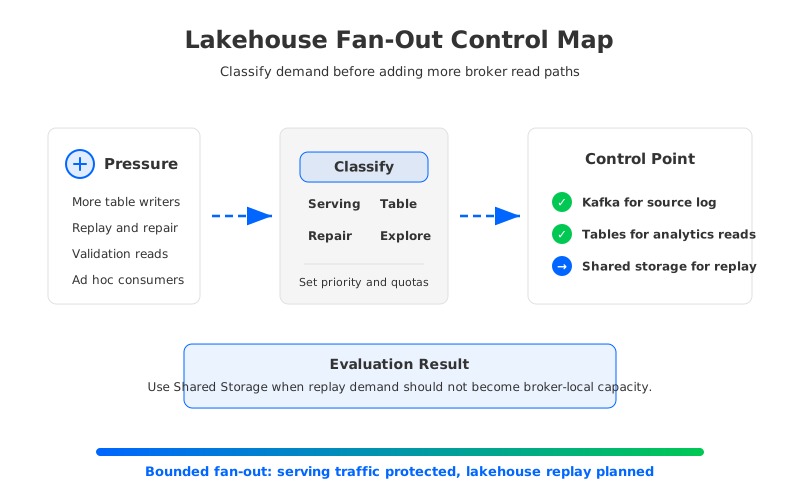
Lakehouse fan-out is harder than ordinary consumer fan-out because analytical consumers are bursty, stateful, and recovery-heavy. A dashboard refresh may be predictable, but a table repair job might replay a full day of records. Kafka can expose the stream to all of them, but the operating cost lands on the brokers unless the architecture gives the platform another control point: which reads hit Kafka directly, which are absorbed by tables, and which are isolated through quotas or dedicated pipelines.
1Why teams search for lakehouse fan out control kafka
The search phrase usually appears after a platform team has built enough streaming success to create its own pressure. Kafka topics are trusted as the operational event log, so other teams naturally ask for access. Analytics teams want lakehouse tables. Search teams want indexing pipelines. Data science teams want training refreshes. Together, those requests change the broker workload.
Kafka's consumer group model is well suited to independent consumers. Each group can track its own offsets and scale across partitions. The catch is that every additional group creates a read path, every lagging group creates retained history pressure, and every recovery operation creates catch-up traffic. When the lakehouse becomes the largest downstream consumer, fan-out control becomes a production architecture topic rather than a client configuration detail.
Lakehouse workloads blur the line between online and offline traffic. A user-facing service reads Kafka continuously and is sensitive to tail latency. A table writer may tolerate slightly more latency if commits are reliable. A backfill job may be throughput-hungry and temporary. Treating all of them as ordinary consumers hides the difference that matters most: some consumers protect user-facing systems, while others protect analytical correctness.
2The lakehouse freshness constraint behind fan-out
A lakehouse pipeline introduces a table clock on top of Kafka's offset clock. Kafka records become durable in partitions, consumers advance offsets, and the lakehouse exposes queryable snapshots through a table format such as Apache Iceberg. Users judge the table clock: whether the table is current, whether queries see a consistent snapshot, and whether corrections can be replayed. Operators still manage the offset clock underneath.
The two clocks move differently. Kafka can append records quickly and let consumers read at different speeds. An Iceberg-oriented table path has to write files, commit metadata, handle schema changes, and coordinate catalog visibility. Short commit intervals improve freshness but increase table maintenance pressure, while longer intervals push data visibility behind the stream. When multiple downstream paths read the same topics, the broker becomes the shared throttle.
The risk is not only lag. The quieter risk is uncontrolled replay demand. A team may increase retention for one table writer, add another partitioning strategy, then introduce validation reads during every deployment. Over time, the Kafka cluster shifts from an event bus into a replay warehouse with online traffic attached.
The platform needs a fan-out policy that separates workload classes:
- Serving fan-out feeds applications, alerts, and operational systems.
- Table fan-out feeds lakehouse writers that need durable offsets and recoverable commits.
- Repair fan-out handles backfills, schema fixes, and replay-heavy validation.
- Exploratory fan-out supports ad hoc analysis, experiments, or temporary consumers that should not inherit production priority.
Once these classes are named, the team can decide which consumers read directly from Kafka, which read from lakehouse tables after materialization, and which require quotas, isolation, or scheduled replay windows.
3Where traditional Kafka absorbs the pressure
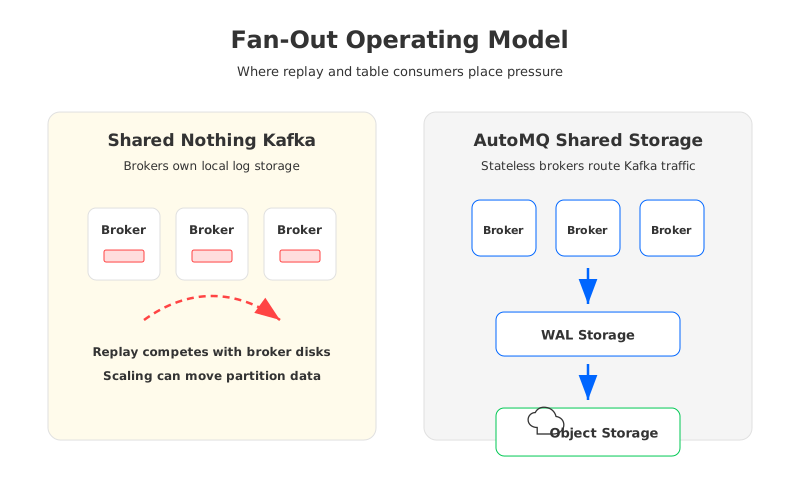
Apache Kafka's Shared Nothing architecture ties partition data to broker-owned local storage. Leaders serve reads and writes, followers replicate data for availability, and broker disks or attached volumes hold log segments. The model is mature, but read fan-out, retained history, and recovery traffic remain broker concerns.
For ordinary event streaming, that trade-off is often acceptable. Lakehouse fan-out stretches the model because the largest consumers may be analytical systems with uneven demand. A connector failure can create a catch-up wave, and a table rebuild can turn historical reads into urgent workload.
Three broker-level costs tend to show up first:
- Storage headroom. Longer retention for table recovery has to fit within the Kafka storage model, so the cluster carries capacity before the recovery event happens.
- Data movement. Scaling or replacing brokers can require partition reassignment and replica movement. That operation competes with the same topics that downstream lakehouse jobs are reading.
- Network amplification. Multi-AZ replication, cross-zone reads, and large catch-up consumers can make cloud network traffic part of the fan-out cost model.
Tiered Storage can reduce local storage pressure by placing older log segments on remote storage. It does not by itself make brokers stateless or remove the need to reason about recent data placement, partition ownership, fetch behavior, and recovery traffic. The core question remains whether retained history and broker compute are forced to scale together.
4Stream-to-table architecture options
There is no single correct fan-out pattern. A Kafka-to-lakehouse connector may fit stable ingestion. A stream processor may be necessary when the table depends on joins, deduplication, enrichment, or routing. A platform-native table path can reduce moving parts for topic-to-table materialization. The wrong move is choosing the tool before defining the fan-out contract.
The contract should state which system owns each guarantee. Kafka owns ordered records, offsets, retention, transactions, and consumer group behavior. The table format owns snapshots, schema evolution, and reader consistency. The writer owns the handoff. The platform defines which readers may compete for broker capacity and which should consume from materialized tables.
| Pattern | Best fit | Fan-out control concern |
|---|---|---|
| Kafka Connect sink | Standard topic-to-table ingestion with limited transformation | Connector tasks and retries still read from brokers during catch-up |
| Flink or Spark streaming job | Stateful transformation, joins, enrichment, or custom table routing | Checkpoints, job upgrades, and backfills can amplify replay demand |
| Platform-native table path | Common stream-to-table materialization under one operating model | Must validate table features, catalog support, and migration boundaries |
| Downstream table consumers | Analytics reads from Iceberg, Athena, Trino, Spark, or similar engines | Keeps analytical fan-out away from Kafka after materialization |
The table shows a practical split. Kafka should remain the event log and recovery ledger for stream consumers. The lakehouse should absorb analytical fan-out after records become table state. Judge the connector or table path by how well it controls that transition.
5Evaluation checklist for platform teams
Fan-out control is an operating model, so evaluate it under failure. Existing producers and consumers should keep Kafka client behavior, topic semantics, offsets, ACL expectations, and operational tooling wherever possible. A lakehouse project should not force every upstream service to absorb a platform migration alongside a table architecture change.
Test replay boundaries early. Pause the table writer, let lag accumulate, restart it, and verify that it resumes from expected offsets. Repeat while a broker is replaced. If recovery depends on manual coordination across Kafka, the connector, the catalog, and table maintenance, record that as operational cost.
Cost and elasticity deserve the same rigor. A design that works at low volume can become expensive when every repair reads from Kafka. Object storage can improve the cost curve for retained history, but only if the streaming architecture avoids turning brokers into long-lived storage owners.
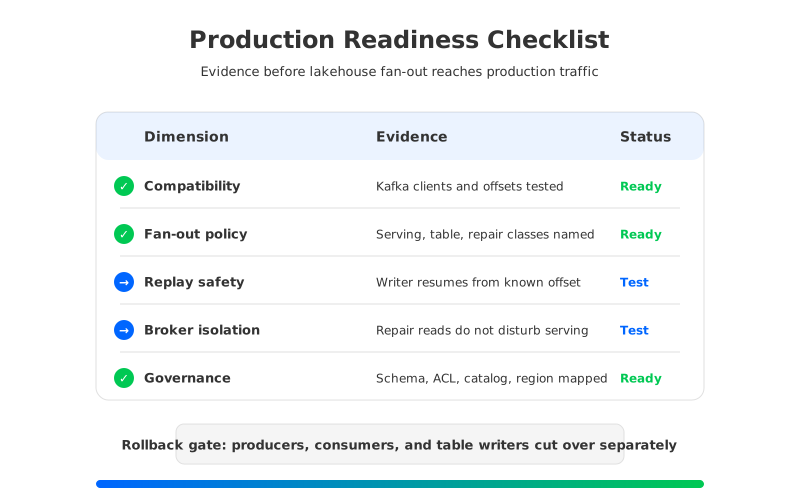
Use a scorecard that forces pass/fail evidence:
| Dimension | Review question | Evidence to collect |
|---|---|---|
| Compatibility | Can Kafka clients, consumer groups, and tools keep their contracts? | Client test matrix and offset migration plan |
| Fan-out priority | Which consumers are serving, table, repair, or exploratory workloads? | Consumer group inventory with quotas or policies |
| Replay safety | Can table writers recover from a known offset without missing records? | Failure rehearsal with committed offsets and table snapshots |
| Broker isolation | Can repair reads avoid disturbing production writes and serving reads? | Lag, fetch, disk, CPU, and network metrics during replay |
| Storage elasticity | Does long retention force larger broker-local disks? | Retention sizing model and storage growth curve |
| Governance | Are schema, catalog, ACL, lineage, and region boundaries explicit? | Data contract and incident runbook |
| Migration risk | Can producers, consumers, and table writers cut over separately? | Staged rollout and rollback checkpoints |
The scorecard often reveals that the hard part is not fan-out itself. The hard part is giving each class of fan-out a bounded cost and a recovery path. Once that is clear, the storage architecture underneath Kafka becomes a first-order decision.
6How AutoMQ changes the operating model
After the fan-out contract is defined, AutoMQ is relevant as a Kafka-compatible streaming platform built around a Shared Storage architecture. It keeps Kafka protocol and API compatibility while moving persistent stream storage away from broker-local disks and into object storage through S3Stream.
That shift changes lakehouse fan-out control in a concrete way. Brokers continue to handle Kafka protocol work, partition leadership, caching, and request routing. Durability is handled through WAL storage and S3-compatible object storage. Longer replay windows no longer have to make every retained byte broker-local capacity.
AutoMQ also has a direct lakehouse surface through Table Topic, which is designed to write streaming data into Apache Iceberg tables. Transform-heavy workloads still need Flink, Spark, or Kafka Connect, and governance still needs schema and catalog review. The difference is that common stream-to-table paths can be evaluated as part of the streaming platform's operating model.
Several AutoMQ capabilities matter for this evaluation:
- Kafka compatibility keeps producer and consumer contracts familiar while the storage layer changes underneath.
- Shared Storage architecture separates durable data from broker-local disks, reducing broker replacement and storage growth work.
- Independent compute and storage scaling helps teams plan fan-out without sizing every broker for the largest replay window.
- Zero cross-AZ traffic architecture can change the cloud cost discussion for multi-AZ streaming deployments.
- Customer-controlled deployment boundaries help teams keep data plane resources, object storage, IAM, and network controls inside their own environment.
- Migration features such as AutoMQ Linking for Kafka can help stage movement from an existing Kafka-compatible cluster while preserving topic data and consumer progress relationships in supported scenarios.
The correct test is whether these capabilities improve the checklist rehearsal. If a table writer falls behind, can retained history remain affordable? If brokers are replaced, does the table path continue from known offsets? Shared Storage is useful when it turns those questions from emergency capacity work into planned policy.
7Migration and rollout scorecard
A clean migration separates three changes that are often bundled together: the streaming storage layer, the lakehouse write path, and the downstream reader contract. Move one boundary at a time. Keep producers on the existing Kafka contract while the new platform proves compatibility. Mirror representative topics, validate consumer offsets, then compare table snapshots and replay behavior.
Rollback should be designed before cutover. Record the offset boundary for each table writer. Decide how duplicate files, partial commits, or failed snapshots will be handled. Define whether rollback means moving producers back, moving consumers back, or only pausing the table path.
Observability closes the loop. Broker health, consumer lag, fetch throughput, storage growth, table snapshot age, failed commits, schema events, and catalog latency should be visible together. If the on-call engineer has to assemble incidents from disconnected tools, the architecture is still hiding the fan-out boundary.
Back at the original search phrase, the goal is not to reduce consumers for its own sake. The goal is to prevent lakehouse demand from becoming uncontrolled broker work. If your team is evaluating a Kafka-compatible platform for this boundary, use the checklist against your replay and table freshness requirements, then review AutoMQ's architecture and Table Topic docs or start a technical conversation here: contact AutoMQ.
8References
- Apache Kafka documentation for Kafka clients, consumer groups, offsets, transactions, Kafka Connect, KRaft operations, and Tiered Storage.
- Apache Kafka Connect documentation for connector framework concepts and operational model.
- Apache Iceberg documentation for table snapshots, schema evolution, catalog behavior, and lakehouse table semantics.
- Apache Iceberg Kafka Connect documentation for Kafka-to-Iceberg sink concepts.
- AWS S3 pricing for object storage and data transfer pricing considerations.
- AWS S3 Tables documentation for an example of managed Apache Iceberg table storage on object storage.
- AutoMQ Shared Storage architecture documentation for stateless brokers and object-storage-backed stream storage.
- AutoMQ Table Topic documentation for stream-to-Apache-Iceberg table ingestion.
- AutoMQ cross-AZ traffic documentation for the architecture behind reducing inter-zone traffic.
9FAQ
9.1Is lakehouse fan-out the same as Kafka consumer fan-out?
No. Kafka consumer fan-out means multiple consumer groups read the same topics independently. Lakehouse fan-out includes table writers, validation jobs, repair jobs, replay operations, and analytical readers that may create bursty historical demand. The control problem is deciding which reads hit Kafka brokers and which are absorbed after data becomes table state.
9.2Does Apache Iceberg remove the need for Kafka retention?
No. Iceberg stores table snapshots and data files, but Kafka retention still determines how far the streaming source can replay for consumers and table writers. If a writer, catalog, or schema deployment fails, the platform may need Kafka records to rebuild or repair the table path.
9.3Can Tiered Storage solve broker overload from lakehouse fan-out?
Tiered Storage can help by moving older log segments to remote storage, reducing pressure on broker-local disks for historical data. It should still be evaluated against recent data placement, fetch behavior, broker replacement, and recovery traffic. A Shared Storage architecture goes further by making object storage the primary durable storage layer instead of a historical archive.
9.4When should a table writer read from Kafka instead of another lakehouse table?
A table writer should read from Kafka when it needs original event order, offset-based replay, or a source-of-record stream contract. Analytical consumers that only need queryable table state should usually read from the lakehouse after materialization. That split protects brokers from becoming the backend for every analytical access pattern.
9.5Where does AutoMQ fit?
AutoMQ fits when teams want Kafka-compatible clients with a cloud-native storage model that separates durable stream data from broker-local disks. It is especially relevant when long retention, replay-heavy table repair, broker elasticity, cross-AZ cost control, or integrated Table Topic ingestion are part of the platform review.


