
Table of Contents
Table of Contents
The hard part of Lambda vs. Kappa architecture was never the whiteboard. One diagram had a batch layer and a speed layer. The other had a durable streaming log, replay, and one processing path. Kappa looked cleaner because it removed duplicate pipelines and duplicate failure modes. Then the Apache Kafka bill arrived, retention windows grew, and the elegant architecture started asking teams to keep months of replayable data on replicated broker disks.
That is why the Lambda vs. Kappa debate keeps coming back. Teams reopen it when real-time products, AI features, observability systems, fraud models, and lakehouse pipelines all want the same operational data. The question is no longer whether streaming can express batch-style computation. The question is whether the storage layer can make replay, retention, and backfill affordable enough that one streaming backbone is sane.
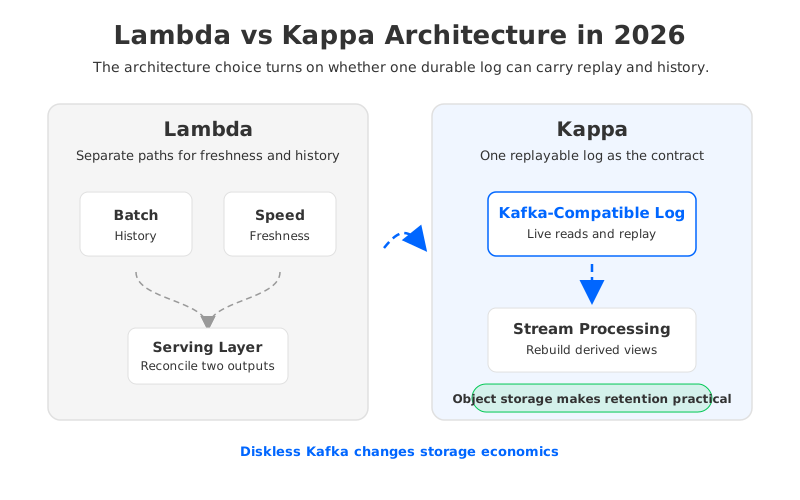
Kappa architecture still needs judgment. It does not erase data governance, lakehouse modeling, historical correction, or workload isolation. But diskless Kafka changes one of the oldest objections: the cost of keeping a long, replayable Kafka log. When Kafka-compatible brokers stop owning persistent local partitions and object storage becomes the durable source of truth, Kappa becomes practical in more scenarios.
1The Original Promise: One Log, One Processing Model
Lambda architecture emerged as a response to a real limitation. Batch systems were good at recomputing historical views. Streaming systems were good at low-latency updates. Putting them together gave teams both correctness and freshness, but it also created two implementations of the same business logic. The batch layer corrected history; the speed layer served now; the serving layer reconciled both.
Kappa architecture challenged that split. Jay Kreps' 2014 O'Reilly article, "Questioning the Lambda Architecture," argued that an immutable log plus stream processing could support both live computation and reprocessing. The key idea was not "streaming is faster than batch." It was that reprocessing from a durable ordered log could remove parallel batch and speed code paths for many applications.
That remains attractive in 2026 because the number of consumers has grown. A Kafka estate may feed services, stream processors, feature pipelines, search indexes, lakehouse tables, security analytics, dashboards, and AI agents. Every duplicate path adds more places where semantics drift:
- Business rules diverge as batch and streaming jobs evolve at different speeds.
- Reconciliation becomes a standing tax because late events and schema changes are handled twice.
- Incident recovery slows down when teams must ask which path produced which view.
- Governance gets awkward because lineage crosses systems with different assumptions.
Kappa's appeal is that it makes the log the contract. Producers write events once. Consumers derive views from the same ordered history. If a bug appears in a transformation, the team fixes the code and replays the relevant window. Apache Flink's documentation reinforces the same model from the processing side: bounded and unbounded data can be handled through a unified execution framework, and stateful stream processing uses checkpoints to recover consistently after failures.
The architecture sounds tidy, but the storage layer decides whether it survives production. A Kappa design without affordable retention is a slogan. The replay story only works when the log can keep enough history, the cluster can serve replays without starving live traffic, and storage growth does not force every team back into a separate batch archive.
2Why Traditional Kafka Made Kappa Expensive
Classic Kafka was designed around broker-local logs and replication between brokers. That design helped Kafka become reliable and fast: partitions are append-only files, consumers track offsets, and replicas provide durability. In a self-managed data center, the economics were often acceptable because east-west replication did not show up as a separate cloud line item.
In the cloud, the same mechanics are easier to operate but harder to ignore. A long-retention Kappa architecture asks Kafka to behave like both a real-time buffer and a replayable historical substrate. With traditional broker storage, that means the hot cluster often carries storage that is not hot most of the time. The pattern gets more painful as throughput, retention, and replication factor rise together.
| Requirement | Traditional Kafka pressure point | Why it matters |
|---|---|---|
| Long retention | Replicated broker volumes grow with the log | Storage cost scales with retention even when reads are rare. |
| Frequent replay | Historical reads compete with live broker resources | Backfills can disturb latency if not isolated. |
| Elastic compute | Partitions are tied to stateful brokers | Scaling can involve large data movement. |
| Multi-AZ durability | Broker replication crosses failure domains | Availability improves, but duplication increases. |
Tiered Storage helps, and it is important not to dismiss it. Apache Kafka's Tiered Storage documentation describes remote log storage as a way to keep older log segments outside broker-local storage while retaining Kafka's topic abstraction. For many clusters, that is a useful step because it reduces pressure on local disks and supports longer retention than a purely local-log design.
The trade-off is architectural. Tiered Storage extends traditional Kafka; it does not make brokers fully stateless. Local storage, replica placement, recovery behavior, and hot-path operations still matter. If your goal is to keep Kafka mostly as it is while moving cold history out of the broker fleet, Tiered Storage can be the right compromise. If your goal is a replay-heavy Kappa backbone where compute elasticity and object-storage economics are first-class assumptions, the difference between "remote tier" and "Shared Storage architecture" becomes material.
A simple storage assumption makes the gap visible. In AWS us-east-1 public pricing checked on May 22, 2026, S3 Standard storage is listed at $0.023/GB-month for the first 50 TB/month, while EBS gp3 volume storage is listed at $0.08/GB-month. A replicated Kafka topic with three broker-side copies multiplies the storage footprint before throughput, snapshots, networking, operational headroom, or managed-service markup. That does not mean every Kafka workload moves from EBS to S3 at a neat ratio. It means the baseline economics of long retention are different when durable history lives in object storage rather than on broker-owned block volumes.
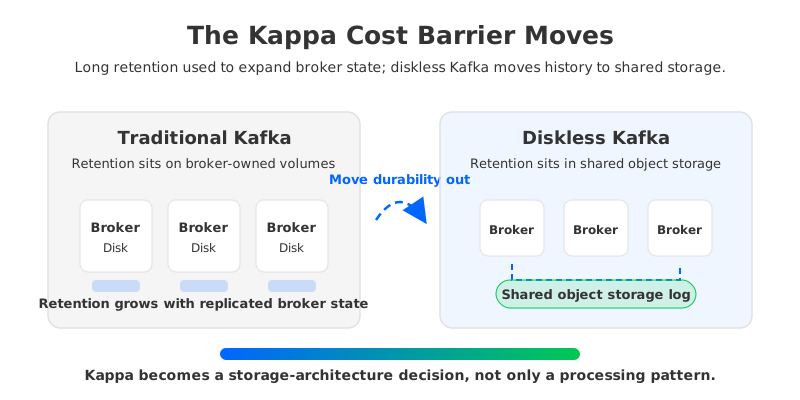
This is where many Kappa discussions used to stall. The architecture was clean, but the production bill rewarded a Lambda-like split: keep Kafka retention short, land history in a lower-cost lake, and use batch systems for correction and backfill. That was a rational response to the storage model.
3Diskless Kafka Changes the Retention and Replay Conversation
Diskless Kafka changes the argument by moving durability away from broker-local disks. The broker still speaks the Kafka protocol to clients, but persistent log data is stored in shared cloud storage. Brokers become compute nodes that can be replaced, scaled, and recovered without treating every partition as a local asset that must be copied around the cluster.
The important shift is not that object storage is inexpensive in isolation. Object storage has different latency, request, consistency, and access-pattern characteristics than block storage, so a Kafka-compatible engine must be designed around those realities. The shift is that long retention and replay no longer have to be paid for mainly through a fleet of stateful brokers whose storage grows with the log.
For Kappa-style systems, that changes four decisions:
- Retention can be sized around product and recovery requirements, not only broker disk budgets.
- Reprocessing becomes a normal operational path rather than an exceptional event.
- Scaling becomes less about moving partition data and more about compute capacity.
- Failure recovery gets simpler because replacement brokers do not rebuild large local logs first.
AutoMQ is one concrete implementation of this pattern. Its documentation describes a Kafka-compatible architecture that uses S3-based shared storage and separates storage from compute. The product keeps the Kafka protocol surface familiar while replacing Kafka's native broker log storage with an object-storage-backed design. For Kappa, the streaming backbone can look familiar while the cost and elasticity model changes.
This is where AutoMQ fits naturally into the Lambda vs. Kappa discussion. It is not a magic switch that makes every pipeline real-time, and it should not be evaluated as a generic managed Kafka wrapper. It is relevant because Kappa's biggest practical dependency is a durable, replayable, cost-effective log. A Kafka-compatible platform built around shared object storage attacks that dependency directly.
The same reasoning explains why diskless Kafka and stream processing should be evaluated together. Flink, Kafka Streams, Spark Structured Streaming, and other engines can express long-running transformations, joins, aggregations, and materialized views. But their operational value depends on source history, checkpoint recovery, and controlled backfills. If the log cannot retain enough history, the processing layer cannot rescue the architecture by itself.
4A Reference Kappa Architecture with AutoMQ
A realistic Kappa architecture in 2026 is not "Kafka for everything." It is an event backbone with clear boundaries. The streaming log is the system of movement and replay. Processing engines create derived views. Object storage and table formats still serve analytical access patterns when tables and open query engines are the right interface.
With AutoMQ in the Kafka-compatible backbone role, the reference architecture usually has five layers:
- Producers publish domain events, change data capture streams, logs, metrics, or feature events into Kafka-compatible topics.
- AutoMQ brokers handle Kafka client traffic while storing durable log data in object storage through its Shared Storage architecture.
- Stream processors consume the retained log to build operational views, enrich events, detect patterns, and materialize serving datasets.
- Lakehouse sinks write selected streams into table formats such as Apache Iceberg when SQL analytics, historical snapshots, or cross-engine access are required.
- Consumers use the right interface for the job: Kafka for event-driven services, serving stores for low-latency queries, and lakehouse tables for analytical workloads.
That design is intentionally not purist. The point of Kappa is not to ban batch engines from the building. The point is to avoid maintaining two independent source-of-truth pipelines for the same business facts. You may still run batch jobs against Iceberg for analytical scans or regulatory reports. What changes is that the streaming log becomes the primary history from which downstream views are rebuilt.
AutoMQ also matters in BYOC and private-cloud conversations because infrastructure control is part of the architecture. Many large Kafka teams want data to stay in their cloud account or private environment while retaining Kafka compatibility. A diskless Kafka design close to object storage changes the storage economics without forcing every client team onto a different messaging API.
The engineering work does not disappear. A good Kappa implementation still needs schema compatibility rules, dead-letter handling, replay throttling, topic lifecycle policy, consumer isolation, checkpoint discipline, and clear ownership for derived datasets. Diskless Kafka makes the foundation more practical; it does not replace platform engineering.
5When Lambda Still Makes Sense
Lambda architecture is not obsolete. It remains strong when the batch and speed layers have genuinely different jobs rather than accidentally duplicated jobs. The mistake is treating every two-path system as legacy. Some systems need separate paths because their consumers, governance model, or compute profile justify the complexity.
Choose Lambda, or a Lambda-like hybrid, when these conditions dominate:
- Historical recomputation is massive, rare, and naturally table-oriented.
- Regulatory controls require a separately governed analytical record.
- The real-time path only needs a short freshness window.
- The organization has mature batch governance and weak streaming operations.
- The source data is not naturally event-shaped.
This is the scenario-based way to read the debate: Lambda separates workloads when their requirements are truly different. Kappa unifies workloads when the same event history can serve live processing, replay, and correction without duplicating business logic.
The old problem was that many teams wanted the second pattern but could only afford the first. Diskless Kafka narrows that gap. It gives architects a stronger reason to revisit systems where Lambda exists mainly because long Kafka retention used to be too expensive.
6When Kappa Is Now Realistic
Kappa becomes realistic when the log is the natural product boundary. That usually happens where events have durable business meaning: orders, payments, inventory changes, user actions, device telemetry, security signals, customer interactions, and operational metrics. If the event stream is already what downstream systems want, duplicating it into a separate batch truth creates avoidable drift.
| Signal | Kappa is attractive when... | Watch-out |
|---|---|---|
| Retention | Teams need days, weeks, or months of replayable event history | Define topic lifecycle and deletion policy early. |
| Replay | Backfills are part of normal development and incident recovery | Throttle replays so live consumers keep predictable latency. |
| Logic ownership | One team owns live and historical semantics | Avoid hidden forks in downstream batch jobs. |
| Storage economics | Object-storage-backed retention changes the cost curve | Include request, network, and processing costs. |
| Client compatibility | Existing apps already use Kafka APIs | Validate protocol compatibility and operational tooling. |
| Governance | Event lineage is easier to govern once than twice | Keep schema, PII, and retention policies explicit. |
The decision tree is fairly direct. If the batch layer exists because historical computation is fundamentally different, keep it. If it exists because Kafka retention was too costly, revisit the premise. If teams are constantly reconciling streaming and batch outputs that should mean the same thing, the architecture is telling you something.
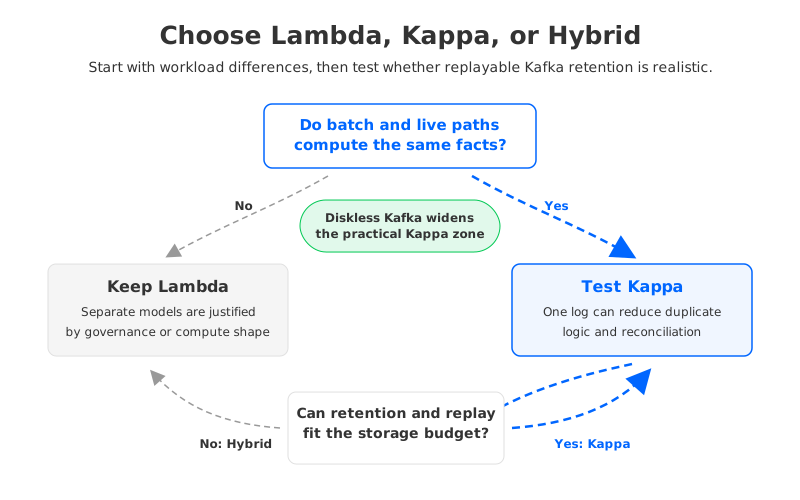
For large Kafka estates, the most practical migration path is usually incremental. Pick one domain where event history is clean, replay requirements are real, and duplicate logic already hurts. Move that domain toward longer-retention Kafka topics, disciplined stream processing, and object-storage-backed durability. Keep the lakehouse where it adds analytical value, but stop using it as a workaround for a short-lived log.
7The 2026 Answer to Lambda vs. Kappa
The clean answer is not "Kappa wins." The clean answer is that the storage assumption behind the debate has changed. Lambda became common because separate batch and speed layers were often the most economical way to combine correctness, history, and freshness. Kappa promised a simpler model, but traditional Kafka made long retention and replay expensive enough that many teams compromised.
Diskless Kafka does not make architecture decisions automatic. It makes a previously expensive option worth evaluating again. If your streaming log can retain more history on object storage, if brokers can scale as stateless compute, and if Kafka compatibility protects existing clients, Kappa becomes a real platform design candidate.
That is the role AutoMQ can play for Kafka teams revisiting Lambda vs. Kappa in 2026. It offers a Kafka-compatible, cloud-native streaming platform built around shared storage rather than broker-owned disks. The result is not the end of Lambda architecture. It is a more honest choice: use Lambda when workloads need separate models, and use Kappa when a durable event log can become the shared backbone without turning retention into the bottleneck.
8FAQ
8.1What is the difference between Lambda and Kappa architecture?
Lambda architecture uses separate batch and speed layers to combine accurate historical processing with low-latency updates. Kappa architecture uses one durable event log and stream processing path for both live computation and reprocessing. The practical difference is operational: Lambda accepts duplicate paths to separate workload types, while Kappa tries to reduce duplicate logic by replaying history from the log.
8.2Is Kappa architecture practical with Kafka?
Kappa architecture can be practical with Kafka when retention, replay, and processing isolation are designed carefully. Traditional Kafka can make long retention expensive because data is stored on replicated broker disks. Tiered Storage and diskless Kafka both improve the equation, but diskless Kafka changes it more directly by using shared object storage as the durable log foundation.
8.3Does diskless Kafka replace a data lake or lakehouse?
No. Diskless Kafka can make the streaming log more durable and cost-effective, but lakehouse tables still matter for SQL analytics, historical snapshots, governance workflows, and cross-engine access. A practical Kappa architecture often keeps Kafka-compatible streaming as the event backbone and writes curated streams into Iceberg or another table format for analytical use.
8.4When should I keep Lambda architecture?
Keep Lambda when batch and streaming workloads are genuinely different. Examples include massive rare recomputation, regulatory table snapshots, mature lakehouse governance, or source systems that naturally produce large periodic files rather than events. Lambda is a problem when it duplicates business logic only because the streaming log cannot afford long retention.
8.5Where does AutoMQ fit in Kappa architecture?
AutoMQ fits as the Kafka-compatible streaming backbone. Its Shared Storage architecture uses object storage for durable log data while keeping Kafka protocol compatibility for clients. That makes it relevant for teams that want longer retention, replay-heavy pipelines, and cloud-native elasticity without asking application teams to rewrite around a non-Kafka API.
9Sources
- Jay Kreps, O'Reilly: Questioning the Lambda Architecture
- Apache Kafka documentation: Tiered Storage
- Apache Flink documentation: DataStream API execution mode
- Apache Flink documentation: Checkpointing
- AWS: Amazon S3 pricing
- AWS: Amazon EBS pricing
- AutoMQ documentation: Architecture overview
- AutoMQ documentation: Difference with Apache Kafka


