
Table of Contents
Table of Contents
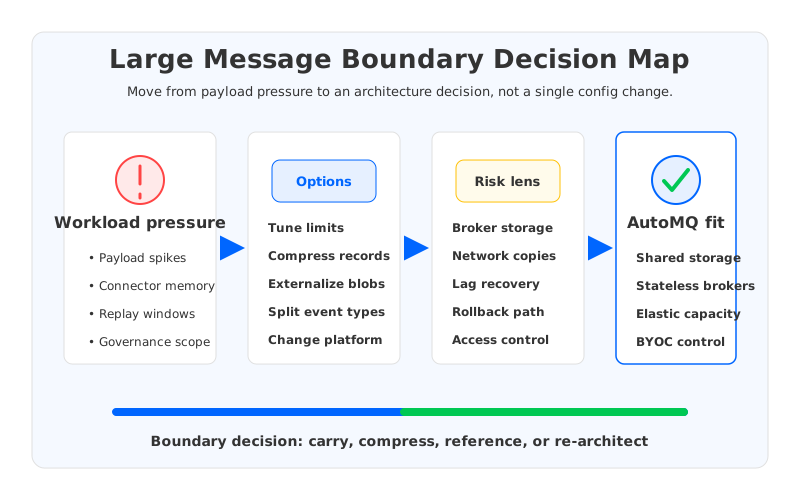
Teams usually search for large message boundaries kafka after a production constraint has already become visible. A CDC connector starts emitting larger rows than expected. A document-processing service wants to put extracted text and metadata into the same event. A fraud or media pipeline discovers that the "event" is not a compact business signal anymore; it is a container for a payload that downstream teams want to replay, inspect, and retain.
Kafka can move large records when the client, topic, broker, replica fetch, and consumer settings are aligned. That statement is technically true and operationally incomplete. The boundary is not the largest value you can place in max.request.size or message.max.bytes. The real boundary is where larger payloads start changing recovery time, broker storage pressure, network movement, connector memory, governance scope, and the blast radius of an application mistake.
That is why large-message design belongs in architecture review, not only in producer tuning. A platform team that raises limits without changing ownership will inherit the consequences later: slower consumer catch-up, heavier replication, larger dead-letter records, longer incident windows, and uncomfortable questions about who was allowed to read a payload that should have stayed in object storage.
1Why Teams Search for large Message Boundaries Kafka
The search phrase sounds narrow, but the underlying pressure comes from several different workloads. Application developers see a failed produce request and ask for a higher limit. Data engineers see a sink connector fail under memory pressure and ask whether Kafka can carry the full object. SREs see broker disk usage grow faster than expected and ask why a topic with ordinary throughput behaves like a storage system.
Those are not the same problem. A few occasional 2 MiB records in an internal service topic are different from a pipeline where every record carries a PDF body, image metadata, or serialized model feature set. A bursty workload is different from a constant high-volume stream. A short-retention topic is different from a replayable event log that must serve audits, backfills, and downstream rebuilds.
Before changing limits, classify the payload pattern:
- Occasional outliers: Most records are small, but a few exceed the default path. The main risk is uneven latency, retries, and surprise failures.
- Consistently large records: The topic behaves like a high-throughput storage workload. The main risk shifts to capacity planning, replication traffic, and recovery.
- Composite payloads: One record contains business metadata plus a large object body. The main risk is governance, because every consumer receives more data than it may need.
- Connector-generated payloads: Source and sink connectors introduce their own batching, buffering, and memory constraints. Kafka limits may pass while the connector boundary fails.
- Replay-heavy payloads: The record size is acceptable during steady state but painful during catch-up, reprocessing, or disaster recovery.
The right answer depends on which pattern you have. If the payload is an occasional exception, tuning and compression may be enough. If large records are the steady-state design, the architecture has to account for the storage and recovery model, not only the client configuration.
2The Production Constraint Behind the Problem
Kafka exposes multiple size-related settings because a record crosses multiple boundaries. A producer request has a maximum size. A topic or broker has a maximum message size. Followers must fetch replicas successfully. Consumers must fetch enough data to receive the record. If one boundary remains smaller than the others, the system fails in a way that looks inconsistent to the application owner.
The more important issue is that every larger record becomes larger work for the cluster. It takes more memory to buffer. It takes more network to replicate. It takes more disk to retain. It takes more time to move when partitions are reassigned or when a broker needs to recover. Compression can reduce some of the cost, but it cannot erase the fact that a record is now a larger unit of scheduling, fetch, retry, and governance.
This creates a practical rule: message size is not an application-only decision once records become operationally visible to the platform. The boundary should be owned jointly by the application team, the data platform team, and the security or governance team that defines who can hold the payload.
| Boundary | What to verify | Failure mode when ignored |
|---|---|---|
| Producer request | max.request.size, batching, compression, retry behavior | Produce failures, retry storms, uneven latency |
| Broker and topic | message.max.bytes and topic-level overrides | Records accepted in one environment but rejected in another |
| Replication path | Follower fetch limits and network capacity | Replica lag, ISR churn, slower broker recovery |
| Consumer path | Fetch size, memory budget, processing time | Consumer stalls, rebalances, connector failures |
| Governance path | Data classification, ACLs, retention, deletion | Oversharing payloads, audit gaps, retention conflicts |
The table is deliberately broader than configuration. Configuration determines whether a large record can pass. Architecture determines whether the system remains operable after it passes.
3Architecture Options and Trade-Offs
There are four common ways to handle large messages in Kafka-compatible systems. The first is to raise limits and keep the payload in Kafka. This preserves the simplest programming model: producers send one record, consumers receive one record, and replay semantics stay inside Kafka. It works when the payload size is bounded, the topic has clear retention, and the team has tested the full path under peak and recovery conditions.
The second option is to compress or reshape the event. Compression helps when payloads contain repeated structure, verbose JSON, or text-heavy content. Reshaping helps when a record includes fields that not every consumer needs. The trade-off is schema discipline. If teams treat compression as a way to avoid data modeling, they postpone the same boundary problem until a larger payload arrives.
The third option is the claim-check pattern: store the large object in object storage and put a reference, checksum, version, and metadata in Kafka. This often gives the cleanest boundary for documents, images, binaries, model artifacts, and other payloads that are not naturally event-sized. It also changes failure handling. Consumers now need access to the object store, object lifecycle must align with Kafka retention, and the reference must remain valid during replay.
The fourth option is to revisit the streaming platform architecture. Traditional Kafka uses a shared-nothing model where brokers own local log segments. That model is robust and familiar, but it ties storage growth, partition movement, and recovery work to broker-local state. When large messages become a regular workload, this coupling makes operational planning harder because scaling compute often implies moving data.
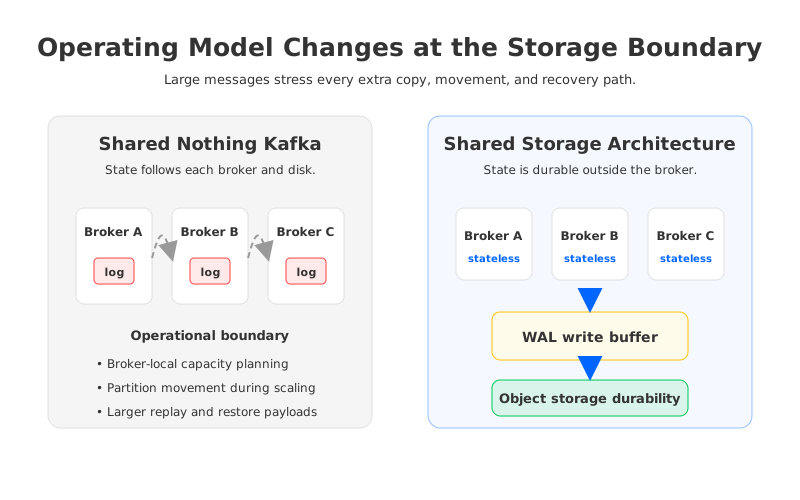
Tiered storage can reduce pressure on local disks for older segments, but it does not make the broker stateless. The hot path, replication behavior, and operational model still matter. A shared storage architecture changes the question: instead of asking how much local broker storage must be reserved for every large-message workload, the platform asks which parts of the write path need low-latency buffering and which parts should live in durable shared storage.
4Evaluation Checklist for Platform Teams
The safest large-message decision starts with a workload inventory. Pick a representative topic, not a synthetic demo topic. Measure the record-size distribution, not only the average. Include producer retries, compression ratio, consumer processing time, connector memory, retention, replay requirements, and the slowest downstream system. Large-message failures often appear in the slowest component, not in the component that first accepted the record.
Use a decision matrix that separates "can Kafka accept this record?" from "should this architecture carry this payload?"
| Decision question | Keep payload in Kafka | Store reference in Kafka | Revisit platform architecture |
|---|---|---|---|
| Payload size is bounded and rare | Strong fit | Usually unnecessary | Usually unnecessary |
| Payload is large for most records | Possible with testing | Strong candidate | Strong candidate |
| Consumers need the full body | Stronger fit | Adds object-store reads | Depends on recovery goals |
| Consumers need only metadata | Wasteful | Strong fit | Depends on storage model |
| Long replay window is required | Test carefully | Strong fit if references live long enough | Strong candidate |
| Broker scaling is already painful | Risky | Helps payload volume | Strong candidate |
The matrix prevents a common mistake: treating the biggest successful test record as the production boundary. The boundary is not a single number. It is the point where the team can still explain cost, latency, recovery, security, and rollback with confidence.
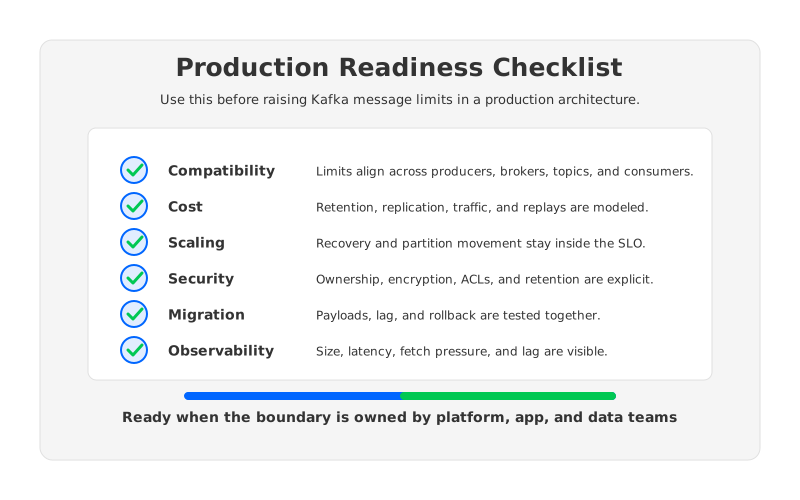
A production review should include seven checks. First, confirm compatibility across producer, topic, broker, replica, and consumer settings. Second, model cost across storage, replication, cross-zone movement, and replay traffic. Third, test scaling and recovery while large records are present, because empty-cluster benchmarks hide the expensive path. Fourth, define security ownership for the payload, especially when consumers have different data entitlements. Fifth, test migration with real payloads and real downstream systems. Sixth, define rollback before raising limits. Seventh, make message size, request latency, fetch pressure, consumer lag, and connector memory visible in observability.
5How AutoMQ Changes the Operating Model
Once the evaluation reaches the architecture layer, the storage model becomes central. AutoMQ is a Kafka-compatible streaming system that keeps Kafka protocol compatibility while moving the storage foundation toward shared object storage and stateless brokers. That matters for large-message boundaries because the operational problem is rarely "one record is too large." The problem is that large records amplify every place where brokers must carry durable state locally.
In AutoMQ's shared storage architecture, brokers write through a WAL layer and persist stream data to object storage. The WAL absorbs the low-latency write path, while object storage provides the durable backing store. This does not remove the need for payload discipline. It changes the operating model around capacity, reassignment, and recovery because broker compute and durable storage are no longer bound in the same way as a shared-nothing cluster.
For platform teams, that changes the large-message conversation in several concrete ways:
- Capacity planning becomes less broker-local. Teams still size brokers for throughput, latency, and network, but long-lived data is not planned as local disk attached to each broker.
- Scaling is less tied to data movement. When brokers are stateless, adding or removing compute does not require the same style of large local log migration.
- Cloud networking becomes part of the design. AutoMQ documents deployment patterns for reducing inter-zone traffic in supported multi-AZ environments, which is relevant when large records increase every unnecessary byte moved across zones.
- Kafka compatibility remains a migration constraint. Existing clients, connectors, and protocol behavior still need testing, especially for large records, transactions, consumer groups, and administrative workflows.
This is not an argument that every large payload belongs inside Kafka. Many document bodies, media files, and binary artifacts still belong in object storage with Kafka carrying references and metadata. The architectural benefit is that when Kafka-compatible streaming must carry larger records, the platform has a storage model that is better aligned with cloud durability and elastic compute.
6Migration and Rollback Guidance
The most reliable migration plan starts by freezing the boundary in writing. Define the maximum accepted record size, the expected percentile distribution, the topics included, the retention window, and the consumer groups that must be tested. Then create a test topic that mirrors production partitioning and retention closely enough to expose fetch, lag, and connector behavior.
Do not treat producer success as migration success. A useful pilot includes produce, consume, replay, broker restart, partition reassignment, connector restart, and downstream failure. If the workload uses transactions or idempotent producers, include those flows. If consumers run in different availability zones or networks, test locality and data transfer behavior. If the payload includes sensitive fields, include access review and deletion behavior.
Rollback should be boring. Keep the previous topic or reference-based path available until consumers prove they can process representative payloads under lag. Avoid irreversible schema changes during the first boundary change. Record-size policies should be enforced at the application edge where possible, not discovered only after the broker rejects a request.
When the boundary is explicit, teams can choose the right architecture without turning every incident into a debate about message size. If your team is evaluating Kafka-compatible infrastructure for large-message workloads, AutoMQ's shared storage architecture documentation is a practical next step: review the architecture with the same workload checklist, or contact AutoMQ to discuss a representative migration test.
7References
- Apache Kafka producer configuration: https://kafka.apache.org/40/configuration/producer-configs/
- Apache Kafka consumer configuration: https://kafka.apache.org/40/configuration/consumer-configs/
- Apache Kafka broker configuration: https://kafka.apache.org/40/configuration/broker-configs/
- Apache Kafka documentation, including KRaft and tiered storage sections: https://kafka.apache.org/documentation/
- AutoMQ architecture overview: https://docs.automq.com/automq/architecture/overview?utm_source=blog&utm_medium=reference&utm_campaign=large-message-boundaries-kafka
- AutoMQ Kafka compatibility: https://docs.automq.com/automq/what-is-automq/compatibility-with-apache-kafka?utm_source=blog&utm_medium=reference&utm_campaign=large-message-boundaries-kafka
- AutoMQ WAL storage: https://docs.automq.com/automq/architecture/s3stream-shared-streaming-storage/wal-storage?utm_source=blog&utm_medium=reference&utm_campaign=large-message-boundaries-kafka
- AutoMQ inter-zone traffic documentation: https://docs.automq.com/automq-cloud/eliminate-inter-zone-traffics/overview?utm_source=blog&utm_medium=reference&utm_campaign=large-message-boundaries-kafka
8FAQ
8.1What is a reasonable Kafka large-message boundary?
There is no universal boundary that works for every Kafka-compatible architecture. Start with your record-size distribution, retention, replay window, consumer memory, connector behavior, and recovery SLO. A boundary is reasonable only when the full path can produce, replicate, fetch, replay, and govern the payload under production-like conditions.
8.2Should large objects be stored directly in Kafka?
Sometimes, but not by default. If every consumer needs the full payload and the size is bounded, keeping the payload in Kafka can preserve simple replay semantics. If consumers mostly need metadata, or the payload is a document, image, binary, or artifact, storing the object in object storage and sending a Kafka reference is often cleaner.
8.3Which Kafka settings usually need alignment for large messages?
The producer request limit, broker or topic message limit, replica fetch limit, and consumer fetch limits must all be aligned. Compression, batching, timeout, and connector memory settings also matter. Testing one producer against one broker is not enough; test the end-to-end path.
8.4Does shared storage remove the need for large-message governance?
No. Shared storage changes the operating model around broker-local state, scaling, and recovery, but it does not decide whether a payload should be visible to every consumer. Data classification, access control, retention, and deletion requirements still define the boundary.
8.5How should teams test a large-message migration?
Use representative payloads, production-like partitioning, real consumers, and real connectors. Include steady-state traffic, consumer lag, replay, broker restart, partition movement, downstream failure, and rollback. The migration is ready when the team can explain both the happy path and the recovery path.


