
Table of Contents
Table of Contents
Latency incidents in Kafka rarely start with a single guilty component. A producer increases batching to save network calls, brokers begin to queue under disk pressure, consumers stretch processing time, and the SRE on call sees the same symptom everywhere: end-to-end delay has drifted outside the service objective. The awkward part is not measuring latency. Most platform teams already collect producer request latency, broker request queue time, consumer lag, and application timers. The harder problem is deciding who owns which part of the latency budget before an incident turns into a debate.
That is why latency budget ownership kafka is an architecture question rather than a narrow tuning keyword. Kafka gives teams many controls, but the controls sit in different places. Producer teams tune batching and acknowledgements. Platform teams own brokers, storage, replication, quotas, and placement. Consumer teams own polling, processing, commits, and downstream calls. FinOps teams care because the same latency choices affect instance sizing, cross-zone traffic, and retention cost.
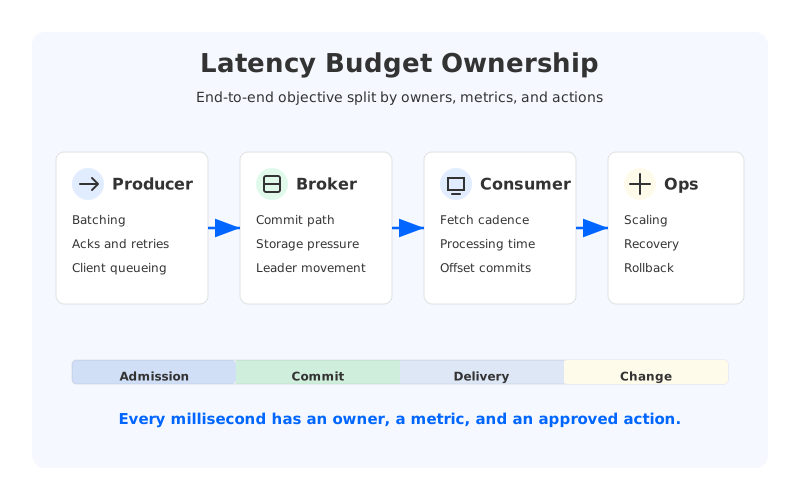
The goal is not to assign blame. A latency budget is a contract that converts a vague target like "events should arrive fast enough" into a set of owned, observable promises. If an order event must reach fraud scoring within a few hundred milliseconds, the producer cannot spend the full budget on batching, the broker cannot spend it on storage flush or leader movement, and the consumer cannot spend it waiting on a database call. Each tier gets room to operate, but it also gets a boundary that can be reviewed.
1Why teams search for latency budget ownership kafka
Teams usually search for this topic after latency becomes cross-functional. Early in a Kafka program, ownership feels obvious: the application team owns the producer and consumer code, while the platform team owns the cluster. That model works when traffic is small and workloads are predictable. It breaks when Kafka becomes shared infrastructure for payments, AI feature pipelines, customer analytics, observability, and data lake ingestion at the same time.
The conflict starts because different teams optimize local metrics. Producer owners may set linger.ms and batching to improve throughput. Consumer owners may increase max.poll.records to reduce fetch overhead. Platform owners may tune broker I/O, rebalance partitions, or change quotas to protect the cluster. Each decision can be reasonable, yet the combined path can spend the end-to-end budget twice.
A practical ownership model starts by separating latency into four domains:
- Client admission latency covers producer batching, compression, request timeout policy, retry behavior, and client-side queueing before records reach brokers.
- Broker commit latency covers request handling, replication, storage persistence, leader availability, controller operations, and network placement.
- Consumer delivery latency covers fetch settings, group stability, polling cadence, deserialization, processing, offset commit behavior, and downstream dependencies.
- Operational latency covers scaling, broker replacement, partition movement, incident response, and migration work that changes the steady-state path.
The fourth domain is often missed because it is not part of the happy path. A cluster that meets the target during a benchmark can still violate it during broker failure, partition reassignment, hot partition recovery, or a retention change that increases disk pressure. Latency budget ownership therefore has to include the operating model, not merely producer and consumer configuration.
2The cloud cost drivers behind the workload
Latency budgets and cloud bills are tied together because the lowest-cost path for one component can move cost or delay to another component. A producer can reduce request overhead through batching, but larger batches increase the time a record waits before send. A broker can absorb bursts with more local disk and headroom, but idle capacity becomes a standing cost. A consumer can fetch larger batches to reduce network calls, but downstream processing may become bursty and increase tail latency.
Traditional Kafka deployments add a second layer of cost pressure in multi-zone clouds. Kafka durability is commonly achieved through replication across brokers, and production clusters often distribute replicas across availability zones. That design protects availability, but it can create substantial broker-to-broker replication traffic and consumer traffic across zones when placement is not aligned. The latency budget then becomes a placement budget as well: where data is written, where it is replicated, and where it is consumed all matter.
The useful FinOps question is not "which setting lowers latency?" It is "which team is allowed to spend cost to buy latency, and where does the bill appear?" The answer changes the review process.
| Budget decision | Owner who changes it | Cost surface | Latency risk |
|---|---|---|---|
| Producer batching and compression | Application team | Client CPU and network | Records wait before send |
| Broker headroom and storage | Platform team | Compute, disk, and data transfer | Queues grow under saturation |
| Consumer fetch and processing size | Application team | Client CPU and downstream load | Larger batches hide tail delay |
| Partition movement and scaling | Platform team | Temporary network and compute | Operations disturb hot paths |
| Cross-zone placement | Platform and cloud architecture | Inter-zone transfer | Reads or replication cross zones |
This table is more useful than a universal latency target because it exposes trade-offs. A platform team can own broker-side SLOs, but it cannot promise low end-to-end latency when a consumer group calls a slow dependency. A producer team can own request configuration, but it cannot compensate for overloaded brokers. The budget has to be decomposed where teams can take action.
3Storage, network, and compute trade-offs
Kafka's original operating model binds partition leadership, request serving, and durable log storage to brokers. That shared-nothing design is proven and widely understood, but it shapes latency ownership in a specific way. Broker failures and scaling events are not merely compute events; they are data placement events. When partitions move, data locality, replica catch-up, disk pressure, network transfer, and leadership all enter the latency conversation.
That coupling matters most during change. Adding brokers to a busy cluster may require partition reassignment before traffic is balanced. Replacing a failed broker may trigger replica catch-up. Extending retention can increase local storage pressure. A hot partition can force a choice between repartitioning, throttling, or more headroom. The broker team owns the symptoms, but producers and consumers feel the delay.
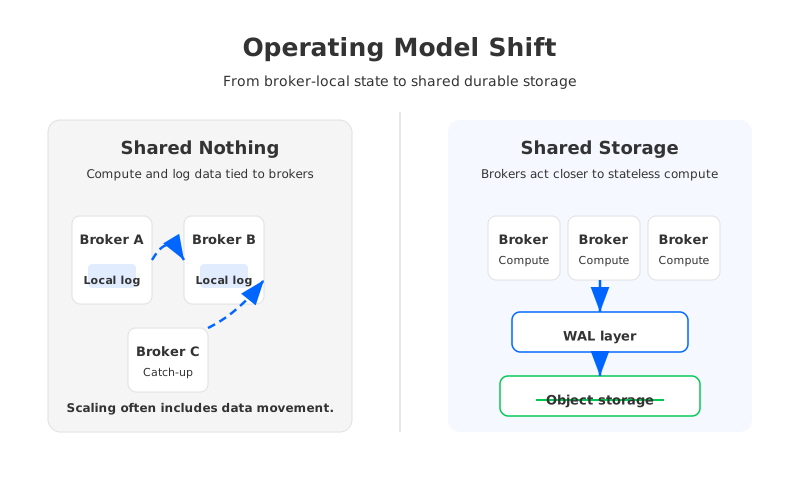
Tiered storage changes part of the storage story by moving older log segments to object storage, but the hot path still needs careful evaluation. For latency-budget planning, the key question is not whether object storage is present. The key question is which data remains broker-local, how fast brokers can recover serving responsibility, and whether scaling a broker requires moving large volumes of partition data before the latency budget returns to normal.
That distinction is where cloud-native Kafka-compatible architectures become relevant. If the target operating model is elastic capacity, faster broker replacement, and lower data movement during scaling, the architecture needs to reduce the amount of durable state tied to each broker. The team can still expose the Kafka protocol to applications, but the internal responsibility for storage, durability, and recovery changes.
4Evaluation checklist for FinOps and platform teams
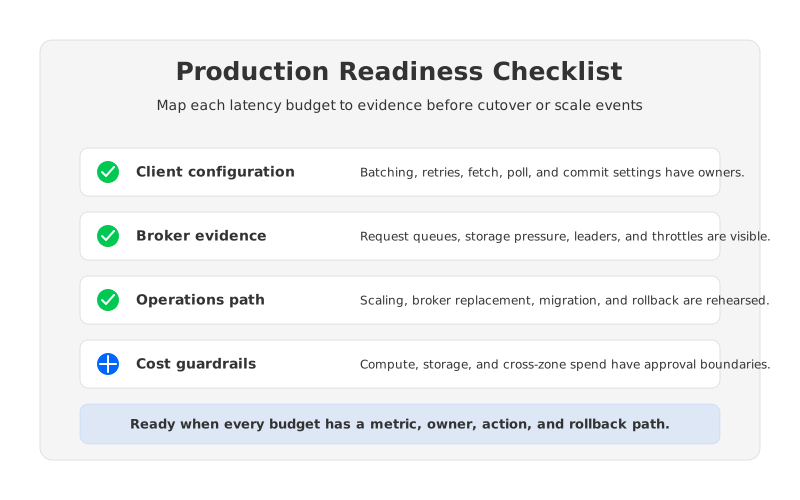
A latency budget should be reviewed as a contract between owners, metrics, and actions. It needs enough precision that a production incident does not turn into an argument about whether the producer, broker, or consumer is "slow."
Start with the workload path. Identify the business event, producer service, topic, partitioning rule, consumer group, downstream dependency, and user-visible outcome. Then assign a budget to each stage. A stage without a metric cannot own a budget, and a stage without an owner cannot defend one.
The ownership review should answer these questions:
- What is the end-to-end objective? Define the event path and the percentile that matters. Average latency hides the incidents that business teams notice.
- Which client settings can spend the budget? Review producer batching, acknowledgement policy, retries, delivery timeout, consumer fetch behavior, poll interval, and commit strategy.
- Which broker conditions can spend the budget? Track request queue time, disk or WAL pressure, replication health, leader movement, controller stability, throttling, and network placement.
- Which operations can disturb the budget? Include scaling, broker replacement, partition reassignment, retention changes, migration, and incident rollback.
- Which cost guardrails apply? Decide whether the team can spend more compute, storage, or network to protect latency, and who approves that spend.
The checklist should be tied to runbooks. If producer request latency rises while broker request queue time is normal, the application team investigates batching, retries, and client-side queueing. If broker commit latency rises with storage pressure, the platform team investigates saturation and placement. If consumer lag rises while broker fetch latency is normal, the consumer owner investigates processing and downstream calls. These branches are not complicated, but they need to be written before the incident.
5How AutoMQ changes the operating model
Once the ownership model is clear, the infrastructure question becomes sharper: which architecture reduces the number of latency-budget disputes created by stateful broker operations? This is where AutoMQ fits naturally. AutoMQ is a Kafka-compatible cloud-native streaming system that keeps the Kafka protocol surface familiar while moving the storage architecture toward shared storage and stateless brokers.
In AutoMQ's architecture, brokers are designed to be more replaceable because durable stream data is backed by object storage rather than being tightly bound to broker-local disks. The write-ahead log layer handles low-latency persistence, while object storage provides scalable durable storage. That separation changes the operational budget. Scaling compute, replacing brokers, and balancing traffic can require less broker-local data movement than a traditional shared-nothing model.
For latency budget ownership, tuning still matters. Producers need sane batching, consumers need responsible polling and processing, and platform teams need observability. The difference is that fewer operational actions have to be treated as large data relocation projects. When brokers become closer to stateless compute, the platform team can own capacity changes and failure recovery with a narrower blast radius.
AutoMQ also changes the cost conversation around multi-zone deployments. Its shared storage architecture and zero cross-AZ traffic design aim to reduce inter-zone data transfer caused by broker replication and reads across availability zones. That matters because latency incidents often tempt teams to add headroom everywhere. A platform that reduces unnecessary data movement gives FinOps and SRE teams more room to protect latency without accepting every hidden network cost as unavoidable.
There is still a migration question. Kafka compatibility helps because existing Kafka clients and tools can remain the contract surface, but migration planning should validate client versions, security settings, quotas, topic configuration, consumer offset handling, rollback paths, and observability coverage. A latency budget that was vague before migration will stay vague after migration. The better approach is to use migration as the forcing function to document ownership.
6A practical scorecard for buyers
Technical buyers can turn the discussion into a scorecard. The scorecard should not rank products by marketing claims. It should rank operating models by how clearly they allocate latency budget, cost authority, and recovery responsibility.
| Review area | Strong signal | Weak signal |
|---|---|---|
| Client compatibility | Existing Kafka clients can be tested with minimal application change | Client behavior depends on proprietary semantics |
| Broker operations | Scaling and replacement have clear recovery expectations | Capacity changes require long data movement windows |
| Storage design | Durable data is not trapped on a small set of broker disks | Local disk pressure dominates incident response |
| Network economics | Multi-zone traffic paths are visible and controllable | Replication and read traffic create opaque transfer cost |
| Observability | Metrics map to producer, broker, consumer, and operations budgets | Teams see lag but cannot assign root cause |
| Migration safety | Cutover, rollback, offsets, and security are rehearsed | Migration plan assumes compatibility equals readiness |
The scorecard keeps the evaluation grounded. A low-latency benchmark does not answer who owns the budget during scaling. A cost estimate does not answer whether lower cost comes from smaller headroom, reduced data movement, or a different storage model. A migration claim does not answer what happens to consumer offsets and rollback when the first workload moves.
For teams evaluating Kafka-compatible infrastructure, this is the right level of abstraction. Producers own the records before they reach the cluster. Brokers own durability, placement, and serving behavior. Consumers own processing and commits. Platform and FinOps teams jointly own the operating envelope that keeps those promises true when traffic, failures, and cloud bills change.
Latency budget ownership is less about drawing a perfect line through a distributed system and more about making hidden spending visible. Some spending is time. Some spending is compute, storage, or network. Some spending is operational risk during change. When those budgets have owners, Kafka stops being a shared complaint surface and becomes shared infrastructure with explicit contracts.
If you are reworking Kafka latency ownership as part of a broader cloud architecture review, AutoMQ's Kafka-compatible shared storage model is worth evaluating against your current broker operations, cross-zone traffic, and migration runbooks. Start with the AutoMQ architecture overview, or book a technical review through the AutoMQ demo page with your latency budget and cost assumptions in hand.
7References
- Apache Kafka producer configuration
- Apache Kafka consumer configuration
- Apache Kafka consumer poll interval configuration
- AutoMQ architecture overview
- AutoMQ S3Stream shared storage overview
- AutoMQ zero inter-zone traffic overview
- AutoMQ Kafka compatibility
8FAQ
8.1What does latency budget ownership mean in Kafka?
Latency budget ownership means dividing an end-to-end Kafka latency objective across producers, brokers, consumers, and operations. Each owner gets measurable responsibilities and a runbook for what to check when its part of the budget is exceeded.
8.2Should producer teams or platform teams own Kafka latency?
Both should own part of it. Producer teams own client-side batching, retry, timeout, and send behavior. Platform teams own broker capacity, storage, replication, placement, and operational changes. Consumer teams own polling, processing, offset commits, and downstream dependencies.
8.3Why does cloud cost belong in a latency budget review?
Many latency decisions spend cloud resources. Extra broker headroom, multi-zone replication, larger instances, cross-zone reads, and temporary capacity during operations all affect cost. A useful latency budget states who can spend those resources and under which conditions.
8.4How does shared storage affect Kafka latency ownership?
Shared storage can reduce the amount of durable state tied to individual brokers. In architectures such as AutoMQ, this can make broker replacement, scaling, and traffic balancing less dependent on moving broker-local partition data, which narrows the operational part of the latency budget.
8.5Is Kafka compatibility enough for a low-risk migration?
No. Compatibility is necessary, but migration readiness also requires client testing, security validation, offset handling, rollback planning, observability, topic configuration review, and workload-specific latency checks.


