
Table of Contents
Table of Contents
A leaderboard looks like a product feature, but the infrastructure behind it behaves like a real-time settlement system. Every match result, quest completion, referral bonus, streak update, tournament score, fraud signal, and ranking adjustment becomes part of a stream that users can see. When teams search for leaderboard event streams kafka, they are usually past the prototype. They need to keep rankings fresh while handling bursts, retries, replay, abuse checks, and product experiments without turning the scoring pipeline into an operational trap.
The difficult part is not writing a consumer that increments a score. The difficult part is keeping the event stream trustworthy when the game or engagement system changes shape. A seasonal tournament can multiply write traffic. A delayed anti-cheat job can invalidate earlier scores. A consumer group rebalance can expose lag at the exact moment a live leaderboard is on screen. A replay for analytics can compete with the scoring path unless the platform has clear isolation and cost boundaries.
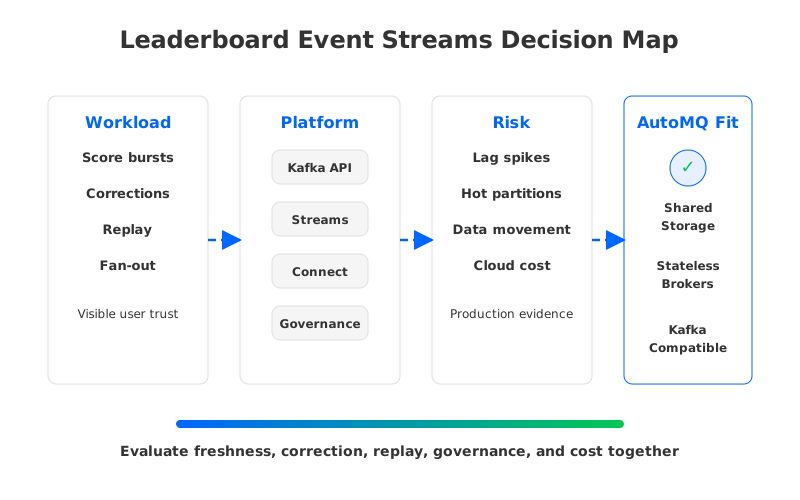
Kafka is a natural fit because leaderboard systems are event-driven, fan-out heavy, and sensitive to ordering within the scoring domain. That does not make every Kafka-compatible architecture equally suitable. The platform has to preserve Kafka semantics, absorb uneven traffic, support replay and correction, expose governance controls, and make cloud cost predictable enough that the team does not avoid useful product events because the stream became too expensive to operate.
1Why Teams Search for leaderboard event streams kafka
The search intent is practical. Developers want to know how to model score events, architects want to know where Kafka fits between game servers and ranking stores, and platform teams want to know whether the streaming layer can survive production traffic. Those are different questions, but they converge on the same architecture: event streams become the system of record for scoring decisions, while materialized views serve the current leaderboard to users.
A typical pipeline begins with producers that publish score-related events from gameplay services, campaign systems, payment systems, or engagement services. Kafka topics then carry raw events, validated score events, fraud decisions, aggregate updates, and downstream analytics. Stream processors or consumers maintain ranking state in Redis, RocksDB-backed stream processing state, a database, or a purpose-built leaderboard service. The same event stream may also feed customer support tooling, experimentation systems, revenue analytics, and compliance archives.
That fan-out is useful because every team reads the same ordered facts instead of building private integrations. It is also why a leaderboard stream becomes infrastructure, not application glue. Once a score event has multiple consumers, every replay, schema change, ACL update, retention decision, and partitioning choice affects more than one team.
Three properties usually determine whether the design holds:
- Freshness: Users expect visible rankings to update quickly after an action. The platform needs predictable produce latency, consumer lag control, and enough headroom for burst traffic.
- Correctability: Scores are not always final. Fraud detection, payment reversal, moderation, and late-arriving events require corrections without losing the audit trail.
- Fan-out: The scoring path, notification path, analytics path, and experimentation path often read the same topics with different latency and replay expectations.
These properties make the workload more demanding than a tutorial pipeline. The platform is not only moving events. It is protecting user-visible trust.
2The Production Constraint Behind the Problem
Leaderboard streams are bursty by design. Traffic spikes at tournament start, level completion, campaign launch, daily reset, and regional peak hours. A platform sized only for average throughput will look fine in dashboards until users concentrate around the same scoring window. At that point, producer batching, partition count, broker CPU, disk throughput, consumer fetch behavior, and downstream write capacity all become part of the freshness budget.
Partitioning deserves special attention because leaderboard correctness often has a domain boundary. A global ranking, per-region ranking, per-match ranking, and guild ranking may need different keys. Keying every event by user can distribute writes well, but it may make per-tournament aggregation expensive. Keying by tournament can preserve local ordering but create hot partitions during popular events. The right answer depends on the read model and correction workflow, not on a generic Kafka rule.
Retention is the next constraint. A leaderboard needs a current view, but the event stream needs history for replay, support investigation, backfill, audit, and fraud review. Short retention reduces storage pressure but weakens recovery and correction. Long retention protects the business record but changes the cost and operating profile of the Kafka layer. If retained history is tied tightly to broker-local storage, a product decision about auditability becomes an infrastructure scaling decision.
The last constraint is multi-tenant pressure. The scoring consumer may be latency-sensitive, while analytics consumers may tolerate delay and read large historical ranges. Anti-cheat consumers may have unpredictable bursts after model updates. Marketing systems may add campaign-specific event types. A healthy platform lets these consumers coexist without pretending they have the same SLO.
3Architecture Options and Trade-Offs
There are several ways to build leaderboard event streams with Kafka or a Kafka-compatible platform. The simple version is a single topic for score events and one consumer that updates a ranking store. That can work for a small product, but mature systems usually split the flow into raw events, validated events, score adjustments, ranking updates, and derived analytics. The split gives teams clearer ownership and rollback points, but it also increases the importance of schema governance, topic naming, ACLs, and observability.
The storage architecture underneath Kafka changes the operational shape of those topics. Traditional Apache Kafka uses a Shared Nothing model: brokers own local log storage, leaders serve reads and writes, followers replicate, and partition movement moves data across brokers. This model is familiar and proven. It also means scaling, replacement, retention growth, and reassignment can involve durable data movement.
Tiered Storage changes part of the storage equation by offloading older segments to remote storage, which can reduce pressure from long retention. It does not fully remove the broker-centered hot path or the need to think about local storage, partition placement, and operational movement. For leaderboard systems, this distinction matters because the workload often combines hot scoring traffic with replay-heavy analytics and correction workflows.
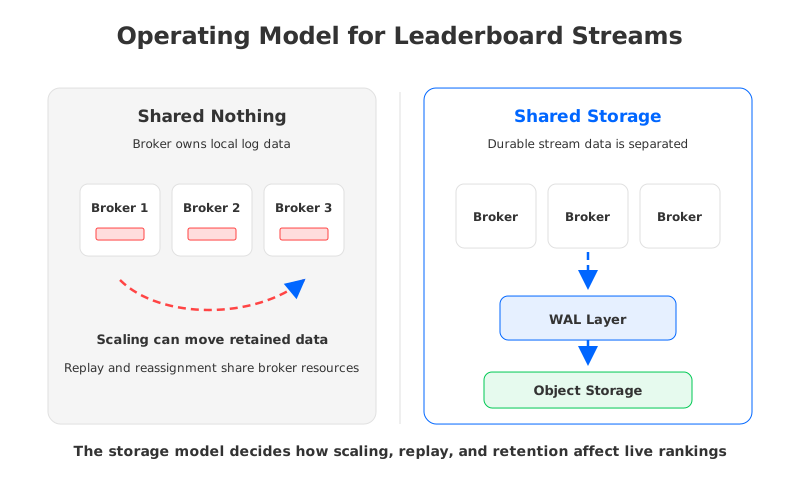
A Shared Storage architecture changes the premise further. Durable stream data lives in shared object storage, while brokers focus on protocol handling, caching, scheduling, and request routing. The point is not that every leaderboard workload cares about storage architecture on day one. The point is that storage architecture decides what happens when the leaderboard becomes important enough to need elasticity, longer retention, and safer broker lifecycle operations.
Use a neutral comparison before choosing:
| Decision area | Broker-local model | Shared Storage model | Leaderboard question |
|---|---|---|---|
| Fresh scoring path | Mature hot-path behavior with local logs. | Depends on WAL, cache, and object storage integration. | Can p99 freshness survive bursts and broker events? |
| Retention | Storage often grows with broker lifecycle or tiering policy. | Durable history can be separated from broker lifecycle. | Can audit history grow without forcing compute growth? |
| Replay | Replays can compete with hot brokers and disks. | Replays can use shared durable data with cache and routing policy. | Can analytics replay avoid hurting live rankings? |
| Scaling | Partition and data movement are operational concerns. | Brokers can be treated more statelessly. | Can the team add capacity during an event window? |
| Cost | Compute, disk, replication, and cross-zone paths must be modeled. | Compute, WAL, object storage, requests, and network paths must be modeled. | Which topology makes cost predictable at tournament scale? |
The table does not declare a universal winner. It forces the team to connect the architecture to the leaderboard's failure modes.
4Evaluation Checklist for Platform Teams
Leaderboard systems make weak platform assumptions visible. A delayed consumer is not an internal metric when users are watching a ranking. A lost correction is not a minor data quality issue when prizes, rewards, or reputation are involved. The platform review should therefore look more like a production readiness assessment than a feature checklist.
Start with compatibility. Kafka-compatible should mean that existing clients, serializers, security settings, consumer groups, offset handling, idempotent producers, transactions where used, and Kafka Connect integrations behave as expected. A leaderboard pipeline may use transactions to keep score updates and derived events consistent, or it may rely on idempotent processing and an external state store. Either way, the migration or platform decision must be tested against the actual semantics in use.
Then model the cost boundary. The cloud bill for leaderboard streams can include brokers, controllers, storage, object storage requests, inter-zone traffic, private connectivity, monitoring ingestion, connector workloads, and operational headroom. A product team may describe a tournament as "one feature launch"; the platform team sees a burst profile, a retention profile, a replay profile, and an SLO profile. Those profiles should be priced separately.
The final review should include these checks:
- Topic and key design: Confirm which events require ordering together, which can be distributed, and which correction workflows need a durable audit trail.
- Consumer isolation: Separate hot scoring consumers from analytics, experimentation, notifications, and anti-cheat workloads with quotas, priorities, or dedicated read paths where needed.
- Replay behavior: Test delayed consumers and historical replay while the live leaderboard remains active.
- Failure drills: Measure broker loss, zone impairment, client reconnect, consumer group rebalance, and downstream state-store recovery.
- Governance: Define ownership for topics, schemas, ACLs, retention, PII handling, and score correction events.
- Migration and rollback: Prove parallel run, offset validation, cutover, rollback, and dashboard parity before moving a live ranking path.
This checklist keeps the discussion grounded and prevents the common mistake of benchmarking only the scoring consumer while ignoring correction and replay paths.
5How AutoMQ Changes the Operating Model
After the neutral framework is clear, AutoMQ becomes relevant as a specific architectural option rather than a slogan. AutoMQ is a Kafka-compatible cloud-native streaming platform that replaces Kafka's local log storage layer with S3Stream shared storage, using WAL storage for low-latency persistence and object storage for durable stream data. In this model, brokers are stateless in the sense that durable stream data is not bound to a broker's local disk.
For leaderboard event streams, that changes the operational conversation in three ways. First, retained history and broker lifecycle become less tightly coupled. If a game adds longer audit retention for prize disputes, the platform does not have to treat that history as broker-local baggage during every scaling event. Second, broker replacement and balancing can focus more on serving traffic than moving retained data. That matters when live events create narrow windows for operational changes. Third, cloud cost can be evaluated around object storage, WAL choice, cache behavior, and network topology instead of only broker disks and replication.
AutoMQ does not remove the need for testing. A leaderboard pipeline should still validate partition design, producer configuration, consumer lag, correction semantics, object storage behavior, WAL choice, cache hit ratio, and failure recovery. The useful difference is the operating model being tested. Instead of asking whether a broker-local design can be stretched far enough for bursty rankings, long retention, and replay-heavy consumers, the team can test whether a shared-storage Kafka-compatible design gives cleaner boundaries for the same workload.
The deployment boundary also matters. Gaming and engagement platforms often handle sensitive user identifiers, payment-adjacent events, and regional data controls. AutoMQ BYOC is designed for customer-controlled cloud environments, while AutoMQ's Kafka compatibility gives teams a path to evaluate existing Kafka clients and ecosystem tools without rewriting the application around a different API.
6Decision Scorecard
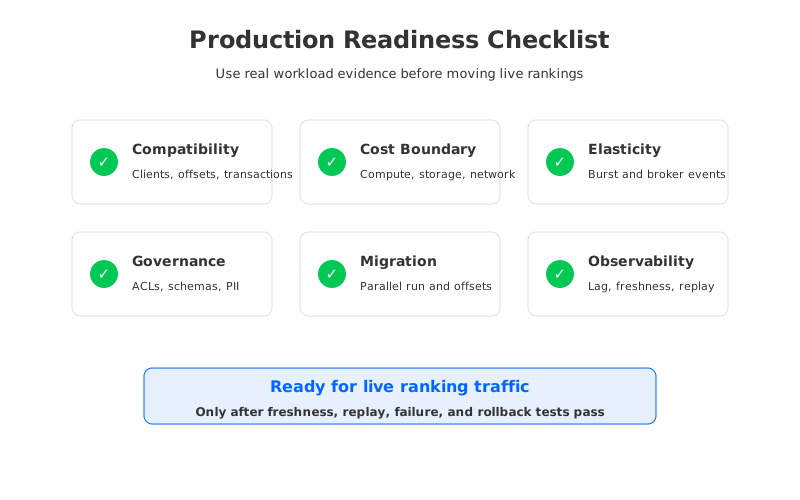
A decision scorecard should translate architecture into operational evidence. Give each row a pass, partial, or fail based on a real test, not a meeting assumption.
| Area | Evidence to collect | Why it matters |
|---|---|---|
| Freshness | Produce latency, consumer lag, ranking-store update latency, and dashboard freshness during burst tests. | Users experience stale rankings as product failure. |
| Correctability | Late events, fraud reversals, compensation events, and replayed score updates preserve auditability. | Leaderboards often need to change past scores safely. |
| Elasticity | Capacity changes and broker replacement do not require risky retained-data movement during live events. | Event windows leave little room for storage-heavy operations. |
| Cost | Compute, storage, WAL, object requests, cross-zone traffic, and monitoring are modeled separately. | Leaderboard growth should not surprise FinOps after launch. |
| Governance | Topic ownership, ACLs, schemas, retention, and PII handling are reviewable. | Shared streams become shared risk without ownership. |
| Migration | Parallel run, offset validation, rollback, and observability parity are proven. | Kafka compatibility is valuable only when the workload behavior survives cutover. |
The result should be a platform decision that product and infrastructure teams can both understand: richer ranking mechanics for product, and a streaming layer that infrastructure can test, price, and govern.
If your current design keeps running into broker-local data movement, replay interference, or cloud cost uncertainty, include a shared-storage Kafka-compatible option in the evaluation. Start with the AutoMQ architecture overview, then bring your real leaderboard workload profile to AutoMQ so the test reflects the system your users will actually see.
7References
- Apache Kafka Documentation: https://kafka.apache.org/documentation/
- Apache Kafka Consumer Configuration: https://kafka.apache.org/documentation/#consumerconfigs
- Apache Kafka Producer Configuration: https://kafka.apache.org/documentation/#producerconfigs
- Apache Kafka Transactions: https://kafka.apache.org/documentation/#transactions
- Apache Kafka Connect: https://kafka.apache.org/documentation/#connect
- Apache Kafka KIP-405: Kafka Tiered Storage: https://cwiki.apache.org/confluence/display/KAFKA/KIP-405%3A+Kafka+Tiered+Storage
- AWS Amazon S3 pricing: https://aws.amazon.com/s3/pricing/
- AWS EC2 instance network bandwidth documentation: https://docs.aws.amazon.com/AWSEC2/latest/UserGuide/ec2-instance-network-bandwidth.html
- AutoMQ compatibility with Apache Kafka: https://docs.automq.com/automq/what-is-automq/compatibility-with-apache-kafka?utm_source=blog&utm_medium=reference&utm_campaign=rpb-0144
- AutoMQ architecture overview: https://docs.automq.com/automq/architecture/overview?utm_source=blog&utm_medium=reference&utm_campaign=rpb-0144
- AutoMQ deployment overview: https://docs.automq.com/automq/deployment/overview?utm_source=blog&utm_medium=reference&utm_campaign=rpb-0144
8FAQ
8.1What does leaderboard event streams kafka mean?
It refers to using Kafka or a Kafka-compatible platform as the event-streaming layer behind leaderboard systems. Score events, corrections, fraud decisions, ranking updates, and analytics consumers use the stream as a durable record while serving systems materialize the current leaderboard for users.
8.2How should leaderboard events be partitioned in Kafka?
Partitioning should follow the correctness boundary. A per-tournament leaderboard may need tournament-oriented keys, while user-centered engagement streams may key by user. The design should test hot partitions, ordering needs, correction workflows, and downstream aggregation cost before production.
8.3Why is replay important for leaderboard systems?
Replay supports fraud review, bug recovery, analytics backfill, ranking reconstruction, and customer support investigation. The platform should prove that delayed consumers or historical replay do not interfere with the live scoring path.
8.4How can AutoMQ help with leaderboard event streams?
AutoMQ keeps Kafka protocol compatibility while using shared object storage, WAL-backed persistence, and stateless brokers. For leaderboard workloads, that can make retained history, broker lifecycle, and elastic scaling easier to reason about while preserving a Kafka-compatible application surface.


