
Table of Contents
Table of Contents
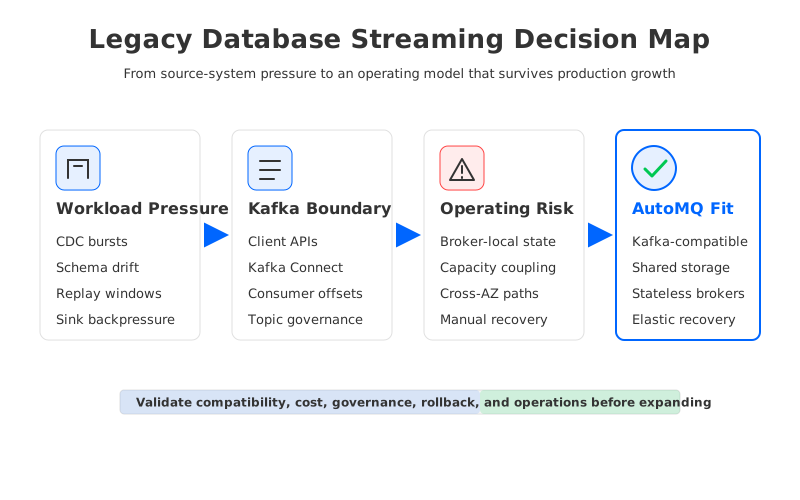
Teams usually search for legacy database streaming kafka after a compromise has already started to hurt. The core systems still run on Oracle, SQL Server, PostgreSQL, Db2, MySQL, or mainframe-adjacent databases. The business wants fresher data in analytics, risk engines, AI features, fraud systems, customer 360 services, and operational dashboards. Application teams do not want to rewrite every transaction path around a new event model before the first pipeline ships.
Kafka became the default buffer for that pressure because it gives teams a durable log between old systems and new consumers. Change data capture, outbox relays, log tailing, source connectors, sink connectors, and stream processors can all meet at a Kafka-compatible boundary. That boundary matters: it lets the database team keep ownership of the source of record while downstream teams subscribe to changes without adding direct load to the production database.
The hard part is not the first connector. The hard part is what happens when the pattern works. One legacy database becomes 20 source systems. One topic per domain becomes hundreds of tables, audit streams, retry topics, dead-letter topics, and compacted state topics. The streaming platform stops being a sidecar for integration and becomes production infrastructure with retention, cost, access control, schema governance, replay, disaster recovery, and SRE ownership requirements.
1Why Teams Search for legacy database streaming kafka
The search query is rarely about Kafka syntax. It is about sequencing risk. Platform teams need a way to expose data changes before every application can publish clean domain events, but they also know that raw database streams can leak implementation details into the rest of the company. A renamed column, a backfill job, a batch correction, or a table split can become a breaking event for systems that were never meant to understand the source schema.
That creates a useful design rule: treat legacy database streaming as an adoption bridge, not the final domain model for every consumer. Kafka-compatible infrastructure can carry CDC events, outbox events, and transformed canonical streams at the same time. The source connector captures what changed; a stream processor or transformation layer decides what should become a stable public event; consumers bind to that stable contract instead of to every table mutation.
This distinction changes how you evaluate the platform. A small proof of concept can succeed with one connector, default topic settings, and a few dashboards. A production platform needs clearer answers:
- Which teams own source connectors, topic contracts, and schema changes?
- How long must raw changes be retained for replay and audit?
- Can consumers reset offsets safely without overloading databases or storage?
- How will secrets, network paths, and private endpoints be governed?
- What is the rollback plan when a connector emits bad data?
The right architecture gives those questions somewhere to live. The wrong architecture turns them into tribal knowledge spread across connector configs, broker disks, cloud bills, and emergency runbooks.
2The Operational Constraint Behind Connector-Heavy Platforms
Traditional Kafka is a shared-nothing system: each broker owns local storage, and partitions are replicated between brokers for durability and availability. That design is proven and still appropriate in many environments. It also means capacity decisions are coupled. When a CDC platform adds retention, replay headroom, or burst throughput, the platform often has to add broker disk, broker compute, and inter-broker replication capacity together.
Connector-heavy workloads make that coupling visible. Source connectors often write unevenly because table activity is uneven. Some tables are cold all day and then spike during batch settlement. Some topics need compaction because they represent current state. Others need longer retention because audit or ML feature pipelines may replay them. Sink connectors may fall behind when a warehouse, search index, lakehouse table, or SaaS API throttles writes. The Kafka cluster absorbs all of that variability.
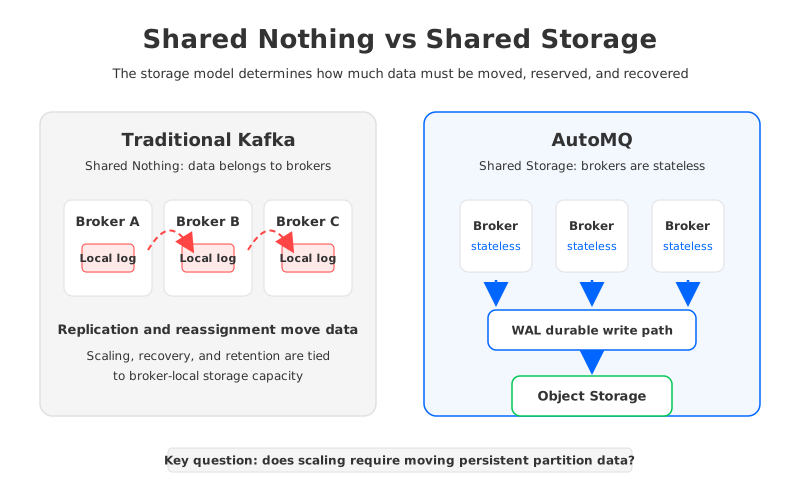
The operational cost is not only storage. Broker-local data creates gravity. Scaling a stateful Kafka cluster can require partition reassignment and data movement. Replacing a broker requires careful recovery. Multi-AZ replication may generate cloud network charges because replicas are copied between zones. Long retention increases disk pressure even when the data is rarely read. None of these issues is a connector bug, but connector-heavy platforms trigger them earlier because they multiply topics, partitions, and replay paths.
Kafka Connect adds another boundary to manage. Distributed workers store connector configuration, offsets, and status in Kafka topics, which is the correct pattern for fault tolerance. It also means platform teams must operate the worker fleet, plugin lifecycle, connector task sizing, secrets, offset reset procedures, dead-letter handling, and observability as a product. A legacy streaming platform is therefore two platforms: the Kafka-compatible log and the connector runtime that feeds it.
3Failure Handling, Schema, and Replay Trade-offs
Failure handling is where legacy database streaming stops being an integration diagram and becomes an operating model. If a source connector pauses, the database log or replication slot may retain more history. If a sink connector fails, Kafka lag grows. If a schema change is incompatible, consumers may fail even though the broker is healthy. If a transformation emits bad records, replay may be technically possible but organizationally risky because multiple downstream systems have already acted on the data.
Replay is powerful because Kafka tracks consumer offsets independently from the log. A consumer group can resume from committed offsets, and operators can reset offsets when the retention window still contains the needed data. The same capability can create sharp edges. Replaying a raw CDC topic into a side-effecting sink may duplicate writes unless the sink is idempotent. Replaying a compacted topic may restore current state but not the full history of changes. Replaying across a schema boundary requires the old schema, the new schema, and a compatibility rule that both producers and consumers understand.
Exactly-once semantics and transactions can help when the producer, processing layer, and sink are designed for them, but they do not remove the need for data contracts. Legacy source systems often emit changes at the table level, while consumers want business events. A platform team should decide which topics are raw capture, which topics are curated events, which topics are internal recovery streams, and which topics are supported public interfaces. Without that taxonomy, every stream looks equally official until the first breaking change.
The practical pattern is to separate failure domains:
- Raw capture topics preserve source changes with clear retention and access limits.
- Curated topics provide stable contracts for application and analytics consumers.
- Retry and dead-letter topics preserve failed records without blocking the entire pipeline.
- Audit topics record connector state changes, schema versions, and operational actions.
This structure is not glamorous, but it is what keeps a database modernization program from turning into a distributed debugging exercise.
4Evaluation Checklist for Platform Teams
The neutral way to evaluate legacy database streaming is to score the platform against the operating promises it must keep after adoption expands. Compatibility matters first because the Kafka ecosystem is the reason many teams choose this path. Existing producers, consumers, Kafka Connect connectors, stream processors, security integrations, and observability tools should keep working with minimal changes. A platform that requires application rewrites defeats the purpose of using Kafka as the migration boundary.
Cost comes next, but the useful cost model is not a single broker price. Model write throughput, read fan-out, retention, replay frequency, cross-AZ traffic, connector worker compute, private connectivity, object storage, monitoring, and operational labor. The database streaming workload may look modest on average and still require expensive headroom because spikes, replay, and sink backpressure are part of normal operation.
| Evaluation Area | What to Validate | Why It Matters |
|---|---|---|
| Kafka compatibility | Client APIs, Connect, transactions, consumer groups, ACLs, and monitoring tools | Avoids rewriting applications and connector estates |
| Elasticity | Scaling brokers and connector workers without long data movement windows | Handles uneven CDC bursts and sink backpressure |
| Storage model | Retention and replay economics for raw, curated, and audit topics | Prevents retention from becoming a broker disk problem |
| Network model | Multi-AZ replication, private endpoints, and data locality | Controls cloud transfer cost and security boundaries |
| Governance | Topic taxonomy, schema rules, access control, and ownership metadata | Keeps raw database details from becoming public contracts |
| Migration risk | Dual-run, offset validation, rollback, and consumer cutover | Lets teams modernize incrementally |
| Operations | Lag, connector health, rebalance behavior, recovery drills, and runbooks | Makes the platform supportable by SREs |
The table is deliberately technology-neutral. It applies whether the target platform is self-managed Kafka, a managed Kafka service, or a Kafka-compatible cloud-native system. The important point is that the infrastructure should be judged by the workflow it enables, not by whether the first connector can move rows into a topic.
5How AutoMQ Changes the Operating Model
Once the evaluation framework is clear, AutoMQ fits into a specific architectural category: a Kafka-compatible streaming platform that keeps the Kafka protocol and ecosystem while changing the storage layer to a shared-storage model. Instead of treating broker-local disks as the durable center of the platform, AutoMQ uses stateless brokers with object-storage-backed stream storage and a write-ahead log layer for durable writes. For teams building legacy database streaming on Kafka-compatible infrastructure, the relevant change is operational rather than cosmetic.
Shared storage changes the scaling question. In a traditional shared-nothing Kafka cluster, scaling and recovery are constrained by where partition data lives. In AutoMQ's model, brokers are not the long-term owners of persistent stream data. Compute can be scaled more independently from storage, and broker replacement no longer implies the same kind of local data recovery workflow. That matters for CDC platforms because traffic shape is rarely steady: source bursts, sink lag, replay, and table backfills all create temporary pressure.
It also changes the cost discussion. Object storage is a natural fit for retained logs that may be replayed occasionally but do not need to sit entirely on broker-local disks. AutoMQ's documentation describes its Shared Storage architecture, WAL storage options, Kafka compatibility, and inter-zone traffic reduction model. Those are the right areas to evaluate if your current Kafka cost is driven by retention growth, over-provisioned brokers, or multi-AZ replication paths rather than by steady compute alone.
AutoMQ should not be evaluated as a magic connector fix. You still need schema governance, connector ownership, backpressure handling, and rollback discipline. The useful question is narrower: does the streaming infrastructure reduce the amount of broker-local state your team must move, reserve, rebalance, and recover while preserving Kafka-compatible APIs for the applications and tools you already operate? For many legacy database streaming programs, that is exactly where the platform risk accumulates.
AutoMQ's deployment boundaries also matter for regulated teams. BYOC and software deployment models can keep the data plane within customer-controlled cloud or private infrastructure, while managed connector capabilities can reduce the undifferentiated work of running Kafka Connect fleets. If your CDC platform touches sensitive operational databases, this boundary is often as important as raw throughput.
6A Practical Migration Scorecard
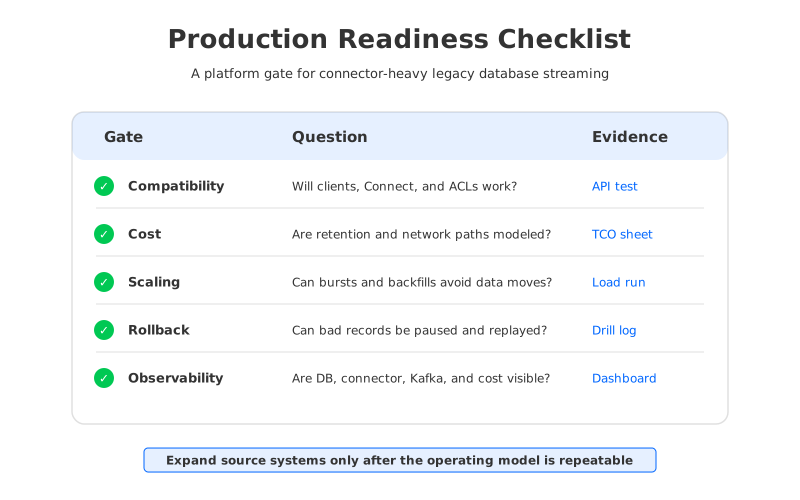
A legacy database streaming initiative should not begin with a full replacement plan for every application. It should begin with a scorecard that separates readiness from ambition. The first production slice should be important enough to prove the operating model, but narrow enough that the team can reason about source ownership, consumer behavior, rollback, and cost.
Use a simple scoring model before expanding the pattern:
- Source stability: The captured tables have known owners, change windows, and schema review paths.
- Consumer safety: Downstream consumers can handle duplicates, late events, and replay according to documented rules.
- Infrastructure elasticity: The platform can absorb burst writes, sink lag, and backfills without emergency broker resizing.
- Governance: Raw, curated, retry, dead-letter, and audit topics have different retention, access, and support expectations.
- Rollback: The team can pause connectors, reset offsets, quarantine bad records, and restore a known-good processing path.
- Observability: Database log position, connector task status, Kafka lag, broker health, sink error rates, and cloud cost are visible together.
The strongest teams treat this scorecard as an entry gate for each new source system. They do not let every database team invent its own CDC pattern, and they do not force every application team to become a Kafka expert. The platform provides paved roads: connector templates, topic naming, schema policy, network patterns, cost tags, dashboards, and incident runbooks.
If your team is evaluating how a Kafka-compatible shared-storage architecture could reduce the operational weight behind legacy database streaming, review AutoMQ's architecture and deployment model at go.automq.com. The useful next step is not a broad rewrite; it is a focused workload review that maps your current connector estate, retention policy, cloud network path, and rollback requirements to the platform responsibilities above.
7References
- Apache Kafka documentation: Kafka Connect overview
- Apache Kafka documentation: Message delivery semantics and transactions
- Apache Kafka documentation: KRaft operations
- Apache Kafka documentation: Tiered Storage operations
- Apache Kafka documentation: Consumer configuration
- AutoMQ documentation: Shared Storage architecture
- AutoMQ documentation: Kafka compatibility
- AutoMQ documentation: WAL storage
- AutoMQ documentation: Eliminate inter-zone traffic
- AutoMQ documentation: Managed Kafka Connect overview
- AWS: Amazon S3 FAQs
- AWS: Amazon EC2 On-Demand Pricing
8FAQ
8.1Is Kafka required for legacy database streaming?
No. Some teams use database-native replication, ETL tools, queues, or direct warehouse ingestion. Kafka becomes attractive when multiple consumers need independent replay, when the organization already standardizes on Kafka clients and connectors, or when source changes must feed both applications and analytics systems.
8.2Should raw CDC topics be exposed directly to application teams?
Usually only with clear expectations. Raw CDC topics are useful for audit, recovery, and transformation, but they mirror source implementation details. Curated topics are safer public contracts because they can hide table structure, normalize schemas, and express business events more clearly.
8.3What is the biggest production risk in connector-heavy streaming?
The biggest risk is unmanaged coupling. Source schemas, connector offsets, topic retention, consumer replay, sink idempotency, and cloud network paths all interact. A healthy platform makes those dependencies explicit through ownership, policy, and observability.
8.4How does shared storage help CDC and legacy streaming workloads?
Shared storage can reduce the amount of persistent data tied to individual brokers. That can make scaling, retention, broker replacement, and replay economics easier to manage, especially when CDC workloads create uneven bursts and long-lived retained logs.
8.5Where does AutoMQ fit in this architecture?
AutoMQ fits as a Kafka-compatible shared-storage streaming layer. It is most relevant when teams want to preserve Kafka APIs and ecosystem compatibility while reducing the operational burden of broker-local storage, cross-zone replication paths, and stateful scaling.


