
Table of Contents
Table of Contents
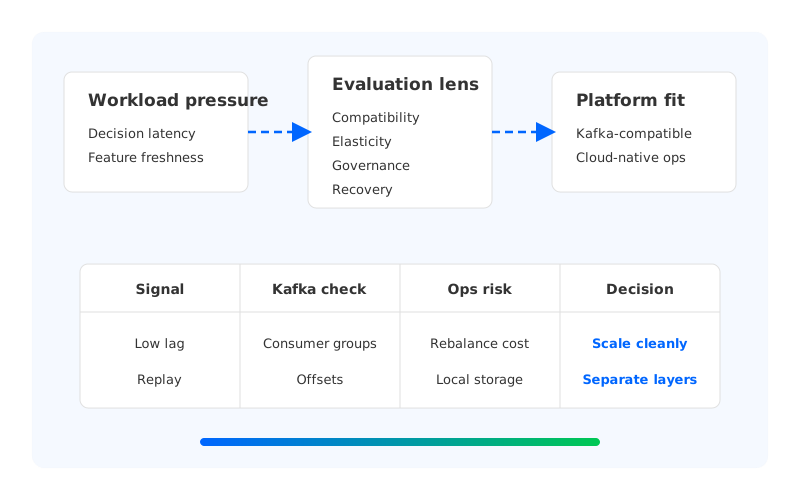
Teams searching for live ai feature feeds kafka are usually past the prototype stage. They already know how to train a model, call an embedding service, or build a retrieval pipeline. The harder problem is getting the right context into the decision path while the context is still fresh enough to matter.
That pressure shows up in practical places: fraud scoring that needs the last few payment attempts, personalization that reacts to a session in progress, logistics decisions that depend on moving inventory, or AI agents that need governed event history instead of an unbounded pile of prompts. In each case, the model is not the whole system. The feature feed is part of the product's control loop, and its failure mode is not only downtime. It can be stale context, incomplete replay, silent schema drift, or a cost curve that gets ugly when the workload finally succeeds.
Kafka is often the default substrate for these feeds because it gives teams a durable, replayable log with a broad ecosystem. That default is reasonable. The question is whether the Kafka-compatible layer you choose can handle the operational shape of live AI decisioning without forcing the platform team into constant capacity planning, data movement, and governance exceptions.
1Why Teams Search for live ai feature feeds kafka
Live feature feeds sit between event capture and model-serving logic. They may carry raw behavioral events, precomputed features, session aggregates, risk signals, model outputs, retrieval metadata, or agent state transitions. The common requirement is not "streaming" in the abstract. It is bounded freshness with durable replay and a clear contract between producers, feature processors, and online consumers.
This is where a plain request-response feature lookup starts to crack. A feature store can serve the latest materialized value, but decisioning systems often need the chain of events behind that value. If a scoring rule changes, the team may need to replay historical events. If a model is rolled back, the team may need to compare old and new outputs against the same event stream. If a downstream service falls behind, the platform should show consumer lag and preserve offsets instead of hiding the gap behind retries.
Kafka's core abstractions map well to that problem. Topics define the feed boundary, partitions preserve ordered slices of the stream, consumer groups coordinate parallel readers, and committed offsets give each consuming application a recovery point. Transactions and idempotent producers can also matter when a pipeline writes derived features and needs stronger processing semantics. These are not AI-specific features, which is exactly why they are useful: they give AI infrastructure a boring, inspectable data plane.
The production challenge starts when the feed becomes important enough to grow. Low-latency decisioning does not forgive oversized maintenance windows, but the workload is rarely steady. Feature volume spikes during campaigns, fraud attacks, product launches, marketplace peaks, and backfills. A platform that looks fine during average traffic can become operationally expensive when it must absorb bursty writes, long retention, catch-up reads, and multiple online consumers at the same time.
2The Freshness and Governance Problem Behind AI Event Streams
Freshness is usually discussed as latency, but live AI systems need a wider definition. The feature that reaches the model must be recent, attributable, authorized, replayable, and compatible with the consumer's schema expectations. A feed that delivers events quickly but cannot explain which producer emitted a field, which consumer used it, or how to rebuild a bad decision is not production-ready.
The governance boundary is also messier than in a classic analytics pipeline. AI feature feeds may include user behavior, derived risk scores, account attributes, embeddings, and model decisions. Some of those fields are sensitive. Some are temporary. Some can be retained for debugging, while others need tighter access control. Kafka-compatible infrastructure gives teams the primitives for topic-level isolation and consumer accountability, but the platform team still has to design the policy surface.
For a feature feed, the policy surface should answer a few concrete questions:
- Which topics are allowed to feed online decisions, and which are analytics-only?
- Who owns the schema contract for each feature family?
- How long must raw events, derived features, and model outputs be retained?
- Which consumers are allowed to replay historical context?
- What happens when a model consumes a feature version that later proves wrong?
Those questions are not paperwork. They determine how the streaming platform is configured. Retention affects storage cost. Replay affects read throughput. Consumer isolation affects partitioning strategy. Access control affects topic layout and service identity. Observability affects incident response because "the model made a bad decision" often turns into "which event did the model see, and when?"
3Architecture Options for Durable, Replayable AI Context
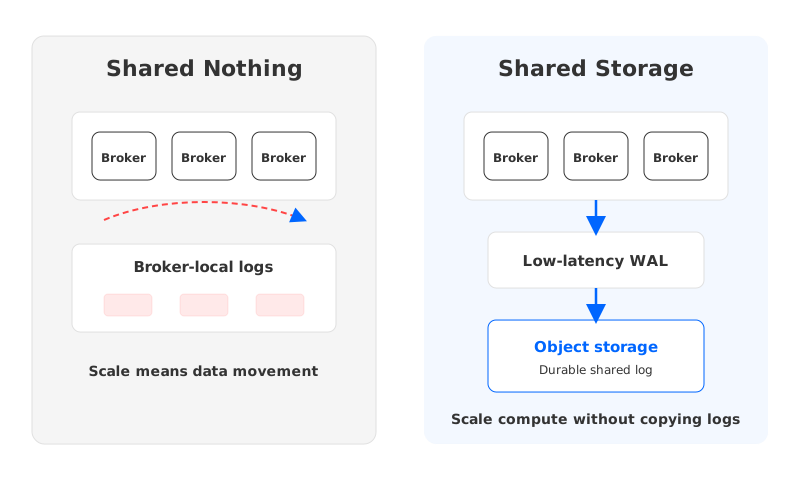
The most familiar deployment model is traditional Apache Kafka with broker-local storage. In that shared-nothing architecture, each broker owns local log segments for the partitions it hosts. Replication across brokers provides durability and availability, while partition reassignment moves data when leadership or placement changes. This design has served the ecosystem well because it is explicit, fast, and operationally understandable.
AI feature feeds stress the parts of that model that are tied to local storage. When a workload grows, adding brokers is not only a compute operation. Data has to be rebalanced across the cluster. When a broker fails, recovery depends on replicas and catch-up behavior. When retention increases, storage pressure lands on broker-attached disks. When consumers perform heavy replay, the same infrastructure serving fresh reads may also be asked to serve historical scans.
Tiered storage can reduce pressure on local disks by offloading older log segments to remote storage, and it is a valuable pattern for long retention. It does not fully remove the operational coupling between brokers and the active log path. The platform still has to reason about local hot data, broker placement, partition movement, and the cost of rebalancing under load.
A useful architecture review separates three concerns that often get bundled together:
| Concern | What to evaluate | Why it matters for live AI feeds |
|---|---|---|
| Write path | Producer latency, durability, batching, transaction needs | Online decisions degrade when fresh features arrive late or inconsistently. |
| Replay path | Consumer lag recovery, catch-up reads, historical scans | Model debugging and rollback depend on deterministic access to past events. |
| Operating path | Scaling, rebalancing, failure recovery, storage growth | Feature workloads are bursty, and operational work should not scale linearly with data volume. |
The wrong conclusion is that every AI workload needs exotic infrastructure. Many feeds can run on a well-operated Kafka cluster. The better conclusion is that the architecture must be matched to the operating model. A compact fraud signal with short retention and stable throughput is different from a multi-tenant feature bus that retains raw events, derived features, embeddings, and model outputs for audit and replay.
4Evaluation Checklist for Platform Teams
Before choosing or changing infrastructure, platform teams should define the evidence they need. Product names do not matter at this stage. The goal is to avoid a decision process where one team optimizes for model latency, another team optimizes for cloud cost, and the SRE team inherits the unspoken trade-offs.
Use this checklist as a first-pass filter:
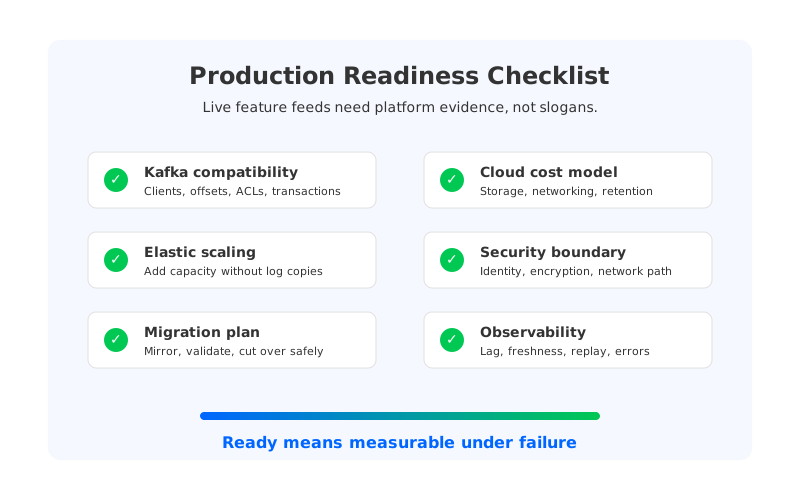
- Kafka compatibility: Verify client behavior, protocol support, consumer groups, offset management, ACLs, transactions if used, and tool compatibility. A feature feed platform should not require application teams to rewrite stable Kafka clients for basic ingestion and consumption.
- Freshness under pressure: Test producer latency, consumer lag, and catch-up behavior during bursts and backfills. Average latency is not enough because AI decisioning incidents usually happen during load shifts.
- Replay and rollback: Confirm how far back each feed must be replayable, how consumers reset offsets, and how rollback works when a model or feature transform changes.
- Cloud cost: Model storage, compute, inter-zone data transfer, private connectivity, monitoring, and retained historical reads. Idle-cluster economics rarely describe the production bill.
- Security and governance: Map service identities, encryption requirements, network boundaries, topic ownership, and auditability before the feed becomes a shared dependency.
- Migration risk: Check whether existing producers and consumers can run in parallel, whether topic state can be mirrored, and how the team validates offsets before cutover.
The checklist should produce a decision record, not a vague preference. For example, a team may accept more broker management for a small, steady workload because existing Kafka operations are mature. Another team may prioritize independent compute and storage scaling because feature retention is growing faster than request volume. A third may care most about deployment boundaries because regulated data must stay in its own cloud account.
5How AutoMQ Changes the Operating Model
Once the evaluation lens is clear, AutoMQ becomes relevant as one concrete architecture option: a Kafka-compatible streaming platform that uses a Shared Storage architecture with stateless brokers and object-storage-backed durability. Its appeal is not that AI workloads need a special API. The appeal is that live feature feeds often need Kafka semantics while reducing the amount of broker-local storage work hidden inside scaling and recovery.
In AutoMQ's model, brokers are designed to be stateless from the perspective of durable log storage. A low-latency write-ahead log handles the fresh write path, while object storage holds the durable shared stream data. This changes the operational question from "which broker owns this data and how do we move it?" to "which broker should serve this traffic now?" For teams running bursty AI feeds, that distinction matters because compute pressure and retained data volume no longer have to grow in lockstep.
The same shift affects failure recovery and capacity planning. If a broker is no longer the long-term home of the data it serves, replacing or scaling broker capacity becomes less tied to copying local log segments. That does not remove the need for engineering discipline. Producers still need sane batching and idempotency settings, consumers still need lag budgets, and schemas still need ownership. It does make the platform's scaling motion closer to cloud-native compute scaling than traditional broker-and-disk expansion.
AutoMQ also fits teams that want Kafka-compatible behavior without giving up customer-controlled deployment boundaries. BYOC and software deployment models are relevant when feature feeds contain sensitive user context, proprietary risk signals, or regulated operational data. In those environments, the infrastructure decision is not only about throughput. It is also about who controls the network path, cloud account boundary, encryption posture, and operational access.
For AI feature feeds specifically, the most important architectural benefit is predictability under change. Feature workloads change when a new model launches, when a new event source is added, when a team needs to replay history, or when retention policy expands for audit. Shared storage does not make those changes free, but it reduces the number of changes that require large broker-local data movement.
6A Practical Readiness Scorecard
A lightweight scorecard helps teams avoid overfitting the architecture to one benchmark. Score each area from 1 to 5, where 1 means "not proven" and 5 means "validated under production-like load." The exact numbers matter less than the gaps that appear across teams.
| Area | 1 means | 5 means |
|---|---|---|
| Compatibility | Client behavior is assumed | Existing clients and tools are tested |
| Freshness | Only average latency is measured | Burst, failover, and catch-up lag are measured |
| Replay | Offset reset is manual and risky | Replay paths are documented and rehearsed |
| Cost | Only broker compute is counted | Storage, networking, retention, and operations are modeled |
| Governance | Topic ownership is informal | Ownership, access, retention, and audit are explicit |
| Migration | Cutover depends on hope | Mirror, validation, rollback, and consumer progress are tested |
Teams often discover that the weakest score is not raw performance. It is rollback, ownership, or cost visibility. A platform that cannot explain how it will recover from a bad feature release is not ready for low-latency decisioning, even if a benchmark chart looks impressive.
The next step is to run a small production-shaped validation rather than a toy throughput test. Pick one feed with real producers, real consumers, realistic retention, and a replay scenario. Measure lag during burst writes. Reset a consumer group in a controlled way. Validate schema evolution. Simulate a broker loss. Estimate the cloud bill with retention and cross-zone traffic included. The exercise will tell you whether your current Kafka-compatible platform is enough, or whether a shared-storage architecture is worth deeper evaluation.
If your team is evaluating Kafka-compatible infrastructure for AI feature feeds, AutoMQ's docs are a useful place to compare the operating model against your current assumptions. Start with the architecture and deployment material, or contact the AutoMQ team here: https://www.automq.com/contact?utm_source=blog&utm_medium=cta&utm_campaign=live-ai-feature-feeds-kafka.
7References
- Apache Kafka documentation: https://kafka.apache.org/documentation/
- Kafka KRaft documentation: https://kafka.apache.org/documentation/#kraft
- Kafka Connect documentation: https://kafka.apache.org/documentation/#connect
- Kafka Tiered Storage documentation: https://kafka.apache.org/documentation/#tiered_storage
- AutoMQ Shared Storage architecture overview: https://docs.automq.com/automq/architecture/overview.md
- AutoMQ S3Stream shared streaming storage: https://docs.automq.com/automq/architecture/s3stream-shared-streaming-storage/overview.md
- AutoMQ compatibility with Apache Kafka: https://docs.automq.com/automq/what-is-automq/compatibility-with-apache-kafka.md
- AutoMQ migration overview: https://docs.automq.com/automq/migration/overview.md
- AWS Amazon S3 pricing: https://aws.amazon.com/s3/pricing/
- AWS data transfer pricing: https://aws.amazon.com/ec2/pricing/on-demand/#Data_Transfer
8FAQ
8.1Is Kafka a good fit for live AI feature feeds?
Kafka is a strong fit when the feed needs durable event history, multiple consumers, replay, offset tracking, and integration with existing data tooling. It is less attractive when the use case only needs a simple point lookup with no replay or fan-out requirement. The decision should start with freshness, replay, and governance requirements rather than the AI label.
8.2Do AI feature feeds require exactly-once processing?
Not always. Some decisioning systems can tolerate idempotent writes and deduplication at the feature layer, while others need stronger transaction semantics across consumed and produced records. The practical rule is to define the consequence of duplication, omission, and reordering for each feature family before choosing the processing guarantee.
8.3How should teams think about retention?
Retention should be tied to operational needs: online recovery, model debugging, compliance, audit, and offline evaluation. Longer retention can be valuable, but it changes the storage and replay profile of the platform. Treat retention as an architecture input, not a cleanup setting.
8.4Where does AutoMQ fit in this architecture?
AutoMQ fits when a team wants Kafka-compatible APIs and ecosystem behavior while changing the storage and scaling model underneath. Its Shared Storage architecture is especially relevant when retained data volume, bursty workloads, replay, or broker-local data movement are becoming operational constraints.
8.5What is the first production test to run?
Run a production-shaped feed with real clients, representative payloads, normal retention, one burst scenario, one catch-up replay, and one broker failure exercise. Measure freshness, consumer lag, recovery behavior, cloud cost drivers, and the amount of manual operator work required to keep the feed healthy.


