
Table of Contents
Table of Contents
Teams rarely search for streaming platform documentation kafka because they want another generic overview of Topics and Consumers. They search for it when Kafka has become shared infrastructure and the operating questions no longer fit in scattered wiki pages. One application team wants a replay window for a backfill. Another wants a stronger isolation boundary for a regulated data set. The SRE team wants to know what happens when a broker fails during a traffic spike. The platform team is left translating all of that into architecture, cost, governance, and migration decisions.
A useful runbook is not a static manual. It is a living decision system that explains how the streaming platform should behave under normal growth, planned change, and failure. For Kafka-compatible streaming, that system must cover more than client bootstrap strings and topic naming rules. It has to connect Kafka semantics such as Consumer group ownership, Offset management, transactions, Kafka Connect, and KRaft metadata with the cloud resources that actually carry the workload. The central question is simple: can your documentation describe both the application contract and the operational consequences of the architecture underneath it?
1Why Teams Search for streaming platform documentation kafka
The phrase looks like a documentation problem, but the pressure usually comes from ownership. Kafka starts as a project-level tool, then becomes the integration layer for payments, telemetry, CDC, machine learning features, fraud checks, and operational events. Once multiple teams depend on it, the platform team has to answer the same questions repeatedly: who can create Topics, how long data is retained, how Consumer lag is handled, how schema changes are reviewed, how cross-region recovery works, and how capacity changes are approved.
That is where many documentation efforts stall. A topic creation guide is straightforward to write. A production runbook for a shared streaming platform is harder because it has to encode trade-offs. Increasing retention may look like an application setting, but it changes storage growth and recovery expectations. Adding partitions improves parallelism for one workload, but it can change ordering assumptions and rebalance behavior. Enabling transactions may be right for a payment workflow, but it changes how producers, consumers, and monitoring are validated during release.
Treat the search term as a symptom. The reader is probably not asking, "What is Kafka?" They are asking, "How do we keep Kafka-compatible streaming understandable after it becomes a platform?"
2The Production Constraint Behind the Problem
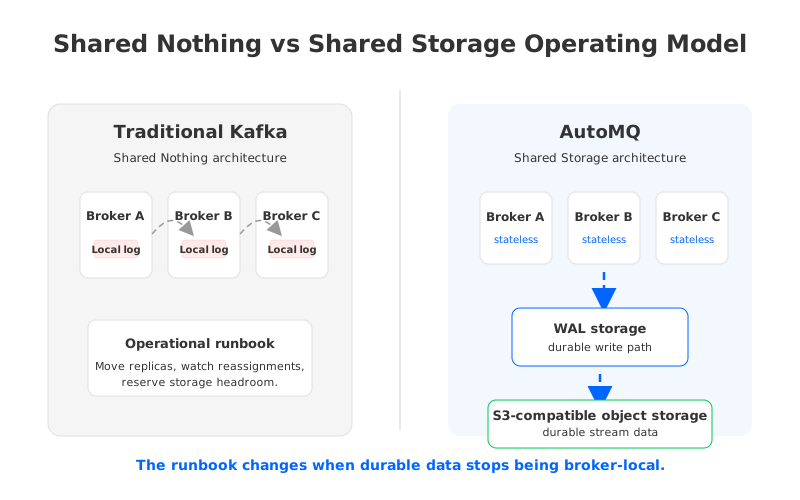
Traditional Apache Kafka uses a Shared Nothing architecture: each Broker owns local log segments, and durability comes from replicas distributed across brokers. This design is a good fit for many deployments because it keeps Kafka's core data model explicit. A Topic is split into Partitions, each Partition has a leader, Consumers in a Consumer group coordinate ownership, and committed offsets let applications resume from a known point. The model is powerful because applications can reason about ordering, replay, and backpressure.
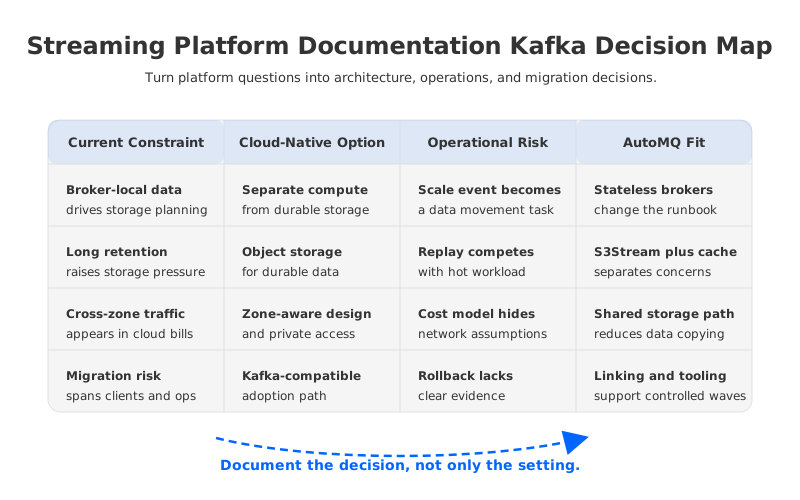
The same model creates an operations shape that runbooks must make visible. Broker-local storage means capacity planning is not only about CPU and network. It is also about how much data is pinned to each node, how replicas are distributed, how quickly reassignments can finish, and what happens when retained data grows faster than broker replacement windows. A scale-out runbook can start as a compute action and quickly become a data movement project.
Cloud deployment adds another layer. Multi-Availability Zone Kafka clusters often replicate data across zones for durability. That can be the right reliability choice, but it also means the platform team should document when traffic crosses zones, how clients are placed, which cloud network charges apply, and how PrivateLink or VPC endpoints affect the access path. Documentation that ignores network placement will make capacity look cleaner than production will feel.
Tiered Storage helps one part of the problem by moving older log segments to remote storage while preserving Kafka's local hot log model. It can reduce pressure from long retention, but it does not by itself make brokers stateless. Your runbook still has to explain which data remains broker-local, when data is fetched from remote storage, how recovery works, and how operational tooling observes both paths. The distinction matters because teams often treat "object storage exists somewhere" as if it means "broker replacement is now a metadata operation." Those are different claims.
3Architecture Options and Trade-Offs
The right documentation starts by separating application semantics from infrastructure mechanics. Kafka semantics answer questions such as ordering, replay, Consumer group behavior, transaction boundaries, and connector compatibility. Infrastructure mechanics answer questions such as storage durability, broker recovery, cross-zone traffic, scaling speed, and who owns the cloud account. A platform adoption runbook should keep both layers in view because a migration that preserves client APIs can still change operational behavior.
Here is the practical evaluation frame most platform teams need before they choose an architecture:
| Evaluation area | What the runbook must answer | Why it matters |
|---|---|---|
| Compatibility | Which producers, consumers, Admin clients, Kafka Connect jobs, and security settings run without application changes? | Compatibility is the migration surface, not only a protocol claim. |
| Cost model | Which costs grow with retained bytes, write throughput, read fanout, cross-zone traffic, and private connectivity? | A platform that is inexpensive at low retention may behave differently under replay-heavy workloads. |
| Elasticity | Does scaling require data movement, leadership changes, compute replacement, or storage rebalancing? | The answer determines whether capacity changes are routine operations or scheduled projects. |
| Governance | Who owns Topic policy, ACLs, encryption, audit logs, schema review, and deployment boundaries? | Kafka becomes shared infrastructure when policy is repeatable. |
| Recovery | What happens during broker failure, zone impairment, metadata issues, or a bad client rollout? | Recovery needs clear authority, observable signals, and rollback paths. |
| Migration | How are offsets, retained data, client configs, connectors, and rollback validated? | A migration without rollback rules is not a controlled migration. |
The table deliberately avoids product names. It is meant to force a harder conversation: which parts of your Kafka operating model are application contracts, and which parts are consequences of broker-local storage? Once that line is clear, the team can compare self-managed Kafka, managed Kafka services, Kafka-compatible shared-storage systems, and cloud-native event services without mixing different categories of change.
4Evaluation Checklist for Platform Teams
Your living runbook should be written as a set of decisions that can be tested. A paragraph that says "the platform supports long retention" is too vague. A stronger entry says which Topic classes can request long retention, who approves it, what storage cost model applies, how restore or replay is tested, and which monitoring signals show that consumers are reading historical data safely.
Start with seven sections that map to how production incidents and platform reviews actually happen:
- Compatibility baseline. Record supported Kafka client versions, authentication patterns, idempotent producer usage, transaction requirements, Kafka Connect dependencies, and Admin API workflows. Include the applications that rely on offset reset, replay, or strict key-based ordering.
- Capacity and cost model. Document how write throughput, read fanout, partitions, retention, object storage, block storage, network traffic, and private connectivity change the monthly bill. Use official cloud pricing pages for assumptions instead of copying an old spreadsheet.
- Governance model. Define Topic classes, naming rules, retention policy, compaction policy, schema review, ACL ownership, encryption, audit evidence, and emergency approval paths.
- Observability model. Map each alert to an owner and an action. Consumer lag, broker saturation, storage errors, connector failures, KRaft quorum issues, and client error rates should not all page the same person with the same instruction.
- Scaling model. Explain what changes during scale-out and scale-in: broker count, partition leadership, data placement, storage allocation, quotas, and client connection behavior.
- Failure model. Write separate paths for broker loss, zone impairment, object storage errors, metadata quorum problems, bad deployments, and runaway consumers. Combining them into "restart the cluster" is not a runbook.
- Migration model. Define inventory, wave planning, offset validation, dual-write or linking behavior, rollback criteria, and final decommission rules.
The value of this checklist is not the checklist itself. The value is that it exposes vague areas before the outage or migration window exposes them for you.
5How AutoMQ Changes the Operating Model
After the neutral evaluation is done, AutoMQ becomes relevant for teams whose runbooks are dominated by broker-local storage operations. AutoMQ is a Kafka-compatible streaming platform that preserves Kafka protocol and ecosystem expectations while replacing broker-local persistent storage with a Shared Storage architecture. Durable data is stored in S3-compatible object storage through S3Stream, while AutoMQ Brokers focus on protocol handling, leadership, caching, and scheduling rather than owning local log data.
That architecture changes the runbook in a specific way: many operations shift from moving bytes between stateful brokers to changing ownership, metadata, placement, and traffic. Stateless brokers make broker replacement and scaling easier to describe because retained data is not anchored to a particular broker's local disk. WAL (Write-Ahead Log) storage provides the write durability layer in front of object storage, while data caching helps serve hot reads and catch-up reads. The documentation still needs to describe failure modes and storage dependencies, but the operational unit is no longer "the machine that owns this partition's durable bytes."
AutoMQ Console, Terraform-based workflows, and monitoring integration matter because architecture alone does not create a platform. A living runbook needs repeatable controls: who can create an Instance, which BYOC Environment it belongs to, how scaling is requested, where metrics are viewed, and how policy changes are reviewed. AutoMQ BYOC keeps the control plane and data plane in the customer's cloud account and VPC. AutoMQ Software targets private data center deployments. Those boundaries help teams align platform operations with existing security, network, and audit processes.
Self-Balancing and Self-healing are also runbook simplifiers when they are documented correctly. They should not be described as a reason to stop caring about operations. They are mechanisms that reduce repeated manual work: traffic can be rebalanced across brokers, abnormal nodes can be isolated, and partition ownership can be adjusted without treating every change as a storage migration. The runbook should say which signals trigger automation, which actions are automatic, which actions need human approval, and how operators verify the result.
AutoMQ Linking and Table Topic belong in the adoption conversation when migration and downstream analytics are part of the platform scope. Linking can help teams plan data movement and cutover while preserving Kafka-oriented operating assumptions. Table Topic can simplify selected stream-to-lake paths by writing streaming data into Apache Iceberg tables. Neither feature replaces the need for governance, but each can remove a class of custom pipeline work that would otherwise become another section in the runbook.
6A Readiness Scorecard You Can Reuse
The final test for streaming platform documentation kafka is whether an onboarding application team can use the runbook without asking the platform team to re-explain the platform from memory. That does not mean every detail must be frozen. It means the document has clear decision points, named owners, and reviewable evidence.
Use this scorecard before adopting, replacing, or expanding a Kafka-compatible streaming platform:
| Scorecard item | Green signal | Review signal |
|---|---|---|
| Application contract | Client behavior, ordering, replay, transactions, and connector needs are inventoried. | Compatibility is assumed because the endpoint accepts Kafka clients. |
| Cost ownership | Storage, compute, network, and private access assumptions are linked to official pricing inputs. | The cost model only counts brokers. |
| Scaling path | Scale-out and scale-in are tested with ownership, alerting, and rollback rules. | Scaling is described as an infrastructure action with no application validation. |
| Security boundary | Account, VPC, IAM, encryption, audit, and access paths are documented. | Security review depends on one diagram and tribal knowledge. |
| Recovery path | Broker, zone, metadata, client, and storage failure modes have separate procedures. | All failures point to the same escalation note. |
| Migration safety | Offsets, retained data, connectors, client configs, and rollback criteria are validated by wave. | Migration success means "traffic moved" with no rollback evidence. |
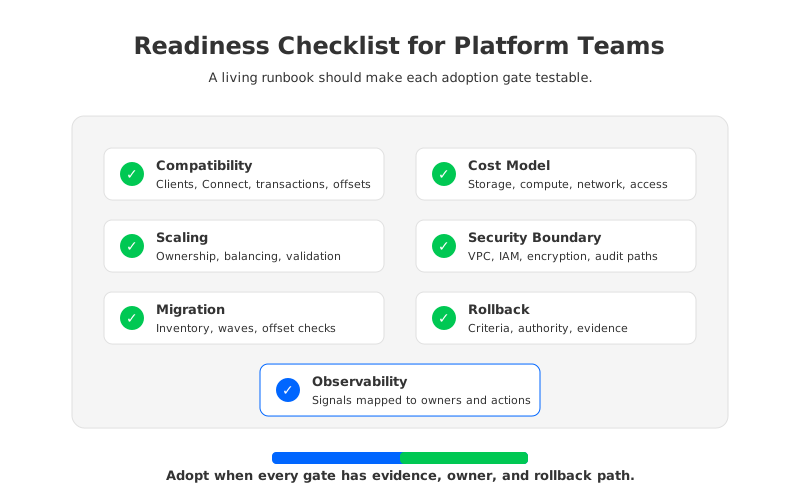
The runbook becomes living when these answers are updated after every real change: an added Topic class, a larger replay window, a connector migration, a scaling event, or a failed deployment. That is the discipline that keeps Kafka-compatible streaming from becoming a platform everyone uses and only two people understand.
If your current documentation keeps circling back to broker replacement, storage movement, cross-zone traffic, or unclear ownership, use the scorecard above against one production workload. To evaluate a Kafka-compatible shared-storage operating model in your own environment, start with the AutoMQ BYOC path and test the runbook before expanding the platform.
7FAQ
7.1What should Kafka platform documentation include beyond basic setup?
It should include client compatibility, Topic policy, retention, Consumer group and Offset operations, Kafka Connect ownership, security boundaries, cost assumptions, scaling procedures, failure modes, migration plans, and rollback rules. Setup instructions are useful, but they are not enough for shared production infrastructure.
7.2How is a living runbook different from a static architecture document?
A static architecture document describes what the platform looks like. A living runbook describes what the platform team does when traffic grows, a broker fails, a Topic needs longer retention, a connector breaks, or an application migrates. It changes as the platform changes.
7.3Does Tiered Storage make Kafka brokers stateless?
No. Tiered Storage can move older log segments to remote storage, but Kafka brokers can still retain a local hot log and broker-owned state. Stateless broker behavior requires a different architecture where durable data is not bound to broker-local storage.
7.4Where does AutoMQ fit in this evaluation?
AutoMQ fits when a team wants Kafka-compatible behavior but wants to reduce operational friction caused by broker-local durable storage. Its Shared Storage architecture, stateless brokers, BYOC and Software deployment options, and platform automation can simplify runbooks for scaling, recovery, and migration.


