
Table of Contents
Table of Contents
An LLM application does not fail in one dramatic moment. It drifts. A retrieval query starts returning stale context. A prompt change improves one task and harms another. A guardrail catches the obvious policy violation but misses the subtle hallucination. By the time the AI platform team sees the pattern in a weekly report, production users have already generated the evidence.
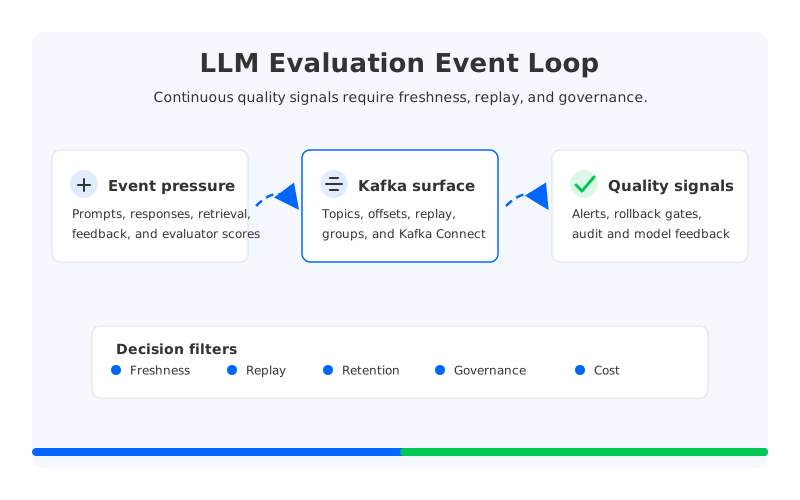
That is why teams search for llm evaluation event loop kafka. They are not looking for another offline benchmark harness. They need a durable stream of prompts, retrieved documents, model outputs, human feedback, automated evaluator scores, safety events, and deployment metadata that can be replayed and joined over time. Kafka is a natural candidate because LLM quality is no longer a batch analytics problem. It is an operational control loop.
The hard part is that evaluation events are awkward data. They are high-cardinality, privacy-sensitive, versioned, and often valuable long after the original request completes. A model incident investigation may require replaying the exact context window, evaluator version, prompt template, and downstream action chain. A governance review may require proving that a specific policy was applied to a specific class of requests. The stream has to be fresh enough for alerting and durable enough for audit.
1Why LLM Evaluation Loops Put Pressure on Kafka
Classic product analytics pipelines tolerate delay because their primary job is to explain the past. LLM evaluation loops have a different failure mode: they are part of the control surface for the application itself. If retrieval quality drops, if a model route starts producing lower-confidence answers, or if a policy evaluator changes behavior, platform teams want the signal while the release is still reversible.
This creates three requirements that pull against each other. The stream must accept many event types without turning schema governance into a release bottleneck. It must preserve ordering and replay for the entities that matter: session, conversation, agent task, document, tenant, model version, or evaluator version. It must also keep enough history for forensic analysis without forcing brokers to carry every byte on local disks.
The pressure becomes more visible as the evaluation loop matures:
- Prompt and response events start as debugging traces, then become quality evidence used by product, risk, and compliance teams.
- Human feedback starts as labels, then becomes a training and routing signal that must be joined with model, retrieval, and policy metadata.
- Automated evaluators start as experiments, then become production gates that require versioning, observability, and rollback.
- Agent actions start as logs, then become audit records for tools, data access, side effects, and user-facing decisions.
Kafka can represent these streams well, but platform teams should not confuse API fit with operating-model fit. The protocol can be right while the storage and scaling model still creates operational drag.
2The Freshness and Governance Problem Behind AI Event Streams
LLM evaluation events are not a single topic with a clean retention policy. A practical platform usually needs short-lived hot signals for incident response, medium-term signals for release analysis, and longer-lived records for governance. The same production request may generate a prompt event, retrieval event, safety event, evaluator score, feedback event, and model deployment marker. Each record is small enough to ignore in isolation, but the total stream grows with traffic, prompt size, context size, and evaluator coverage.
The governance boundary is equally important. Evaluation data can contain user content, retrieved documents, intermediate reasoning traces, tool-call payloads, and business decisions. A platform team may need to redact some fields, encrypt others, restrict consumer groups, and prove that downstream systems consumed the right topic versions. Kafka features such as consumer groups, offsets, access control, and transactions give the platform useful primitives, but the primitives do not remove the need for architectural discipline.
The mistake is treating evaluation as a side channel. Side channels become production dependencies once alerting, rollback, model routing, and governance depend on them. At that point, the stream needs the same design review as the application data plane: what is the partitioning key, what is the ordering contract, which consumers are allowed to lag, which consumers can be replayed, and which events must survive a broker failure without relying on a fragile local-disk assumption?
3Architecture Options for Durable, Replayable AI Context
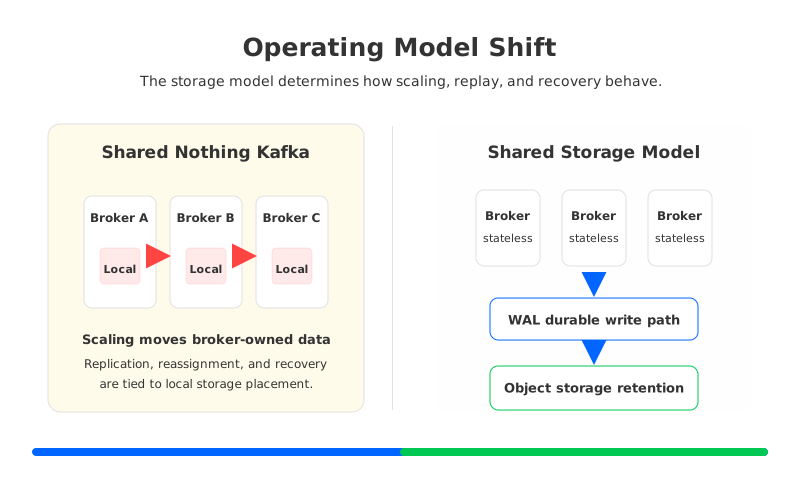
A traditional Kafka cluster follows a Shared Nothing architecture. Each broker owns local data, and durability comes from replication across brokers. This design is proven and widely understood. It also means that scaling, recovery, retention, and partition reassignment are tied to where data physically resides. When an LLM evaluation workload grows faster than expected, the platform team may need to add brokers, rebalance partitions, move replica data, expand disks, tune network paths, and protect consumers from the side effects.
That coupling is not a theoretical inconvenience. Evaluation workloads tend to have uneven tenant traffic, bursty release windows, and replay-heavy investigations. If a team stores large context payloads or long retention windows in broker-local storage, capacity planning becomes defensive. The cluster is sized not for average signal flow but for the combination of peak write load, catch-up reads, retention, replication, and reassignment risk.
A platform team usually has four architectural choices:
| Option | When it fits | What to test before committing |
|---|---|---|
| Existing Kafka cluster | Early evaluation streams with modest retention and low replay pressure. | Topic isolation, quota behavior, schema compatibility, consumer lag, and operational blast radius. |
| Dedicated Kafka cluster | Regulated or high-volume evaluation signals that should not share capacity with product events. | Broker storage growth, cross-zone traffic, partition reassignment, failover drills, and cost under retention growth. |
| Managed Kafka service | Teams that want a managed control plane while keeping familiar Kafka semantics. | Feature compatibility, private networking, connector limits, cost model, migration path, and data boundary. |
| Kafka-compatible shared storage | Teams that want Kafka APIs while reducing the dependency between broker compute and durable data. | Client compatibility, WAL behavior, object-storage latency envelope, replay throughput, security controls, and rollback plan. |
The decision should not start with a vendor page. It should start with the event loop: how fast signals must arrive, how long they must be retained, how often they will be replayed, and which teams are allowed to operate on them.
4Evaluation Checklist for Platform Teams
A useful evaluation framework has to be stricter than "can it produce and consume records." LLM evaluation loops involve production clients, governance teams, model owners, data engineers, and SREs. Each group cares about a different failure mode, and the platform architecture has to survive all of them at once.
Use the following checklist as the first pass:
- Compatibility: Validate producers, consumers, Kafka Connect jobs, serialization formats, transactions, compaction requirements, consumer group behavior, ACLs, and monitoring integrations against the exact client versions in production.
- Freshness: Define the maximum acceptable delay for evaluator scores, policy alerts, and release rollback signals. Then test that delay during peak write traffic and catch-up reads.
- Replay: Measure how quickly the platform can replay a tenant, model version, evaluator version, or incident window without starving live consumers.
- Retention: Separate hot operational windows from long-term audit requirements. Do not make broker-local disk capacity the hidden governance policy.
- Cost: Model compute, storage, network movement, private connectivity, managed-service fees, object operations, and over-provisioned capacity under peak and steady-state workloads.
- Security: Confirm encryption, identity, ACLs, network boundaries, credential rotation, and support access for events that may contain prompts, retrieved context, or user content.
- Migration: Preserve offsets and consumer behavior during cutover. Test rollback with real consumer groups, not a synthetic producer-only demo.
- Observability: Track produce latency, end-to-end signal delay, consumer lag, failed evaluator jobs, schema errors, replay throughput, and broker or storage saturation.
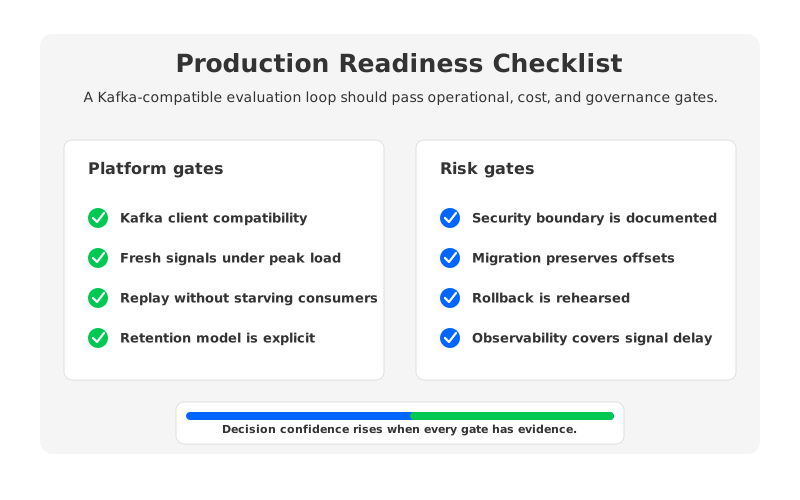
The strongest architecture is the one whose weak points are explicit. For example, if the workload requires very low p99 produce latency, the WAL path and client configuration deserve close testing. If the workload is replay-heavy, cold-read behavior matters more than a steady-state write benchmark. If the workload crosses regulated tenants, the cloud account and network boundary may matter as much as broker throughput.
5How AutoMQ Changes the Operating Model
Once the evaluation framework is clear, the platform requirement becomes more specific: keep the Kafka ecosystem surface, but reduce the operational cost of broker-local durable state. That is where AutoMQ fits the conversation. AutoMQ is a Kafka-compatible, cloud-native streaming platform built around Shared Storage architecture, with stateless brokers and durable stream data stored in object storage through S3Stream and WAL storage.
The important change is not cosmetic. In a Shared Nothing cluster, broker replacement and scaling are storage events because durable data is attached to broker-local disks. In AutoMQ's Shared Storage architecture, brokers handle Kafka protocol processing, scheduling, caching, and network I/O, while persistent stream data is separated into shared storage. The WAL provides the immediate durable write path, and object storage provides elastic capacity for retained stream data.
For LLM evaluation loops, that changes several operating assumptions. Scaling compute no longer has to imply large broker-local data movement. Retention growth no longer has to be absorbed primarily by broker disks. Recovery from a broker failure can focus on remapping work to healthy brokers instead of rebuilding the failed broker's local data footprint. The result is not that operations disappear; the result is that the most painful operations move from "copy data between stateful brokers" toward "manage stateless compute, shared storage, and clear compatibility gates."
AutoMQ also matters for deployment boundaries. In AutoMQ BYOC, the environment runs in the customer's cloud account, which can be relevant when evaluation events include sensitive prompts, retrieved context, and policy evidence. For teams that operate their own Kubernetes or private infrastructure, AutoMQ Software offers a self-managed path while preserving the Kafka-compatible API surface. Those boundaries should be tested against security requirements, not accepted as marketing labels.
The migration question is practical. A team with existing Kafka topics for traces, labels, and evaluator scores should test producer compatibility, consumer group offsets, connector behavior, ACLs, observability, and rollback before moving production evaluation loops. A clean proof of concept replays a real incident window, not a toy stream. It includes model owners and SREs because both groups will use the signals during an outage.
6Readiness Scorecard
A scorecard turns the architecture discussion into a decision that can survive procurement, security review, and an incident review. Weight the criteria according to your business risk; a regulated support assistant and an internal code-review bot do not need the same governance envelope.
| Criterion | Strong signal | Weak signal |
|---|---|---|
| Event contract | Event types, schemas, retention classes, and partitioning keys are documented. | Topics grow organically from debugging traces. |
| Compatibility | Real clients, connectors, offsets, and security settings pass migration tests. | The test proves only basic produce and consume. |
| Replay behavior | Incident-window replay works under live traffic without starving core consumers. | Replay capacity is unknown or requires manual broker intervention. |
| Storage model | Retention and replay growth have a clear cost and capacity model. | Retention policy is constrained by broker-local disk anxiety. |
| Governance | Data boundary, access model, encryption, and audit use cases are explicit. | Governance depends on undocumented operational habits. |
| Operations | Scaling, failure recovery, and rollback are rehearsed. | The runbook assumes a calm day and an expert operator. |
The right answer may be a dedicated Kafka cluster, a managed Kafka service, or a Kafka-compatible shared-storage platform such as AutoMQ. What matters is that the decision follows the evaluation loop rather than the other way around. If your quality signals are becoming part of production control, the streaming platform is no longer a passive log buffer. It is the memory and nervous system of the AI application.
If your team is designing that event loop and wants to test a Kafka-compatible shared-storage operating model, start with a workload-shaped evaluation rather than a feature tour. You can contact AutoMQ with your topic model, retention requirements, replay scenarios, and migration constraints, then validate the architecture against the checklist above.
7References
- Apache Kafka Documentation: https://kafka.apache.org/documentation/
- Apache Kafka Consumer Group Configuration: https://kafka.apache.org/documentation/#consumerconfigs_group.id
- Apache Kafka Message Delivery Semantics: https://kafka.apache.org/documentation/#semantics
- Apache Kafka Connect Documentation: https://kafka.apache.org/documentation/#connect
- Apache Kafka KRaft Documentation: https://kafka.apache.org/documentation/#kraft
- AWS S3 User Guide: https://docs.aws.amazon.com/AmazonS3/latest/userguide/Welcome.html
- AWS PrivateLink Pricing: https://aws.amazon.com/privatelink/pricing/
- AutoMQ Architecture Overview: https://docs.automq.com/automq/architecture/overview?utm_source=blog&utm_medium=reference&utm_campaign=rpb-0019
- AutoMQ WAL Storage: https://docs.automq.com/automq/architecture/s3stream-shared-streaming-storage/wal-storage?utm_source=blog&utm_medium=reference&utm_campaign=rpb-0019
- AutoMQ Kafka Compatibility: https://docs.automq.com/automq/architecture/technical-advantage/native-compatible-with-apache-kafka?utm_source=blog&utm_medium=reference&utm_campaign=rpb-0019
- AutoMQ Cloud BYOC Overview: https://docs.automq.com/automq-cloud/overview/what-is-automq-cloud?utm_source=blog&utm_medium=reference&utm_campaign=rpb-0019
8FAQ
8.1Why use Kafka for LLM evaluation event loops?
Kafka fits LLM evaluation loops because the data is event-driven, replayable, and consumed by multiple teams. The same prompt, response, retrieval, feedback, and evaluator events may feed alerting, offline analysis, governance review, and model improvement workflows. The important question is not whether Kafka can carry the events; it is whether the chosen Kafka-compatible architecture can handle retention, replay, cost, and governance as the loop becomes production-critical.
8.2What should be the partition key for LLM evaluation events?
There is no universal key. Start from the ordering contract that matters most: conversation, session, tenant, agent task, model deployment, document, or user workflow. Many platforms use different topics for different event classes so they can choose partitioning and retention independently. The wrong key is the one chosen for producer convenience while consumers later need ordered replay by a different entity.
8.3How long should LLM evaluation events be retained?
Retention should follow use case, not habit. Operational alerting may need a short hot window, release analysis may need weeks, and governance or audit may need longer retention with stricter access control. Teams should separate hot stream retention from long-term analytical or audit storage so broker-local capacity does not become the accidental policy.
8.4Where does AutoMQ fit in an LLM evaluation event-loop architecture?
AutoMQ fits when a team wants Kafka-compatible APIs but does not want durable stream data tied tightly to broker-local disks. Its Shared Storage architecture uses stateless brokers, WAL storage, and object storage, which can reduce the operational burden of scaling, recovery, and retention-heavy workloads. Teams should still test real clients, evaluator traffic, replay windows, security boundaries, and rollback behavior before production migration.
8.5Does a shared-storage architecture remove the need for Kafka operations?
No. It changes the work rather than removing it. Platform teams still need schema governance, ACLs, observability, client tuning, failure drills, and cost review. The architectural advantage is that compute scaling and broker recovery can be less entangled with large broker-local data movement, which is especially useful when evaluation streams grow in retention and replay demand.


