
Table of Contents
Table of Contents
Teams usually search for local kafka sandbox when a small developer problem has grown into a platform problem. A producer works on one laptop, fails in a shared test environment, behaves differently in CI, and then exposes another surprise when the application finally meets a production Kafka cluster. The local sandbox was meant to reduce friction, but it quietly became a second streaming platform with different networking, durability, security, observability, and operational assumptions.
The hard part is not starting a broker on a laptop. Kafka can be started in many ways, and containers make that first milestone approachable. The hard part is deciding what the sandbox is allowed to prove. A sandbox can validate serialization, topic naming, and consumer group behavior. It should not pretend to prove failover, cross-zone traffic, retention economics, or production governance.
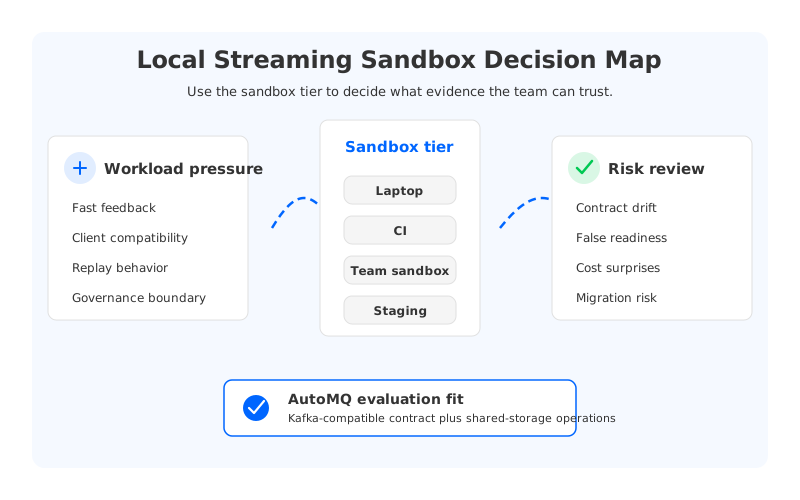
That distinction matters for platform engineering. Application teams need fast feedback loops, but platform teams need repeatable behavior across local development, CI, shared integration, staging, and production. The useful question is no longer "how do we run Kafka locally?" The useful question is "which streaming behaviors must stay compatible as the workload moves from a local sandbox to a production Kafka-compatible platform?"
1Why Teams Search for local kafka sandbox
The search intent is practical. A team may be writing a service that emits order events, testing a fraud detection consumer, building a CDC ingestion path, or validating an AI feature that needs event history for replay. They want a Kafka-compatible endpoint without waiting for a shared cluster request, opening a platform ticket, or risking noisy experiments in a production-adjacent environment.
Local sandboxes are useful because event-driven applications are hard to reason about from code alone. A producer has batching, retries, idempotence settings, schema expectations, and partitioning choices. A consumer has offsets, group membership, rebalance behavior, error handling, and replay semantics. A connector has source state, sink behavior, credentials, and backpressure. Unit tests around a mocked interface do not expose those behaviors.
The problem appears when every application team invents its own miniature streaming world. One team uses a single broker with default topic settings. Another pins client versions that differ from the platform standard. A third hard-codes bootstrap addresses or skips authentication because local setup felt heavy. These choices are understandable, but they create integration debt for the platform team.
A good sandbox strategy gives developers autonomy without letting local convenience rewrite the production contract.
2The Production Constraint Behind the Sandbox
Kafka's local development story often starts with connectivity. Producers and consumers need bootstrap servers, the broker needs advertised listener settings that work inside and outside a container network, and clients need to resolve the address they receive from metadata. This sounds like setup detail until the local address pattern diverges from the network boundary used in shared environments.
That first mismatch is a warning sign. Local sandboxes are not production clusters, but they should preserve the application-facing contract that production depends on. Topic names, partition counts, keying assumptions, serializers, consumer group identifiers, retry behavior, offset reset settings, and authentication paths are part of that contract. When a sandbox ignores those pieces, it tests a different application.
The storage model creates a second mismatch. A laptop broker stores data locally and disappears when the container or volume is removed. Production Kafka has replication, retention policies, disk capacity planning, backup assumptions, and incident procedures. A sandbox cannot reproduce those economics, but it can force developers to make retention, replay, and idempotency assumptions explicit.
The governance model creates the third mismatch. Local environments tend to relax identity, network policy, audit logging, encryption, quotas, and change control. That is reasonable for fast development, but the application should still know which parts are placeholders.
3Architecture Options and Trade-Offs
Platform teams do not need one sandbox pattern for every use case. They need a small set of patterns with clear limits. The most useful split is between developer feedback, integration confidence, and production rehearsal.
| Sandbox pattern | What it proves | What it does not prove | Good fit |
|---|---|---|---|
| Laptop container | Client wiring, serialization, basic produce and consume loops | Production durability, multi-broker behavior, governance, cloud networking | Individual feature development |
| CI ephemeral cluster | Test isolation, repeatability, compatibility against pinned client versions | Long-running retention, operational behavior under load | Pull request and contract tests |
| Shared team sandbox | Cross-service integration, topic conventions, connector behavior | Full production cost, failover, incident response | Application team integration |
| Production-like staging | Security, observability, migration rehearsal, workload sizing | Developer speed and local isolation | Release readiness and platform validation |
This table is deliberately strict. A laptop container is not a failed staging environment; it is a different tool. CI clusters are not a substitute for shared integration. Staging is not a place for every developer experiment. When each tier has a clear job, the platform team can make local development faster without turning production readiness into guesswork.
The deeper trade-off is operational drift. The farther a sandbox moves from production, the faster it runs and the less friction it creates. The closer it moves to production, the more valuable its evidence becomes and the more ownership it requires. One tier cannot provide both extremes.
4Build the Sandbox Around a Contract
The contract should be concrete enough to put in source control. It does not need to describe every production setting, but it should describe the behaviors that application owners and platform owners both rely on: topics, partitions, serializers, schemas, consumer groups, offset reset policy, required security mode, expected retention window, and supported client versions.
For Kafka-compatible application teams, the contract should also name the behaviors local tests cannot claim. If the local sandbox uses one broker, the evidence should not imply multi-broker failover readiness. If authentication is disabled locally, the application still needs a test path for credentials and authorization. If the test topic uses a short retention window, replay logic is not production-ready until it is validated against the real retention policy.
This is where a short checklist prevents long incident reviews:
- Keep bootstrap configuration externalized. The same application artifact should move from local to CI to staging by changing configuration, not code.
- Pin client and protocol expectations. A sandbox should make client version drift visible before a production upgrade or migration.
- Treat topic definitions as infrastructure. Partitions, retention, cleanup policy, and naming conventions should be generated or reviewed through a source-controlled path.
- Test consumer recovery deliberately. Offset reset behavior, poison-message handling, retry loops, and replay windows should be visible in tests, not discovered during a backfill.
- Separate "fast local" from "production-like." Developer speed matters, but production-like evidence belongs in a controlled environment with real security and observability boundaries.
The checklist is not bureaucracy. It is a way to keep local autonomy from becoming platform entropy.
5The Cloud Cost and Operations Question
Local sandbox decisions eventually reach cloud cost because every shortcut has a production equivalent. A team that treats topics as disposable locally may request high-retention topics later without understanding storage growth. A consumer that replays aggressively in development may become an expensive read pattern in production. A connector that works locally may generate backpressure, duplicate writes, or large validation reads when attached to real data volume.
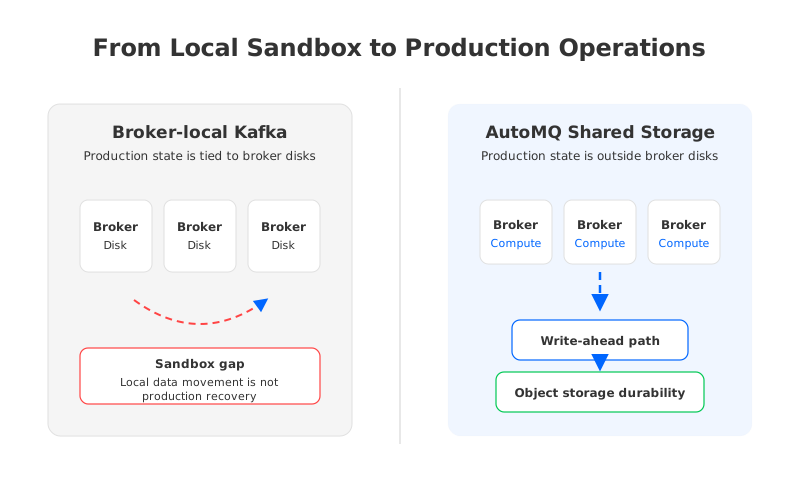
Traditional Kafka's Shared Nothing architecture makes those production effects operationally important. Brokers own local storage, replication moves data between brokers, and scaling decisions have to account for disk, network, partition leadership, and recovery traffic together. The architecture is familiar and mature, but it can make the jump from sandbox to production larger than application teams expect. A production broker with local data is part of the durability model.
That does not mean local sandboxes should mimic production storage. They should instead expose the questions that storage will answer later. How much event history does the application need? Can consumers recover from the earliest required offset? How does the service behave when a partition receives a skewed key distribution? What happens when downstream systems are unavailable? Which metrics tell the team whether the stream is healthy?
Cost reviews improve when those questions are asked early. Platform teams can map application behavior to storage retention, replication, cross-zone traffic, connector capacity, and observability volume. Application teams can revise the design before production.
6How AutoMQ Changes the Operating Model
After the sandbox contract is clear, AutoMQ becomes relevant as a Kafka-compatible cloud-native streaming platform built around Shared Storage architecture. Application teams usually do not need a different API. The production operating model can change underneath the Kafka-compatible surface.
In a broker-local model, production readiness depends on how the platform handles local disks, replica movement, broker replacement, and capacity headroom. AutoMQ separates broker compute from durable stream storage, using object storage and a write-ahead log path so brokers behave more like replaceable compute from the operator's point of view. The application contract still has to be validated, but the operational question shifts from "how much data is tied to this broker?" to "does this workload's Kafka behavior remain compatible under the shared-storage model?"
That shift is useful for sandbox strategy because it narrows the gap between developer intent and production operations. Local sandboxes can focus on application behavior: records, keys, schemas, offsets, replay, and error handling. Production-like environments can focus on durability path, security, scaling, zero cross-AZ traffic design, observability, Terraform or Kubernetes operations, and migration readiness.
AutoMQ should not be evaluated from a happy-path local demo alone. The right evaluation is a workload contract exercised across tiers. Start with one application flow, then compare how the same producer, consumer, topic definition, replay requirement, and incident runbook behave in broker-local Kafka and in an AutoMQ shared-storage deployment.
7A Practical Sandbox Maturity Model
The easiest way to improve local streaming sandboxes is to stop treating them as one environment. A maturity model gives platform teams a vocabulary for deciding which controls belong in each tier.
| Level | Developer experience | Platform evidence | Typical next step |
|---|---|---|---|
| 1. Local smoke test | Application can produce and consume records locally | Minimal; mostly proves wiring | Add source-controlled topic and client configuration |
| 2. Contract test | CI validates schemas, topics, consumer behavior, and error paths | Repeatable evidence for pull requests | Add shared integration with realistic dependencies |
| 3. Team integration | Multiple services and connectors run against a shared sandbox | Cross-service ownership and observability gaps become visible | Add security, quotas, and migration rehearsal |
| 4. Production rehearsal | Workload runs with production-like identity, monitoring, retention, and rollback | Release and migration evidence | Compare operating models and cost assumptions |
This model gives architects and SREs a cleaner conversation with application teams. A team at Level 1 is early in the evidence chain. A team at Level 3 should not be blocked by laptop setup discussions. A team preparing for Level 4 needs platform involvement because the questions involve governance, reliability, cost, and incident response.
8Evaluation Checklist for Platform Teams
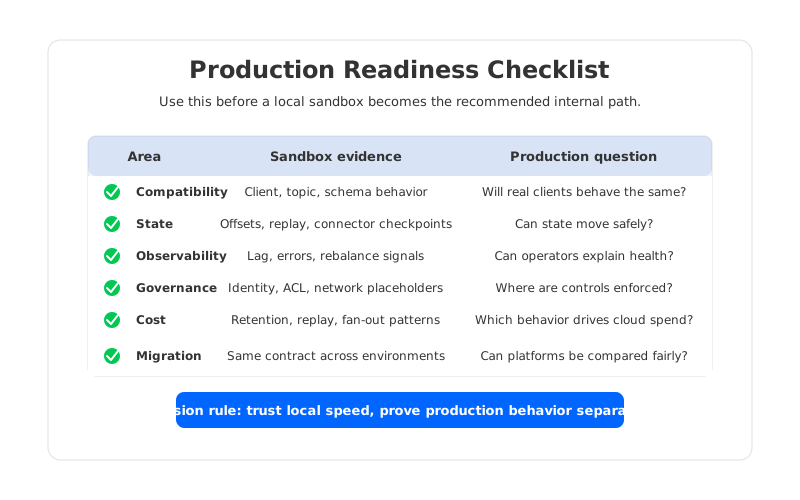
The final checklist should be run before a sandbox pattern becomes a recommended internal path. It should be short enough for application teams to understand and strict enough for platform teams to support.
- Compatibility: Which Kafka client versions, APIs, authentication mechanisms, topic settings, consumer group behaviors, and connector patterns are supported?
- Configuration: Are bootstrap servers, credentials, topic names, schema registry endpoints, and consumer group IDs externalized and environment-specific?
- State: Which offsets, schemas, connector checkpoints, replay windows, and dead-letter paths must survive a move between environments?
- Observability: Are produce latency, fetch latency, consumer lag, error rates, rebalance events, connector failures, and storage growth visible where they matter?
- Governance: Which controls are intentionally disabled locally, and where are identity, authorization, audit, encryption, quotas, and network boundaries tested?
- Cost: Which local behaviors could become material cloud cost drivers through retention, replay, cross-zone traffic, validation reads, or connector fan-out?
- Migration: Can the same workload contract be used to compare broker-local Kafka, managed Kafka services, and Kafka-compatible shared-storage platforms?
The checklist turns a local sandbox from a convenience script into a platform interface. It tells application teams what they can trust, tells SREs where production evidence begins, and gives technical buyers a way to compare operating models.
When the search starts with local kafka sandbox, the answer should not end with a container command. The real goal is a clean path from developer feedback to production evidence. If your team is standardizing Kafka-compatible sandboxes and wants to compare broker-local operations with a Shared Storage model, start from one workload contract and review how AutoMQ's architecture would change the production side of that path: explore AutoMQ for Kafka-compatible streaming infrastructure.
9References
- Apache Kafka documentation
- Apache Kafka quickstart
- Apache Kafka Connect documentation
- Apache Kafka broker configuration reference
- AutoMQ Shared Storage architecture
- AutoMQ Kafka compatibility
10FAQ
10.1What is a local Kafka sandbox?
A local Kafka sandbox is a developer-controlled environment for testing Kafka-compatible producers, consumers, topics, schemas, and basic event flows. It is useful for fast feedback, but it should not be treated as proof of production durability, governance, cloud cost, or failover behavior.
10.2Should every application team run Kafka locally?
Not every team needs the same local setup. Teams that produce or consume important events should have a fast local or CI path for compatibility checks, while shared integration and production-like staging should be owned with platform guidance.
10.3What should a local sandbox prove?
It should prove application-facing behavior: bootstrap configuration, serialization, topic naming, partition keys, consumer group behavior, offset reset handling, retry paths, and basic error handling. Production-like environments should prove security, observability, retention, scaling, migration, and rollback.
10.4How does AutoMQ relate to local Kafka sandboxes?
AutoMQ does not replace the need for local developer feedback. It changes the production operating model behind the Kafka-compatible surface by separating broker compute from durable stream storage.
10.5What is the biggest mistake in sandbox design?
The biggest mistake is letting a fast local environment imply production readiness. A local sandbox should make assumptions visible, not hide the differences between local development and production operations.


