
Table of Contents
Table of Contents
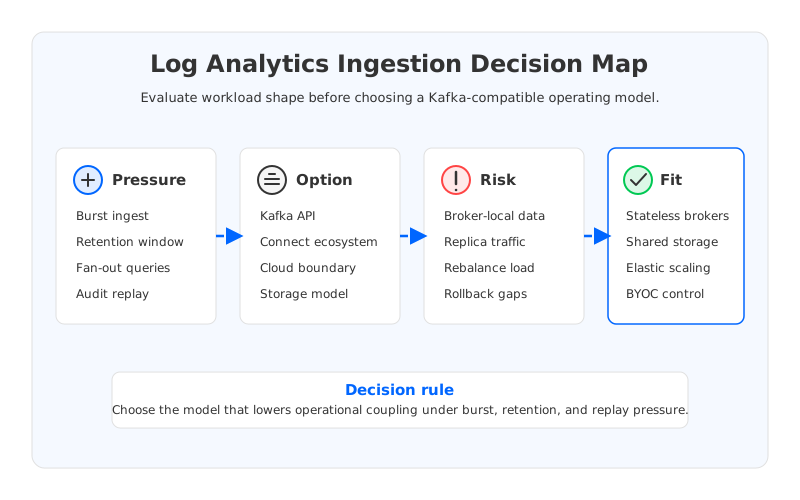
Security and operations teams usually discover the limits of their log pipeline during the worst possible week. A detection rule lands, a compliance team asks for a wider retention window, an incident response team needs replay across several noisy services, and the platform team realizes the ingestion layer is no longer a sidecar to observability. It is production infrastructure. That is why searches for log analytics ingestion kafka often come from teams that already run Kafka, SIEM, object storage, and search systems, but need a cleaner way to connect them under bursty, high-volume pressure.
The hard part is not collecting logs. Agents, collectors, and connectors can push events into a stream. The hard part is keeping the ingestion backbone predictable when log volume spikes, retention grows, and consumers move at different speeds. Security analytics wants durability and replay. Operations analytics wants low lag and fast search fan-out. Finance wants cloud spend that follows actual usage. Those goals collide when Kafka is treated as a fixed broker fleet with broker-local storage.
1Why teams search for log analytics ingestion kafka
The search query is shorthand for a bigger architecture question: should Kafka sit between log producers and analytics systems, and if so, what kind of Kafka operating model can survive production security workloads? Direct shipping from agents to a search store or SIEM is simple until one downstream system slows down, one region needs local retention, or one investigation requires replaying raw events without asking every application to re-emit them.
Kafka is attractive because it gives the pipeline a durable event buffer with consumer isolation. A detection engine, lakehouse sink, alerting service, and archive can read at their own pace. Consumer groups and offsets let each workflow track progress. Kafka Connect can standardize integration instead of leaving every team to operate a custom script.
The same properties also raise the bar. A log analytics ingestion layer is not a queue you can drain and forget. It becomes the system of record for operational evidence during an incident window. That means the platform team has to answer questions often skipped in early designs:
- How many hours or days of raw logs must remain replayable in Kafka before downstream compaction, indexing, or archiving changes them?
- Which consumers are allowed to fall behind without affecting security detection or operations dashboards?
- How much write burst can the system absorb while a broker, availability zone, connector, or sink is degraded?
- What is the recovery path if a migration causes duplicate events, missing offsets, or out-of-order ingestion into a downstream analytics system?
These questions determine whether Kafka stabilizes the pipeline or wakes the same on-call rotation.
2The production constraint behind the problem
Log analytics ingestion has an awkward workload shape. Writes are high volume and often bursty. Reads are uneven because most logs are never queried deeply, but an investigation can trigger fan-out, replay, and enrichment across a large window. Retention varies by source: firewall logs, application logs, audit records, endpoint events, and Kubernetes control-plane events rarely deserve the same policy. Yet the ingestion backbone has to provide one operational experience across all of them.
Traditional Kafka can serve this role, but the operating cost comes from how it couples compute and storage. Brokers serve client traffic and hold durable log segments on local disks or attached volumes. Replication protects availability by placing copies across brokers. When data grows, the cluster often needs more broker storage even if CPU is fine. When throughput grows, it may need more broker compute even if disk still has room. When the fleet changes, partition reassignment moves data across brokers and zones.
That coupling is manageable for many workloads. It becomes painful when log ingestion combines high write volume, long retention, and unpredictable replay. The ingestion layer starts paying for spare capacity, moving replicas under pressure, and pushing network traffic through paths hidden by simple per-instance estimates. A Kafka cluster that looked economical can become expensive during backfills, retention expansion, or incident-driven replay.
The platform team also inherits governance complexity. Security logs need access control, encryption, auditability, and data residency boundaries. Operations logs need schema discipline, topic naming rules, retention policies, and consumer ownership. Connectors need secrets management and failure handling. The architecture has to make those controls routine because the team will use them during noisy production conditions, not during a calm design review.
3Architecture options and trade-offs
There are four common ways to place Kafka in a log analytics ingestion architecture. None is universally right. The choice depends on whether the team is optimizing for raw latency, replay depth, cloud elasticity, deployment control, or operational familiarity.
| Option | Where it fits | Main trade-off |
|---|---|---|
| Self-managed Kafka | Teams with deep Kafka operations experience and strict customization needs. | Maximum control, but the team owns scaling, upgrades, storage planning, connector operations, and incident response. |
| Managed Kafka service | Teams that want to offload control-plane work while keeping Kafka APIs. | Easier operations, but cost, storage behavior, networking, and feature boundaries depend on the service. |
| Kafka-compatible cloud-native streaming | Teams that want Kafka client compatibility with a storage model designed around cloud elasticity. | Requires validation of compatibility, latency profile, migration path, and operational tooling. |
| Direct log shipping without Kafka | Simpler observability pipelines with few downstream consumers and limited replay requirements. | Less infrastructure, but weaker consumer isolation and replay when analytics systems diverge. |
The critical distinction is where durable state lives and how that state moves during scaling, failure, and recovery.
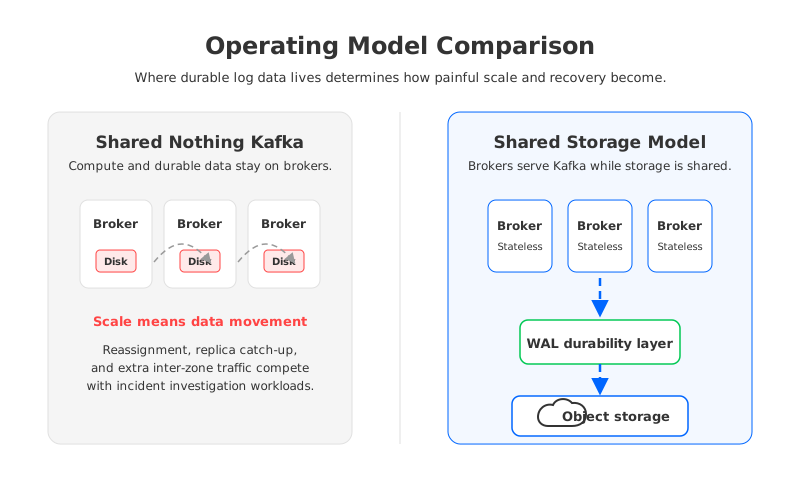
In a shared nothing Kafka model, broker-local data is the center of gravity. Replication, partition leadership, and disk utilization all sit close to the broker fleet. That design remains valid for many deployments. In cloud log analytics, however, every broker can become both a traffic processor and a storage container. Expanding the cluster may reduce CPU pressure while creating data movement. Extending retention may solve compliance while increasing local disk pressure. Repairing a failed node may compete with the investigation workload the logs were meant to support.
A shared storage model changes the question. If durable log data is stored in object storage and brokers are closer to stateless compute, scaling can focus more directly on serving traffic. The broker no longer has to carry local long-term persistence. The write-ahead log layer, cache behavior, object storage request pattern, metadata handling, and failure semantics still matter. But the operational unit changes from "move data attached to brokers" to "add or remove serving capacity around shared durable storage."
4Evaluation checklist for platform teams
The evaluation should start with workload physics rather than vendor names. A security log pipeline with 30 days of replay, multiple detection engines, and bursty endpoint telemetry differs from an application metrics stream with short retention and predictable consumers. The most useful architecture review ties platform behavior to production operations.
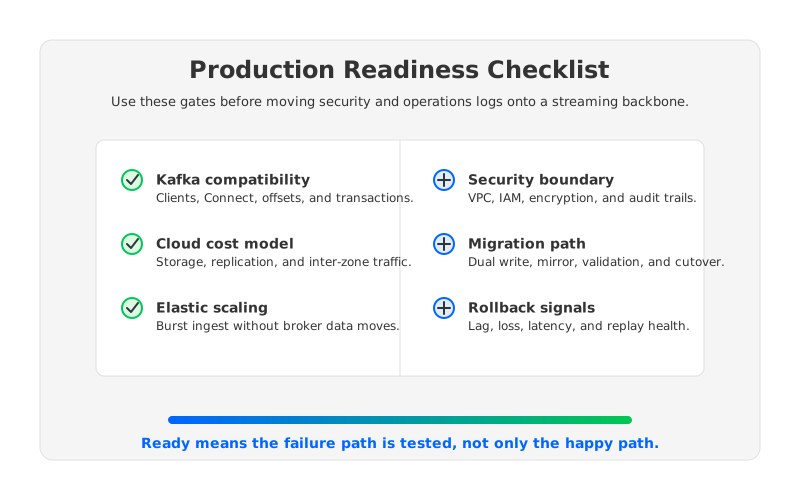
Start with compatibility. Kafka clients, producer configurations, consumer groups, offsets, transactions, and Kafka Connect behavior are not decorative details. They determine whether existing agents, collectors, stream processors, lakehouse sinks, and alerting services can migrate without rewriting the ecosystem. Compatibility testing should include produce and consume paths, consumer lag recovery, offset reset, idempotent producers, transaction usage if present, connector restart behavior, and client library versions.
Then test cost against the real traffic shape. For log analytics ingestion, the model should include these dimensions:
- Write throughput after compression, because raw log volume and on-wire volume can diverge sharply.
- Retention by topic class, because audit logs, debug logs, and security events do not share the same business value.
- Cross-zone and cross-region traffic, especially replication, consumer fan-out, connector placement, and private network paths.
- Storage request patterns, because object storage economics include capacity and operation behavior, not only stored bytes.
- Operational overhead, including upgrades, connector supervision, capacity reviews, and incident labor.
Security and governance should be evaluated as day-to-day workflows. Can the team isolate sensitive log topics by tenant, environment, or application domain? Are credentials and connector secrets managed through approved systems? Is encryption consistent? Can access changes be audited? Can the platform enforce retention without depending on every producer team?
Migration risk deserves its own review. The safer path is incremental: mirror selected topics, validate ordering and schema assumptions, compare downstream outputs, move low-risk consumers first, then shift critical detection and incident workflows after rollback has been rehearsed. A log pipeline migration that lacks rollback is a bet that no incident will happen during the cutover.
5How AutoMQ changes the operating model
Once the evaluation points to Kafka APIs, elastic serving capacity, and less broker-local storage coupling, AutoMQ becomes relevant as a Kafka-compatible cloud-native streaming platform built around shared storage. It keeps the Kafka protocol surface familiar while changing the storage architecture underneath. The platform team can evaluate AutoMQ as a way to preserve existing Kafka client and ecosystem investments while reducing the operational friction that comes from attaching durable log data to individual brokers.
The key architectural shift is separation of compute and storage. AutoMQ uses stateless brokers with data persisted through its shared storage architecture on object storage, with a WAL layer for durability and write path behavior. For log analytics ingestion, that matters because the workload often needs independent scaling. A spike in endpoint telemetry should not imply a long broker-local data rebalancing event. A longer replay window should not require broker compute to scale in lockstep with retained data.
AutoMQ's cloud deployment model is also relevant for teams that care about boundaries. Teams can evaluate BYOC-style deployment when they need infrastructure to run in their own cloud account, VPC, and governance perimeter. That aligns with buyers who cannot send sensitive operational logs into an opaque external boundary without additional approval.
The cross-zone traffic model is another place where architecture affects operations. In multi-AZ Kafka deployments, replication and reassignment can create traffic that is easy to underestimate. AutoMQ documents a zero cross-AZ traffic design for supported deployments, relevant when log ingestion volume is high and steady. The right evaluation is to model current replication and consumer paths, then test whether revised placement changes the traffic the cloud provider actually bills.
AutoMQ should still be tested like infrastructure, not accepted like a slide. Platform teams should run workload-specific validation across producer throughput, consumer lag recovery, connector behavior, failover, replay, and access control. Kafka compatibility lets much of this validation use existing clients and operational knowledge. Shared storage lets failure and scaling tests focus on whether the operating model reduces data movement and capacity coupling under the conditions that made log analytics ingestion hard in the first place.
6A practical readiness scorecard
A good scorecard is short enough to use in a review meeting and concrete enough to drive tests. This table is a starting point for teams evaluating Kafka-compatible log analytics ingestion.
| Gate | Pass condition | Evidence to collect |
|---|---|---|
| API compatibility | Existing producers, consumers, and connectors run without semantic surprises. | Client matrix, offset behavior, connector restart tests, transaction tests if used. |
| Ingest elasticity | Burst traffic is absorbed without manual partition movement becoming the bottleneck. | Load test, broker scaling test, lag recovery profile. |
| Retention economics | Topic retention maps to storage cost and replay value, not a single blanket policy. | Per-topic retention plan, storage forecast, archive policy. |
| Network control | Cross-zone, cross-region, and private link paths are understood. | Cloud billing model, VPC topology, traffic measurement. |
| Governance | Sensitive logs have access, encryption, retention, and audit controls. | IAM review, ACL plan, audit trail, secrets handling. |
| Migration safety | Cutover can be paused or reversed without losing evidence. | Mirror validation, dual-run comparison, rollback runbook. |
| Operations | On-call teams can see lag, throughput, failures, and saturation quickly. | Dashboards, alerts, SLOs, incident playbook. |
The scorecard also prevents a common mistake: evaluating log analytics ingestion only as a throughput benchmark. Throughput matters, but it is not enough. A platform that writes quickly but creates unclear rollback, expensive retention, or difficult connector ownership can still fail during incidents.
7Closing guidance
The strongest Kafka log ingestion architectures are designed around replay, isolation, and operational control. They do not treat logs as disposable exhaust, and they do not assume that adding brokers is the same thing as adding resilience. They ask where durable state lives, how it moves, who can access it, and what happens when the downstream analytics stack is the component under stress.
If you are evaluating Kafka-compatible infrastructure for security or operations log ingestion, use the checklist above against your own traffic shape first. Then compare operating models under the same failure and replay tests. To see how AutoMQ approaches Kafka compatibility, shared storage, and cloud cost control, review the AutoMQ pricing and deployment overview.
8References
- Apache Kafka documentation: Consumers
- Apache Kafka documentation: Kafka Connect
- Apache Kafka documentation: KRaft
- Apache Kafka documentation: Tiered Storage
- Apache Kafka documentation: Message delivery semantics
- AutoMQ documentation: Compatibility with Apache Kafka
- AutoMQ documentation: Architecture overview
- AutoMQ documentation: WAL storage
- AutoMQ documentation: Zero inter-zone traffic
- AutoMQ documentation: Migration overview
- AWS: Amazon S3 pricing
- AWS: Amazon EC2 On-Demand pricing
- AWS documentation: What is AWS PrivateLink?
9FAQ
9.1Is Kafka a good fit for log analytics ingestion?
Kafka is a good fit when logs need durable buffering, replay, and independent consumers. It is less compelling when the pipeline has one destination, short retention, and no replay requirement. Base the decision on consumer isolation, retention, and failure behavior.
9.2What makes security log ingestion different from general observability ingestion?
Security logs often become evidence. That raises requirements for replay, access control, retention, audit trails, and migration safety. Operations logs can be high volume and valuable, but security workflows usually have stricter expectations around completeness.
9.3How much retention should Kafka hold for log analytics?
There is no single correct window. Keep enough replay in Kafka to protect downstream outages, delayed consumers, and investigation workflows, then move longer-term storage into a lakehouse, archive, or search system when Kafka replay no longer adds value.
9.4Does a Kafka-compatible platform remove the need for migration testing?
No. Compatibility reduces application rewrite risk, but it does not replace testing. Validate client versions, producer settings, consumer groups, offsets, connectors, lag recovery, failure handling, and rollback before moving critical topics.
9.5Where does AutoMQ fit in a log analytics ingestion architecture?
AutoMQ fits when teams want Kafka-compatible APIs with a cloud-native shared storage architecture and customer-controlled deployment boundaries. It is relevant when broker-local storage coupling, retention growth, burst scaling, or cross-zone traffic make the existing Kafka operating model harder to manage.


