
Table of Contents
Table of Contents
The team searching for long retention kafka storage cost is usually trying to keep replay, audit, recovery, and data products alive without turning Kafka into the most expensive storage system in the platform. Retention sounds like a policy setting, but in production it becomes an architecture decision. A topic retained for seven days behaves differently from the same topic retained for ninety days, especially when the write rate is steady, consumers fall behind, and downstream teams rebuild state from Kafka after a bad deploy.
Kafka makes long retention attractive because offsets give consumers a precise way to replay, consumer groups let applications move at different speeds, and existing clients, Kafka Connect, stream processors, and observability tools already understand the log. If more history stays inside the Kafka-compatible boundary, teams do not need a separate archive path for every recovery workflow. That convenience is why cost grows quietly: every extra day of retention is more than stored bytes; it can mean more replicas, more broker headroom, more recovery work, and more network movement.
1Why Long Retention Becomes A Cost Problem
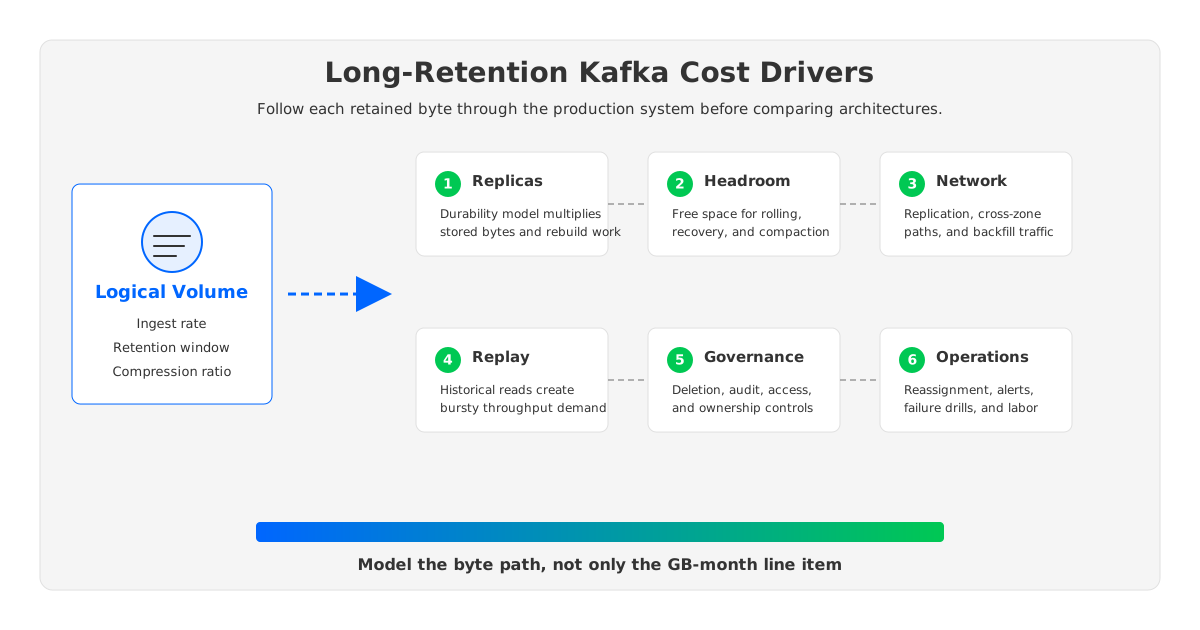
The first cost model most teams write is too small. It starts with retained bytes, multiplies by a storage price, and stops. That model can fit an archive bucket, but Kafka is an active distributed log. A retained record participates in replication, compaction, rebalancing, consumer catch-up, recovery, and governance controls. Even when the record is rarely read, the cluster still has to serve it through Kafka semantics.
The cost drivers usually show up in four places:
- Replica multiplication. Traditional Kafka stores partition replicas on broker-local storage. A longer retention window increases the amount of local data carried by the replica set, beyond the logical topic size.
- Capacity headroom. Brokers need free space for segment rolling, recovery, reassignment, compaction, and burst tolerance. Long-retention clusters often buy disk before they buy CPU.
- Network movement. Replication, client traffic, cross-zone placement, rebalancing, and backfill can move the same bytes through multiple paths. Cloud providers may charge for some cross-Availability Zone traffic, so topology matters.
- Operational labor. Long retention increases the blast radius of bad retention settings, slow consumers, under-tested cleanup policies, and broker replacement. Human time is part of the bill even when it does not appear on the storage invoice.
Trimming retention can lower the bill while removing the replay windows application teams rely on. The AI platform gets fresher features for a while, then an incident forces a rebuild from a lake table, a CDC snapshot, or an untested backup job. Long retention is not waste when it supports recovery and product velocity. It becomes waste when the storage architecture makes every retained byte carry too much operational weight.
2The Production Constraints Behind The Search
Long-retention Kafka projects rarely fail because someone forgot to set retention.ms. They fail because the retention target collides with a production constraint hidden during sizing. A fraud pipeline may need weeks of transaction events for model debugging. A data platform may need replay after schema fixes. An observability platform may need high-throughput logs for incident timelines. A regulated business may need retention evidence and deletion controls. These use cases all ask Kafka to behave like both a real-time stream and a durable replay layer.
The right architecture review starts by separating four windows:
| Window | What It Means | Why It Affects Cost |
|---|---|---|
| Hot tail | Data read near the latest offsets by normal consumers | Drives low-latency broker, cache, and network requirements |
| Recovery catch-up | Data used after restarts, deploys, or short downstream outages | Determines how much history must remain efficient to fetch |
| Historical replay | Data read for backfill, incident recovery, model rebuilds, or audits | Creates bursty read and object/request cost risks |
| Governance retention | Data kept because policy, compliance, or business contracts require it | Requires deletion, access, encryption, and proof controls |
Putting all retained data into one bucket called "storage" hides the tradeoff. Hot tail data needs latency and locality. Recovery catch-up needs predictable throughput. Historical replay needs controlled concurrency so it does not disturb live traffic. Governance retention needs lifecycle confidence. A low-cost architecture for one window can be poor for another, so the decision should be made by workload shape rather than by a single storage price.
FinOps adds another mismatch: engineering sets retention, while finance reviews the bill. Engineers think in MiB/s, partition count, replication factor, consumer lag, and offset range. Finance sees instance hours, provisioned disks, storage capacity, cross-zone data transfer, and support cost. A useful model translates between the two instead of forcing one side to speak the other's language.
3Architecture Patterns Teams Usually Compare
Most teams compare three patterns. The first is classic Kafka with broker-local storage. It is mature and often the lowest migration-risk choice when the workload is stable. The tradeoff is coupling: compute and durable storage scale together. If retention grows, broker disks grow. If disks grow, broker replacement and reassignment become heavier. If the cluster is multi-zone, replica placement and traffic patterns become part of the cost model.
The second pattern is Apache Kafka tiered storage, also known as remote log storage. Apache Kafka documentation describes a local tier that uses broker disks for log segments and a remote tier, such as S3, for completed log segments. This fits when the primary problem is retaining older data without keeping all of it on broker disks. It preserves Kafka's operating model while extending the retention hierarchy. It still requires production testing around remote storage manager behavior, local retention settings, remote fetch latency, metadata consistency, deletion, and supported topic types.
The third pattern is Kafka-compatible shared storage. The platform keeps the Kafka protocol surface but changes the durable storage contract underneath. Brokers still handle clients, leadership, caching, and runtime coordination, but durable log data is no longer permanently bound to broker-local disks. That architecture asks harder correctness questions: when is a record durable, how are stale writers fenced, how do readers locate objects, and how does cache behave during replay? When implemented well, it can make long retention less tied to broker count and make scaling closer to compute scheduling than data migration.
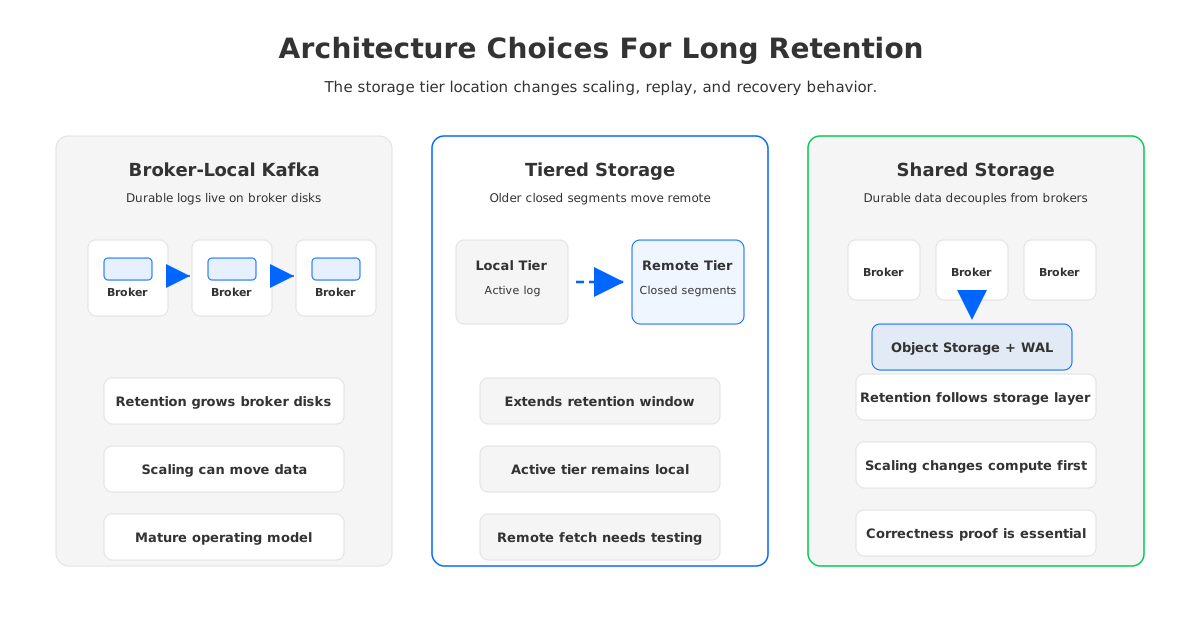
No pattern is universally right. Local Kafka optimizes maturity and predictable hot-path behavior. Tiered storage optimizes retention relief while keeping the familiar broker-local active tier. Shared storage optimizes storage-compute separation, elastic operations, and an object-storage-oriented cost structure. A serious evaluation should state which center of gravity matters before it compares products.
4A Practical Cost Model For Long-Retention Kafka
The safest way to model long-retention Kafka storage cost is to start with the logical write stream and follow the byte through the architecture. A workload writes records into Kafka, Kafka replicates them, brokers retain segments, consumers read from the tail, some consumers catch up, and occasionally a replay job reads older offsets. Each step has a different cost driver: capacity, requests, throughput, or operational risk that becomes cost during incidents.
Use a worksheet with these inputs:
- Ingest rate after compression, measured in MiB/s or GiB/day.
- Retention windows for hot tail, normal recovery, historical replay, and governance.
- Replication factor or durability mechanism, including whether the storage service already replicates data internally.
- Partition count, segment size, compaction behavior, and topic growth pattern.
- Consumer fan-out, worst-case lag, and expected replay concurrency.
- Placement assumptions across zones, regions, VPCs, and private connectivity paths.
- Operational headroom for reassignment, broker replacement, disk alerts, and backfill throttling.
The worksheet does not need invented benchmark numbers. If the platform writes at a known sustained rate, the logical retained volume can be calculated. If the architecture uses broker-local replicas, the local storage footprint should reflect replicas and headroom. If historical replay goes through object storage, request and retrieval patterns should be tested. If cross-zone network transfer is possible, topology should be reviewed against the cloud provider's current pricing documentation before approval.
This prevents a common mistake: comparing a local-disk Kafka bill with an object-storage-backed architecture by storage capacity alone. Object storage can improve the retained-byte economics, but it introduces design questions around request rate, object layout, cache hit ratio, and replay behavior. The goal is to move the conversation from a vague "Kafka is expensive" complaint to a measurable architecture review.
5Where AutoMQ Fits In The Evaluation
After the neutral framework is in place, AutoMQ enters the discussion as a Kafka-compatible shared-storage architecture. AutoMQ keeps compatibility with the Kafka protocol and ecosystem while replacing Kafka's broker-local log storage with S3Stream, a shared streaming storage layer built around WAL storage, object storage, and data caching. The intent is to make brokers more stateless, keep durable stream data in shared storage, and reduce the need to scale broker-local disks to extend retention.
That distinction matters for long retention. A tiered-storage Kafka cluster can be the right answer when you want to preserve the existing Kafka model and offload older closed segments. AutoMQ is aimed at a different question: what if the cluster should keep Kafka compatibility, but the storage cost structure and scaling behavior should look more like cloud-native shared storage? In that category, evaluate produce durability, WAL choice, cache behavior, catch-up reads, metadata correctness, broker replacement, and deployment boundary.
AutoMQ BYOC and AutoMQ Software are relevant for teams that want the data plane inside their own cloud account or private environment. In long-retention conversations, this is not a minor procurement detail. Data location, object storage ownership, encryption, network path, observability, and incident response all affect whether a platform can satisfy both engineering and governance.
AutoMQ also changes the scaling conversation. In traditional Kafka, adding or replacing brokers often means thinking about partition data movement. In a shared-storage design, the goal is to make durable history less attached to a specific broker, so scaling and recovery can rely more on metadata, ownership, and cache warming. That does not remove the need for testing. It changes what you test.
6Migration And Governance Checks
The migration path should be boring on purpose. Long retention means the blast radius of a mistake is large, so the first goal is to prove that the architecture preserves the workload contract. Start with topics where retention value is clear, consumer behavior is known, and replay can be tested without risking critical business flows. Mirror traffic or run parallel consumers when possible. Compare produce latency, consumer lag, replay throughput, object storage metrics, and operational procedures before broad rollout.
Governance deserves the same attention as performance. Longer retention creates more value, but it also keeps more data available for longer. Review encryption, access control, audit logging, deletion semantics, retention exceptions, topic ownership, and incident response. Kafka-compatible does not mean governance-compatible by default; the storage layer, control plane, cloud account boundary, and observability path all need review.
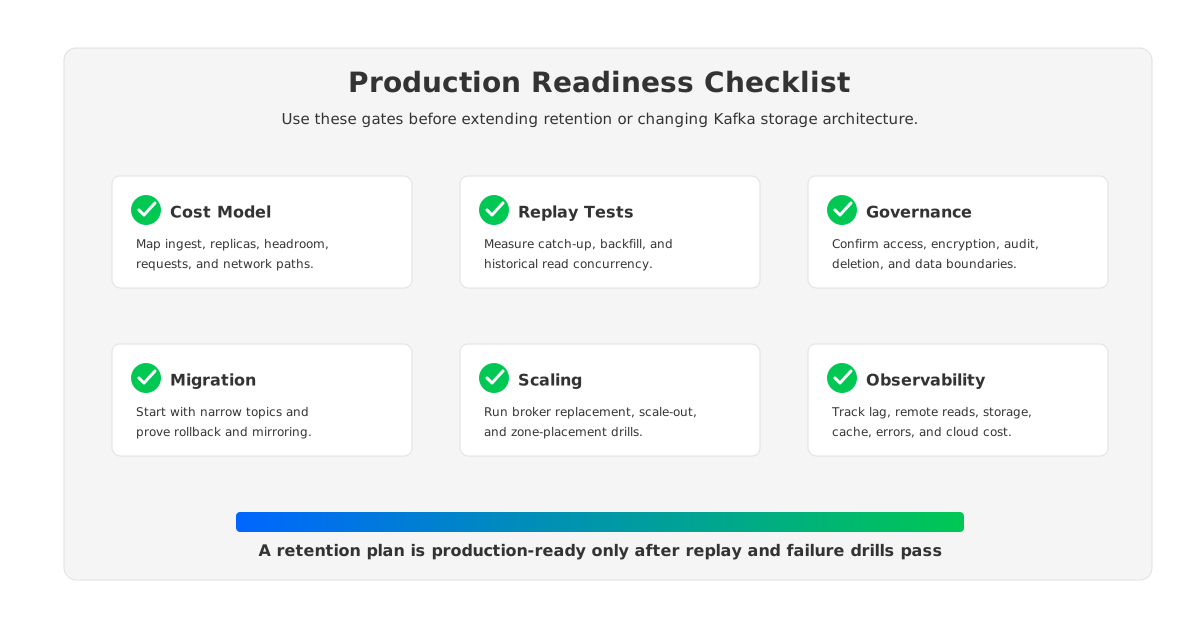
A readiness review should end with decisions. The team should know which topics stay on the existing Kafka architecture, which topics use tiered storage, which workloads justify a shared-storage Kafka-compatible platform, and which replay workflows belong outside Kafka entirely. Kafka should not become the universal answer for every historical analytics query. Long retention is valuable when it preserves streaming semantics and operational recovery, not when it turns the cluster into an accidental data warehouse.
7Decision Framework
If your Kafka estate is stable, retention is moderate, and the team already handles broker operations well, optimize the existing cluster first. Compression, topic ownership, retention-by-topic, consumer lag hygiene, partition cleanup, and capacity dashboards can remove waste without introducing a new storage architecture. The lowest-risk migration is the one you do not need.
If the primary problem is older history filling broker disks, evaluate Apache Kafka tiered storage. Test it with the exact Kafka version, remote storage implementation, topic settings, and replay patterns you expect in production. Pay special attention to local retention windows. Setting them too low may push normal recovery into the remote path; setting them too high may keep the storage bill mostly unchanged.
If Kafka is too stateful for your cloud operating model, evaluate Kafka-compatible shared storage. That is where AutoMQ belongs in the shortlist. The proof should be workload-shaped: sustained ingest, consumer catch-up, replay, broker replacement, scale-out, zone-aware networking, and governance. The question is whether retained data can grow without forcing broker-local storage, partition movement, and recovery time to grow in lockstep.
The search for long retention kafka storage cost starts with a bill, but it should end with an architecture decision. Keep the Kafka semantics that make replay valuable. Change the parts of the storage contract that make every retained byte too expensive to keep.
For teams comparing a Kafka-compatible shared-storage path, the next useful step is to study AutoMQ's S3Stream architecture and validate it against one real long-retention workload: AutoMQ S3Stream overview.
8References
- Apache Kafka documentation: Tiered Storage
- KIP-405: Kafka Tiered Storage
- Apache Kafka documentation: Replication
- Amazon EC2 On-Demand Pricing: Data Transfer
- AutoMQ S3Stream Overview
- AutoMQ S3 Storage Architecture
9FAQ
9.1What drives long retention Kafka storage cost?
The main drivers are retained logical volume, replication or durability model, broker-local headroom, consumer replay behavior, cross-zone network paths, object storage request patterns, and operational work around recovery and reassignment. Storage capacity is one line in the model, not the whole model.
9.2Is Kafka tiered storage enough for long retention?
It can be enough when the main problem is older log segments consuming broker disks. It is less complete when the main problem is broker statefulness, slow scaling, or recovery tied to local storage ownership.
9.3Does object storage make Kafka retention cost disappear?
No. Object storage changes the cost structure. It can reduce dependence on broker-local disks, but teams still need to model requests, retrieval, cache behavior, replay concurrency, metadata correctness, and network transfer.
9.4When should AutoMQ be evaluated for long-retention Kafka?
Evaluate AutoMQ when the team wants Kafka compatibility plus shared-storage architecture, more stateless broker behavior, object-storage-backed durable data, and deployment control through BYOC or software models. It is most relevant when long retention, scaling, and recovery are connected problems.
9.5How should teams start a migration?
Start with a narrow topic set, mirror or replay real workload data, and measure produce latency, consumer lag, historical replay, storage metrics, broker replacement, and governance controls. Treat the first phase as architecture validation rather than a bulk migration.


