
Table of Contents
Table of Contents
Product and growth teams do not search for low latency analytics loop kafka because they want a prettier dashboard. They search for it when the business has outgrown batch feedback: experiment results arrive late, personalization rules lag behind behavior, and fraud signals become useful after damage is done. Kafka is usually already in the conversation because the events exist somewhere. The harder question is whether the streaming platform can close the loop without turning the data team into a permanent incident response group.
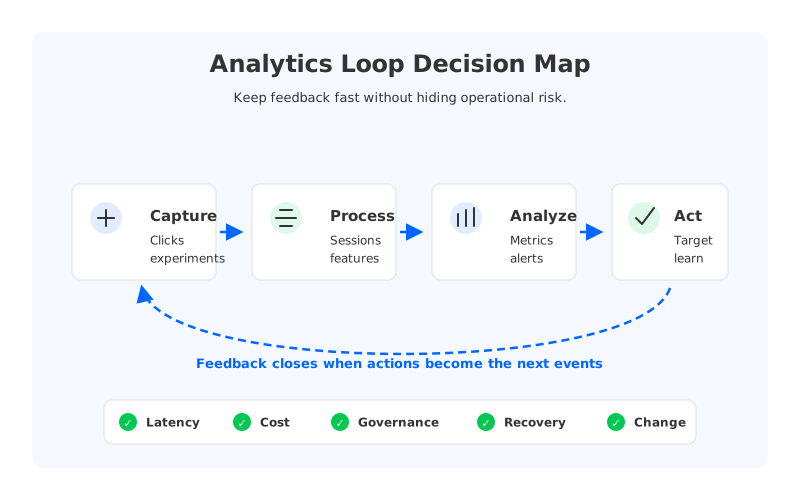
That loop has a simple shape. A user does something, the system captures the event, a stream processor updates features or aggregates, analytics surfaces the result, and the product changes what happens next. The loop feels simple on a whiteboard. In production, the weak point is the infrastructure underneath the arrows.
1Why Teams Search For Low Latency Analytics Loop Kafka
The search intent usually starts with a real product constraint. A growth team wants campaign suppression to update within minutes instead of the next day. A product team wants experiment metrics to converge fast enough to stop a bad rollout. A marketplace team wants risk scores to reflect behavior while the session is still active. In each case, latency changes what the product can safely do.
Kafka fits this problem because it gives teams a durable event log, consumer groups, offsets, replay, and broad client compatibility. Those properties matter when multiple downstream systems need to read the same events at different speeds. The same clickstream may feed a metrics store, a feature store, a warehouse sink, and a stream processing job. Kafka lets those readers move independently, which is exactly what product analytics loops need.
But Kafka by itself does not guarantee a low-latency loop. The loop includes producer batching, broker write path behavior, replication, consumer lag, stream processing state, sink throughput, query freshness, and deployment operations. One slow stage can stretch a minute-level loop into a business-day loop. One bottleneck can make teams afraid to add the next product surface.
This is where many teams misdiagnose the problem. They tune producer linger settings, add partitions, and scale consumers, but the broader operating model stays unchanged. The platform still requires capacity reservations for peak load, storage decisions are tied to broker placement, and recovery plans depend on moving or rebuilding broker-local state. The application team sees latency. The platform team sees a storage and operations problem.
2The Production Constraint Behind The Problem
A low-latency analytics loop has two latency budgets. The first is the data path budget: how long it takes a record to move from user action to usable signal. The second is the change budget: how quickly the platform can absorb traffic changes, add consumers, recover from failure, and migrate workloads without creating a queue of operational work. Teams often measure the first budget and hand-wave the second one.
For product and growth workloads, traffic is rarely smooth. Campaigns spike, experiments create uneven cohorts, large customers onboard with unusual patterns, and backfills compete with live processing. A Kafka cluster that looks healthy at average throughput can still create painful tail latency when hot partitions, storage pressure, or consumer group churn line up. The architecture has to keep the live path predictable while allowing replay and catch-up work.
The risk grows when analytics loops become shared infrastructure. One team adds segmentation, another adds billing checks, and a third adds model features. The platform team may be happy about reuse, but the cluster now has many latency expectations on the same substrate. That is where a local tuning issue becomes a governance issue.
A useful evaluation separates five questions that are often mixed together:
- Event semantics: Can the platform preserve ordering, durability, replay, and offset behavior for the client patterns already in use?
- Latency control: Can teams measure producer-to-action latency beyond broker-side averages?
- Elasticity: Can the platform handle traffic spikes and retention growth without long broker reshuffles?
- Cost visibility: Can teams explain compute, storage, replication, and network cost in a way finance can forecast?
- Operational safety: Can migrations, rollbacks, and recovery drills run without asking product teams to freeze releases?
Those questions are broader than "is Kafka fast enough?" Fast is not a stable property when workload, retention, fan-out, and recovery patterns keep changing. The right question is whether the system can stay fast while the loop becomes important enough to depend on.
3Architecture Options And Trade-offs
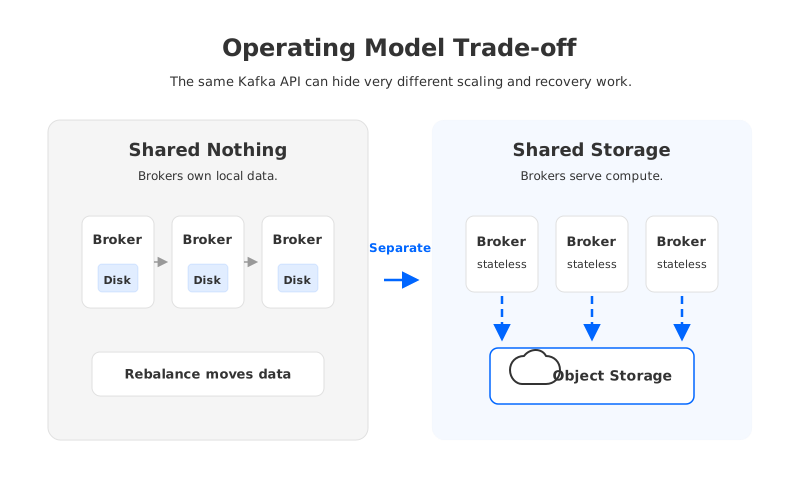
The standard Kafka operating model is shared nothing: brokers serve traffic and own local persistent data. This design made sense in the environment where Kafka was born. Local disks were close to compute, replication across brokers provided durability, and operators could reason about data by reasoning about broker placement. In cloud environments, the same model can tie together decisions that product teams would rather separate.
Local storage creates a practical coupling between throughput, retention, and recovery. If the loop needs more retention for replay, broker disks grow. If it needs more compute for a launch spike, data placement still matters. If a broker fails or a cluster is rebalanced, data movement becomes part of the operational path. Traditional Kafka is not wrong; storage locality is a constraint the platform team must price into any latency promise.
Tiered storage changes part of that equation by moving older log segments to object storage while keeping brokers responsible for the hot path. This can help with retention economics and restore pressure, but it does not make the broker fully stateless. The live operating model still has to account for local disks, hot partitions, and the relationship between broker capacity and data ownership.
Shared storage takes a more aggressive approach. Brokers become more stateless, while durable log data is backed by object storage and a write-ahead log layer handles the low-latency write path. The goal is to decouple compute from storage so scaling brokers does not require the same volume of data movement. That shift is not a magic latency switch. It changes what the platform team has to manage when product traffic moves faster than capacity planning cycles.
The trade-off can be summarized without turning it into a vendor checklist:
| Question | Broker-local model | Shared storage model |
|---|---|---|
| Scaling compute | Often tied to data placement and partition movement | Can be more independent when brokers are stateless |
| Retention growth | Increases local storage pressure unless tiering is added | Uses object storage as the durable storage layer |
| Failure recovery | Broker state and data placement remain central | Recovery can focus more on metadata and compute replacement |
| Cost model | Compute, storage, and network are often blended in cluster sizing | Compute and storage can be reasoned about separately |
| Migration risk | Mature ecosystem, but operational state is sticky | Requires careful compatibility and failure-mode validation |
Different models move the constraint to different places. Product and growth teams feel the result as freshness, launch confidence, and how often platform work blocks product work.
4Evaluation Checklist For Platform Teams
A low-latency analytics loop should be evaluated as a production system, not a streaming demo. The demo proves that events can flow. The production review proves that the loop can survive product success, partial failure, schema change, and reuse by the next team.
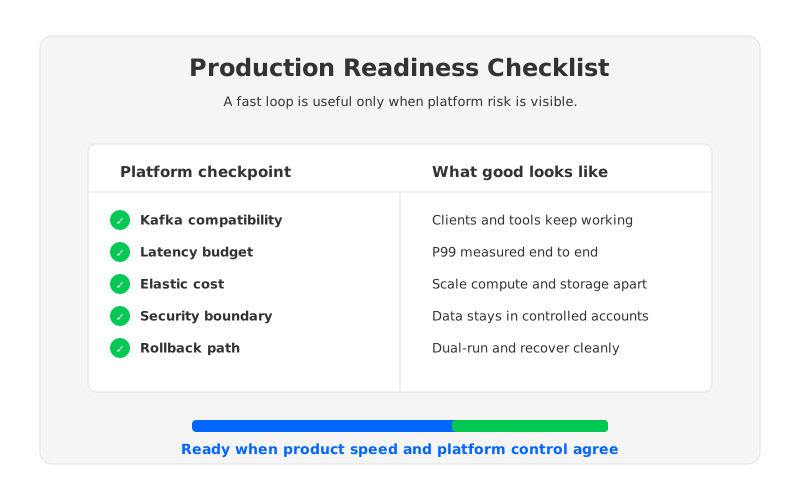
Start with compatibility because it is easy to underestimate. Kafka-compatible infrastructure should be tested against the clients, connectors, stream processors, security settings, and operational tooling already in the environment. Consumer groups and offsets are especially important because analytics loops often depend on replay and controlled catch-up. If migration changes offset behavior or client assumptions, the team may discover the problem only after downstream systems diverge.
Latency comes next, but it has to be measured end to end. Broker metrics are necessary, but they do not tell the whole story. A product loop cares about the time between an event being emitted and a decision becoming available. That path may include producer batching, broker durability, stream processing state, sink writes, and query serving. Measuring only one stage makes the dashboard cleaner and the incident harder.
Cost needs the same end-to-end discipline. Streaming workloads can hide cost in places that do not appear in a broker bill: cross-zone traffic, overprovisioned instances, retained data, connector fleets, monitoring cardinality, and backfill capacity. The right cost model separates steady-state live traffic from replay, retention, and failure recovery. That separation helps platform teams explain what a loop will cost before it becomes a permanent dependency.
Security and governance are not paperwork for this workload. Analytics loops often combine behavioral data, customer identifiers, model features, and operational signals. The platform must support clear ownership boundaries, access control, encryption expectations, auditability, and data residency requirements. When those controls are added after the loop is popular, the product team experiences governance as a slowdown. When they are built in, governance becomes part of the delivery path.
Migration planning is the last checkpoint because it exposes weak assumptions from the earlier ones. A credible plan describes how the team will dual-run, compare outputs, control consumer cutover, roll back, and verify that dashboards or features have not drifted. It also defines what "done" means. Without that definition, teams may move the happy path and leave the hardest consumers behind.
5How AutoMQ Changes The Operating Model
Once the evaluation reaches compute-storage coupling, a different architecture becomes relevant. AutoMQ is a Kafka-compatible cloud-native streaming platform that separates broker compute from durable storage on object storage. For teams building analytics loops, the important idea is not "another Kafka service." It is a change in which parts of the platform stay stateful under traffic, retention, or recovery pressure.
In a shared storage design, brokers can be treated more like replaceable compute nodes. Durable data lives in shared object storage, while the write path is designed around a WAL layer for low-latency ingestion. That separation lets platform teams reason about scale in two dimensions: add broker compute when product traffic needs more serving capacity, and rely on object storage for durable data growth.
This also changes how teams think about multi-zone operations. In traditional Kafka deployments, replication and client placement can create cross-zone network cost and capacity planning questions that are easy to miss until the bill arrives. AutoMQ's architecture includes a zero cross-AZ traffic design goal for supported deployment patterns, which is relevant when product analytics loops have heavy fan-out. The practical benefit is a more forecastable cost of freshness.
AutoMQ BYOC is also relevant for teams with strict deployment boundaries. Product analytics often uses sensitive customer behavior, so many organizations want the data plane inside their own cloud account while reducing day-to-day platform work. A BYOC model can preserve that boundary while giving teams a managed operational experience. The platform still needs compatibility testing, observability, and migration discipline, but the data control model can match enterprise governance requirements.
The strongest way to introduce AutoMQ into an analytics-loop roadmap is to make it compete against the checklist, not a vague promise of speed. Can existing Kafka clients and stream processors run? Can the team measure the real P99 loop latency? Can compute scale without a storage reshuffle? Can retention grow without forcing a broker sizing exercise? Can the security team understand where data lives? Concrete answers make the architecture decision much less emotional.
6A Practical Rollout Pattern
The safest rollout begins with one loop that matters but does not carry the entire business. Pick a workload where freshness has visible value, such as experiment monitoring, growth-campaign alerts, or near-real-time segmentation. Avoid the most tangled system because the first migration should validate assumptions, not maximize organizational drama.
Run the first loop with explicit success criteria. Measure event-to-action latency, consumer lag under replay, stream processing recovery, sink freshness, and operational steps during a simulated broker failure. Include a cost view that separates steady-state traffic from replay and retention.
During dual-run, compare outputs rather than checking that pipelines are alive. Analytics loops can look healthy while producing different aggregates, especially when event time, late arrivals, or deduplication are involved. Keep the original path available until the replacement path proves that it can match semantics under normal load and during catch-up. A rollback plan is what lets the team move without pretending distributed systems never surprise anyone.
After the first loop is stable, turn the migration notes into a reusable platform contract. That contract should state supported client versions, producer and consumer configuration defaults, observability dashboards, ownership boundaries, schema rules, and a cutover playbook. Product teams do not need every storage detail, but they need a predictable way to ask for a loop and understand what it will cost.
Bring AutoMQ into the evaluation after the team has defined latency budget, compatibility requirements, cost model, and governance boundary. Its Kafka-compatible shared storage architecture is most relevant when compute-storage coupling, retention growth, cross-zone traffic, or broker recovery work blocks progress. Start with the AutoMQ Cloud overview and test one production-shaped loop.
7References
- Apache Kafka Documentation
- Apache Kafka Consumer Configuration
- Apache Kafka Producer Configuration
- Confluent Documentation: Tiered Storage
- AWS S3 Data Durability
- AWS S3 Performance Guidelines
- AutoMQ Cloud Overview
8FAQ
8.1Is Kafka enough for a low-latency analytics loop?
Kafka provides the event log, replay model, consumer groups, and ecosystem compatibility that make the loop possible. It is not enough by itself because end-to-end latency also depends on producer behavior, broker durability, stream processing, sinks, query serving, and operations. Treat Kafka as the backbone, then evaluate the full path.
8.2What is a realistic latency target?
The right target depends on the product decision. Fraud checks may need seconds, growth segmentation may tolerate minutes, and experiment analysis may care more about consistent freshness than subsecond response. Define the decision window first, then set producer-to-action SLOs that match it.
8.3Does shared storage always reduce latency?
No. Shared storage changes the operating model by separating broker compute from durable storage. Latency still depends on the write path, caching, networking, client settings, and downstream processing. Its main advantage for analytics loops is operational elasticity: scaling and recovery can be less tied to broker-local data movement.
8.4How should teams compare traditional Kafka, tiered storage, and cloud-native Kafka-compatible platforms?
Compare them against workload behavior, not feature names. Look at compatibility, hot-path latency, replay behavior, retention economics, failure recovery, cross-zone traffic, governance, and migration risk. The right answer for a small internal metrics stream may differ from the right answer for a customer-facing product decision loop.
8.5Where should AutoMQ enter the evaluation?
Bring AutoMQ in after the team has defined the latency budget, compatibility requirements, cost model, and governance boundary. Its shared storage architecture is most relevant when compute-storage coupling, retention growth, cross-zone traffic, or broker recovery work is becoming a blocker.


