
Table of Contents
Table of Contents
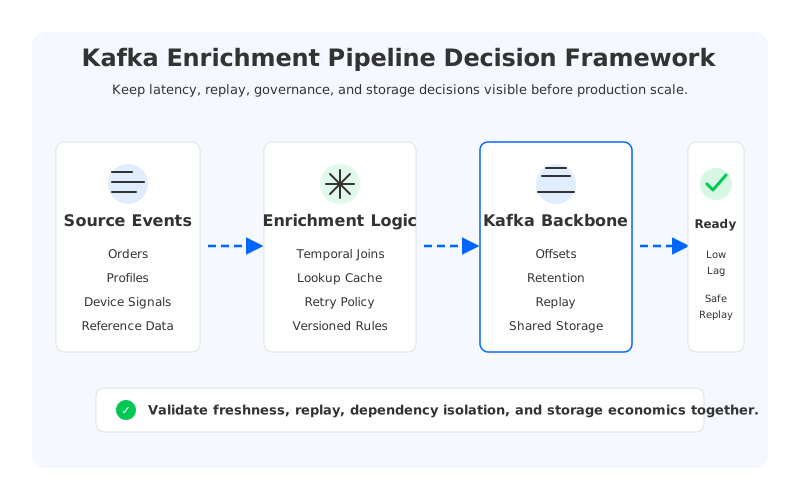
A search for kafka enrichment pipeline usually starts after the first integration becomes uncomfortable. A service consumes an order event, calls a profile database, adds risk context, and writes an enriched event for fraud, personalization, search, or AI feature generation. The prototype looks harmless because Kafka absorbs the event flow and the enrichment code is close to the business logic. Production changes the shape of the problem.
The first production surprise is rarely Kafka throughput by itself. It is the combination of low-latency joins, external lookup variance, replay, schema change, derived topics, and downstream consumers that expect enriched events to be durable. A pipeline that only works when every lookup is fast and every consumer is caught up is a fragile service chain with a log in the middle.
The architecture question is not whether Kafka can carry enriched events. It can. The harder question is whether the Kafka-compatible backbone, processing layer, and cloud storage model can support enrichment as normal production work instead of treating every backfill or recovery event as an exception.
1Why Kafka Enrichment Pipeline Design Matters Now
Enrichment has moved from back-office ETL into user-facing systems. Fraud scoring may need device, account, and behavior context before it approves a transaction. A recommendation system may need fresh catalog and session signals before it updates a ranking feature. An AI application may need policy tags or document context before downstream retrieval runs. In each case, the enriched event is not merely nicer data. It becomes the record that other systems trust.
That trust creates a stricter contract than ordinary fan-out. Producers need stable schemas. Enrichment jobs need deterministic retry and replay behavior. Consumers need offsets, ordering where it matters, and a way to rebuild state when logic changes. Kafka gives the pipeline a durable event log and offset-based progress, but the application still has to decide where enrichment state lives and how recovery works.
There are several common owners for enrichment logic:
- Application-local enrichment. The producing or consuming service performs lookup and writes the enriched event. This keeps logic close to product code, but it can duplicate rules across services and make replay harder to standardize.
- Stream processor enrichment. Flink, Kafka Streams, Spark Structured Streaming, or another processor owns joins, windows, keyed state, and derived topics. This is usually stronger for shared logic and controlled replay, but it introduces job lifecycle and state management.
- Connector-edge enrichment. Connectors or lightweight transforms add fields at the ingestion edge. This works for simple normalization, but it is usually too limited for stateful joins or latency-sensitive external calls.
- Lakehouse-side enrichment. Raw events are stored first, then enriched in analytical tables. This is useful for offline correction and historical analysis, but it may not satisfy operational freshness requirements.
Strong architectures often use more than one pattern. The mistake is to hide that choice behind a generic "real-time pipeline" label. Enrichment needs an explicit serving contract: what must be enriched before action, what can be enriched later, and what must remain replayable from the original source events.
2The Production Constraints Behind Low Latency
Low latency is easy to draw and hard to operate. A Kafka consumer can process records quickly until it waits on an external database, feature store, HTTP service, or model endpoint. Once enrichment depends on another system, tail latency matters more than average latency. A small fraction of slow lookups can create consumer lag, retry storms, or out-of-order behavior downstream.
State makes the problem more interesting. Some enrichment is a point lookup: add customer tier to an order. Other enrichment is temporal: join an order with the most recent account status, device risk signal, or inventory snapshot. Temporal enrichment needs a rule for event time, late records, updates, and deletion. If the pipeline is rebuilt after a bug, the result should be understandable rather than dependent on whatever lookup service happened to return during the rebuild.
That is why production teams separate enrichment concerns instead of placing every lookup inside one consumer loop:
| Concern | Architecture question | Failure mode if ignored |
|---|---|---|
| Freshness | How stale can reference data be before the enriched event becomes wrong? | Fast pipeline, incorrect business outcome |
| Replay | Can the same input history produce explainable enriched output after a code change? | Backfills create inconsistent derived topics |
| External dependencies | What happens when a lookup service slows down or returns partial data? | Consumer lag grows while Kafka appears healthy |
| State ownership | Does Kafka, the processor, or a serving store own the versioned context? | No clear recovery path during incidents |
| Cost | Does retention, fan-out, or replay force broker scaling unrelated to live writes? | Storage and network spend grow with each added consumer |
The table points to a useful principle: low-latency enrichment is a control-plane problem as much as a data-plane problem. You need policies for schema evolution, lookup versioning, retry, dead-letter handling, and replay. Without those policies, Kafka makes the pipeline more durable, not more governable.
3Architecture Patterns Teams Usually Compare
The first pattern is the direct consumer service. It is attractive because the service team can ship enrichment logic using ordinary deployment tools. The Kafka topic becomes both input queue and output log. This pattern works when enrichment is narrow, ownership is clear, and replay is not shared across many teams.
The second pattern is stateful stream processing. A processor reads source topics, maintains reference state, performs joins, and writes enriched topics. This shifts the pipeline from service choreography to data platform ownership. It also makes checkpointing, state compatibility, and source retention part of the production design. Apache Flink is a common example because its Kafka connector and state model connect Kafka offsets with checkpointed operator state.
The third pattern is a log-plus-serving-store design. Kafka carries raw and enriched events, while a key-value store, feature store, or OLAP table serves reference data for lookups. This can reduce pressure on source systems, but it introduces a synchronization question: the serving store must be refreshed from a source of truth, and the enrichment job must know which data version it used.
The fourth pattern is cloud-storage-centered replay. Raw events, enriched events, and historical context are retained long enough that backfills become planned work rather than emergency recovery. This is where the Kafka storage model becomes visible. If retained history lives primarily on broker-local disks, replay and retention can pull broker capacity away from live ingestion needs. If the log backbone uses shared object storage underneath a Kafka-compatible API, the trade-off shifts toward storage economics, read isolation, and cache design.
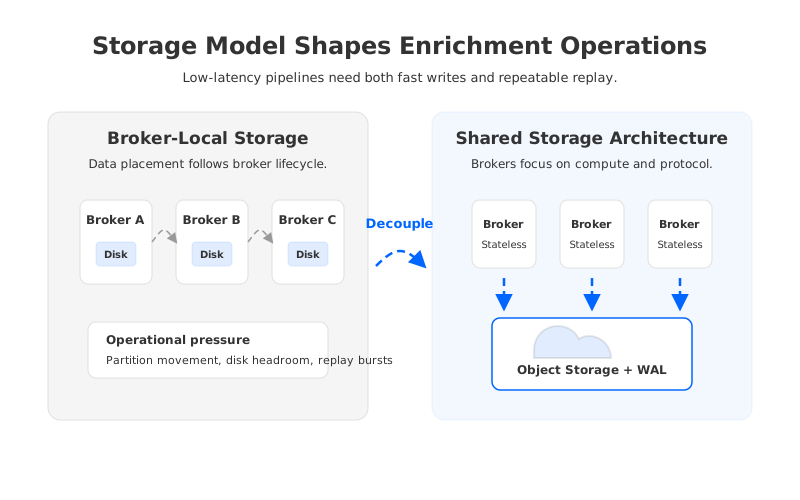
Traditional Kafka's shared-nothing architecture is proven and widely understood: brokers own partitions on local storage, replication provides durability, and consumers read from broker-owned logs. The model is familiar, but it couples data placement to broker lifecycle. Long retention, large backfills, and multiple enrichment consumers can require extra disk headroom, partition movement, and recovery planning even when the live write path is not the bottleneck.
Tiered storage reduces some of this pressure by moving older log segments to remote storage. It is useful, but it does not automatically make brokers stateless. The hot path, write path, cache behavior, and failure recovery still decide whether the enrichment platform can scale compute separately from retained history. For latency-sensitive enrichment, this distinction matters because the team needs both fast current processing and affordable, repeatable replay.
4A Vendor-Neutral Evaluation Checklist
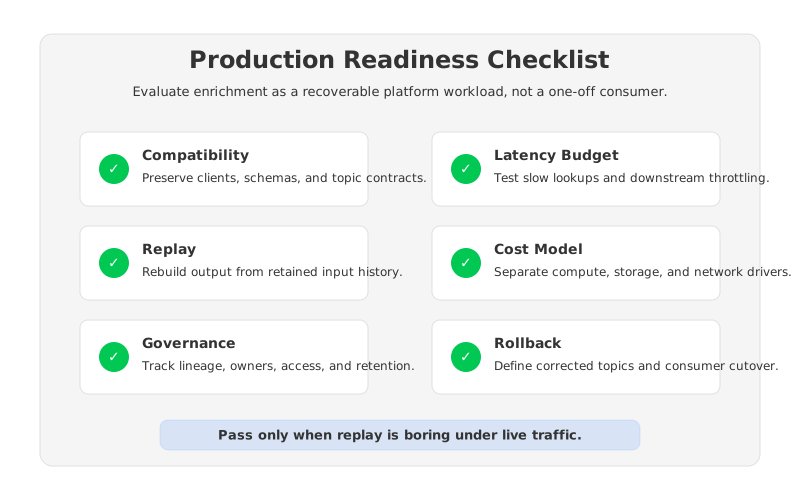
Start with the event contract. Which fields are authoritative in the raw topic, which fields are derived, and which derived fields must be explainable later? If the answer is vague, the pipeline will struggle during audits and backfills. A good enrichment design names the source topic, reference data source, enrichment version, output topic, schema owner, and rollback path.
Then test latency under dependency stress. Do not only benchmark Kafka read and write throughput. Add slow lookups, partial failures, reference data refreshes, consumer restarts, and sink throttling. Watch end-to-end freshness, consumer lag, processor backpressure, retry queues, and output correctness. The goal is to discover whether latency remains bounded when the non-Kafka parts behave like real systems.
Replay deserves its own test. Pick a historical window, change one enrichment rule, and rebuild the derived topic in a controlled environment. The test should answer whether source retention is sufficient, reference data can be reconstructed, replay traffic disturbs live workloads, and consumers can switch to corrected output without hand-crafted cleanup.
Governance is the final gate. Enriched events are tempting because they make consumers simpler. They are also risky because one mistaken field can spread across analytics, AI features, search indexes, and customer-facing decisions. Treat enriched topics as data products with owners, access controls, lineage, and retention policy.
5Where AutoMQ Changes the Operating Model
If the main pain is unclear enrichment logic, start with the processor and data contract. Improve schema discipline, lookup versioning, checkpoint strategy, and deployment review before changing the storage layer. A cloud-native Kafka-compatible platform will not fix an enrichment rule that no team owns.
But if the repeated pain is retained history, replay, broker recovery, storage growth, and cross-zone data movement, the Kafka layer deserves a different evaluation. The goal is to keep the Kafka programming model that producers, consumers, connectors, and processors already use while changing how durable log storage is operated underneath.
AutoMQ fits this category as a Kafka-compatible, cloud-native streaming platform built on Shared Storage architecture. Brokers are designed to be stateless compute nodes, while durable data is stored in object storage with a WAL layer on the write path. For teams that need customer-controlled infrastructure, AutoMQ BYOC keeps the data plane inside the customer's cloud boundary.
That changes the enrichment discussion in practical ways. Retention planning becomes less tightly bound to broker-local disk sizing. Scaling broker compute is less likely to require large partition data movement. Replay can be modeled as a normal workload against shared storage instead of as a broker-local recovery crisis. In multi-AZ cloud deployments, AutoMQ's zero cross-AZ traffic design is also relevant when teams want to reduce unnecessary zone-to-zone movement while preserving availability goals.
The important word is "evaluate." AutoMQ is not a stream processor and does not replace Flink checkpoints, Kafka Streams state stores, feature stores, or schema governance. It becomes interesting after a neutral review shows that the log backbone is making enrichment harder to operate than the enrichment logic itself. Separating broker compute from durable storage can give platform teams a cleaner boundary for latency, replay, and cost decisions.
6Decision Table for Platform Teams
A practical decision should produce a next step, not a preference for a tool name. The following table maps symptoms to the first layer worth investigating.
| Symptom | First place to investigate | Likely next action |
|---|---|---|
| Enriched output is fast but sometimes wrong | Reference data freshness and versioning | Add versioned lookup data or temporal join rules |
| Consumer lag grows when lookup services slow down | Enrichment dependency isolation | Add caching, async lookup control, backpressure, or processor-owned state |
| Backfills produce different results from live processing | Replay and reference-data reconstruction | Store enough source and context history to make rebuilds explainable |
| Kafka scales mainly because retained history grows | Log storage architecture | Compare broker-local storage, tiered storage, and shared-storage designs |
| One replay affects unrelated consumers | Workload isolation | Add quotas, separate clusters, or a backbone that handles replay as ordinary load |
| Migration risk is dominated by application rewrites | Kafka API compatibility | Favor Kafka-compatible platforms and preserve client contracts |
The healthiest Kafka enrichment pipeline has a boring failure story. A lookup slows down, and the pipeline degrades in a controlled way. A schema changes, and consumers know the compatibility contract. A bug is fixed, and the team can replay the affected history without turning the Kafka cluster into the incident. That boring story takes architecture work, but it is less costly than discovering the missing contract during a customer-facing outage.
If your enrichment pipeline is already pushing Kafka retention, replay, and broker recovery into the foreground, review AutoMQ's architecture documentation alongside your own workload model. The useful comparison is not a generic feature checklist. It is whether a Kafka-compatible Shared Storage architecture can make your enrichment backbone easier to scale, govern, and recover.
7References
- Apache Kafka Documentation: Consumers
- Apache Kafka Documentation: Exactly-Once Semantics
- Apache Flink Documentation: Kafka SQL Connector
- Apache Flink Documentation: Stateful Stream Processing
- AutoMQ Documentation: Architecture Overview
- AutoMQ Documentation: WAL Storage
- AWS Documentation: Amazon S3 Data Consistency Model
8FAQ
8.1What is a Kafka enrichment pipeline?
A Kafka enrichment pipeline reads source events from Kafka, adds context from reference data, services, state stores, or stream processors, and writes enriched events to Kafka or another serving system. Production designs must define ownership for schemas, state, replay, and downstream compatibility.
8.2Should enrichment happen before or after Kafka?
Use Kafka for the raw event when downstream teams need replay, fan-out, or independent processing. Enrich before Kafka only when the added fields are inseparable from the event contract and the producing service can own replay. Many production systems keep both raw and enriched topics.
8.3Is Flink required for Kafka enrichment?
No. Simple enrichment can live in services, connectors, or Kafka Streams applications. Flink becomes useful when enrichment needs stateful joins, event-time logic, checkpoints, controlled replay, or shared ownership by a data platform team.
8.4How much latency should a Kafka enrichment pipeline target?
The target should come from the business action, not from a generic streaming benchmark. Fraud decisions, AI feature updates, observability routing, and analytical enrichment have different freshness budgets. Define the maximum acceptable event-to-output delay, then test it under slow lookup and replay conditions.
8.5Where does cloud storage fit in low-latency Kafka enrichment?
Cloud storage matters when retention, replay, and backfill become major parts of the workload. It can support longer histories and more elastic recovery economics, but the architecture must still protect the low-latency write path with an appropriate WAL, cache, and broker design.
8.6Where does AutoMQ fit?
AutoMQ fits at the Kafka-compatible log backbone layer. It is relevant when the team wants to preserve Kafka APIs while reducing the operational coupling between broker compute, durable storage, replay, and multi-AZ data movement.


