
Table of Contents
Table of Contents
Searching for mainframe modernization kafka usually means the organization has already found the limit of point-to-point integration. A banking ledger, insurance policy system, airline reservation platform, payment switch, or settlement workflow may still run reliably on the mainframe, but the surrounding business now expects real-time fraud signals, AI retrieval context, mobile notifications, cloud analytics, and partner APIs. The modernization problem is no longer only "move the workload." It is "make high-value mainframe data usable without weakening the systems that still run the business."
Kafka-compatible streaming often enters that conversation because it gives teams a durable event backbone between systems that change at different speeds. The mainframe can remain a system of record while change data capture, transactional events, and API-driven updates flow into operational stores, data products, AI pipelines, and cloud applications. That pattern is powerful, but it also adds a new production platform. If the streaming layer is undersized, poorly governed, or too expensive to retain data, the modernization effort simply moves the bottleneck from the mainframe to Kafka operations.
The right question is not whether Kafka belongs in mainframe modernization. The better question is what role the streaming platform should play, where it should sit in the failure domain, and how its storage model affects cost, elasticity, and recovery. A careful architecture review separates modernization pressure from streaming-platform design before a team commits to tooling.
1Why mainframe modernization kafka matters now
Mainframes persist because they are good at the work they were built to do: high-volume transaction processing, strict operational control, and long-lived business logic. The pressure comes from the systems around them. Digital channels need fresh account state, risk teams need transaction events before the batch window closes, and AI applications need current business context rather than yesterday's extracts. A nightly file transfer cannot satisfy every downstream expectation without creating duplicate logic, fragile reconciliation, and slow incident response.
Streaming changes the integration contract. Instead of treating the mainframe as a periodic data source, the architecture exposes state changes as ordered records that downstream systems can consume at their own pace. A consumer building a fraud feature store, a search index, and a customer-service timeline can subscribe to the same event stream without asking the mainframe team to build three separate exports. That is the operational value behind the keyword.
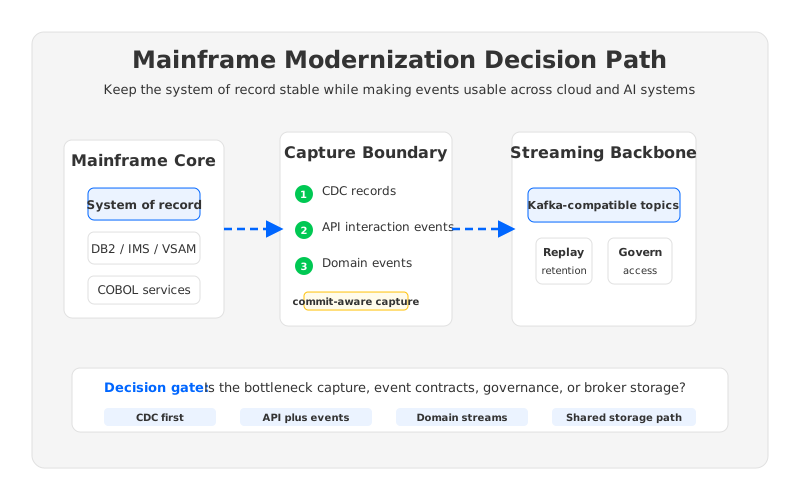
The risk is that teams compress several choices into one label. "Kafka for mainframe modernization" can mean CDC from DB2 or IMS, API event publication from COBOL transactions, MQ bridge patterns, log shipping into cloud analytics, or event-driven decomposition of a core domain. Each has different durability, ordering, security, and rollback requirements. Treating them as one migration pattern makes the first proof of concept look smoother than the production design will be.
Frame the work around four boundaries:
- Source boundary. Which mainframe systems emit changes, through what mechanism, and with what recovery semantics?
- Event boundary. Which events become shared business facts, and which remain technical replication records?
- Control boundary. Which team owns schemas, access, consumer onboarding, retention, replay, and incident handling?
- Cloud boundary. Which data can move to cloud regions, which must remain in controlled environments, and where encryption and audit evidence live?
Those boundaries matter more than the first connector choice. A modernization platform must protect the system of record, serve downstream teams, and remain operable when traffic, retention, or consumer demand grows.
2The production constraints behind the search
Mainframe modernization projects often begin with a simple data freshness goal: make changes visible to cloud services faster. The first production constraint is capture semantics. Change data capture can be log-based, table-based, message-based, or API-triggered, and each method answers a different question. Does the stream represent committed database changes, domain events emitted by application logic, or integration messages that happen to contain state? Downstream consumers need that distinction because it shapes idempotency, deduplication, schema evolution, and replay.
The second constraint is ordering. Kafka topics and partitions provide ordered records within a partition, but the architecture still needs a partitioning strategy. Account ID, policy number, customer ID, branch code, and transaction type all create different tradeoffs. A key that preserves business ordering may concentrate load; a key that spreads load evenly may complicate reconstruction of a single business timeline. Mainframe systems with high-value transactional domains rarely tolerate vague ordering guarantees.
The third constraint is retention and replay. A streaming backbone becomes more valuable when teams can replay data to rebuild indexes, hydrate AI context, backfill new services, or recover from consumer bugs. That value creates storage pressure. Traditional Kafka clusters bind retention to broker-local or broker-attached storage, so long retention can force teams to provision disk and compute together. Tiered storage can change some economics, but teams still need to inspect recovery behavior, operational ownership, and which parts of the log remain hot.
Finally, governance is not optional. Mainframe data often includes regulated customer, financial, healthcare, or operational records. The modernization story fails if it accelerates data movement while making access harder to explain to auditors.
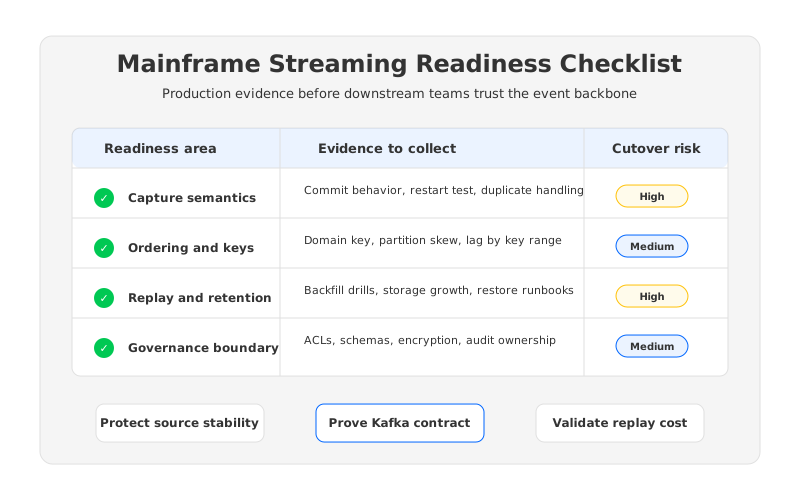
| Constraint | Architecture question | Evidence to collect |
|---|---|---|
| Capture semantics | Is the stream a business event, a CDC record, or a technical integration message? | Source logs, commit behavior, deduplication rules, restart tests |
| Ordering | Which key preserves the business invariant without creating hot partitions? | Domain key analysis, partition skew, consumer lag by key range |
| Replay | How far back can consumers rebuild state, and at what operational cost? | Retention plan, storage growth, restore drills, backfill runbooks |
| Governance | Who may publish, read, replay, and export mainframe-derived events? | ACLs, schemas, audit logs, encryption policy, data classification |
| Cutover | Can consumers move without interrupting the system of record? | Parallel-run plan, rollback owner, offset mapping, acceptance criteria |
The evidence column is where modernization planning becomes real. It is easy to draw an event streaming architecture; it is harder to prove restart, lag, replay, and data-retention behavior under production pressure.
3Architecture patterns teams usually compare
The most conservative pattern is replication-first CDC. Mainframe database or transaction-log changes are captured and written into Kafka topics, often with a downstream operational store or analytics platform as the first consumer. It keeps the source system stable, but it can produce technical change records that require transformation before business teams can use them safely.
A second pattern is API-plus-events. Tools such as mainframe API gateways can expose controlled access to existing transactions, while the modernization layer publishes event records for downstream consumers. This is useful when the organization wants to keep business logic on the mainframe while giving new applications a more direct integration path. The design must avoid turning the mainframe into a synchronous dependency for every digital workflow, so teams often combine request/response APIs with asynchronous event streams.
A third pattern is domain decomposition. The team identifies a bounded domain, publishes canonical events, builds a new cloud-native service around part of the workflow, and gradually reduces dependency on the mainframe for that domain. The streaming platform becomes the continuity layer between old and new systems, which makes durability and replay migration-critical.
These patterns are not mutually exclusive. A large modernization program may start with CDC for data availability, add API-plus-events for controlled interactions, and later decompose selected domains. The platform decision should anticipate that sequence. A Kafka-compatible backbone that only needs to serve a narrow CDC feed has a different operating profile from one that will become the event fabric for multiple products, AI applications, and cloud services.
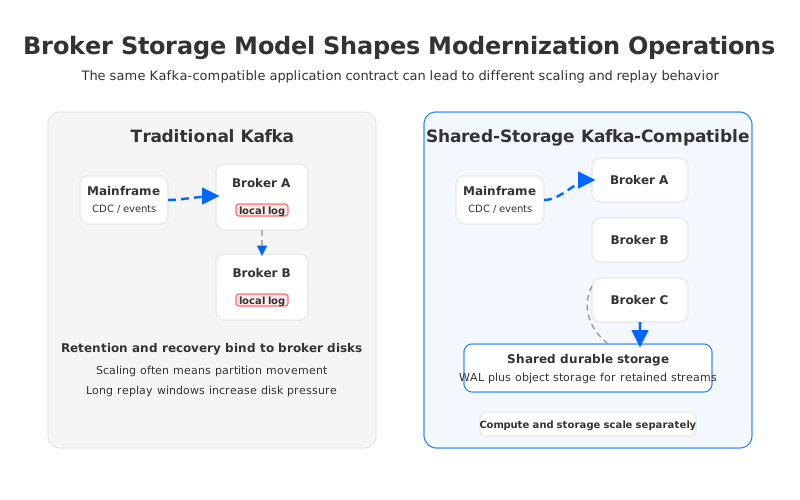
This is also where traditional Kafka Shared Nothing architecture needs scrutiny. In a classic Kafka deployment, brokers own partition replicas on local or attached disks. Producers write to partition leaders, followers replicate, and consumers read from broker-held log segments. The model is mature and familiar, but scaling and retention decisions often become broker decisions. If modernization increases retained bytes faster than compute demand, or if broker replacement triggers long data movement, the streaming layer can become expensive to operate precisely when more teams start depending on it.
4Evaluation checklist for platform teams
Start with the source system because modernization should not make the mainframe less reliable. The team needs a capture design that respects commit boundaries, restart behavior, and backpressure. If a schema changes, who validates downstream impact before the next business day starts?
Then evaluate the Kafka-compatible contract. Producers, consumers, Connect workers, stream processors, schema tooling, transactions, and consumer groups should be tested as part of the target platform. Compatibility is not a marketing checkbox; it is a test plan across clients, admin APIs, offsets, security, observability, and failure recovery.
Cost belongs in the same checklist as reliability. Mainframe modernization data can have bursty change windows, long retention expectations, and many downstream consumers. A platform that scales storage and compute together may over-provision one to satisfy the other. A platform that separates compute from durable storage may improve elasticity, but teams must validate latency, object-storage behavior, failure modes, and replay performance against their workload.
Use this decision sequence before selecting a platform:
- Define whether the first stream is CDC, domain events, API interaction events, or a mix.
- Pick partition keys from business invariants, then test load distribution and ordering.
- Set retention by consumer recovery needs, not by default broker disk size.
- Decide where schemas, ACLs, encryption, and audit ownership live.
- Validate cutover with offsets, duplicate handling, and rollback evidence.
- Revisit the storage architecture if broker-local disks become the scaling constraint.
This sequence keeps the discussion vendor-neutral. The output should be a decision record that explains why the chosen platform fits the modernization phase, not a tool list that assumes the architecture is solved.
5Where AutoMQ changes the operating model
Once the evaluation reaches retention growth, broker replacement, and customer-controlled deployment boundaries, AutoMQ becomes relevant as a Kafka-compatible cloud-native streaming option built around Shared Storage architecture. The key idea is not to change the mainframe modernization goal. It is to keep the Kafka client and ecosystem surface while moving durable log storage away from broker-local disks and into shared object storage, with brokers acting closer to stateless compute.
That shift affects the operating model behind modernization. If a mainframe-derived stream must be retained for replay, backfills, AI context, or audit-driven reconstruction, the platform team can evaluate storage growth separately from broker compute growth. For cloud programs, AutoMQ BYOC is also relevant because the deployment can run in the customer's cloud account and network boundary, while AutoMQ Software addresses private data center deployment needs.
AutoMQ should still enter the shortlist through evidence. Teams should test source-capture behavior, end-to-end latency, consumer replay, schema and ACL operations, failure recovery, and migration tools against their own workload. A Kafka-compatible shared-storage architecture is most compelling when the modernization program expects the streaming layer to become a long-lived platform, not when a narrow point-to-point feed would solve the immediate problem.
The practical advantage of introducing AutoMQ at this stage is that the conversation stays architectural. AutoMQ is evaluated as one way to preserve Kafka compatibility while changing the cost and operations profile of the data plane.
6Decision table for modernization paths
The best path depends on the modernization phase. A team extracting the first CDC feed should not use the same checklist as a team turning mainframe events into the backbone for digital channels and AI systems. The table below gives stakeholders a shared language.
| If your main pressure is... | Prefer this path | Watch for |
|---|---|---|
| Faster data freshness with low source disruption | CDC into Kafka-compatible topics | Commit semantics, duplicates, schema drift, source backpressure |
| Controlled access to existing transactions | API-plus-events | Synchronous dependency risk, authorization, event consistency |
| Gradual domain decomposition | Canonical event streams plus new services | Business ownership, replay, dual-write avoidance, cutover criteria |
| Long retention for replay and AI context | Shared-storage streaming evaluation | Latency profile, object storage behavior, governance, recovery drills |
| Customer-cloud or private-environment control | BYOC or software deployment evaluation | IAM, audit evidence, network paths, operational ownership |
Back to the original search: mainframe modernization kafka is not just a connector question. It is a platform decision about how old and new systems share facts without making either side more fragile. Keep the mainframe stable, make event contracts explicit, test compatibility as an application contract, and choose a streaming storage model that can grow with retention and consumer demand. For teams evaluating a Kafka-compatible shared-storage path, a practical next step is to compare the AutoMQ deployment overview with the modernization boundaries in your own environment.
7References
- Apache Kafka introduction
- Apache Kafka documentation: Kafka Connect
- Apache Kafka documentation: log compaction
- IBM z/OS Connect
- AWS Mainframe Modernization data replication with Precisely
- AWS Prescriptive Guidance: replicate mainframe databases to AWS by using Precisely Connect
- AutoMQ documentation: compatibility with Apache Kafka
- AutoMQ documentation: deployment overview
8FAQ
8.1Does Kafka replace the mainframe in a modernization project?
No. Kafka-compatible streaming usually acts as an event backbone around the mainframe. The mainframe may remain the system of record while CDC records, domain events, or API interaction events flow to cloud applications, analytics systems, AI pipelines, and operational stores. Replacement is a separate business and application decision.
8.2Is CDC enough for mainframe modernization?
CDC is often a strong first step because it improves freshness with limited source disruption. It is not the whole modernization architecture. Teams still need event contracts, schema governance, ordering choices, replay policy, security controls, and a plan for turning technical change records into useful business events.
8.3Why does Kafka storage architecture matter for mainframe data?
Mainframe-derived streams can require long retention for replay, recovery, audit, and AI context. In traditional Kafka, retention growth often increases broker disk pressure and can complicate scaling or replacement. A shared-storage architecture lets teams evaluate compute and durable storage more independently, but it should be tested against latency, recovery, and governance requirements.
8.4When should AutoMQ be considered?
Consider AutoMQ when the modernization program needs Kafka compatibility but expects pressure around long retention, broker-local storage, elastic scaling, cloud cost, or customer-controlled deployment boundaries. It is less relevant if the immediate requirement is a narrow, short-lived integration feed with limited replay needs.
8.5What should be tested before production cutover?
Test source capture restart behavior, duplicate handling, partition-key ordering, schema evolution, ACLs, encryption, observability, consumer lag, replay, offset handling, rollback, and failure recovery. The goal is to prove that downstream applications can trust the stream, not only that records appear in a topic.


