
Table of Contents
Table of Contents
Teams do not search for warehouse visible events kafka because they want another connector diagram. They search for it when warehouse tables become the interface to event streams. Fraud analysts want near-current transactions in SQL. Product teams want feature events before the next model run. Finance wants immutable raw events for replay and audit. Kafka is still the transport layer, but the success metric has moved: events are only useful when they become queryable, governed, and recoverable outside the broker fleet.
That shift creates an uncomfortable infrastructure question. If every warehouse-visible workload increases broker-local retention, fan-out, replica traffic, and recovery time, the lakehouse initiative is borrowing reliability from the Kafka cluster instead of reducing risk. Traditional Kafka can feed warehouses and table formats. The issue is whether the platform can make more events visible without turning brokers into an expanding storage estate.
1Why Teams Search for warehouse visible events kafka
The search intent usually appears after a streaming platform has succeeded. Kafka topics carry production events, consumer groups coordinate applications, and offsets track progress. Then the organization asks for a second contract: the same events should be visible in a warehouse or lakehouse with clear freshness, schema ownership, and replay semantics. The ask sounds like integration work, but it changes broker pressure.
Kafka's core abstractions remain the right starting point. Producers append records to partitioned logs. Consumers read by offset, typically as part of a consumer group. Kafka Connect moves data between Kafka and external systems. Transactions can coordinate writes for applications that need stronger delivery semantics. KRaft has removed the ZooKeeper dependency in current Kafka deployments. These pieces keep Kafka-compatible streaming relevant for warehouse-facing pipelines.
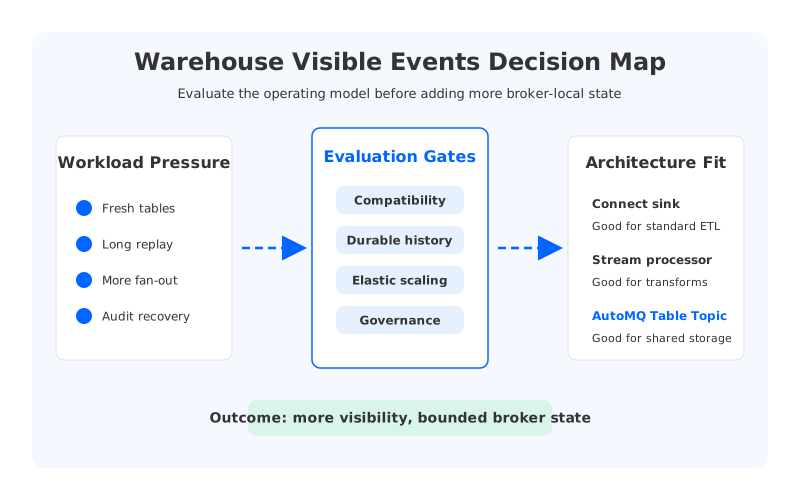
The hard part begins when warehouse visibility becomes a default expectation rather than a handful of special pipelines. Four pressures show up together:
- Freshness pressure: analytic users stop accepting daily export jobs and start asking why warehouse tables trail source events by minutes or hours.
- Retention pressure: replay windows grow because downstream tables, model features, and audit jobs all need a reliable source of truth.
- Fan-out pressure: multiple warehouses, lakehouse tables, stream processors, and governance tools read the same topics with different timing and throughput patterns.
- Recovery pressure: a connector failure is no longer an isolated integration incident; it can block analysts, ML pipelines, compliance workflows, and customer-facing dashboards.
Those pressures are not solved by adding a warehouse sink alone. A sink can move bytes, but the platform still has to decide where durable history lives, how replays are isolated from hot traffic, and who owns rollback when a table receives malformed data.
2The Lakehouse Freshness Constraint Behind the Workload
Warehouse-visible events sit between two operating models. Kafka optimizes for ordered append, partitioned consumption, and low-latency fan-out. Warehouses and lakehouses optimize for queryable files or tables, schema evolution, access control, and scans. A working architecture has to preserve the stream contract while producing table state that data teams can trust.
That is why freshness is a systems constraint, not a dashboard metric. If the warehouse table is late, the cause may be producer batching, broker throttling, connector imbalance, object storage writes, table commit contention, schema validation, or warehouse-side limits. The visible symptom is one number, but the root cause can sit in any layer. Teams that treat the pipeline as "Kafka plus a sink connector" often discover this during the first replay after a bad deploy.
The cleanest way to reason about the workload is to separate the event lifecycle into three planes:
| Plane | What It Owns | Failure Mode When Underspecified |
|---|---|---|
| Stream plane | Topic partitions, offsets, retention, producer and consumer semantics | Brokers become the main recovery boundary, so retention and replay expand local state |
| Table plane | File layout, table commits, schema evolution, warehouse visibility | Events arrive but are not queryable, or bad schema changes require manual repair |
| Governance plane | Ownership, lineage, access, audit, rollback | Teams can move data but cannot prove ownership or recover confidently |
This separation matters because each plane scales differently. Stream throughput may grow with producers. Table pressure may grow with query concurrency and commit frequency. Governance pressure often grows with the number of teams, not records. If all three pressures land on broker-local disks and connector operators, incidents become harder to reason about.
3Stream-to-Table Architecture Options
There are several legitimate ways to make Kafka events visible in a warehouse. The right choice depends on freshness requirements, replay design, and whether Kafka remains the long-lived storage boundary.
The first option is a conventional Kafka Connect sink into a warehouse or lakehouse. This fits destinations with mature connectors and modest replay windows. It keeps application code simple and uses familiar Kafka offsets for progress. The trade-off is operational: connector tasks, warehouse write limits, schema mapping, and backfill behavior become production concerns.
The second option is stream processing with Flink, Spark Structured Streaming, or a similar engine. This fits pipelines that transform, join, deduplicate, or enrich records before table publication. The engine owns more state, making business logic explicit, but it also introduces checkpoint management, state recovery, and versioned rollout.
The third option is direct table-oriented ingestion from the streaming platform. Topics are designed with warehouse visibility in mind, and the platform writes or exposes table-compatible data without requiring every team to operate a separate ETL path. This reduces duplicated integration work, but Kafka compatibility, durable history, and table metadata all have to line up.
None of these options removes the need for Kafka-compatible semantics. Consumers still care about offsets. Producers still need predictable acknowledgments and retry behavior. Operators still need access control, observability, and upgrade discipline. The differentiator is where durable event history lives and how much broker state grows as warehouse visibility expands.
4The Broker-State Trap in Traditional Shared-Nothing Kafka
Traditional Kafka follows a shared-nothing storage model: broker nodes own local log segments for the partitions assigned to them, and replication copies data across brokers for availability. This design was reasonable for data center-era assumptions. Local disks were the storage boundary, network transfer inside a cluster was not usually itemized as a separate cloud bill line, and moving partition ownership often meant moving storage with it.
Cloud deployments change the economics and the operational shape. Broker-local retention consumes block storage. Replica traffic and cross-zone reads can create network cost. Partition reassignment can become a data movement project rather than a control-plane operation. Tiered Storage helps by moving older log segments to remote storage, but the broker still owns the hot path and partition state.
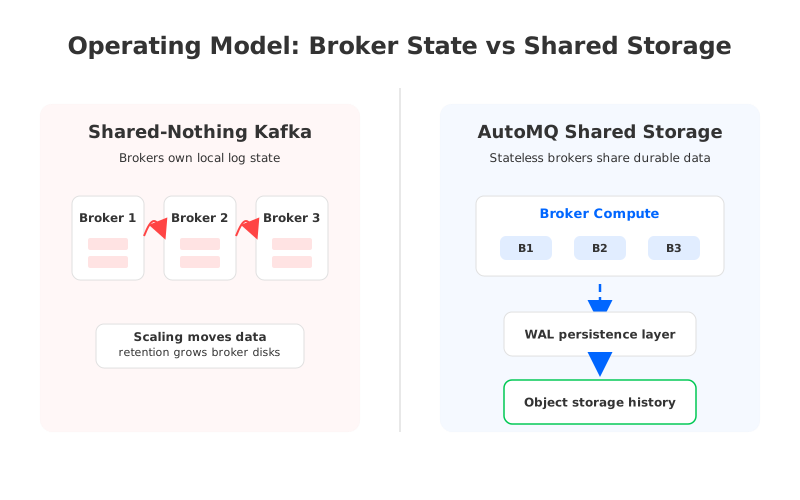
Warehouse-visible workloads amplify this state problem because they ask Kafka to serve both hot application consumers and slower analytic or recovery consumers. A failed warehouse sink may need to replay hours or days of data. A governance audit may need longer retention than the core application. A lakehouse backfill may read historical ranges with a different access pattern from normal tail reads. Each demand is defensible, but the combined effect is more retained data, more catch-up reads, and more coupling between brokers and downstream tables.
The trap is subtle because the first pipeline usually works. The pain arrives when platform teams standardize the pattern across domains and discover that every warehouse-visible topic expands capacity planning. At that point the architecture is asking stateful brokers to behave like an elastic storage service.
5Evaluation Checklist for Platform Teams
A neutral evaluation framework keeps the decision grounded. The goal is not to declare one ingestion pattern universally correct; it is to identify which platform assumptions will survive production growth.
| Dimension | Question to Ask | Evidence to Require |
|---|---|---|
| Compatibility | Can existing Kafka clients, consumer groups, offsets, ACLs, and operational tools continue to work? | Client compatibility matrix, migration test results, rollback plan |
| Durable history | Where does replayable event history live as retention grows? | Storage architecture, retention policy, recovery procedure |
| Elasticity | Does scaling compute require moving large volumes of partition data? | Scale-out and scale-in runbooks, reassignment behavior |
| Cost boundary | Which costs grow with broker count, storage retention, cross-zone traffic, and warehouse fan-out? | Cloud pricing assumptions and measured network/storage metrics |
| Governance | Who owns schema, table publication, access, lineage, and bad-data rollback? | Ownership model, audit logs, schema process |
| Failure recovery | What happens when a sink, stream job, or table commit path falls behind? | Replay test, lag alerts, backpressure handling |
| Migration risk | Can the team adopt the architecture without rewriting producers and consumers? | Dual-run plan, offset validation, cutover gates |
Strong evaluations include failure rehearsal. Pause a sink, accumulate lag, resume it, then measure whether consumers remain healthy. Corrupt a schema in staging and verify rollback. Scale brokers during a backfill and observe whether data movement competes with production traffic. These tests expose architecture boundaries faster than feature checklists.
They also clarify team boundaries. Data engineering may own table quality, but platform engineering owns broker durability and cluster cost. SRE may own incident response, but application teams own event contracts. A strategy that ignores these boundaries turns every incident into a cross-functional debugging meeting.
6How AutoMQ Changes the Operating Model
Once the evaluation focuses on durable history and broker state, a different architecture becomes relevant: Kafka-compatible streaming with shared storage and stateless brokers. AutoMQ fits that category. It keeps Kafka protocol and API compatibility as the application-facing contract, while moving storage toward object-storage-backed durability and independent compute/storage scaling.
In AutoMQ's Shared Storage architecture, brokers do not own durable log history in the same way a shared-nothing Kafka broker owns local segments. The storage layer uses object storage such as S3-compatible systems for durable data, with a write-ahead log layer for low-latency persistence. The operational implication is more important than the component diagram: adding or removing broker compute is no longer dominated by moving large local partition data.
That changes the warehouse-visible events discussion in three practical ways. Longer replay windows do not have to translate directly into larger broker-local disks. Catch-up and backfill patterns can be planned against shared storage rather than treated as a disturbance to broker ownership. Table publication features, such as AutoMQ Table Topic, can be evaluated as part of a broader stream-to-table model instead of as a connector bolted onto a stateful cluster.
AutoMQ does not remove the need for design discipline. You still need schema governance, table ownership, lag SLOs, access control, and migration tests. The architecture changes which parts of the system carry state. For a platform team making events warehouse-visible across many domains, that is the difference between scaling a pattern and multiplying exceptions.
There is also a cloud cost angle, but it should be handled carefully. Object storage and cross-zone network pricing differ by cloud provider and region. Model cost by behavior: tail reads, catch-up reads, retained bytes, broker count, inter-zone traffic, connector compute, and warehouse write cost. AutoMQ's documentation describes zero cross-zone traffic patterns for compatible deployments, which is worth testing against your own client placement and availability-zone strategy.
7Production Readiness Scorecard
Before standardizing a warehouse-visible events architecture, require a scorecard that is specific enough to block a launch. A vague "Kafka to warehouse works" sign-off is too weak for a capability that will carry production analytics, ML features, and audit workflows.
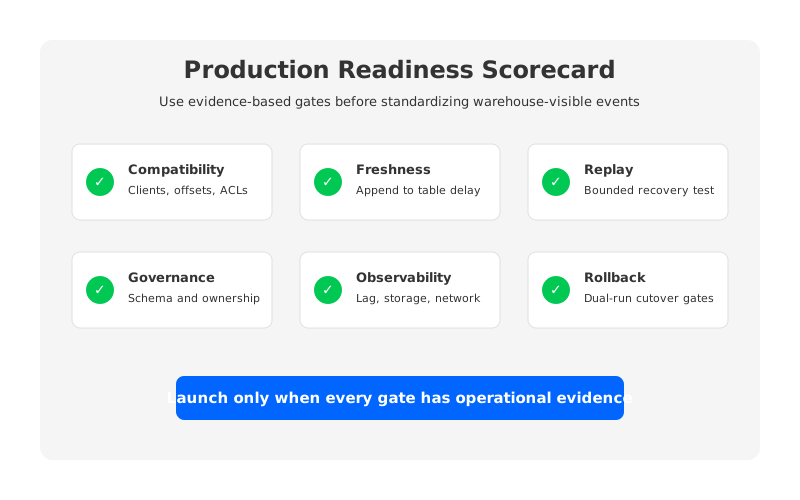
Use the scorecard as a release gate:
- Compatibility: existing producers and consumers run against the target platform in a staging environment, including offset reset, consumer group inspection, ACLs, and error handling.
- Freshness: the team measures end-to-end delay from event append to warehouse-visible table state, not only Kafka lag.
- Replay: operators can replay a bounded time range without starving production consumers or creating uncontrolled warehouse writes.
- Governance: schema change, table ownership, access control, lineage, and bad-data rollback have named owners.
- Observability: broker metrics, connector or table ingestion metrics, lag, storage behavior, and cloud network metrics are visible in one incident workflow.
- Migration and rollback: the cutover plan includes dual-run validation, offset comparison, producer switchback, and a clear point where rollback stops being safe.
The scorecard is intentionally operational. Architecture diagrams are useful, but production readiness is proven through behavior under stress. If a platform cannot explain where replayable history lives, what grows when retention doubles, and how a broken table commit is recovered, it is not ready as the default path.
For teams exploring this model, AutoMQ's Table Topic documentation is a useful next step because it connects Kafka-compatible topics with table-oriented ingestion and object-storage-backed architecture. Start with the mechanics, then test them against your own freshness, replay, and governance gates: review AutoMQ Table Topic configuration.
8References
- Apache Kafka documentation: Consumers and consumer groups
- Apache Kafka documentation: Kafka Connect
- Apache Kafka documentation: Transactions and producer configuration
- Apache Kafka documentation: KRaft
- Apache Kafka documentation: Tiered Storage
- AutoMQ documentation: Shared Storage architecture overview
- AutoMQ documentation: Table Topic configuration
- AutoMQ documentation: Kafka compatibility
- AutoMQ documentation: Eliminate inter-zone traffic overview
- AWS documentation: Amazon S3 pricing
- AWS documentation: Amazon EC2 data transfer pricing
9FAQ
9.1What does "warehouse-visible events" mean in a Kafka architecture?
It means Kafka events are available to streaming consumers and queryable in a warehouse or lakehouse with a defined freshness, schema, access, and replay contract. A one-off export job can put events in a table, but a platform capability must make that table reliable enough for analytics, ML, audit, and operational use.
9.2Is Kafka Connect enough for warehouse-visible events?
Kafka Connect is often the right starting point when a mature sink connector exists for the target system. It is not the whole operating model. Teams still need to define retention, replay, schema handling, lag SLOs, connector recovery, warehouse write limits, and bad-data rollback.
9.3How is shared storage different from Kafka Tiered Storage?
Tiered Storage moves older Kafka log segments to remote storage while preserving the traditional broker ownership model for the active log path. Shared storage architectures go further by reducing the broker's role as the owner of durable local data. The practical difference is elasticity: scaling broker compute is less tied to moving partition data between local disks.
9.4When should a team consider AutoMQ for this workload?
Consider AutoMQ when Kafka compatibility is required but broker-local state, retention growth, cloud storage cost, cross-zone traffic, or partition movement has become a constraint on warehouse-facing pipelines. It is most relevant when the organization wants warehouse-visible events as a reusable platform pattern rather than a small number of custom integrations.
9.5What should be tested before production rollout?
Test producer and consumer compatibility, offset behavior, end-to-end freshness, lag recovery, table rollback, schema changes, scale-out during backfill, and cloud cost metrics. A good rollout also includes dual-run validation and a rollback plan with explicit cutover gates.


