
Table of Contents
Table of Contents
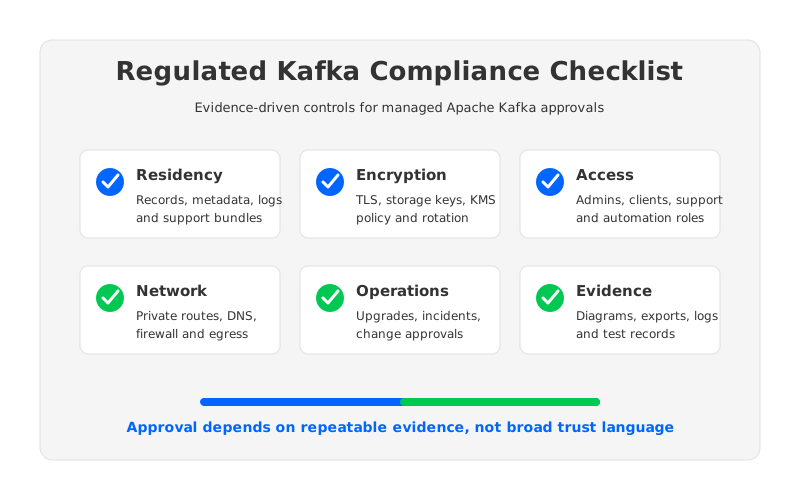
Managed Apache Kafka is attractive to regulated enterprises for the same reason it is hard to approve. Kafka carries important event streams, yet operating Kafka well requires deep platform expertise, continuous patching, careful capacity management, and practiced incident response. A managed service can reduce that operational burden, but financial services, insurance, healthcare, public sector, and energy teams cannot treat Kafka as a generic cloud database. They need to know where records live, who can access the environment, what evidence is available, and which control boundary will survive an audit.
The practical question is not whether a provider says "enterprise ready." The question is whether the deployment model gives architects, security teams, platform engineers, and procurement enough evidence to accept the risk. That evidence spans data residency, encryption, identity, network isolation, audit logs, support access, change control, and operational telemetry. It also spans the managed Kafka model itself: SaaS, bring your own cloud, private cloud, and customer-operated software do not create the same compliance boundary.
1Why Regulated Industries Evaluate Kafka Differently
Kafka often becomes the nervous system for regulated data movement. It may carry payment authorization events, claims status, patient workflow signals, market data, energy telemetry, identity events, fraud decisions, or public-sector case updates. Even when applications encrypt sensitive fields, Kafka topics, headers, keys, offsets, schemas, client identifiers, and consumer group names can reveal business processes. Retention and replay add another dimension because messages can remain available after the original transaction completes.
That is why regulated teams evaluate managed Kafka through control evidence rather than feature breadth. A normal platform review asks whether the service scales, supports the Kafka API, provides monitoring, and meets reliability goals. A regulated review asks those questions and then adds: can we prove where data is stored, can we show access history, can we restrict network paths, can we approve support actions, and can we collect audit material without relying on screenshots from a vendor portal?
The evaluation also crosses organizational boundaries. Architects care about topology and failure domains. Security and compliance teams care about access control, encryption, logging, and third-party risk. Platform teams care about upgrades, capacity, on-call workflow, and incident evidence. Procurement cares about contract terms, data processing obligations, service levels, and exit options. A managed Apache Kafka platform for regulated industries has to satisfy all four groups with one coherent operating model.
2Data Residency, Audit, and Access Control
Data residency is the first gate because it defines where the Kafka data plane is allowed to exist. The review should identify every artifact related to Kafka, not the message payload alone. Kafka records, keys, headers, offsets, schemas, broker logs, controller metadata, metrics, diagnostics, audit logs, backups, retained segments, and support bundles may have different sensitivity levels. A provider that can classify each artifact and show where it is stored will move faster through review than one that treats all metadata as harmless.
For regulated deployments, access control should be mapped to both human and machine identities. Kafka client identities need authentication and authorization. Operators need privileged access paths. Automation needs cloud permissions. Support teams may need time-bound diagnostic access. The strongest reviews ask for evidence, not assurances:
- Identity model for administrators, Kafka clients, automation, and vendor support.
- Authorization model for topics, consumer groups, cloud resources, object storage, and observability systems.
- Audit trail showing configuration changes, access attempts, secret changes, and infrastructure actions.
- Retention policy for logs, metrics, support artifacts, and audit events.
- Approval workflow for privileged access, break-glass actions, and emergency changes.
Encryption should be reviewed in two places. Kafka traffic should use TLS where policy requires encrypted client and inter-broker communication. Durable data should use the storage encryption controls of the deployment environment, such as cloud-provider key management for object storage or volumes. For teams using customer-managed keys, the KMS key policy, rotation policy, deletion protection, and access logs become part of the Kafka compliance package.
Auditability is broader than logs. A compliance reviewer may ask for architecture diagrams, data-flow maps, IAM policy exports, network rules, encryption settings, change tickets, vulnerability management evidence, support access records, backup tests, restore tests, and incident postmortems. A managed Kafka provider should make those artifacts repeatable. If evidence collection depends on a heroic manual scramble during every audit cycle, the service may be operationally managed but compliance-hostile.
3Network Isolation and Private Deployment Models
Kafka is a network-sensitive platform. Producers and consumers rely on bootstrap addresses, advertised listeners, DNS, TLS certificates, authentication mechanisms, firewall rules, and routing that remain stable during failures and upgrades. For regulated environments, the acceptable network path may be narrower than a typical SaaS service can offer.
Network isolation usually starts with private connectivity. Broker endpoints should be reachable from approved application networks and blocked from the public internet unless a deliberate exception exists. Management consoles, metrics endpoints, and support channels should be separated from Kafka client traffic. In cloud environments, private subnets, security groups, firewall policy, private endpoints, peering, transit gateways, and DNS zones all become part of the evidence set. In Kubernetes environments, ingress rules, NetworkPolicy, RBAC, service accounts, and secret handling need the same scrutiny.
The network review should also cover egress. A managed service may need package downloads, license checks, control-plane calls, telemetry export, alert delivery, or support connectivity. Those flows can be acceptable when they are documented, minimized, and logged. They become risky when they are broad, persistent, or hard to explain. Regulated buyers should ask for a data-flow diagram that distinguishes Kafka records from operational metadata and support traffic.
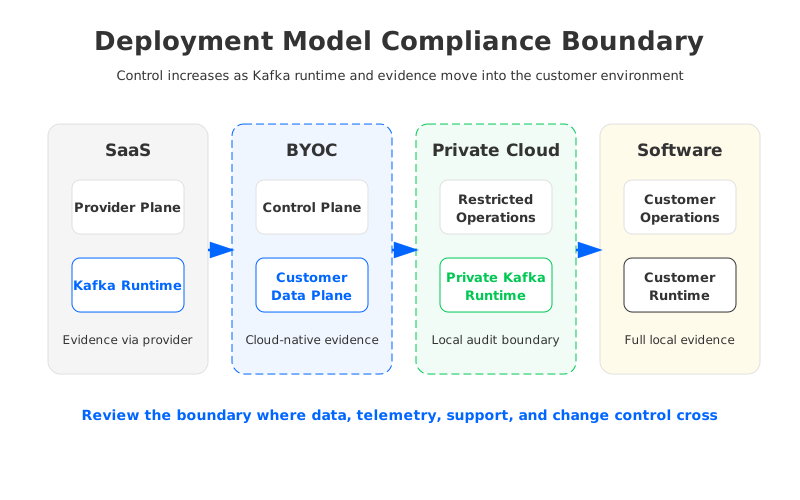
Private deployment models exist because this boundary matters. BYOC Kafka places the runtime in the customer's cloud account, VPC, VNet, or project. Private cloud Kafka extends the idea to restricted cloud, enterprise Kubernetes, dedicated environments, or private infrastructure. Software deployment gives the customer more operating responsibility but can satisfy environments where no provider-managed control plane is allowed. The right answer depends on risk tolerance, internal platform maturity, regulatory obligations, and which evidence the organization must produce.
4SaaS vs BYOC vs Private Cloud for Compliance
SaaS managed Kafka can be a strong fit when the provider's region, controls, certifications, private connectivity options, and contract terms match the workload. The provider owns more infrastructure and often delivers faster provisioning, mature operations, and centralized support. The compliance tradeoff is that the customer has less direct visibility into the data plane and must rely more heavily on provider attestations, audit reports, and service configuration evidence.
BYOC Kafka changes that boundary. The runtime is deployed into the customer's cloud account while the provider supplies automation, lifecycle management, and support. This can help regulated teams align Kafka with existing cloud governance: IAM, network policy, encryption keys, audit logs, tagging, budget controls, and incident workflows. BYOC does not remove vendor risk. It makes the management path explicit and gives the customer more direct evidence from its own cloud control plane.
Private cloud Kafka is useful when the approved environment is narrower than a normal public-cloud BYOC account. A bank may require a restricted landing zone. A public-sector team may need a sovereign or dedicated environment. An energy company may need Kafka near industrial systems with strict egress policy. In these cases, the provider has to prove that managed operations can work without broad standing access or uncontrolled telemetry export.
Customer-operated software sits at the far end of the control spectrum. It can satisfy environments where provider access is restricted or impossible, but it shifts more lifecycle responsibility to the enterprise. Platform teams must own installation, upgrades, monitoring, failure drills, security hardening, and capacity planning. The compliance benefit is control; the operational cost is the burden of proving that control works day after day.
| Model | Compliance strength | Main review risk |
|---|---|---|
| SaaS managed Kafka | Provider-operated controls and mature service processes | Less direct customer visibility into runtime infrastructure |
| BYOC Kafka | Customer cloud account, IAM, network, and audit integration | Control-plane access, telemetry, and delegated permissions |
| Private cloud Kafka | Strong placement and network control for restricted environments | Support model and lifecycle automation across a tighter boundary |
| Software | Maximum customer control over deployment and evidence | Higher operational responsibility and internal skill requirements |
5How AutoMQ Fits Regulated Kafka Requirements
AutoMQ is relevant in this evaluation because it offers Kafka-compatible deployment models where the data plane can remain in the customer's environment. AutoMQ Cloud BYOC documentation describes software services deployed in the user's cloud account, with data remaining in the user's VPC. For regulated teams, that architecture creates a concrete boundary to inspect: customer account, customer network, customer storage policy, customer audit logs, and delegated management permissions.
AutoMQ Software is another fit for teams that need a private or customer-operated deployment. The architectural distinction is storage. AutoMQ uses S3-compatible object storage as the durable storage foundation and keeps Kafka compatibility for clients and ecosystem tools. That means regulated teams can bring object storage governance into the Kafka review: bucket or container policy, key management, access logs, lifecycle settings, retention controls, and storage-level audit evidence.
This should not be read as a blanket compliance claim. A regulated deployment still depends on configuration, contractual terms, cloud controls, support process, internal policy, and the customer's evidence package. The useful point is more specific: AutoMQ can be evaluated as a BYOC or Software option when Kafka records must stay in a customer-controlled data plane and when object storage governance is an important part of the compliance design.
Security teams should still ask the same hard questions. What management metadata leaves the environment? Which roles can the console or automation assume? How are upgrades approved? Which metrics and logs are collected? Can support access be time-bound and customer-approved? How are keys, object storage permissions, and network paths configured? A good BYOC or private-cloud architecture gives these questions better surfaces to inspect; it does not make them disappear.
6Compliance Evidence Checklist
The strongest managed Kafka approval packages are built before production. They create a reusable evidence set that can support internal risk review, external audit, vendor assessment, and incident response. Treat the following checklist as a working map for managed Kafka compliance.
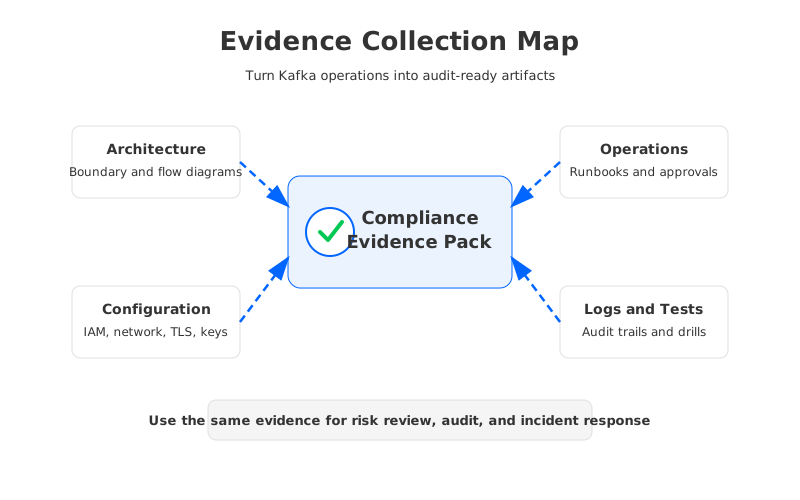
Start with the deployment boundary. Draw where producers, consumers, brokers, controllers, storage, schemas, connectors, observability agents, management consoles, vendor systems, and support users sit. Label the trust boundary, cloud account, network zones, storage systems, and outbound flows. This diagram should be precise enough that a reviewer can tell whether Kafka records and operational metadata follow different paths.
Then collect configuration evidence. Export IAM roles, service accounts, RBAC policies, security groups, firewall rules, route tables, private endpoint configuration, TLS settings, Kafka ACLs, object storage policies, KMS key policies, and logging configuration. Where possible, store the evidence in the customer's system of record rather than in a personal folder or vendor ticket.
Operational evidence is equally important. Reviewers will ask whether the service is governed after launch, not only during procurement. Keep runbooks for upgrades, incident response, backup and restore, capacity changes, credential rotation, emergency support, and decommissioning. Capture test results for failure drills, restore drills, access revocation, and audit-log retrieval. If the provider performs an action, the customer should be able to show who approved it, what changed, and where the logs live.
Finally, separate compliance certifications from architectural control. A provider may have security attestations, and those can be valuable during vendor review. But a certification does not answer every workload question. The deployment-specific evidence still needs to show residency, encryption, access control, network isolation, support access, and operational change history for the actual Kafka environment.
7References
- Apache Kafka Documentation: Security
- Apache Kafka Documentation: Monitoring
- AutoMQ Documentation: What Is AutoMQ Cloud
- AutoMQ Documentation: Install AutoMQ on AWS
- AutoMQ Documentation: Architecture Overview
- AWS IAM Documentation: Security Best Practices in IAM
- Amazon S3 Documentation: Using Server-Side Encryption
- AWS PrivateLink Documentation: What Is AWS PrivateLink?
- NIST SP 800-53 Rev. 5: Security and Privacy Controls
8FAQ
8.1What is managed Apache Kafka for regulated industries?
It is a Kafka service or Kafka-compatible platform evaluated for workloads that have strict requirements around residency, encryption, auditability, access control, network isolation, support access, and evidence collection. The important distinction is not the marketing label. It is whether the deployment model can satisfy the organization's control and audit requirements.
8.2Is BYOC Kafka automatically compliant?
No. BYOC Kafka can help because the runtime, network, storage, and audit logs can sit inside the customer's cloud environment, but compliance depends on configuration, provider controls, contracts, operational process, and evidence. BYOC should be treated as a reviewable boundary, not a certification.
8.3When is private cloud Kafka better than SaaS managed Kafka?
Private cloud Kafka is usually better when production records, metadata, or operational access paths must remain inside a customer-controlled or restricted environment. SaaS can still fit regulated workloads when the provider's controls, regions, private connectivity, and audit artifacts satisfy the risk review.
8.4What evidence should a managed Kafka provider supply?
Ask for deployment architecture, data-flow classification, IAM and network diagrams, encryption configuration, audit logging details, support access workflow, upgrade runbooks, incident process, telemetry export details, and any relevant third-party security reports. The evidence should be specific to the deployment model.
8.5Where does AutoMQ fit in regulated Kafka evaluations?
AutoMQ fits when teams need Kafka compatibility with BYOC or Software deployment options where Kafka records remain in a customer-controlled data plane. It should still be reviewed against the same compliance checklist: IAM, network isolation, encryption, telemetry, support access, operational process, and evidence collection.


