
Table of Contents
Table of Contents
Change data capture rarely stays a small integration project. A team starts by streaming row changes from PostgreSQL, MySQL, SQL Server, or MongoDB into Kafka. A few consumers use the events for search indexing, cache invalidation, warehouse ingestion, fraud detection, or product analytics. Then the pipeline becomes part of the business clock. If CDC is late, downstream systems are stale. If CDC is duplicated, consumers may replay side effects. If CDC stops, every team asks whether the database, Debezium, Kafka Connect, Kafka, or the sink system is responsible.
That is when the Debezium alternative discussion becomes more serious. The question is not whether Debezium works. Debezium is a widely used open source CDC framework with deep connector behavior, snapshot modes, schema history, offsets, and streaming support. The question is whether the team wants to keep operating the full stack around it: database log retention, connector workers, Kafka topics, schemas, retries, backpressure, broker storage, retention cost, and recovery runbooks.
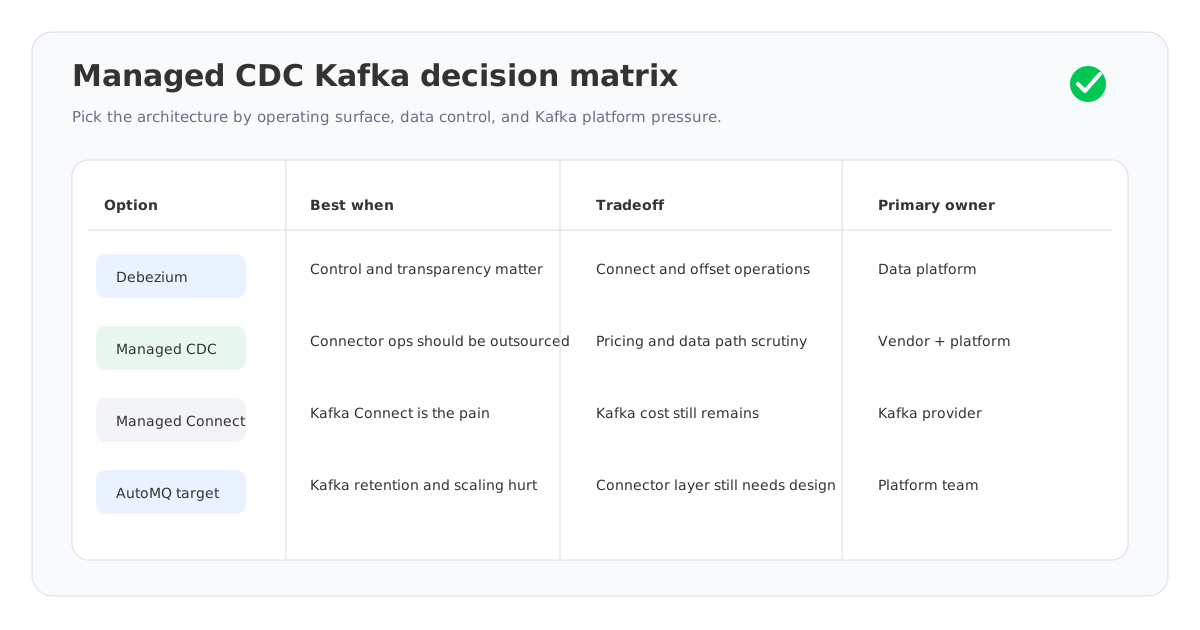
Managed CDC Kafka decisions should therefore compare architecture choices, not only connector catalogs. A managed CDC service may reduce connector operations but introduce a new pricing and data-control model. Self-managed Debezium may preserve control but require strong operational maturity. Managed Kafka Connect may help with workers but still leave Kafka platform cost and retention design untouched. A Kafka-compatible platform such as AutoMQ can be relevant when the team wants to keep Kafka CDC patterns while changing the broker storage and scaling model underneath.
1Why Teams Look Beyond Self-Managed Debezium
Self-managed Debezium is attractive because it is explicit. Teams can choose connector versions, inspect configuration, control Kafka Connect workers, tune snapshot behavior, route topics, and keep data inside their own network boundary. For data engineering teams with strong Kafka Connect operations, that control can be worth the effort.
The pressure appears when CDC volume and organizational dependency grow. A database migration can trigger snapshots. A schema change can expose weak schema-history handling. A slow sink can increase consumer lag. A failed connector can require careful offset decisions. A broker storage limit can turn a CDC backlog into a Kafka capacity problem. None of these are unusual edge cases; they are normal production concerns once CDC becomes a platform service.
Common reasons teams search for managed CDC Kafka alternatives include:
- Operational ownership: Connect workers, plugin versions, task failures, secrets, and offsets become a separate production system.
- Database-side risk: log retention, permissions, snapshot locks, replication slots, and failover behavior need database team coordination.
- Kafka cost: CDC topics often need replayable retention, high write volume, and enough partitions for downstream fanout.
- Recovery complexity: restarting a connector after snapshot or schema-history issues requires confidence in offsets and duplicate handling.
- Pricing visibility: managed CDC or managed Connect pricing may be hard to forecast when connector count, task parallelism, or change volume grows.
The core decision is not open source versus managed. It is which operating surfaces the platform team wants to own and which ones should move to a service provider or target platform.
2The CDC Architecture Options
There are five common paths. Each solves a different part of the stack, so comparing them as direct substitutes can be misleading.
| Option | What It Reduces | What Still Needs Design |
|---|---|---|
| Self-managed Debezium on Kafka Connect | Vendor dependency and opaque pricing | Worker operations, offsets, snapshots, schema history, Kafka capacity |
| Managed Debezium or managed Connect | Worker lifecycle and connector maintenance | Data control, service limits, pricing, Kafka platform cost |
| Managed CDC SaaS | Connector operations and source/sink integration | Lock-in, network paths, replay model, target Kafka semantics |
| Custom CDC pipelines | Precise transformation and validation logic | Long-term code ownership and correctness testing |
| Kafka-compatible platform modernization | Broker storage, scaling, and retention economics | Connector choice, source database behavior, migration validation |
Self-managed Debezium remains a strong choice when teams need maximum control and already run Kafka Connect well. The main requirement is discipline: connector configuration must be versioned, offsets must be observable, internal topics must be protected, and recovery paths must be rehearsed.
Managed Debezium and managed Kafka Connect reduce the workload around workers, plugins, and connector lifecycle. They are useful when the team wants Kafka CDC but does not want to operate every worker. The tradeoff is service scope. Some services support specific connectors, clouds, networks, authentication patterns, or throughput ranges. Pricing can also move from infrastructure cost to connector, task, capacity, or data-volume units.
Managed CDC SaaS can be attractive when the business wants sources and sinks connected quickly. It may provide a polished operational interface, broad connector coverage, and support. The tradeoff is control: data path, private connectivity, schema handling, replay semantics, and pricing model all become part of the vendor decision.
Kafka-compatible platform modernization is different. It does not replace Debezium by itself. It changes the Kafka side of the CDC architecture. If the team's pain is retained CDC data, broker scaling, multi-consumer replay, or Kafka operational cost, then changing the Kafka platform may matter as much as changing the connector tool.
3How To Compare CDC Pricing, Reliability, And Data Control
Managed CDC pricing is difficult because the visible unit is rarely the whole cost. A service may charge by connector, task, compute unit, throughput, event volume, source table count, destination, network transfer, support tier, or retained history. Self-managed Debezium has no license fee in the same sense, but it consumes engineers, Kafka Connect infrastructure, Kafka broker resources, storage, monitoring, and incident response time.
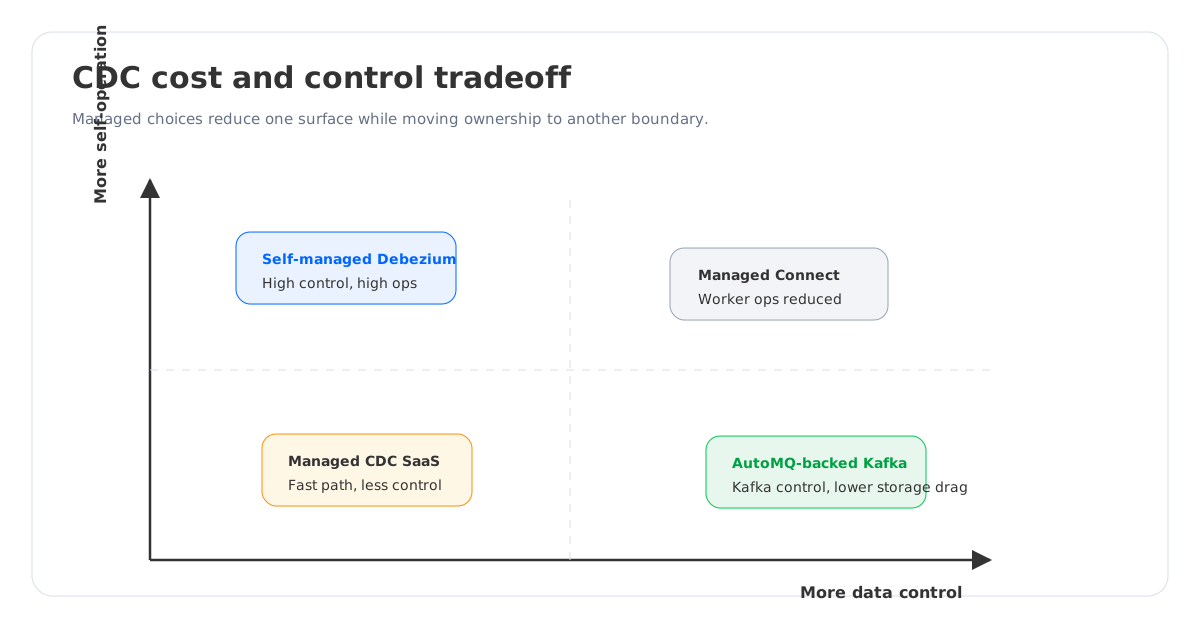
A practical CDC cost review should include:
- source database log retention and snapshot impact;
- connector workers, tasks, and scaling policy;
- Kafka topic partitions, replication, and retention;
- schema registry or schema-history storage;
- cross-region or cross-cloud network paths;
- sink retries, dead-letter queues, and replay windows;
- engineering hours for upgrades, failures, and audits.
Reliability should be measured through recovery questions rather than uptime slogans. Can the connector resume after a database failover? Can the team distinguish source lag from Kafka lag and sink lag? Are offsets checkpointed in a way that operators understand? Can schema-history corruption or topic deletion be recovered without guessing? How are duplicates handled after restart?
Data control is the third axis. Some teams can send CDC streams through SaaS services without concern. Others have strict BYOC, compliance, tenancy, or sovereignty requirements. For those teams, the "managed" part must be compatible with where data moves, who can access it, which keys protect it, and how audit evidence is collected.
4Why Kafka Platform Architecture Matters For CDC
CDC workloads stress Kafka in a particular way. They produce steady write traffic, burst during snapshots, require replayable retention, and often feed multiple consumer groups. A warehouse loader, search indexer, feature store, audit service, and cache invalidation pipeline may all read the same change topics with different latency budgets.
Traditional Kafka clusters store durable log data on broker-local disks. That works, but it couples CDC retention to broker capacity. If change volume grows, the platform may need larger brokers or more brokers because disk capacity, replication, and failure headroom must grow together. When rebalancing or broker replacement is required, long-retained CDC topics increase the amount of data tied to broker lifecycle.
This is why a Debezium alternative discussion can become a Kafka platform discussion. If the connector is unstable, fix the connector layer. If the pain comes from storage growth, replay cost, partition movement, or capacity planning, the Kafka architecture is part of the root cause.
For architects, the key questions are:
| CDC Symptom | Likely Layer To Investigate |
|---|---|
| Connector restarts or task failures | Debezium, Kafka Connect, secrets, source database |
| Snapshot creates downstream backlog | Source database, connector parallelism, Kafka partitions, sink capacity |
| Retention cost grows faster than traffic | Kafka storage model and replication policy |
| Consumer replay is slow or expensive | Kafka read path, cache behavior, broker pressure |
| Broker replacement disrupts CDC stability | Broker-local storage and partition movement |
This separation keeps the decision honest. A managed connector cannot remove all Kafka storage economics. A new Kafka platform cannot remove source database permissions or Debezium snapshot semantics. The best architecture addresses the layer where the pain originates.
5Where AutoMQ Fits For Kafka-Compatible CDC Workloads
AutoMQ fits this discussion as a Kafka-compatible streaming platform that uses object-storage-backed shared storage and stateless brokers. For CDC teams, the relevant point is not "replace Debezium." It is "keep Kafka-compatible CDC ingestion and replay while changing the Kafka storage and scaling model."
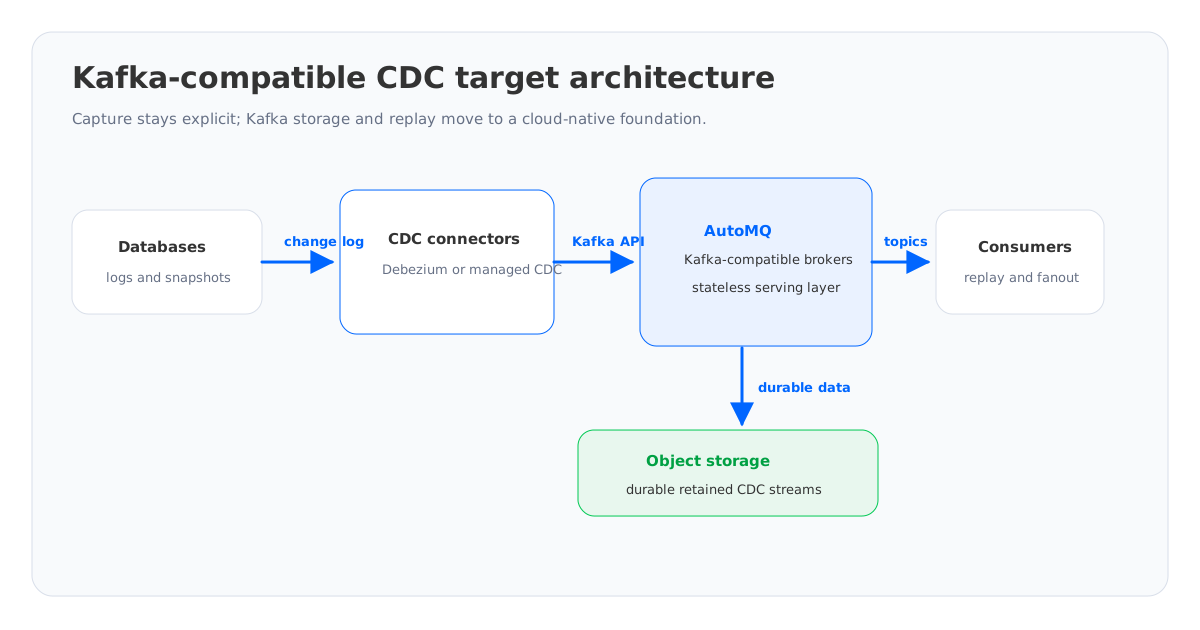
That can matter in three situations. First, CDC topics often need longer retention than ordinary operational streams because teams want replay, audit, and backfill options. Object storage can change the retention cost profile compared with sizing broker-local disks around retained bytes. Second, CDC workloads can be bursty during snapshots or database recovery. Stateless broker capacity can make scaling decisions less tied to long-lived local partition data. Third, platform teams may want BYOC-style data control while avoiding the operational burden of self-managing every Kafka failure mode.
AutoMQ should be introduced after the CDC architecture is understood, not as a shortcut around validation. Teams still need to test connector behavior, source database failover, schema handling, consumer offsets, topic configuration, security, and rollback. Kafka compatibility reduces application rewrite pressure, but CDC correctness is still a workload-level property.
The natural fit is a modernization project where Kafka remains the event backbone and the team wants to improve the economics and operability of the Kafka layer. Debezium, managed Connect, or a CDC service may still be used as the capture layer; AutoMQ can be evaluated as the Kafka-compatible target that stores and serves the resulting streams.
6A Decision Framework For Managed CDC Kafka
The cleanest decision process is to rank the pain before ranking products. If the team is struggling with connector uptime, compare Debezium operations, managed Connect, and managed CDC services. If the team is struggling with Kafka storage cost and replay pressure, compare Kafka platform architectures. If the team is struggling with data sovereignty, compare BYOC and private-network options before connector features.
Use this shortlist:
- Keep self-managed Debezium when control, transparency, and internal Kafka Connect expertise are strong.
- Use managed Connect or managed Debezium when worker lifecycle and connector maintenance are the main pain.
- Use managed CDC SaaS when speed, connector breadth, and outsourced operations matter more than deep control.
- Modernize the Kafka platform when CDC growth exposes retention, scaling, recovery, or cost problems in Kafka itself.
The best answer may combine options. A team might run Debezium into AutoMQ, use managed Connect with a Kafka-compatible target, or use a managed CDC service for specific sources while keeping core Kafka streams in a BYOC environment. What matters is making the boundary explicit: who owns capture, who owns transport, who owns retention, who owns replay, and who owns recovery.
7References
- Debezium Documentation
- Apache Kafka Connect Documentation
- Apache Kafka Documentation
- AutoMQ Documentation
8FAQ
8.1What is the best Debezium alternative for Kafka CDC?
There is no universal best option. Self-managed Debezium is strong for teams that need control and operate Kafka Connect well. Managed Connect or managed Debezium helps when worker lifecycle is the pain. Managed CDC SaaS helps when connector breadth and outsourced operations matter. Kafka-compatible platform modernization helps when the Kafka side of CDC is the bottleneck.
8.2Is managed CDC cheaper than self-managed Debezium?
Sometimes, but not automatically. Managed CDC can reduce engineering time and incident burden, while self-managed Debezium may have lower direct service fees. Compare connector count, tasks, throughput, network transfer, Kafka retention, support, and operational staffing before deciding.
8.3Does replacing Debezium remove Kafka storage cost?
No. Connector choice and Kafka storage architecture are separate layers. A managed CDC service can reduce capture operations, but CDC events still need to land somewhere. If Kafka retention, replay, and broker-local disk growth are the expensive parts, the Kafka platform architecture needs its own review.
8.4Can AutoMQ replace Debezium?
AutoMQ is not a Debezium replacement. It is a Kafka-compatible streaming platform. Debezium or another CDC tool can produce change events into Kafka-compatible topics, while AutoMQ can be evaluated as the target platform for storage, replay, scaling, and operations.
8.5What should a production CDC migration test?
Test connector startup, snapshots, schema changes, offsets, duplicate handling, source database failover, topic configuration, consumer replay, sink backpressure, security, and rollback. For Kafka-compatible targets, also validate client compatibility and monitoring behavior before cutover.


