
Table of Contents
Table of Contents
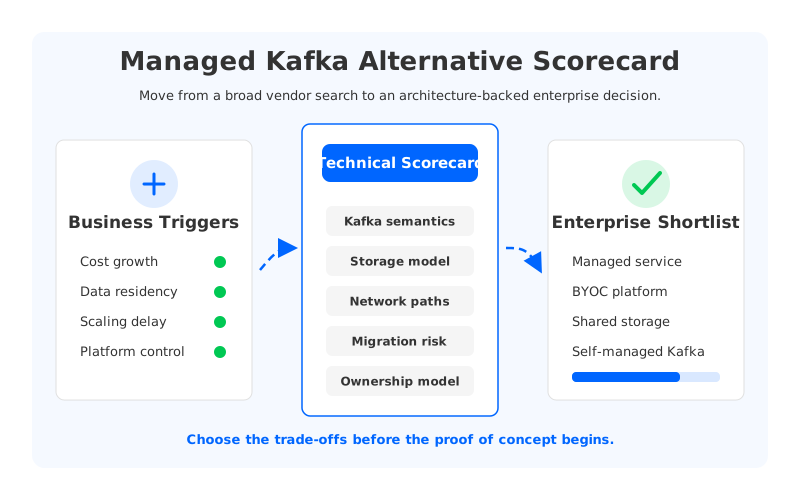
Searching for confluent alternatives rarely means a team has lost confidence in Kafka. It usually means Kafka has become important enough that the platform decision now belongs to architecture, SRE, security, procurement, and FinOps at the same time. A developer may start with a simple question about a lower-cost or more open option, but the enterprise buyer has to answer a harder one: which streaming platform can preserve Kafka semantics while reducing operational and commercial risk?
That question is uncomfortable because the alternatives do not sit on one clean axis. A fully managed Kafka service may reduce broker operations but keep the same storage and network shape. A Kafka-compatible engine may change the storage layer and require deeper compatibility checks. A self-managed Apache Kafka deployment may offer control but move more burden back to the platform team. The useful comparison is not a vendor ranking. It is a scorecard that exposes which risks you are choosing.
1Why Enterprise Teams Search for Confluent Alternatives
Confluent is a respected platform in the Kafka ecosystem, and many organizations use it successfully for managed Kafka, stream governance, connectors, and operational tooling. Looking for alternatives is not a verdict against that model. It is often a sign that the workload has crossed a boundary where a single managed-service evaluation no longer answers all the questions a buyer now has to defend.
The trigger is usually one of four patterns. Data volume grows faster than the original business case. Retention and fan-out expand, turning storage and network behavior into board-level cost lines. Security teams want clearer control over where data planes run, who can reach them, and which accounts hold the data. Platform teams need portability because their Kafka estate spans cloud accounts, regions, or deployment models.
Those triggers point to different alternatives:
- If the main problem is operating brokers, a managed Apache Kafka service may be enough.
- If the main problem is cloud cost shape, the storage and network architecture matter more than the control plane.
- If the main problem is data residency or procurement control, deployment model and account boundary become first-order requirements.
- If the main problem is ecosystem compatibility, client behavior, Kafka APIs, transactions, ACLs, Connect, Streams, and operational tooling deserve direct testing.
The mistake is treating these scenarios as one procurement event. A team that only needs managed operations will weigh the scorecard differently from a team trying to redesign its streaming cost base. A team moving regulated data will care less about a feature checklist and more about the data plane boundary. The rest of the scorecard exists to keep those conversations separate.
2The Evaluation Surface Is Larger Than the Service Name
A Kafka buyer can make a poor decision even after choosing a technically strong product. That happens when the evaluation stays at the product category level: managed Kafka, Kafka-compatible, serverless Kafka, open source Kafka, or self-managed Kafka. Categories help shortlist vendors, but they hide the mechanisms that decide production outcomes.
The deeper surface has six layers:
| Scorecard layer | What to test | Why it matters |
|---|---|---|
| Kafka semantics | Client protocol, offsets, consumer groups, transactions, ACLs, quotas, KRaft behavior | Application teams expect existing Kafka behavior, not a similar-looking API. |
| Storage architecture | Local disks, cloud block storage, tiered storage, or shared object storage | Storage design drives scaling, recovery, retention, and cost structure. |
| Network boundary | Cross-AZ, cross-VPC, PrivateLink, egress, and replication traffic | Streaming systems move data continuously, so small network assumptions compound. |
| Operations model | Upgrades, rebalancing, partition movement, observability, incident response | The managed surface does not remove every operational responsibility. |
| Governance and security | Account boundary, encryption, identity, audit, connector isolation | Streaming platforms often become shared infrastructure for sensitive data. |
| Commercial control | Pricing dimensions, commit structure, overage exposure, exit path | Procurement needs explainable unit economics, not only a monthly estimate. |
The table is architecture-heavy because Kafka is not a stateless application behind an API. It is a distributed log with long-lived data, consumer position, partition leadership, and client behavior accumulated over years. A platform can look attractive in a demo and still create hard problems if it changes one of those assumptions without making the trade-off explicit.
3Architecture Criteria Behind the Shortlist
The first architectural question is compatibility, but compatibility should not be reduced to a yes/no label. Kafka clients expose edge cases through retries, idempotent producers, transactions, offset commits, fetch behavior, ACLs, quota enforcement, and coordinator paths. A platform that speaks the Kafka protocol is not automatically equivalent to Apache Kafka under production traffic. Enterprise buyers should test the behaviors their applications already depend on, especially older client versions and operational tooling that may not be part of a marketing demo.
The second question is where durable data lives. Traditional Kafka ties partitions to broker-local storage, then uses replication to keep data available across failure domains. That model is well understood and battle-tested, but it also makes scaling and recovery data-movement problems. Tiered storage changes the retention story by moving colder data to object storage, yet the hot write path and partition ownership model can still keep important operational coupling in the broker layer.
A different architecture puts object storage closer to the center of the design. In a shared-storage model, brokers handle Kafka protocol, leadership, caching, and request processing while durable data is placed in cloud object storage through a streaming storage layer. That does not make latency concerns disappear; it shifts the engineering problem toward write-ahead logging, cache design, object layout, metadata management, and failure recovery. The buyer's question becomes whether the implementation preserves Kafka semantics while making brokers easier to replace, scale, and rebalance.
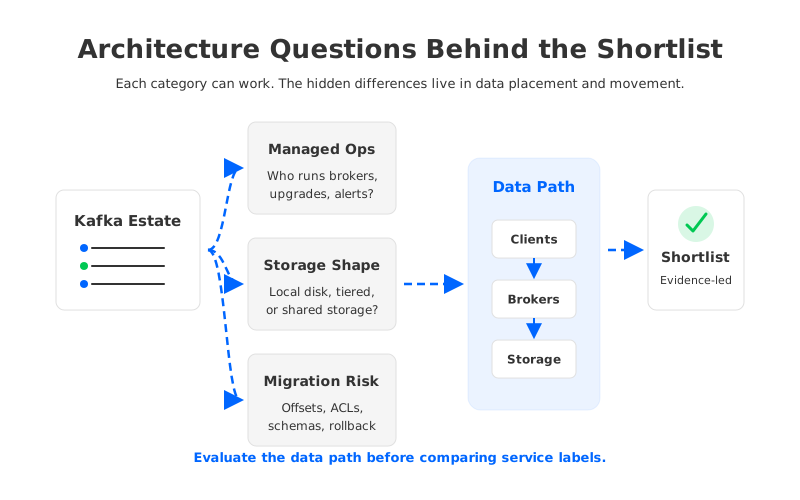
The third question is network cost. AWS states that Amazon MSK customers pay standard AWS data transfer charges for traffic in and out of clusters, while in-cluster broker replication is treated separately on the MSK pricing page. That distinction is useful, but it does not remove the need to model client placement, PrivateLink, cross-VPC traffic, cross-region replication, connectors, and consumer fan-out. A streaming platform that looks inexpensive at the broker line item can still create material cost through the data paths around the cluster.
These architecture questions produce a more useful shortlist than brand comparisons. If your core concern is managed operations, the shortlist should emphasize operational responsibility and support model. If your core concern is data gravity, it should emphasize storage architecture and movement. If your core concern is procurement flexibility, it should emphasize deployment boundary, contract shape, and exit plan.
4Cost Evaluation Should Follow the Data Path
Kafka cost analysis often starts with broker hours because broker hours are easy to count. That is a convenient spreadsheet habit, not a reliable mental model. Streaming cost follows data movement: writes, replication, retention, reads, catch-up reads, cross-zone paths, private connectivity, connector traffic, monitoring export, and backup or migration pipelines.
Use a unit-cost worksheet before asking vendors for quotes:
- Ingress path: producer traffic, compression ratio, acknowledgement settings, and the failure domains crossed before an acknowledgement returns.
- Durability path: replication, write-ahead log, object storage, tiered storage, or any background upload that creates additional write amplification.
- Read path: steady-state consumer fan-out, reprocessing events, catch-up reads after outages, and analytics jobs that read historical topics.
- Network path: client-to-cluster placement, cross-AZ or cross-VPC hops, PrivateLink processing, inter-region replication, and egress to downstream systems.
- Operational path: rebalancing, partition movement, upgrades, mirror traffic, metrics export, and incident recovery.
The important step is not assigning a universal number to each item. Different clouds, regions, service tiers, and network topologies change the answer. The point is to force every alternative to explain its cost mechanics in the same language. Once the data path is visible, a buyer can separate a lower list price from a genuinely lower operating model.
5Migration and Ownership Questions for Platform Teams
The migration scorecard should begin with reversibility. A streaming platform is sticky because it holds data, consumer offsets, topic configuration, ACLs, schemas, connector flows, and operational habits. A credible plan defines how traffic moves in, pauses, rolls back, verifies offsets, and proves that consumers have not silently changed behavior.
That plan is easier to review when it is broken into ownership questions:
| Migration area | Buyer question | Evidence to ask for |
|---|---|---|
| Client compatibility | Which client versions and APIs are covered by production tests? | Test matrix, known limitations, and upgrade guidance. |
| Offset and topic state | How are offsets, configs, ACLs, and schemas migrated or mirrored? | Runbook with rollback and verification steps. |
| Data plane boundary | Does data stay in the buyer's cloud account or vendor account? | Architecture diagram, IAM model, and security review package. |
| Cutover model | Is cutover blue-green, mirror-based, topic-by-topic, or application-by-application? | Timeline, validation checkpoints, and failure plan. |
| Operations handoff | Who handles upgrades, incidents, capacity, and cost anomalies after go-live? | RACI, SLOs, alert ownership, and escalation paths. |
The ownership section matters because "managed Kafka" can hide different responsibility models. Some services manage infrastructure but still require the customer to understand partitions, quotas, storage sizing, connector capacity, and client placement. Some BYOC models keep control and data planes in the customer's cloud account, changing the security review without eliminating the need for operational clarity.
6How AutoMQ Fits the Evaluation
Once the scorecard is framed around architecture and ownership, AutoMQ fits as one specific category: a Kafka-compatible cloud-native streaming system that keeps the Kafka protocol and compute semantics while replacing the traditional broker-local storage model with shared object storage through S3Stream. That positioning is useful for teams whose alternative search is not only about managed operations, but also about storage coupling, scaling speed, and cloud cost shape.
AutoMQ's architecture separates broker compute from durable storage. Brokers remain responsible for Kafka-facing behavior, while S3Stream uses WAL storage for durable low-latency writes and object storage as the primary storage layer. In this model, a broker failure or scaling event does not require treating each partition's full history as broker-local state. The recovery and reassignment problem becomes more about metadata, ownership, cache warming, and the WAL window than about copying large local logs between brokers.
That design has practical implications for the scorecard:
- Compatibility: AutoMQ is designed around Kafka protocol and semantic compatibility rather than a separate streaming API, so existing Kafka clients and ecosystem tools are the starting point for evaluation.
- Storage and scaling: Shared storage reduces the amount of data movement tied to broker replacement, partition reassignment, and capacity changes.
- Cost structure: Object-storage-backed durability and independent compute/storage scaling let buyers model retention and compute separately instead of sizing brokers around peak storage and traffic at the same time.
- Deployment boundary: AutoMQ BYOC and AutoMQ Software are relevant when a buyer wants the data plane in its own cloud account or private environment.
- Network design: AutoMQ's documentation describes patterns for eliminating inter-zone traffic in supported deployments, which matters when cross-zone movement is a large part of the streaming bill.
AutoMQ is not the answer to every confluent alternatives search. A team buying a broad managed ecosystem may weigh integrated governance, connectors, marketplace integrations, and vendor-operated service scope more heavily. A small Kafka footprint may favor the operational simplicity of a familiar managed service. AutoMQ becomes more interesting when the bottleneck is Kafka's physical shape in the cloud: local-disk coupling, slow scaling movement, retention cost, and the need to keep Kafka compatibility while changing storage architecture.
7A Practical Buyer Scorecard
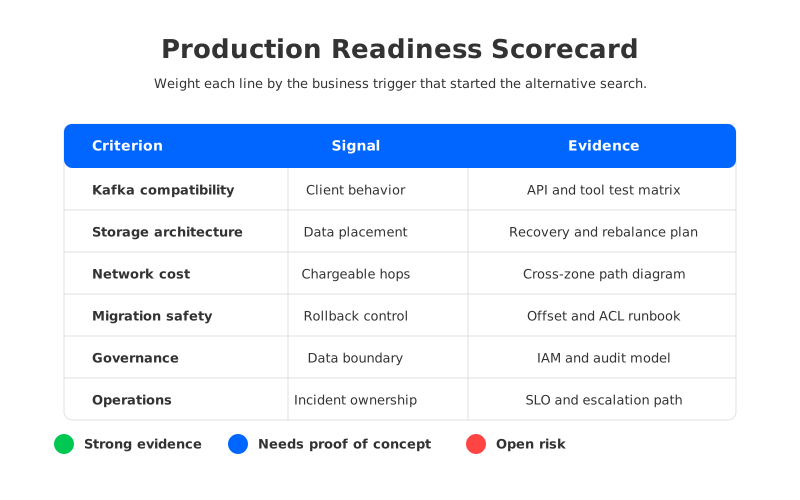
The final evaluation should fit on one page. Give every candidate a score from 1 to 5, but do not average the result blindly. Weight each line according to the business trigger that started the search.
| Criterion | Weight when it matters most | What a strong answer looks like |
|---|---|---|
| Kafka compatibility | Always high | Specific API, client, transaction, ACL, and tool compatibility evidence. |
| Storage architecture | High for large retention or fast scaling | Clear separation of hot path, durable storage, recovery, and rebalance mechanics. |
| Network cost visibility | High for multi-AZ, multi-VPC, or fan-out workloads | Data-path diagram with chargeable hops and mitigation options. |
| Migration safety | High for existing Kafka estates | Topic, offset, ACL, schema, connector, rollback, and verification plan. |
| Operational ownership | High for regulated or lean teams | Explicit division of responsibility across vendor, platform, app, and security teams. |
| Commercial flexibility | High for procurement-driven searches | Transparent pricing dimensions, commit strategy, growth path, and exit plan. |
The scorecard will not make the decision automatic, and that is the point. It prevents the wrong kind of simplicity. Enterprise Kafka decisions fail when a team chooses a product label and discovers the hidden architecture later. They succeed when the buyer knows which trade-offs are acceptable before a proof of concept begins.
If your team is evaluating Kafka-compatible alternatives because storage coupling, rebalancing time, or cloud data movement has become the limiting factor, review the AutoMQ architecture and deployment model in the docs: Explore AutoMQ for Kafka-compatible cloud-native streaming.
8References
- Apache Kafka Documentation: https://kafka.apache.org/documentation/
- Apache Kafka KRaft Operations: https://kafka.apache.org/41/operations/kraft/
- Amazon MSK Pricing: https://aws.amazon.com/msk/pricing/
- AWS PrivateLink Pricing: https://aws.amazon.com/privatelink/pricing/
- AWS EC2 Data Transfer Pricing: https://aws.amazon.com/ec2/pricing/on-demand/
- AWS Architecture Blog, Data Transfer Costs for Common Architectures: https://aws.amazon.com/blogs/architecture/overview-of-data-transfer-costs-for-common-architectures/
- AutoMQ Architecture Overview: https://docs.automq.com/automq/architecture/overview?utm_source=blog&utm_medium=reference&utm_campaign=gs100-0025
- AutoMQ S3Stream Shared Streaming Storage: https://docs.automq.com/automq/architecture/s3stream-shared-streaming-storage/overview?utm_source=blog&utm_medium=reference&utm_campaign=gs100-0025
- AutoMQ WAL Storage: https://docs.automq.com/automq/architecture/s3stream-shared-streaming-storage/wal-storage?utm_source=blog&utm_medium=reference&utm_campaign=gs100-0025
- AutoMQ Zero Inter-Zone Traffic: https://docs.automq.com/automq-cloud/eliminate-inter-zone-traffics/overview?utm_source=blog&utm_medium=reference&utm_campaign=gs100-0025
9FAQ
9.1What is the most important criterion when comparing Confluent alternatives?
Start with the business trigger. If the trigger is operational burden, managed-service scope matters most. If the trigger is cost growth, storage and network architecture usually matter more. If the trigger is governance, data-plane boundary and access control should be weighted heavily.
9.2Are Kafka-compatible platforms the same as Apache Kafka?
No. Kafka compatibility needs evidence at the protocol, client, semantic, and operational levels. Test the client versions, producer settings, transactions, ACLs, consumer groups, Connect flows, and observability tools your applications already use.
9.3Does managed Kafka remove the need for Kafka expertise?
It reduces some infrastructure work, but it does not remove Kafka design responsibility. Teams still need to understand partitions, client placement, quotas, retention, consumer lag, schema governance, and the data paths that create cost.
9.4When should AutoMQ be on the shortlist?
AutoMQ is worth evaluating when a team wants Kafka compatibility but is constrained by broker-local storage, slow partition movement, retention cost, or cloud network architecture. Its shared-storage design is most relevant when the goal is to change the operating model, not only outsource broker management.


