
Table of Contents
Table of Contents
Teams rarely search for Aiven Kafka because they need a definition of Kafka. They usually know Kafka already. The search happens when a platform team is deciding how much Kafka responsibility to keep, how much a vendor should absorb, and which parts must stay under internal control.
A managed Kafka page answers the first layer of that question: can someone else run Apache Kafka as a service across the clouds and regions we care about? That is useful, but it is not the whole decision. At production scale, the harder questions live below the service label. Who owns the data plane? What happens to storage growth? How are cross-zone and remote-read costs modeled? Which failure modes remain visible after the service becomes managed?
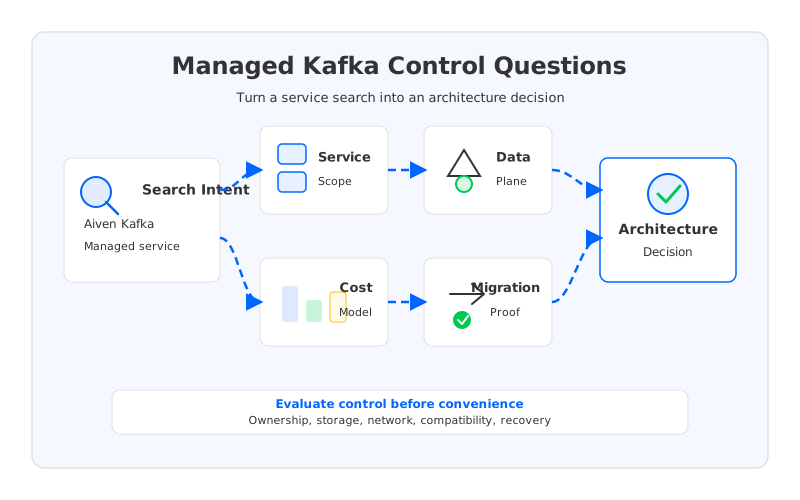
The right evaluation does not start by ranking vendors. It starts by separating control questions from convenience questions. A platform can be easy to provision and still leave unresolved architecture risks. Another can ask for more design work but give stronger control over cost, placement, and recovery. The decision depends on what the Kafka estate is expected to become.
1Why Teams Search for Aiven Kafka
Aiven for Apache Kafka is easy to understand as a managed-service option: Apache Kafka packaged with operational automation, cloud choice, security features, and related ecosystem components. That positioning matters because many organizations do not want their first Kafka decision to become a permanent broker operations program. They want a service boundary around upgrades, monitoring, provisioning, backups, and routine maintenance.
The search intent usually appears in one of three situations:
- A new Kafka program needs a fast operating model. The team wants Kafka semantics without building a large internal platform team before the first application goes live.
- An existing self-managed cluster has become operationally expensive. Broker replacement, disk balancing, version upgrades, and incident response are consuming time that should be spent on application reliability.
- A procurement or architecture review needs alternatives. The buyer wants to compare managed Apache Kafka, cloud-provider-native Kafka, BYOC platforms, and Kafka-compatible engines before committing to a long-term model.
Those situations sound similar, but they lead to different decisions. A greenfield analytics pipeline may value managed convenience above all else. A regulated platform may care more about where the data plane runs. A FinOps team may start with price, then discover that storage, replication, and network traffic dominate the real bill. The better question is "which parts of Kafka should remain under our architectural control?"
2What a Managed Kafka Page Usually Covers
A product documentation page for a managed Kafka service normally does a useful job with scope. It tells the buyer what the service is, which components are available, how plans are packaged, and which operational tasks the vendor handles. For an early buyer, that is enough to decide whether the service belongs on the shortlist.
But public product documentation is not a workload-specific architecture review. It cannot know your partition count, producer settings, replay fan-out, compliance boundary, or cross-zone traffic model. These gaps are not documentation failures. They are the buyer's responsibility because they depend on the workload.
The split is important enough to make explicit:
| Evaluation layer | What public service docs can answer | What the buyer still has to prove |
|---|---|---|
| Service scope | Managed Kafka packaging, regions, ecosystem components, support model | Whether the service boundary matches internal ownership and security rules |
| Kafka behavior | Kafka version support and advertised feature coverage | Exact client behavior for producers, consumers, transactions, ACLs, connectors, and Streams |
| Operations | Provisioning, upgrades, monitoring, maintenance practices | Incident workflow, failure drills, observability ownership, and rollback authority |
| Cost | Published plans, cloud/provider cost inputs, billing dimensions | Real throughput, retention, fan-out, cross-zone movement, and replay activation cost |
This table keeps the evaluation fair. Aiven, Amazon MSK, Confluent Cloud, Redpanda, AutoMQ, WarpStream, and self-managed Apache Kafka should be judged against the workload contract rather than a generic checklist. A service page can qualify a platform. It cannot replace a production test plan.
3The Production Questions Search Results Leave Unanswered
The most expensive Kafka decisions tend to hide behind ordinary words: managed, compatible, durable, scalable, multi-cloud. Each word needs a second question. Managed by whom, inside whose account, with what access model? Compatible with which clients and features? Durable across which failure boundary?
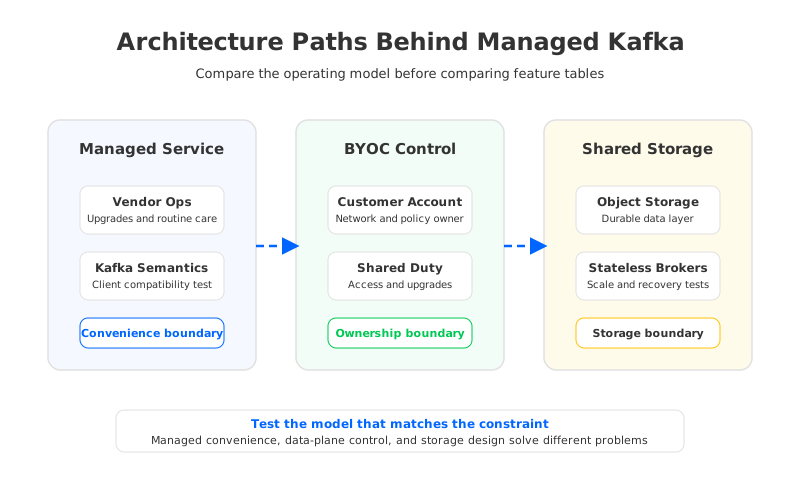
The first unresolved area is data-plane control. Some teams are comfortable with a fully managed service where the vendor owns most operational details. Others need the Kafka data path to run in their cloud account or private environment because of residency, inspection, audit, procurement, or incident-response rules. This affects who can observe packet paths, approve maintenance, collect evidence, and isolate failures.
The second area is storage architecture. Traditional Kafka ties broker compute to local durable storage. That model is familiar and battle-tested, but it means retention growth, broker replacement, replica placement, and disk balancing remain central operational concerns. Kafka tiered storage extends the model by moving older log segments to remote storage while keeping the broker abstraction. Shared-storage Kafka-compatible systems go further by making object storage part of the primary durable layer. The difference matters because it changes scaling, recovery, and cost behavior.
The third area is network and replay cost. A Kafka bill is not only the cluster plan or broker instance. Multi-AZ replication, client placement, private connectivity, remote reads, connectors, and cross-region recovery can all add cost. A quiet cluster can look economical until a backfill, audit replay, or consumer recovery event reads a large retained window.
The fourth area is migration risk. "Kafka compatible" is a starting point, not a conclusion. Existing applications may use idempotent producers, transactions, compression, ACLs, consumer groups, compaction, Kafka Connect, Schema Registry, or Streams. The migration plan should test the exact features in use, not only a produce-consume happy path.
4A Technical Evaluation Framework for Platform Teams
The most useful framework starts with a workload contract. Pick two or three representative topic families, then describe them in operational language: write rate, read fan-out, retention window, partition count, message size, client libraries, security controls, replay behavior, and failure expectations. This prevents the team from comparing service labels while ignoring the workload that will decide the outcome.
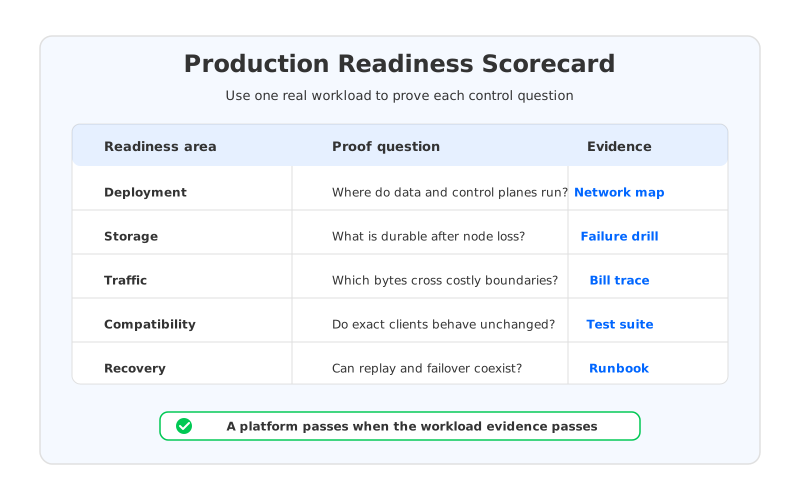
After the workload contract is written, evaluate five control planes:
- Deployment control: where brokers, agents, metadata services, control planes, and data planes run; which identities can access them; and who approves maintenance.
- Storage control: whether durable data lives on broker-attached disks, remote tiers, shared object storage, or a combination; how recovery works after node or zone loss.
- Traffic control: which bytes cross zones, VPC boundaries, regions, or provider networks; how replay and backfill traffic are isolated from tailing consumers.
- Compatibility control: which Kafka protocol features, admin APIs, ecosystem tools, and operational scripts must behave without application changes.
- Cost control: which costs scale with throughput, retention, partitions, remote reads, support, observability, and recovery drills.
That list may look more demanding than a normal vendor comparison, but it saves time. If a security review requires BYOC, fully managed SaaS options no longer carry the same score. If the main pain is broker-local storage growth, a classic managed Kafka service may reduce operations without solving the underlying cost driver. If the team needs Apache Kafka itself rather than API compatibility, that constraint should be explicit before testing a Kafka-compatible engine.
The evaluation should also separate normal operation from stress operation. Normal operation answers whether the platform can run the workload on an ordinary day. Stress operation answers what happens when a consumer falls behind, a zone fails, a broker is replaced, or a large replay starts. Kafka systems often look similar during normal traffic. They diverge when retained data, failure recovery, and ownership boundaries are tested together.
5How to Compare Managed Kafka, BYOC, and Shared Storage
The managed Kafka category is now too broad to evaluate as one thing. Aiven for Apache Kafka, Amazon MSK, Confluent Cloud, Redpanda Cloud, WarpStream, AutoMQ, and self-managed Kafka all sit near the same buyer conversation, but they do not assign responsibility in the same way. A useful comparison should group platforms by operating model before it compares feature tables.
| Path | Good fit | Control trade-off |
|---|---|---|
| Fully managed Kafka service | Teams that want the vendor to absorb most routine operations | Less direct control over the data-plane boundary and some infrastructure choices |
| Cloud-provider-managed Kafka | Teams standardized on one cloud's identity, networking, billing, and observability | Strong cloud fit, weaker multi-cloud consistency |
| BYOC managed platform | Teams that need data to remain in their account while a vendor manages part of the lifecycle | Shared responsibility must be read carefully, especially for access and upgrades |
| Kafka with tiered storage | Teams extending retention while keeping the conventional broker model | Remote storage helps retention, but brokers remain central to serving and recovery |
| Shared-storage Kafka-compatible architecture | Teams targeting independent compute/storage scaling and faster recovery from broker-local storage pressure | Requires compatibility and latency validation against real workloads |
| Self-managed Apache Kafka | Teams with deep Kafka/SRE capacity and strict control requirements | Maximum control, maximum operational burden |
The right path may change over time. A startup can begin with a managed service, then move toward BYOC when enterprise customers require data-plane ownership. A platform with long retention and heavy replay may test tiered storage or shared storage because broker-local disk economics become the primary constraint.
No model replaces all others. Each one answers a different control question. A buyer who knows the control question can evaluate Aiven Kafka and its alternatives without being pulled into a generic ranking.
6Where AutoMQ Fits the Evaluation
AutoMQ becomes relevant after the evaluation reaches a specific conclusion: the team wants Kafka-compatible behavior, but it does not want broker-local disks to remain the center of durability, scaling, and recovery. AutoMQ is a cloud-native streaming platform that keeps Kafka protocol compatibility while using object-storage-backed shared storage, stateless brokers, and a WAL path for write durability. That places it in the shared-storage Kafka-compatible category rather than in the classic managed Kafka category.
The architecture matters because it changes the questions a buyer can ask. Instead of sizing broker disks as the durable data foundation, the team evaluates object storage, WAL choices, cache behavior, broker statelessness, and failure recovery. Instead of scaling compute and retained data together, the team can test whether broker capacity and storage growth can be planned independently.
None of that removes the need for validation. A serious AutoMQ evaluation should test producer idempotence, consumer groups, offset seeking, compaction, ACLs, transactions if used, connector behavior, observability integration, broker replacement, and replay under load. The value is that AutoMQ gives teams a different architectural lever when managed Kafka convenience does not answer the storage and control problem.
For teams already evaluating Aiven Kafka, AutoMQ should not be framed as "the same service with another logo." It is a different operating model for Kafka-compatible streaming. If the requirement is managed Apache Kafka with broad service packaging, Aiven may remain a strong fit. If the requirement has shifted toward data-plane control, object-storage economics, independent scaling, and recovery without broker-local durable state, AutoMQ belongs on the technical shortlist.
7A Practical Buyer Worksheet
Before a procurement conversation becomes a feature spreadsheet, ask the architecture team to answer these questions in writing. The answers need to be concrete enough to make vendor claims testable.
| Question | Why it matters |
|---|---|
| Which applications cannot change Kafka client behavior during migration? | Compatibility risk lives in exact client features, not in the word "Kafka." |
| Which topics drive the retention and replay requirement? | Long retention is manageable only when owners, replay purpose, and service levels are known. |
| Which traffic paths cross zones, regions, VPCs, or vendor boundaries? | Network cost and security posture often depend on placement more than broker count. |
| Who controls maintenance, emergency access, and rollback? | Managed services still need incident authority and evidence collection rules. |
| What failure drill must pass before production cutover? | A platform that has not been tested under failure has not been evaluated. |
Use the worksheet to design a short proof of concept: one high-throughput topic family, one long-retention or replay-heavy topic family, and one security-sensitive application. Run normal traffic, run a replay, replace or restart a broker-equivalent component, inspect the bill, and review the incident workflow. That exercise produces better evidence than a long comparison table because it shows how the platform behaves where the buyer carries risk.
The original search for Aiven Kafka is a useful starting point because it signals a mature question: who should operate Kafka for us? The production question is sharper: which parts of Kafka must we continue to control, even when the service is managed? If your answer points toward Kafka-compatible shared storage, data-plane ownership, and independent compute/storage scaling, use the AutoMQ Cloud Console to test one real workload against your control, cost, recovery, and compatibility scorecard.
8References
- Aiven documentation: Aiven for Apache Kafka
- Apache Kafka documentation
- Apache Kafka documentation: Tiered Storage
- Amazon MSK Developer Guide: What is Amazon MSK?
- Amazon MSK pricing
- AutoMQ documentation: Overview
- AutoMQ documentation: Compatibility with Apache Kafka
- AutoMQ documentation: S3Stream Shared Streaming Storage
- AutoMQ documentation: WAL storage
9FAQ
9.1Is Aiven Kafka the same as self-managed Apache Kafka?
No. Aiven for Apache Kafka is a managed service built around Apache Kafka, while self-managed Kafka means your team owns provisioning, upgrades, monitoring, broker storage, incident response, and operational automation. The client-facing Kafka concepts may be familiar, but the responsibility model is different.
9.2What should teams evaluate beyond managed Kafka pricing?
Evaluate data-plane ownership, storage architecture, network traffic paths, replay behavior, client compatibility, security controls, and failure recovery. Published pricing is only one input. The real cost model depends on throughput, retention, fan-out, cross-zone movement, support, observability, and operational labor.
9.3When does BYOC matter for Kafka?
BYOC matters when the organization needs the data path to run inside its own cloud account or private network. That requirement can come from compliance, data residency, security inspection, procurement policy, or incident-response authority. BYOC still requires careful review of who controls upgrades, access, telemetry, and emergency operations.
9.4Where does AutoMQ fit for teams comparing Aiven Kafka?
AutoMQ fits when the team wants Kafka-compatible streaming while evaluating a shared-storage architecture based on object storage, stateless brokers, and independent compute/storage scaling. It should be tested against the same compatibility, latency, replay, cost, and recovery requirements as any managed Kafka or Kafka-compatible option.


