
Table of Contents
Table of Contents
Most managed Kafka cost comparisons start in the wrong place. They ask which vendor has the lowest line item, then discover months later that the real bill was shaped by retention, network traffic, compliance work, migration labor, and idle capacity. Kafka is especially sensitive to this mistake because the workload is not one-dimensional. A cluster that looks moderate by broker count can become expensive when it keeps long retention, serves multiple consumer groups, spans availability zones, or runs a replay-heavy data product.
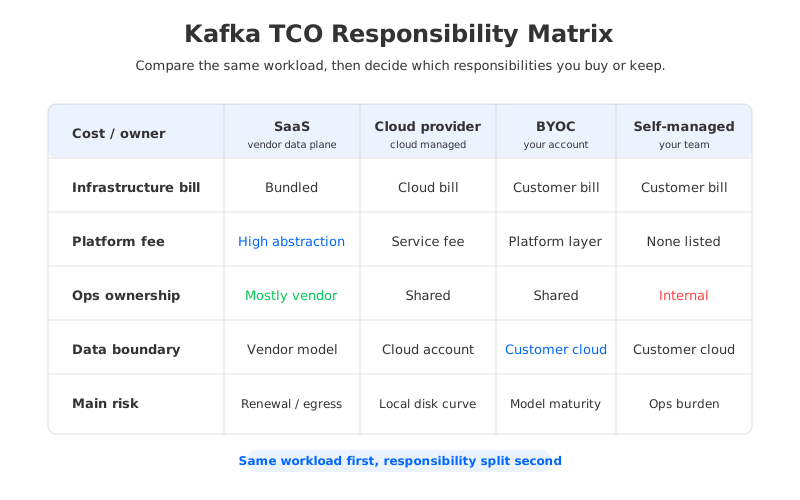
A useful managed Kafka cost comparison needs the same workload assumptions across every model. SaaS Kafka, cloud-provider managed Kafka, BYOC or private cloud Kafka, and self-managed Kafka do not merely price the same thing differently. They move responsibilities across organizational boundaries. The invoice changes, but so do operational risk, procurement friction, data-plane ownership, support expectations, and the amount of engineering time consumed by routine capacity work.
1The Workload Assumptions for a Fair Comparison
Start with a workload profile before opening any pricing page. A practical model should describe write throughput, read fanout, partition count, retention period, availability requirements, security posture, and migration constraints. For example, the same 100 MiB/s ingest workload can have very different economics depending on whether it retains data for 24 hours or 30 days, whether consumers read each event once or five times, and whether the platform must tolerate zone loss without manual recovery.
The cleanest comparison uses a table like this:
| Dimension | Why it matters for Kafka cost |
|---|---|
| Write throughput | Drives broker, network, storage, and service capacity. |
| Read fanout | Turns one produced byte into multiple delivered bytes. |
| Retention | Converts streaming traffic into a storage economics problem. |
| Availability zones | Adds replication traffic, cross-zone data transfer, and capacity headroom. |
| Partition count | Affects broker memory, metadata load, balancing, and scaling complexity. |
| Recovery objective | Determines whether you pay for warm standby, multi-region replication, or manual recovery risk. |
| Compliance boundary | Changes who owns IAM, encryption, audit evidence, and data residency. |
Without this baseline, a pricing comparison becomes a catalog of unrelated SKUs. SaaS Kafka may bundle more control-plane responsibility into the service fee. A cloud-provider service may expose cloud-native billing dimensions such as broker hours, storage, and data transfer. BYOC may leave infrastructure charges in your cloud account while adding a platform fee. Self-managed Kafka may look inexpensive on infrastructure alone while moving labor, incident response, upgrades, and architecture mistakes onto the internal team.
2Cost Categories Every Kafka Model Must Cover
Kafka cost has visible and hidden layers. Visible costs are easy to put in a spreadsheet: service fees, broker instances, storage, throughput units, support plans, and network transfer. Hidden costs are harder because they appear as engineering time, delayed projects, slow incident recovery, or over-provisioned capacity kept alive because resizing is operationally painful.
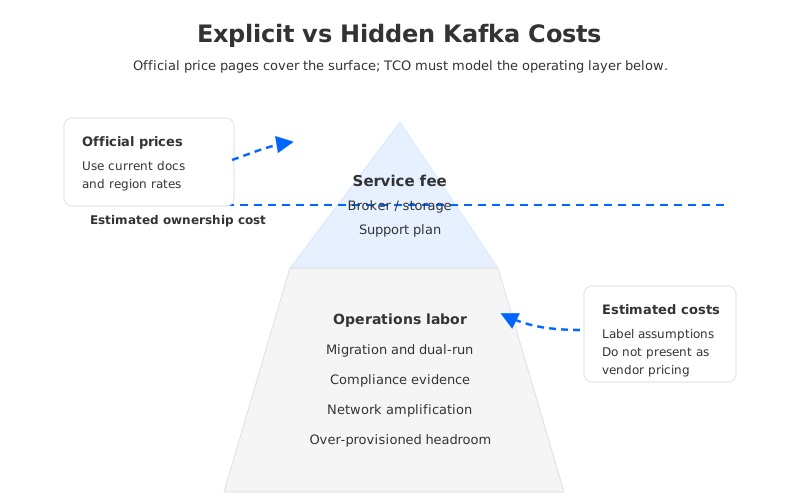
For a finance-ready model, separate the categories instead of mixing them into one vendor column:
| Cost category | Treat as official price? | How to model it |
|---|---|---|
| Infrastructure | Yes, when sourced from current cloud pricing pages | Use broker, compute, storage, data transfer, and region-specific rates. |
| Platform or service fee | Yes, when listed by the provider | Record the pricing unit and what responsibility it buys. |
| Support | Yes for published plans, estimate for internal support | Tie to required response times and production criticality. |
| Operations labor | No | Estimate SRE/platform hours for upgrades, scaling, security, monitoring, and incidents. |
| Migration and dual-run | No | Estimate project duration, application changes, test environments, and parallel operation. |
| Compliance and procurement | No | Estimate audit, vendor review, IAM, encryption, and data residency work. |
| Network | Yes for cloud transfer rates, workload-dependent in practice | Include cross-zone, cross-region, ingress, egress, and consumer fanout. |
| Over-provisioning | No direct SKU | Estimate idle headroom kept for spikes, rebalancing, and failure scenarios. |
The important discipline is labeling. Human effort, migration, and support effort are estimation frameworks, not official vendor prices. They still matter because they can dominate the business decision, but they should not be presented as if a pricing page published them.
3SaaS Kafka Cost Model
SaaS Kafka moves the largest share of operational responsibility to the vendor. The buyer pays for the service abstraction: managed control plane, upgrades, availability design, observability surfaces, enterprise support options, and a faster path to production. For teams without deep Kafka operations skills, that can be the economically rational choice even when the line-item service fee looks higher than raw cloud infrastructure.
The pricing model usually depends on a mix of capacity, throughput, storage, network, cluster type, region, and support tier. Confluent Cloud, for example, publishes pricing guidance for cluster types and usage dimensions on its official pricing page. The exact bill still depends on workload shape and region, so procurement teams should avoid comparing a SaaS list price to self-managed VM cost alone. That comparison ignores the labor being bought by the service.
SaaS Kafka tends to fit when:
- time-to-market is more valuable than deep infrastructure control;
- the team wants fewer upgrade, patching, and incident ownership tasks;
- the organization accepts a vendor-operated data plane or the provider's available private networking model;
- procurement prefers a managed service contract over staffing internal Kafka specialists.
The risk is not only price. SaaS can also introduce data-plane governance questions, egress costs, connector pricing surprises, regional availability limits, and renewal leverage issues. A good TCO model asks what happens during a traffic spike, a long replay, a region expansion, and contract renewal. The lowest first-month bill is not always the lowest two-year cost.
4Cloud-Provider Managed Kafka Cost Model
Cloud-provider managed Kafka services sit between SaaS abstraction and self-managed ownership. Amazon MSK, Google Cloud Managed Service for Apache Kafka, and other cloud-native offerings reduce some operational burden while keeping the deployment closer to the customer's cloud environment. They are often attractive for organizations standardizing on one cloud's IAM, networking, billing, and procurement process.
The tradeoff is that cloud-provider managed Kafka can still preserve much of Kafka's traditional infrastructure shape. You may still reason about broker capacity, storage, network transfer, partitions, and availability-zone design. AWS publishes MSK pricing around service-specific dimensions such as cluster type, broker or capacity usage, storage, and data transfer. Google Cloud's managed Kafka pricing similarly exposes provisioned capacity, networking, and storage-related dimensions. The details differ by provider and region, but the modeling principle is consistent: do not treat "managed" as a synonym for "fully abstracted."
This model often fits teams that want:
- cloud-native procurement and billing;
- direct alignment with existing VPC, IAM, KMS, observability, and security controls;
- less operational effort than raw self-managed Kafka;
- more cloud-account control than a pure SaaS model may offer.
The TCO watchouts are familiar to experienced Kafka operators. Broker-local storage can make scaling and recovery data-heavy. Multi-AZ replication can turn durability into network cost. Long retention can force teams to provision expensive storage near brokers even when most retained data is cold. These issues are architectural, not merely operational. A managed service can automate more tasks while still inheriting the cost curve of the underlying Kafka design.
5BYOC and Private Cloud Kafka Cost Model
BYOC, or bring your own cloud, is attractive because it separates two concerns that are often bundled together: who runs the platform experience and who owns the cloud resources. In a BYOC model, the customer typically keeps infrastructure, data, network boundaries, and cloud discounts inside their own account, while a vendor or platform layer provides lifecycle management, automation, and operational tooling. Private cloud variants apply a similar idea inside a controlled enterprise environment.
From a TCO perspective, BYOC can make the spreadsheet more transparent. Infrastructure charges remain visible under the customer's cloud bill. Committed-use discounts, enterprise agreements, private networking, and internal chargeback models can apply. At the same time, the organization may pay a platform fee for automation, support, and product capabilities that reduce the operational load compared with building everything internally.
This is where Kafka architecture starts to matter more than the deployment label. If a BYOC platform still binds durable data tightly to broker-local disks, the cost curve may remain close to traditional Kafka. If the platform changes the storage model, the comparison changes. AutoMQ is one example of a Kafka-compatible system designed around object storage as primary storage. By moving durable log data away from broker-local disks, reducing the binding between brokers and local storage, and making brokers more elastic compute nodes, it can create a different TCO curve for workloads with high throughput, long retention, and frequent scaling needs.
The point is not that BYOC is automatically lower cost. The point is that BYOC lets teams compare architecture, resource ownership, and operating model separately. That is useful for FinOps because it prevents a managed-service discussion from collapsing into a single monthly platform fee.
6Self-Managed Kafka Cost Model
Self-managed Kafka gives the platform team the most control and the most responsibility. The visible infrastructure bill may look efficient: VMs or Kubernetes nodes, disks, load balancers, monitoring, backup or replication tooling, and network transfer. For teams with mature Kafka operations, automation, and incident discipline, self-managed Kafka can be a valid choice.
The danger is undercounting the cost of ownership. Kafka operations require capacity planning, partition balancing, broker replacement, rolling upgrades, security patching, client compatibility management, quota tuning, disaster recovery tests, and on-call response. These are not occasional tasks. They become part of the platform's recurring operating rhythm.
Self-managed cost should include:
- infrastructure for steady-state load and failure headroom;
- storage sized for retention, replication, and rebalancing overhead;
- cross-zone and cross-region network traffic;
- observability, alerting, backup, and disaster recovery tooling;
- SRE and platform engineering time for routine operations;
- incident cost and business impact for degraded streaming pipelines;
- hiring, training, and documentation overhead.
The model is strongest when Kafka is a strategic internal platform and the team has both the skills and mandate to operate it. It is weakest when self-management is chosen because raw infrastructure prices look lower before labor, availability, and opportunity cost are counted.
7Where AutoMQ Changes Kafka TCO
The most expensive Kafka costs often appear when the cluster is forced to move or reserve data because compute and storage are tightly coupled. Scaling out means adding brokers and redistributing partitions. Recovering from broker failure means rebuilding local replicas. Long retention means keeping large volumes of data close to brokers. Over-provisioning becomes the safety buffer because changing capacity is not frictionless.
AutoMQ addresses this cost shape by using object storage as the primary storage layer while keeping Kafka protocol compatibility. Brokers become less bound to local durable data, so scaling and recovery can be treated more like compute lifecycle operations. In BYOC deployments, the customer can retain resource ownership in their own cloud account while the platform provides a managed Kafka-compatible experience. For FinOps and platform leaders, that changes the conversation from "which managed Kafka SKU is lower" to "which architecture reduces the amount of expensive capacity we must reserve."
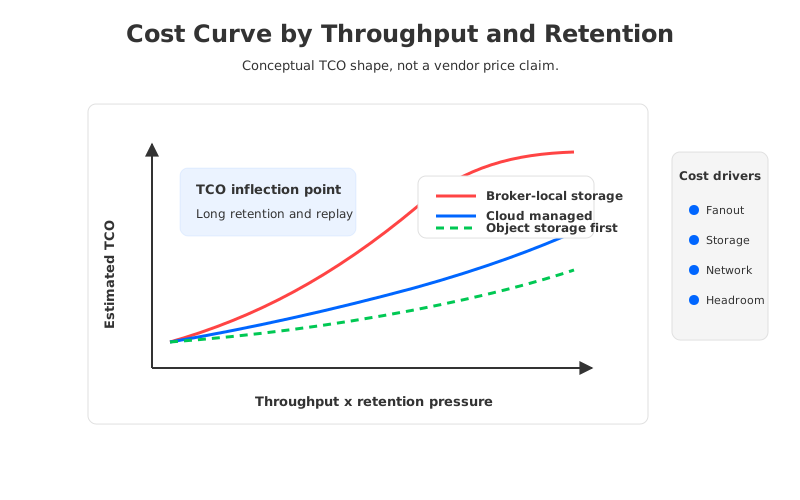
This distinction matters most in four workload patterns:
- high write throughput where broker and storage sizing are repeatedly revisited;
- long retention where object storage economics can be materially different from broker-local disk economics;
- bursty traffic where elastic scaling reduces idle headroom;
- strict data ownership requirements where BYOC aligns better with enterprise governance.
AutoMQ should still be evaluated with the same discipline as every other option. Use current official pricing, map the workload, include support and migration effort, and run a pilot that measures throughput, latency, recovery behavior, and operational steps. The architectural advantage is meaningful only when it is reflected in the workload's actual cost drivers.
8Decision Table: Lowest Operations Cost vs Lowest TCO
The best answer depends on which constraint is dominant.
| Decision pressure | Likely starting point | Reason |
|---|---|---|
| Fast launch with limited Kafka expertise | SaaS Kafka | Buys the most operational abstraction. |
| Standardized cloud procurement and security | Cloud-provider managed Kafka | Aligns with existing cloud account controls. |
| Data ownership plus managed operations | BYOC or private cloud Kafka | Keeps resources closer to the customer boundary. |
| Deep internal Kafka expertise and custom control | Self-managed Kafka | Maximizes control when the team can absorb operations. |
| High throughput, long retention, elastic capacity needs | Object-storage-backed Kafka-compatible architecture | Targets the storage and scaling cost drivers directly. |
For CTOs and platform leaders, the question is not whether managed Kafka is worth paying for. The better question is which responsibility you want to buy, which responsibility you still own, and whether the architecture reduces the workload's dominant cost driver. For FinOps teams, that framing turns Kafka pricing from a vendor comparison into an ownership model.
9References
- Confluent Cloud pricing
- Amazon MSK pricing
- Google Cloud Managed Service for Apache Kafka pricing
- Azure Event Hubs pricing
- AutoMQ pricing
- AutoMQ documentation
10FAQ
10.1What is the fairest way to compare managed Kafka cost?
Use the same workload assumptions for every model: write throughput, read fanout, retention, partition count, availability zones, recovery objectives, and compliance requirements. Then separate official prices from internal estimates such as operations labor, migration, support coordination, and over-provisioning.
10.2Is SaaS Kafka always more expensive than self-managed Kafka?
Not necessarily. SaaS can have a higher visible service fee while reducing internal operations work, upgrade risk, incident burden, and time-to-production. Self-managed Kafka can look lower cost on infrastructure but become more expensive once staffing, incidents, and opportunity cost are included.
10.3How should FinOps teams model Kafka labor cost?
Treat labor as an estimate, not an official vendor price. Define recurring tasks such as upgrades, capacity planning, incident response, security review, and compliance evidence. Then estimate the monthly engineering hours and review the assumptions with platform leaders.
10.4Why does retention change managed Kafka TCO?
Retention turns Kafka from a pure streaming capacity problem into a storage economics problem. Longer retention increases stored data, replica rebuild work, and often broker-local disk requirements. Architectures that use object storage as primary storage can change this curve, especially for replay-heavy workloads.
10.5Where does AutoMQ fit in a managed Kafka pricing comparison?
AutoMQ fits when teams want Kafka compatibility, BYOC resource ownership, elastic scaling, and an object-storage-backed architecture that reduces dependence on broker-local disks. It should be compared with the same workload model and official pricing discipline used for SaaS, cloud-provider managed Kafka, and self-managed Kafka.


