
Table of Contents
Table of Contents
Searching for msk alternatives usually starts after a team has learned what Amazon Managed Streaming for Apache Kafka can do. The question is no longer whether Kafka should be self-managed or fully ignored as an operations problem. The question is which Kafka operating model gives the team enough compatibility, enough cost predictability, and enough control over the data plane without turning every scaling event into a broker project.
Amazon MSK is a serious baseline because it runs Apache Kafka and sits close to the rest of the AWS estate. That makes the alternative search more specific than a generic streaming-platform comparison. Buyers are often trying to decide whether they need a different managed Kafka service, a Kafka-compatible engine, a BYOC deployment, a shared-storage architecture, or a narrower change to their current MSK design. Those are different decisions, and collapsing them into one vendor shortlist creates confusion early in the process.
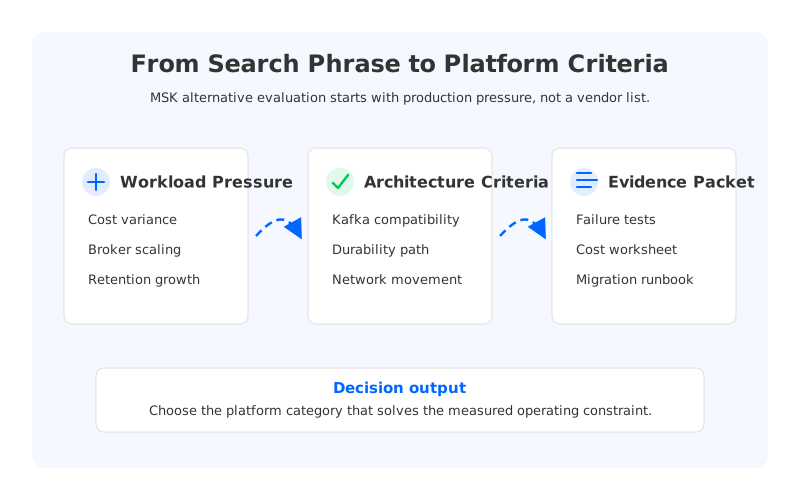
The useful move is to convert the search into criteria. A platform team does not need a list of logos first. It needs a way to test whether the current pain comes from operations, cost shape, storage architecture, migration limits, or ownership boundaries.
1Why Teams Search for msk alternatives
MSK alternative searches usually come from a production constraint rather than curiosity. One team may be dealing with broker storage growth and partition rebalancing. Another may be looking at cross-availability-zone traffic and asking why the Kafka bill does not behave like the rest of its cloud services. A third may need stronger operational abstraction but cannot give up standard Kafka clients, security controls, or private networking.
The phrase also hides different buyer roles. SREs care about upgrades, recovery, scaling, observability, and incident ownership. Data engineers care about client compatibility, replay behavior, connector workflows, schema governance, and retention. FinOps teams care about broker hours, storage, inter-AZ transfer, PrivateLink, support, and forecast variance. Procurement cares about contract shape and vendor risk. A useful evaluation has to hold all of those concerns at the same time.
MSK is often the incumbent because it is already inside AWS procurement and network boundaries. That strength can also narrow the first evaluation pass too much. If the workload is mostly AWS-native, a platform team may assume the decision is MSK versus another hosted service. If the painful part is Kafka's local-disk replication model, the better question may be whether the storage architecture should change. If the painful part is self-service and day-two operations, the decision may be about control plane and automation rather than broker internals.
The first diagnostic question is therefore not "Which product replaces MSK?" It is "Which part of the current operating model is forcing the replacement search?"
2What a First-Pass Comparison Usually Covers
Most first-pass MSK alternative research covers service scope, pricing pages, support models, deployment patterns, ecosystem components, and headline differences between managed offerings. That is useful because it tells a buyer whether a platform is worth deeper diligence. It is not enough to approve a production migration.
Managed Kafka decisions usually fail when the comparison stays at the service wrapper level. Apache Kafka behavior is defined by producers, consumers, topics, partitions, replication, offsets, transactions, ACLs, and administrative workflows. The service around Kafka can remove operational burden, but the application contract still depends on Kafka semantics. If the alternative changes those semantics, the migration becomes a software change, not only an infrastructure change.
The first pass also tends to understate cost shape. AWS publishes Amazon MSK pricing separately from general EC2 data transfer pricing, and that separation matters. Kafka workloads move bytes through brokers, across zones, into storage, out to consumers, and sometimes through private connectivity. A quote that treats compute, storage, network, and operations as separate rows can look tidy while still missing the reason the bill is hard to forecast.
That is why platform teams should treat public comparisons as input, not as the decision model. They can reveal buyer questions, but they rarely encode the workload-specific acceptance tests that decide whether an alternative will carry production traffic.
3Architecture Criteria Behind the Shortlist
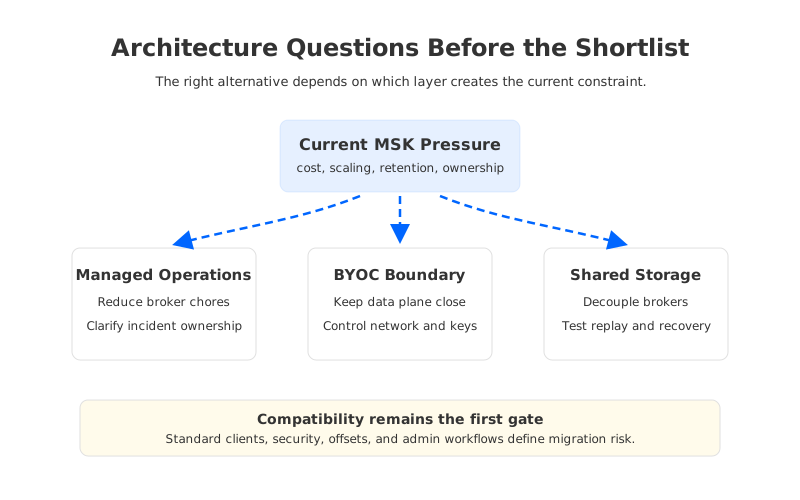
The shortlist should start with architecture fit. There are several legitimate paths away from an uncomfortable MSK deployment, and each path solves a different problem. A fully managed Kafka service can reduce operational load. A Kafka-compatible engine can change the execution or storage model while preserving familiar APIs. A BYOC model can keep the data plane closer to the customer account. A shared-storage design can reduce the coupling between broker compute and durable stream data.
Those categories are not interchangeable. The wrong category can give a team a polished service while leaving the original bottleneck intact. If the pain is manual broker operations, a stronger managed service may be enough. If the pain is retention growth and partition movement tied to local disks, a service wrapper around the same storage model may still leave the team doing capacity planning around broker state.
The architecture review should cover six areas before any vendor scorecard:
- Kafka protocol and feature compatibility. Existing producers, consumers, Kafka Streams jobs, Connect workers, ACLs, compaction, transactions, and admin scripts should either keep working or have documented exceptions.
- Write durability path. The team should understand when a produce request is acknowledged, where the record is durably stored, and how broker or zone failures are fenced.
- Read and replay behavior. Hot reads, consumer fan-out, long-retention replay, cache misses, and backfill jobs should be tested with realistic partition counts.
- Storage and compute coupling. Scaling brokers should not require a surprise data-movement project unless the team accepts that trade-off explicitly.
- Network movement. Inter-AZ, cross-region, VPC endpoint, and private connectivity charges should be modeled as part of the Kafka platform cost.
- Operational boundary. Ownership of data, metadata, encryption keys, metrics, logs, upgrades, and emergency actions should be clear before procurement starts.
These criteria turn "alternative" into a workload conversation. The same platform can be a strong fit for one Kafka estate and a poor fit for another. A low-latency operational pipeline, an observability ingestion system, a CDC backbone, and a lakehouse replay tier all stress different parts of the architecture.
4Cost Criteria That Matter More Than List Price
Kafka cost is rarely one number. Broker instance hours are visible, but the hidden part of the bill often comes from the way Kafka moves and stores data under failure-tolerant deployment. In a multi-AZ design, replicas, consumers, and operational workflows can create network paths that are easy to miss in a service-level quote. Retention and replay add another layer because stored data is not passive when downstream systems need to read it again.
A useful cost model should break the platform into cost drivers instead of comparing monthly estimates in isolation.
| Cost driver | What to model | Why it changes the decision |
|---|---|---|
| Broker capacity | Instance type, broker count, CPU, memory, and partition density. | Under-sized brokers create instability; over-sized brokers hide inefficient storage coupling. |
| Durable storage | Local disks, attached volumes, object storage, retention, and replication. | Retention-heavy workloads can make storage architecture more important than broker price. |
| Network transfer | Inter-AZ replication, consumer reads, cross-region movement, and private connectivity. | Network cost can grow with fan-out even when write traffic is stable. |
| Operations | Upgrades, scaling, partition reassignment, incident response, and observability. | A lower service bill can still be expensive if senior engineers remain tied to routine broker work. |
| Migration | Dual writes, offset migration, ACL parity, testing, rollback, and temporary over-provisioning. | The first month of migration can dominate the first year of savings if the runbook is weak. |
The table also explains why "MSK alternative cost" is not the same as "lower broker price." A platform can be more cost-effective because it reduces data movement, decouples compute from retained data, automates operations, or keeps traffic inside a cleaner network boundary. Another platform can have attractive headline pricing while requiring more engineering labor or more conservative over-provisioning.
FinOps teams should ask for a bill-of-materials worksheet with assumptions rather than a single blended estimate. The worksheet should show how cost changes when retention doubles, consumer fan-out increases, traffic shifts across zones, or a replay job reads older data. Those sensitivity checks reveal whether the platform is resilient to normal workload drift.
5Migration and Ownership Questions for Platform Teams
Migration risk is where many alternative searches become real. A Kafka estate is not one cluster. It is application code, topic naming, ACLs, quotas, schema rules, Connectors, consumer offsets, monitoring dashboards, alert thresholds, runbooks, and organizational habits. Moving the brokers without moving those surrounding contracts creates partial success and long-term operational drag.
The migration plan should be written before the buyer chooses the platform. That may sound early, but it forces the right questions into the selection process. Can the target accept the current client versions? Can topics and ACLs be recreated predictably? How will consumer groups cut over without offset ambiguity? Which topics need dual-write, mirror, or replay strategies? What is the rollback point if a downstream team finds an application-level issue after the first production wave?
Ownership boundaries need the same precision. A fully managed service may be attractive because the provider handles more of the operational surface. A BYOC deployment may be attractive because the data plane, network, and storage remain under the customer's cloud account. Neither model is inherently better for every buyer. The right model depends on compliance requirements, procurement policy, incident response expectations, and the team's appetite for control.
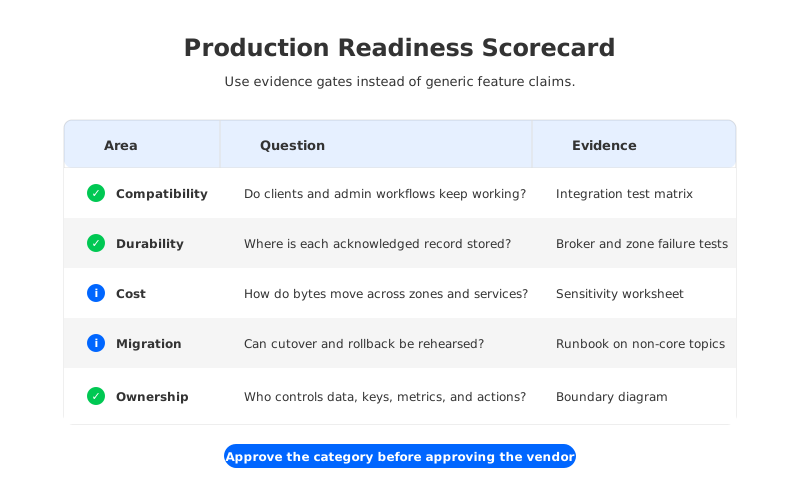
The most practical evaluation artifact is a readiness scorecard. It should be short enough that engineering, security, procurement, and finance can all read it, but specific enough that vague claims do not pass.
6How AutoMQ Fits the Evaluation
Once the evaluation reaches storage architecture, AutoMQ becomes relevant as a Kafka-compatible, cloud-native streaming system built around shared storage. The point is not that every MSK search should end in the same place. The point is that some MSK searches are really about the limits of broker-local state: capacity planning around disks, data movement during scaling, multi-AZ network paths, and the operational cost of keeping compute and durable storage tightly coupled.
AutoMQ keeps the Kafka protocol surface familiar while moving durable stream storage to object storage through its S3Stream shared-storage architecture. Brokers become more stateless, compute and storage can scale more independently, and the architecture is designed to reduce cross-AZ traffic in supported deployments. For teams whose MSK pain is mostly contract management or a desire for a different managed service wrapper, that may be more architecture than they need. For teams whose pain is retention, elasticity, and cloud traffic economics, it is the category worth testing.
The evaluation should still be empirical. Run representative producers and consumers. Test the Kafka features your applications use. Replay cold data. Trigger broker loss and scaling events. Inspect where bytes move across zones. Compare the operational runbook before and after the architecture change. A shared-storage design is most persuasive when the workload shows that local broker state is the source of the operating burden.
That is also the right moment to separate compatibility from sameness. A Kafka-compatible platform should preserve the client contract that matters to applications, but it does not need to reproduce every internal implementation choice of traditional Kafka. If the reason for leaving an uncomfortable MSK deployment is rooted in those implementation choices, preserving the API while changing the storage layer is a rational path to evaluate.
If your team is using an MSK alternative search to revisit Kafka architecture rather than collect vendor names, review AutoMQ's Kafka compatibility and shared-storage architecture, then test it against your own traffic model: start with AutoMQ.
7References
- Apache Kafka Documentation
- Amazon MSK Developer Guide
- Amazon MSK Pricing
- AWS EC2 On-Demand Pricing and Data Transfer
- AWS PrivateLink Documentation
- AutoMQ Kafka Compatibility
- AutoMQ S3Stream Shared Streaming Storage
8FAQ
8.1What is the main reason teams look for MSK alternatives?
The main reason is usually not a single missing feature. Teams search for MSK alternatives when the current operating model creates pressure around cost predictability, broker scaling, storage growth, network movement, or control over the data plane. The first step is to identify which pressure is driving the search.
8.2Should an MSK alternative be fully Kafka-compatible?
For most production migrations, Kafka compatibility is the first gate. Existing clients, security workflows, topic configurations, consumer offsets, and ecosystem tools define the application contract. Any compatibility gap may still be acceptable, but it should be explicit and tested before the migration plan is approved.
8.3Is a managed Kafka service enough to solve MSK cost concerns?
Sometimes. If the cost concern comes from operations labor or conservative over-provisioning, a managed service can help. If the cost concern comes from storage growth, replication behavior, replay, or inter-AZ traffic, the team should evaluate the underlying architecture rather than only the service wrapper.
8.4When does shared storage matter in an MSK alternative evaluation?
Shared storage matters when broker-local state is creating operational or cost friction. Typical signs include slow scaling, expensive retention, data movement during broker changes, and difficulty separating compute capacity from durable stream data. The value should be tested with the team's real partition count, retention, and replay patterns.
8.5How should a team compare MSK, another managed Kafka service, and AutoMQ?
Use the same acceptance criteria for all three: Kafka compatibility, write durability, read behavior, storage and compute coupling, network movement, operating boundary, migration safety, and cost sensitivity. That keeps the evaluation factual and prevents the shortlist from becoming a feature-list debate.


