
Table of Contents
Table of Contents
Managed Kafka disaster recovery often starts with a deceptively simple question: "Can this service run in multiple regions?" For an enterprise Kafka team, that question is not specific enough. A second cluster in another region is infrastructure. A recoverable streaming platform is an operating model that preserves topics, committed data, consumer positions, schemas, access controls, producer routing, monitoring, and a tested application cutover path.
Kafka DR is not another cluster waiting in a different region. It is a set of promises about how much data the business can afford to lose, how quickly producers and consumers must resume, who decides that a failover is real, and what the platform does when the primary region returns. Those promises are usually expressed as RPO and RTO, but the hard work is translating them into replication topology, network design, application behavior, and runbooks that engineers can execute under pressure.
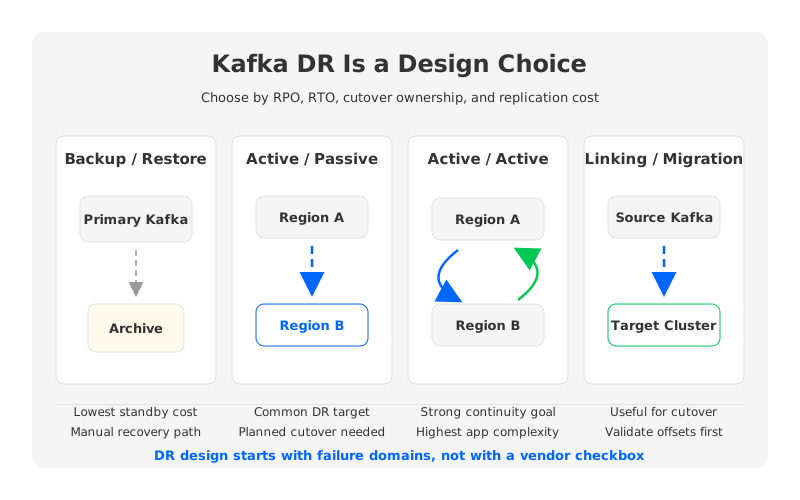
The managed Kafka buyer should therefore evaluate disaster recovery as a system design problem, not only as a vendor feature comparison. A provider may offer multi-AZ clusters, cross-region replication, cluster linking, managed connectors, private networking, or BYOC deployment options. Each one solves a different failure mode. None removes the need to define ownership at the application boundary.
1Define RPO and RTO Before Choosing a Design
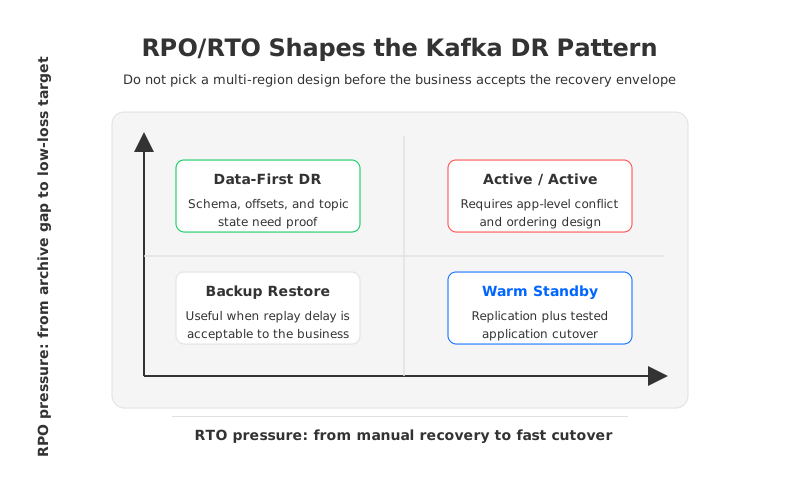
Recovery point objective, or RPO, describes the amount of accepted data the business is prepared to lose during a disaster. Recovery time objective, or RTO, describes the time window for service restoration. Kafka teams should resist the urge to copy generic numbers from another platform. A fraud decision stream, an observability pipeline, and a product analytics stream can all use Kafka while carrying very different business consequences.
The first design review should classify streams by business criticality:
- Event-of-record streams where losing acknowledged records creates financial, compliance, or user-visible damage.
- Operational streams where delayed processing is painful but replay from an upstream system is possible.
- Analytical streams where temporary gaps may be repairable from batch sources or object storage.
- Migration streams where the goal is a controlled cutover rather than long-term dual-region serving.
This classification changes the DR architecture. A topic that can be rebuilt from a database change log may accept a backup-and-restore path. A topic that is the system of record may require continuous replication, strict producer acknowledgement settings, schema compatibility enforcement, and rehearsed consumer restart logic. A topic that powers real-time user experience may need fast cutover more than long retention.
RPO and RTO also need an application definition. Kafka can replicate records to another cluster, but the application must know which bootstrap servers to use, whether writes are allowed in both regions, how consumer groups resume, how idempotency is enforced, and whether downstream systems can accept a sudden replay. A low RPO target without an application cutover plan is only a storage statement.
2Multi-AZ Is Not Multi-Region DR
Multi-AZ Kafka and multi-region Kafka solve different failure domains. Multi-AZ protects against a zone-level failure inside one cloud region. The cluster still depends on the regional control plane, regional networking, regional quotas, and regional service health. Multi-region DR is about surviving the loss or isolation of a region, or about moving a workload away from a region for business continuity reasons.
This distinction matters in managed Kafka procurement. A service can be highly available across zones and still have no automatic regional failover. Another service can offer cross-region replication while leaving client routing, DNS, consumer offsets, schema registries, and application cutover to the customer. Both can be reasonable offerings, but they answer different questions.
For each managed Kafka option, ask the provider to map the covered failure domains:
| Failure domain | What to evaluate | Typical ownership question |
|---|---|---|
| Broker or node failure | Broker replacement, partition leadership, storage recovery, client retry behavior | Does the provider recover the node, and do clients tolerate the transition? |
| Availability zone failure | Replica placement, quorum health, cross-zone traffic, storage durability | Is the cluster designed to keep producing and consuming through zone loss? |
| Regional service impairment | Cross-region replication, control plane dependency, endpoint routing | Who declares failover, and what client path changes? |
| Network isolation | Private connectivity, DNS, firewall rules, egress controls | Can applications reach the standby region without emergency firewall work? |
| Data corruption or bad deploy | Replay, rewind, schema rollback, poison message handling | Can the platform recover from logical failure, not only infrastructure failure? |
The last row is often neglected. Regional redundancy does not help if a bad producer writes invalid records to both regions. For many Kafka incidents, the DR plan needs replay controls, schema governance, consumer isolation, and dead-letter handling as much as it needs another cluster.
3Replication Is Necessary, but Not Sufficient
Kafka replication for DR usually falls into a few patterns. Apache Kafka documents geo-replication through MirrorMaker 2, which is built on Kafka Connect and uses source, checkpoint, and heartbeat connectors to replicate data and support offset translation. Confluent offers Cluster Linking for directly linking clusters and creating mirror topics. Managed services such as Amazon MSK Replicator package cross-cluster replication as a provider-managed capability.
These tools are important, but the evaluation should go beyond "does it replicate records?"
First, inspect offset behavior. Consumer offsets are part of the application recovery contract. If a DR tool changes topic names, translates offsets, or requires consumers to reset positions, the recovery procedure must account for duplicate processing and gaps. For stateful stream processing frameworks, offset continuity can determine whether a failover is routine or a full state migration.
Second, inspect schema and metadata handling. Kafka data is not only bytes in topics. Many production environments depend on schema registries, topic configurations, ACLs, quotas, connector configurations, and monitoring conventions. A target region with replicated records but missing schema compatibility rules can fail at the first producer restart.
Third, evaluate write ownership. Active/passive designs usually keep writes in one primary region, then promote the standby during failover. Active/active designs can reduce regional dependency, but they introduce ordering, conflict resolution, duplicate detection, and per-key routing decisions. Kafka ordering is partition-scoped, so two writable regions can break assumptions unless the application deliberately partitions ownership by tenant, geography, key range, or business domain.
Fourth, evaluate reverse direction. After the primary region recovers, does the team fail back, stay in the new region, or run a controlled migration later? The answer affects replication direction, DNS strategy, monitoring, and audit evidence. A good DR plan describes both failover and the next stable operating state.
4Cost and Networking Can Decide the Real Architecture
Multi-region managed Kafka can become expensive for reasons that do not appear in a feature checklist. Every continuously replicated byte may cross a regional boundary. Private connectivity can add endpoint, data processing, or gateway costs depending on the cloud and design. Cross-region reads during a failure can stress links that were sized only for steady-state replication. Long retention in two regions doubles storage unless the platform uses a different storage architecture or tiering model.
The cost model should include at least five buckets:
- Replication traffic between regions, including bursts during catch-up after outages.
- Storage in primary and standby environments, including retention, compaction, and schema or connector state.
- Compute capacity for a warm or hot standby cluster, not only broker minimums.
- Private networking, interconnect, peering, endpoint, firewall, NAT, and load balancing charges.
- Operational cost for game days, runbook maintenance, observability, and compliance evidence.
Cloud pricing pages for AWS PrivateLink, Google Cloud VPC network pricing, and Azure bandwidth all reinforce the same theme: network paths are billable design choices. The exact line item differs by provider and region, so teams should model traffic using their own write throughput, read fanout, retention, and failover test frequency. A standby cluster that looks affordable at idle can become materially different once replication catch-up and private connectivity are included.
This is one reason some teams separate local availability architecture from regional disaster recovery architecture. Multi-AZ durability should be optimized for the common failure case. Multi-region DR should be sized for business continuity, not accidentally treated as a second full-production platform unless active/active is truly required.
5How AutoMQ Fits DR and Migration Planning
AutoMQ is relevant to this discussion in a specific way: it is a Kafka-compatible streaming platform that separates broker compute from durable storage using object storage and a WAL-based write path. That architecture changes some local failure and scaling dynamics because brokers are designed to be stateless rather than owners of large local disks. In DR planning, this can reduce the operational blast radius of broker replacement, scaling, and partition movement inside a deployment.
That is different from claiming that shared storage automatically solves every multi-region DR problem. Regional disaster recovery still requires a design for data replication, client cutover, networking, and application state. The right way to evaluate AutoMQ in a DR review is to separate three layers:
| Layer | What AutoMQ can influence | What still needs DR design |
|---|---|---|
| Kafka compatibility | Existing Kafka clients and ecosystem tools can remain part of the migration plan | Application cutover, bootstrap routing, and client retry behavior |
| Stateless broker recovery | Broker failure and scaling are less tied to local partition data movement | Regional isolation, control plane access, and standby capacity |
| Linking and migration | AutoMQ Linking can be evaluated for Kafka-compatible migration and controlled cutover scenarios | Business RPO/RTO, offset validation, and failback ownership |
This distinction keeps the evaluation honest. AutoMQ's shared-storage architecture is valuable when teams want Kafka semantics with less state bound to individual brokers. AutoMQ Linking is relevant when teams need a lower-risk path from an existing Kafka-compatible cluster to a target platform. But a multi-region DR plan still has to specify the replication direction, failover trigger, consumer position validation, and recovery-state decision.
For enterprise architects, the useful question is not "does the vendor say multi-region?" It is: which failure modes does the architecture make simpler, and which failure modes remain a customer-owned runbook?
6Build a Failover Runbook, Then Test It
A managed Kafka DR design is incomplete until it becomes an executable runbook. The runbook should not be a generic incident document. It should name the signals that trigger failover, the people authorized to declare it, the sequence of platform actions, the application teams affected, and the rollback conditions.
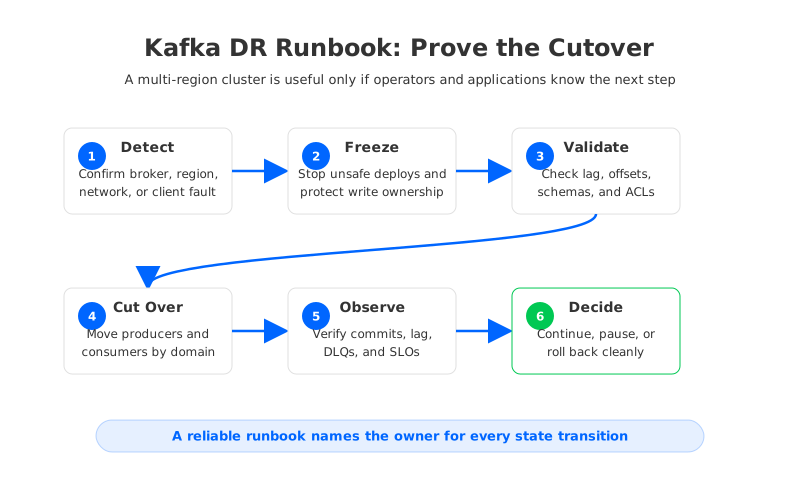
At minimum, the runbook should answer these questions:
- What health signals distinguish a Kafka failure from a downstream database or client network failure?
- Who freezes deployments, topic changes, schema changes, and connector changes during the incident?
- How is replication lag measured, and what lag level changes the cutover decision?
- Which producers move first, and can they safely retry without duplicate business side effects?
- Which consumers resume from preserved offsets, translated offsets, or explicit reset points?
- How are schema registry, ACL, secrets, certificates, DNS, and private connectivity validated?
- What is the decision point for staying in the standby region versus failing back later?
The runbook should be exercised before the real incident. Game days often reveal that the Kafka layer is only one dependency. DNS TTLs are too long. Firewall rules were built only for steady-state traffic. Schema registry endpoints are not reachable from the standby VPC. Consumer lag dashboards assume the primary cluster name. A critical downstream service cannot accept replay at failover speed. These are not Kafka product defects; they are system integration facts that a DR design must surface.
The strongest teams also use different runbooks for different failure types. Broker loss, zone loss, regional isolation, data corruption, and migration cutover have different decision trees. Treating all of them as "failover" makes the procedure vague exactly when clarity matters.
7DR Readiness Checklist for Managed Kafka Buyers
Before signing for enterprise managed Kafka, ask for architecture evidence, not only a reliability promise. The provider should be able to explain which features are managed, which are customer-owned, and which are partner or cloud-provider dependencies.
Use this checklist during vendor evaluation:
| Area | Evaluation question |
|---|---|
| RPO/RTO | Are objectives defined per workload, and are they contractual, architectural, or only operational targets? |
| Replication | Are topics, offsets, schemas, ACLs, and configurations handled by the same mechanism or separate procedures? |
| Cutover | Is failover automated, operator-driven, application-driven, or a hybrid process? |
| Networking | Are private paths, DNS, routing, firewall rules, and cross-region charges modeled before go-live? |
| Observability | Can you see replication lag, consumer positions, broker health, connector health, and data-plane errors in one incident view? |
| Failback | Is there a documented path after the original region returns? |
| Testing | Can the provider support scheduled DR exercises without special-case manual work? |
| Ownership | Does the responsibility matrix include application teams, not only platform engineering and the vendor? |
Managed Kafka can reduce operational burden, but it does not remove architecture. The platform can automate broker operations, expose replication capabilities, and provide private networking patterns. The enterprise still owns the business meaning of recovery. That is where SREs, architects, and continuity teams should spend their attention: define the recovery envelope, validate the data path, and rehearse the cutover before the outage writes the plan for you.
8References
- Apache Kafka documentation: Geo-replication
- Confluent Cloud documentation: Cluster Linking
- Confluent Platform documentation: Replicator
- Amazon MSK documentation: MSK Replicator
- AWS PrivateLink pricing
- Google Cloud VPC network pricing
- Azure bandwidth pricing
- AutoMQ Linking for Apache Kafka migration and replication
- AutoMQ documentation: What is AutoMQ
- AutoMQ documentation: What is AutoMQ BYOC
9FAQ
9.1Is multi-AZ managed Kafka enough for disaster recovery?
Multi-AZ protects against zone-level failures inside one region. It is a core availability requirement, but it is not the same as multi-region disaster recovery. Regional DR requires cross-region data strategy, client routing, private networking, cutover ownership, and a tested runbook.
9.2Does Kafka replication automatically preserve consumer offsets?
Not always in the way applications expect. Some tools replicate offsets or provide offset translation, while others require explicit procedures. Always test consumer restart behavior with real topics, real groups, and stateful processing jobs before treating the standby cluster as recoverable.
9.3Should Kafka DR use active/passive or active/active?
Active/passive is often easier to reason about because one region owns writes until failover. Active/active can reduce regional dependency, but it requires application-level design for ordering, conflict handling, duplicate detection, and ownership of keys or domains. The decision should follow RPO, RTO, and business semantics.
9.4Where does AutoMQ fit in a managed Kafka DR strategy?
AutoMQ can fit as a Kafka-compatible platform where stateless brokers and shared storage reduce the operational impact of broker failure and scaling. AutoMQ Linking can also be evaluated for migration and controlled cutover scenarios. Cross-region DR still needs explicit replication, networking, client cutover, and failback design.
9.5What is the most common mistake in Kafka DR planning?
The most common mistake is treating the standby cluster as the plan. A second cluster helps only if topics, offsets, schemas, ACLs, routing, observability, and application ownership are ready. The real plan is the tested sequence that moves business traffic safely.


