
Table of Contents
Table of Contents
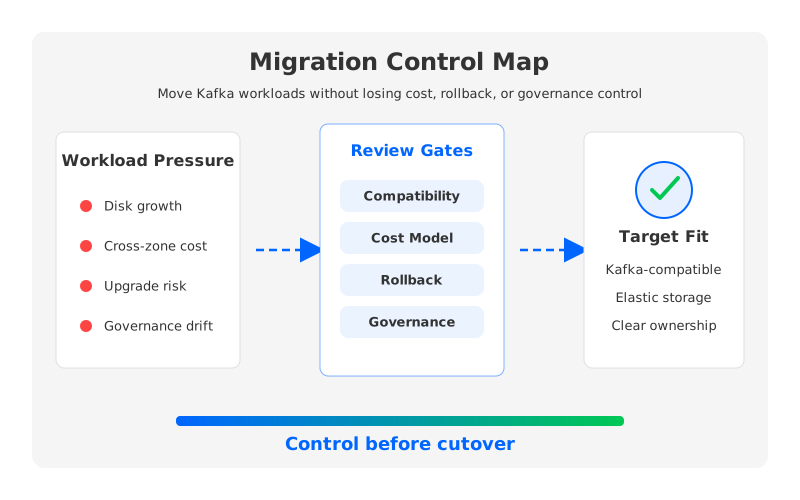
Teams search for managed kafka migration planning when Kafka has stopped being a background service and started shaping business decisions. A cluster that once looked manageable now carries regional expansion, retention growth, audit pressure, version drift, and cloud cost that nobody wants to explain every quarter. The question is whether the next platform choice gives the organization more control or replaces one operational boundary with another.
That distinction matters because "managed" can mean several different things: broker patching, a cloud marketplace contract, a hosted control plane, a BYOC deployment, or a Kafka-compatible system that changes the storage model while preserving client behavior. Buyers who treat those options as interchangeable often discover the trade-off late: less infrastructure work can also mean less visibility into cost, placement, recovery, and governance.
A useful migration plan starts from production pressure, not vendor packaging. Which workloads must keep ordering guarantees? Which consumer groups can tolerate replay? Which topics create most of the storage and network cost? Which compliance boundary controls where data lives? These questions determine contract shape, team ownership, and exit options.
1Why Teams Search for managed kafka migration planning
Kafka migrations usually begin with a symptom that has survived several internal fixes. Broker disks fill faster than capacity reviews can keep up. Rebalances take longer than a maintenance window. A cloud bill shows data transfer lines that do not map cleanly to business value. A platform team wants to retire ZooKeeper-era operational patterns, or leadership asks whether a region failure would require manual cluster surgery. Each symptom points to a different surface area, but the root problem is the same: the current operating model is too expensive to keep changing.
Managed Kafka looks attractive because it promises to move some burden away from the team. The promise is real, but incomplete. If the target service keeps broker-local storage assumptions, migration may reduce patching work while preserving harder capacity questions. If the service hides too much detail, procurement may get easier while cost attribution or rollback gets harder.
The buyer's job is to separate convenience from control. Convenience asks, "Who runs the cluster?" Control asks, "Can we predict the cost, recover from failure, move workloads without rewrites, and keep data inside the boundary we chose?" A strong plan answers both.
2The Migration Risk Behind the Workload
Traditional Kafka was designed around a shared-nothing model: brokers own compute and local durable storage, and replication across brokers provides availability. That model has served the ecosystem well, but it makes migration planning physical. Partitions and leaders live on brokers. Retention consumes local disk. When brokers are added, replaced, or rebalanced, data moves through the cluster and competes with production traffic.
The risk is not that Kafka cannot migrate. Kafka has proven tools and patterns for replication, client cutover, and rolling upgrades. The risk is that a plan focused only on moving records misses the operational weight around those records. A large topic with long retention is storage capacity, network throughput, consumer lag behavior, rebalance time, backup expectation, and rollback complexity bundled together.
Several details deserve early classification:
- Write path pressure. High-throughput topics can make replication, dual writes, and target warm-up visible to users if capacity is under-modeled.
- Consumer recovery tolerance. Some applications can replay hours of data. Others treat duplicate processing or skipped offsets as incidents.
- Retention and catch-up behavior. Long retention changes the storage economics of the destination and the time required to validate historical reads.
- Connectivity boundaries. Private networking, cross-account access, and regional placement can be more difficult to change after contracts are signed.
- Operational ownership. A managed service changes who performs tasks, but it does not remove the need for on-call decisions when lag, quota, or auth failures appear.
These points turn migration planning into architecture planning. The target is a new answer to how data is stored, how traffic crosses zones, how capacity expands, how clients authenticate, and how teams prove that rollback still exists.
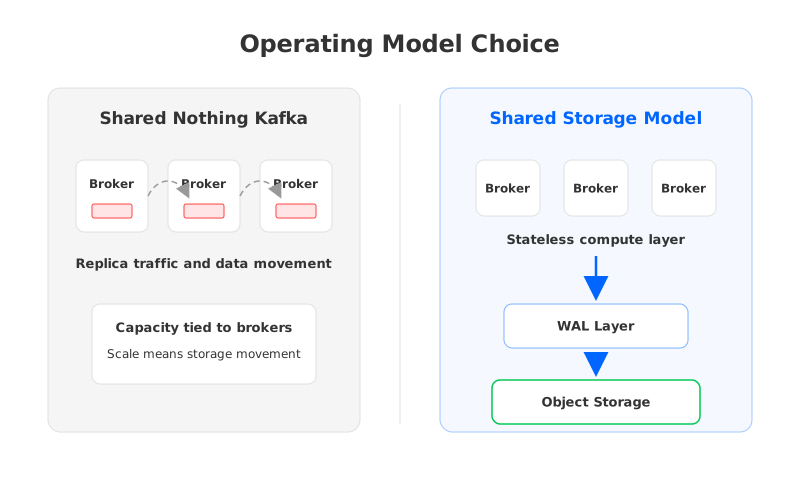
The highest-risk migrations share one pattern: the team preserves too much of the old model while expecting the new service to behave like a new model. Moving from self-managed brokers to a hosted shared-nothing service may reduce patching and monitoring burden, but it does not automatically remove storage rebalancing, replica traffic, or capacity reservation. That may be the right choice, but it should be chosen deliberately.
3Compatibility, Replication, Rollback, and Observability Trade-Offs
Compatibility is the first gate. "Kafka-compatible" should cover the client protocol, producer and consumer behavior, admin operations, authentication modes, ACL expectations, topic configuration, consumer group handling, and transactional semantics where applications depend on them. List client libraries and versions, then test representative clients against the target before debating final topology.
Replication design is the second gate. A migration bridge, a disaster recovery standby, an analytics copy, and an active-active design are different systems, even if they use similar tooling. Apache Kafka documents geo-replication patterns and Kafka Connect as core parts of the ecosystem, but the review still has to decide what the pipeline is for. Migration bridges optimize cutover and rollback. Disaster recovery optimizes failover confidence. Analytics copies may tolerate lag but care about schema and retention boundaries.
Rollback is where many plans become vague. A target cluster is ready when the team can describe what happens after a partial cutover fails. If producers have moved and consumers have not, which cluster is the source of truth? If consumer offsets were translated, how were they validated? If topic names or ACLs were transformed, can the old path still serve traffic?
Observability needs the same rigor. Lag is useful, but a platform owner needs more than one graph. The migration dashboard should show connector health, replication throughput, failed records, consumer group movement, broker saturation, topic skew, auth failures, and cost indicators. Runbooks should name the team that acts when each signal crosses a threshold.
| Review Area | Buyer Question | Engineering Evidence |
|---|---|---|
| Compatibility | Can clients move without a rewrite? | Client matrix, protocol features, auth modes, integration tests |
| Cost control | Which costs scale with traffic, retention, and zones? | Storage model, network path, broker sizing, object storage assumptions |
| Elasticity | Can capacity change without large data movement? | Scale test, rebalance behavior, partition movement evidence |
| Governance | Who controls data placement and access boundaries? | Region design, VPC or PrivateLink plan, ACL model, audit logging |
| Rollback | Can the team reverse a partial cutover? | Offset plan, source-of-truth rule, rehearsal notes |
| Operations | Who owns incidents after migration? | Alerts, SLOs, escalation path, service responsibility matrix |
The table prevents a common procurement mistake: comparing managed Kafka options by feature names while ignoring the failure modes that decide whether the migration is controllable.
4Evaluation Checklist for Migration Teams
A practical migration checklist starts by classifying workloads, because not every topic deserves the same path. Critical topics with strict ordering and low replay tolerance may need shadow consumers, offset validation, and rollback drills. Low-risk analytics topics may move earlier and expose target sizing issues before the hardest workloads arrive.
The next step is to separate acceptance criteria from implementation choices. Acceptance criteria describe what must be true: clients connect, consumers resume correctly, cost is observable, data stays in the approved region, and rollback works. Implementation choices describe how those criteria are met: MirrorMaker 2, Kafka Connect, dual writes, blue-green producers, import tools, or platform-native linking.
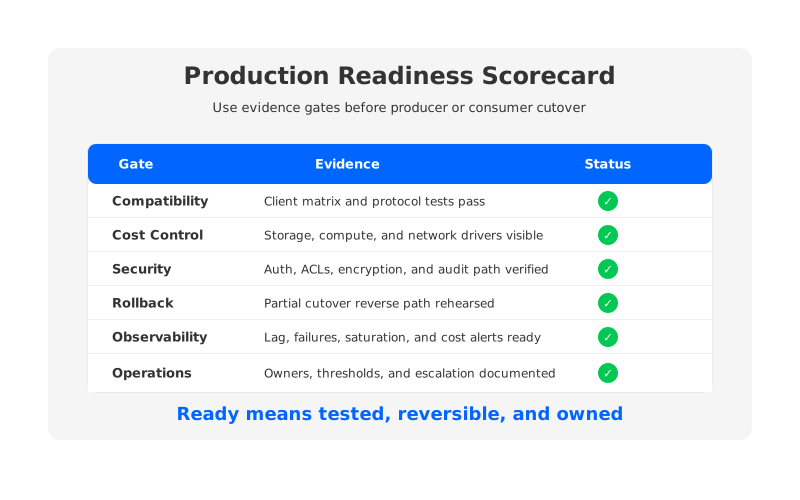
Use a scorecard that every stakeholder can read:
| Gate | Pass Condition | Warning Sign |
|---|---|---|
| Workload inventory | Topics, owners, retention, traffic, and consumers are mapped | "Top topics" are known, but ownership is unclear |
| Client readiness | Representative producers and consumers pass target tests | Only admin scripts were tested |
| Replication readiness | Lag, throughput, and failed-record handling are measured | Pipeline works only during low traffic |
| Security readiness | Auth, ACLs, encryption, and audit paths are validated | Security is deferred until cutover |
| Cost readiness | Storage, compute, and network drivers are visible | The bill is estimated only from broker count |
| Rollback readiness | A partial cutover has a rehearsed reverse path | Rollback means "restore from backup" |
| Operations readiness | Alerts and runbooks name owners and thresholds | The managed provider is treated as sole escalation path |
Run this checklist twice. The first pass happens during vendor or architecture selection, when the team still has room to change direction. The second pass happens before production cutover, when assumptions can be replaced by test evidence. A plan that passes only after the contract is signed is a hope with a ticket queue.
5How AutoMQ Changes the Operating Model
Once the neutral evaluation is complete, the architectural question becomes sharper: should the target preserve broker-owned storage, or should the migration move Kafka-compatible workloads to a shared-storage model? AutoMQ belongs in the second category: a Kafka-compatible cloud-native streaming system that keeps Kafka protocol semantics while separating broker compute from durable storage backed by object storage and a write-ahead log layer.
That separation changes the migration conversation. In a shared-nothing cluster, scaling brokers and rebalancing storage are tightly connected. In AutoMQ's shared-storage architecture, brokers are designed to be stateless, while durable log data is placed in shared storage. Capacity planning can focus on active compute and throughput, while durability and retention rely on cloud storage primitives rather than broker-local disks.
For buyers, this matters in four places. Kafka compatibility reduces application migration scope because existing clients can use familiar producer, consumer, and admin APIs. Independent compute and storage scaling changes the cost review because retention growth does not automatically require the same broker-local disk expansion pattern. AutoMQ's inter-zone traffic optimization is relevant when cross-AZ data movement has become a recurring cost concern. BYOC and software deployment options can help teams keep cloud account, network, and data boundaries under their own control.
Not every migration should become an architecture replacement. Some teams should choose a conservative managed Kafka move because their current operating model is stable and the main pain is staffing. Other teams are migrating because the old model is the problem: storage rebalancing is slow, cost is tied to over-provisioned brokers, and recovery depends too much on where data sits. For them, evaluating Kafka-compatible shared storage during migration is rational.
AutoMQ also fits the rollback discussion differently from a generic endpoint swap. A migration plan can pair Kafka-compatible client movement with staged topic migration, observability checks, and controlled cutover. If a team uses AutoMQ's migration guidance or linking capabilities, the plan should still document source-of-truth rules, offset validation, ownership, and failure drills.
6Decision Matrix for Buyers Seeking Control
The final decision should be written as a control matrix, not a brand preference. Self-managed Kafka gives deep control but keeps the team responsible for broker lifecycle, storage growth, and recovery. A hosted shared-nothing managed Kafka service can reduce infrastructure toil but may keep much of the storage and capacity model. A Kafka-compatible shared-storage platform can change the economics and elasticity profile, but it deserves the same compatibility and operational tests as any production target.
Frame the decision this way:
| If Your Main Constraint Is... | Prefer a Target That Proves... |
|---|---|
| Application rewrite risk | Kafka protocol and client behavior compatibility under your actual libraries |
| Cost unpredictability | Transparent storage, compute, and network cost drivers |
| Slow scaling or recovery | Minimal broker-local data movement during capacity changes |
| Data governance | Clear region, account, VPC, encryption, and audit boundaries |
| Small platform team | Managed operations plus visible runbooks and escalation contracts |
| Vendor lock-in concern | Standard Kafka APIs, documented migration paths, and realistic exit planning |
Buyers seeking control should leave the planning process with three artifacts: a workload inventory that names topic owners, traffic, retention, consumers, and risk class; a migration design that explains replication, cutover, rollback, and observability; and a platform decision record that states why the chosen operating model fits the next several years, not only the first migration weekend.
If broker-local storage, cross-zone traffic, and capacity reservation are the parts you most want to change, evaluate AutoMQ's Kafka-compatible shared-storage architecture as part of the target design. The AutoMQ architecture overview is a practical next step for teams building a migration plan that needs stronger control over elasticity, cost, and deployment boundaries: Read the AutoMQ architecture overview.
7References
- Apache Kafka documentation: Geo-replication
- Apache Kafka documentation: Kafka Connect
- Apache Kafka documentation: KRaft
- Apache Kafka KIP-405: Kafka Tiered Storage
- Apache Kafka KIP-1150: Diskless Topics
- AWS EC2 pricing: Data Transfer
- AutoMQ documentation: Architecture overview
- AutoMQ documentation: Compatibility with Apache Kafka
- AutoMQ documentation: Migrating from Apache Kafka to AutoMQ
- AutoMQ documentation: Eliminate inter-zone traffics
8FAQ
8.1What is the most common mistake in managed Kafka migration planning?
The most common mistake is treating migration as endpoint replacement. A real plan must cover workload inventory, client compatibility, replication semantics, rollback, observability, governance, and cost drivers.
8.2Should every Kafka migration use MirrorMaker 2 or Kafka Connect?
Not necessarily. MirrorMaker 2 and Kafka Connect are important Kafka ecosystem tools, but they are implementation choices. First define whether the goal is migration, disaster recovery, analytics copy, or multi-region operation.
8.3When should buyers evaluate a shared-storage Kafka-compatible architecture?
Evaluate shared storage when the current pain comes from broker-local storage operations: slow rebalancing, over-provisioned capacity, retention growth, cross-zone traffic, or recovery tied to data placement.
8.4How should rollback be planned?
Rollback should be planned as a production workflow. Define source of truth, producer cutover order, consumer offset validation, topic mapping, data replay tolerance, and the team responsible for the decision.
8.5Does Kafka compatibility remove migration risk?
Kafka compatibility reduces application rewrite risk, but it does not remove migration risk. Teams still need to test client versions, auth flows, topic configurations, consumer behavior, observability, and failure handling.


