
Table of Contents
Table of Contents
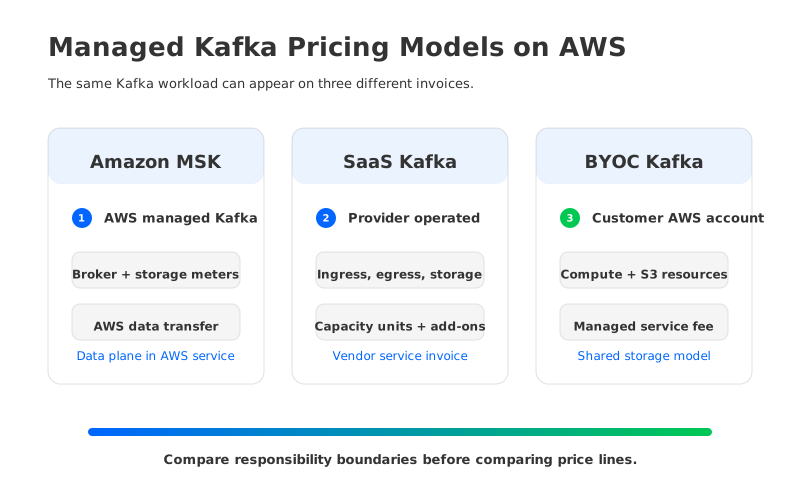
Managed Kafka on AWS pricing is hard to compare because "managed" hides several responsibility models. Amazon MSK manages Apache Kafka inside AWS. SaaS Kafka may run the data plane in the provider's account and bill for ingress, egress, storage, and capacity. BYOC Kafka keeps the data plane in your AWS account while the vendor manages automation.
That is why a useful comparison starts with cost drivers, not a headline rate. Kafka cost is shaped by broker compute, retained bytes, replication, read fan-out, traffic locality, connector workloads, support, and engineering work. AWS, Apache Kafka, Confluent, and AutoMQ all publish enough public documentation to build a pricing model, but that model has to state its assumptions.
1Why Managed Kafka Pricing Is Hard to Compare
Kafka was designed around partitions stored as replicated logs. Apache Kafka documentation describes Kafka as a distributed commit log where partitions are replicated for fault tolerance, and the current docs still frame storage and replication around brokers that serve records to clients. That matters financially because the broker is not only compute. It is also the owner of durable log replicas, compaction work, and recovery behavior.
AWS pricing then adds another layer. Amazon MSK has pricing for Provisioned clusters, Serverless, MSK Connect, MSK Replicator, broker storage, and related features. EC2 has instance and data transfer pricing. EBS charges for provisioned storage and, depending on volume type, provisioned IOPS and throughput. S3 charges for storage, requests, retrievals, and data transfer. VPC features such as NAT Gateway and PrivateLink can add per-hour and per-GB charges.
The comparison gets messy when teams ask: "What is the monthly price for managed Kafka?" Better questions:
- Who owns the data plane account and cloud resources?
- Are retained Kafka bytes stored as broker-local replicas, tiered objects, or primary shared storage?
- Are client reads, connector reads, and replication paths metered by the Kafka service, AWS networking, or both?
- Does the service charge for capacity, partitions, throughput, retained data, uptime, or a mix?
- Which operational work is removed, and which work remains with the platform team?
Those questions change the answer more than a small instance-rate difference. A small event bus and a multi-TiB log analytics pipeline are not the same pricing problem.
2Amazon MSK Cost Model
Amazon MSK is the AWS-native managed Kafka option. For Provisioned clusters, AWS lists broker instance usage, storage, and related meters on the Amazon MSK pricing page. The page also distinguishes Standard and Express brokers, and separately covers MSK Serverless, MSK Connect, and MSK Replicator. Exact price depends on Region, broker type, cluster mode, storage settings, and add-ons.
In the MSK Provisioned model, brokers still matter. You size broker count and broker type for CPU, memory, network, partition leadership, throughput, and failure headroom. Storage is attached to brokers, and long retention raises the durable footprint. MSK tiered storage can move older data to a remote tier, but that differs from a system where object storage is the primary durable repository from the beginning.
| MSK cost area | Pricing source | Engineering variable |
|---|---|---|
| Broker compute | Amazon MSK broker instance pricing | Broker count, instance type, headroom, partition count |
| Broker storage | Amazon MSK broker storage pricing and EBS-related behavior | Retention window, replication factor, compaction, spare capacity |
| Storage throughput | MSK storage throughput or EBS throughput concepts | Write rate, catch-up reads, compaction, recovery |
| Managed integration | MSK Connect pricing | Connector task count, worker capacity, data processed |
| Replication | MSK Replicator pricing plus AWS data transfer where applicable | Cross-Region or cross-cluster topology, replicated volume |
| Networking | AWS EC2 data transfer, VPC, NAT Gateway, PrivateLink | Client placement, VPC boundaries, AZ and Region paths |
This model is attractive when teams want AWS-native operations, Kafka compatibility, and clear ownership inside AWS. The caution is that Kafka's local-replica model can make retention, recovery, and data movement bigger cost levers than expected. If a topic uses replication factor 3, retained logical data has multiple broker replicas before overhead and headroom. That is Kafka doing availability work.
3SaaS Kafka on AWS Cost Model
SaaS Kafka changes the ownership boundary. The provider usually operates the control plane and data plane, and the customer consumes Kafka as a cloud service. Confluent Cloud's billing documentation describes dimensions such as ingress, egress, storage, CKU or eCKU capacity, connectors, ksqlDB, cluster linking, and support. SaaS pricing tends to abstract away raw EC2/EBS/S3 line items.
That abstraction is useful. Your team does not decide broker instance families, patch brokers, manage EBS sizing, or run the full operational loop. The trade-off is that the provider's usage dimensions become the cost language: GB written, GB read, GB stored, configured capacity, connector throughput, support, or private networking.
For FinOps teams, SaaS Kafka should be modeled separately from AWS-native MSK:
- It may reduce operational cost when teams need Schema Registry, connectors, stream processing, governance, or multi-cloud access.
- It may simplify invoice review at the Kafka-service level, while making raw infrastructure mapping less direct.
- It may expose data egress and retained storage as product meters, so read fan-out and retention still matter.
- It may shift data residency and account-boundary questions, depending on where the data plane runs.
SaaS Kafka is not "more managed" in a single universal sense. It is managed across a different boundary. That boundary is the first thing to document before comparing it with MSK or BYOC.
4BYOC Shared Storage Kafka Cost Model
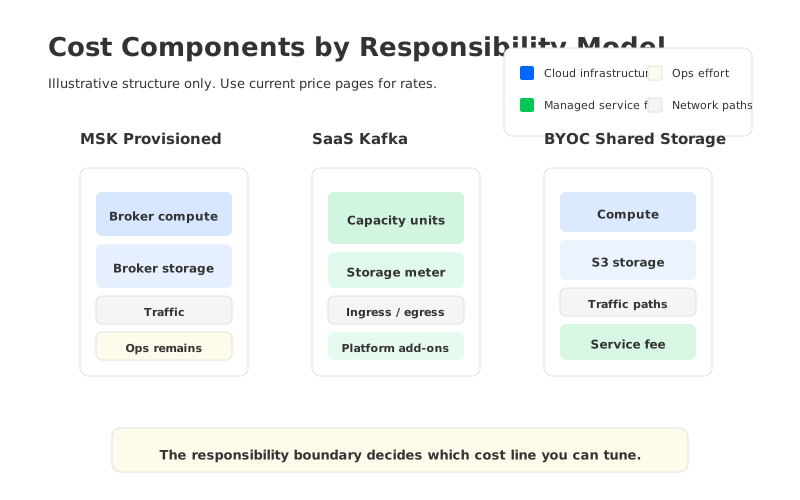
BYOC, or bring your own cloud, moves the data plane back into the customer's cloud account while keeping vendor-managed automation, control, and support around it. AutoMQ's AWS BYOC documentation places the environment in the customer's AWS account, with resources such as VPC, EKS, and S3 in the preparation model. AutoMQ's usage-based billing documentation describes BYOC dimensions such as data ingress, data egress, data retention, and cluster uptime, with AWS Marketplace used for AWS settlement. AutoMQ's pricing page separates customer cloud infrastructure cost from the managed service fee.
The deeper difference is architectural. AutoMQ represents a BYOC shared-storage Kafka model: it remains Kafka-compatible, but it uses cloud object storage as the durable storage foundation instead of treating broker-local disks as the main long-term log repository. That changes which levers dominate the cost model.
4.1Compute
In a broker-local Kafka model, compute and storage are coupled. A broker is both a request-serving process and a holder of partition replicas. When storage grows, recovery and rebalancing can become storage movement problems. When reads grow, brokers need enough CPU, memory, network, and disk throughput.
In a shared-storage Kafka model, broker compute is closer to a stateless serving layer. It still needs capacity for producers, consumers, metadata operations, and cache behavior, but durable log ownership shifts away from local disks. The cost question changes from "how many brokers hold all retained replicas?" to "how much serving capacity is needed for current traffic, and how much durable data sits in object storage?"
4.2Object Storage
Object storage pricing is not magic; S3 charges for storage, requests, retrievals, and data transfer according to the current S3 pricing page. The advantage is that the durable repository has separate scaling and billing characteristics from broker compute.
This distinction matters when comparing MSK tiered storage with shared storage Kafka. Tiered storage can reduce pressure on broker-local retention by moving older data to a remote tier. Shared storage Kafka makes object storage part of the primary architecture, so the model starts with object storage as a first-class line item.
4.3Network Traffic
Network cost is easy to underestimate because it hides inside topology. AWS EC2 data transfer, VPC pricing, NAT Gateway processing, PrivateLink, internet egress, and cross-Region transfer are separate topics. A clean Kafka diagram can still send bytes across chargeable boundaries.
Shared storage can reduce some broker-to-broker data movement patterns because durable replication is not implemented by copying full log replicas between broker disks in the same way. It does not remove network cost. Reads still move data to consumers, writes still enter the cluster, and cross-Region designs still need careful accounting.
5Example Workload Comparison Framework
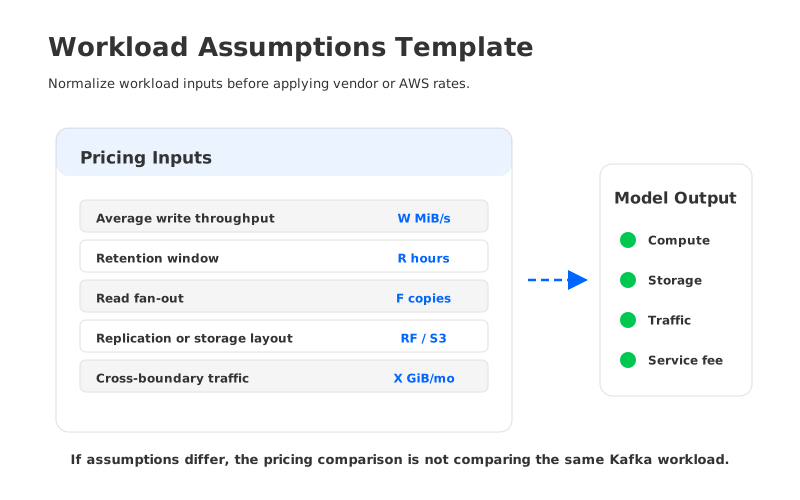
Do not start with vendor rates. Start with a workload template and fill in current prices after engineering assumptions are agreed. The following framework is illustrative and avoids hard-coded prices. Use current AWS, Confluent, and AutoMQ pricing pages for final calculations.
| Assumption | Example placeholder | Why it matters |
|---|---|---|
| Average write throughput | W MiB/s | Drives monthly ingress and retained logical data |
| Average read fan-out | F consumer copies | Drives egress, broker load, and SaaS read meters |
| Retention window | R hours | Converts throughput into stored data |
| Replication factor | RF, often 3 for production Kafka | Converts logical retained data into broker-local replicas |
| Availability Zones | AZ count | Affects placement, locality, and recovery assumptions |
| Compression ratio | C | Determines stored and billed bytes |
| Connector volume | K GiB/month | Drives Connect and network meters |
| Cross-boundary traffic | X GiB/month | Drives VPC, PrivateLink, NAT, internet, or cross-Region charges |
For a broker-local MSK estimate, the storage approximation begins with:
logical retained GiB = W_MiB_per_s * 3600 * R / 1024 * C
broker retained GiB ~= logical retained GiB * RF + overhead + free-space headroom
monthly model = broker hours + broker storage + optional storage throughput + add-ons + AWS data transfer
For a SaaS Kafka estimate, the formula is usually expressed through service meters:
monthly model = capacity units + ingress GiB + egress GiB + stored GiB-hours + connectors + private networking + support
For a BYOC shared-storage Kafka estimate, the model separates cloud infrastructure from the managed service:
monthly model = customer AWS compute + S3 storage/requests/transfer + network paths + BYOC managed service fee
The formulas force the team to decide whether it is comparing the same workload across all options. If one estimate assumes one consumer copy and another assumes four, the difference is a workload mismatch.
6When Each Model Tends to Fit
MSK is often a strong default when the platform team wants AWS-native managed Kafka, the data plane must remain inside AWS, and the workload maps well to provisioned broker capacity.
SaaS Kafka is often attractive when the organization values a broader managed data-streaming platform more than direct AWS resource control. Review ingress, egress, storage, capacity units, connectors, support, and private connectivity.
BYOC shared-storage Kafka fits teams that want managed operations without moving the data plane out of their cloud account. It is worth evaluating when retention, broker-local replica storage, recovery movement, or elastic scaling are material cost drivers. AutoMQ belongs in this category: its BYOC model keeps resources in the customer's AWS environment while documenting managed service dimensions and cloud-provider infrastructure cost.
The best decision is rarely one-dimensional. FinOps may prefer invoice transparency. SRE may prefer simpler recovery and scaling. Security may prefer customer-account data plane ownership. Architects may prefer Kafka protocol compatibility with a different storage foundation.
7Practical Checklist Before You Compare Quotes
Before asking vendors or AWS for final numbers, normalize the scenario:
- Use the same Region, AZ count, retention window, compression assumption, and write/read volumes.
- Separate logical Kafka data from post-replication or post-storage-layout data.
- Include connector, replication, and private connectivity costs rather than treating them as edge cases.
- Model both steady-state and operational events such as broker replacement, scale-out, backfill, and consumer replay.
- Keep cloud-provider infrastructure cost separate from managed service fees.
- Mark every price as "accessed on" a specific date, because cloud pricing and service packaging change.
Managed Kafka pricing is not a beauty contest between rate cards. It is a model of where bytes live, where they move, who operates each layer, and which risks the platform team still owns.
If you are evaluating BYOC shared-storage Kafka on AWS, AutoMQ's pricing calculator can be a useful second estimate alongside AWS Pricing Calculator and your MSK baseline: model your workload on AutoMQ pricing. Validate it against your Region, topology, and retention policy.
8FAQ
8.1Is Amazon MSK the same as managed Kafka on AWS?
Amazon MSK is AWS's managed Apache Kafka service, but the phrase can also mean SaaS Kafka, BYOC Kafka, or self-managed Kafka with managed components. The ownership boundary changes the pricing model.
8.2Why can MSK pricing differ from the final AWS bill?
The MSK pricing page covers MSK service meters, but production architectures may also include EC2 data transfer, EBS-related storage behavior, S3, NAT Gateway, PrivateLink, CloudWatch, MSK Connect, MSK Replicator, and cross-Region traffic.
8.3Does shared storage Kafka eliminate storage cost?
No. Shared storage Kafka changes the storage architecture; it does not make storage free. S3 still has storage, request, retrieval, and data transfer pricing. The benefit is that durable storage can scale independently from broker compute.
8.4Is SaaS Kafka always more expensive than MSK?
Not necessarily. SaaS Kafka includes a different operational boundary, feature set, and billing model. Compare normalized workloads, not labels.
8.5What is the most important assumption in a Kafka cost estimate?
Read fan-out and retention often move the estimate the most after baseline throughput. Write throughput determines ingress; fan-out and retention determine how often data is read and how long it remains billable.
8.6How should FinOps teams compare MSK and BYOC Kafka?
Separate cloud infrastructure cost, managed service fee, network cost, operational effort, and risk. For BYOC, cloud infrastructure is paid to AWS while the managed service fee is paid to the BYOC provider.
9References
- AWS, Amazon MSK pricing, accessed May 27, 2026.
- AWS, Amazon EC2 On-Demand Pricing, accessed May 27, 2026.
- AWS, Amazon EBS pricing, accessed May 27, 2026.
- AWS, Amazon S3 pricing, accessed May 27, 2026.
- AWS, Amazon VPC pricing, accessed May 27, 2026.
- AWS, AWS Pricing Calculator, accessed May 27, 2026.
- Apache Kafka, Kafka 4.3 Design documentation, accessed May 27, 2026.
- Confluent, Manage Billing in Confluent Cloud, accessed May 27, 2026.
- AutoMQ, Usage-Based Billing for BYOC, accessed May 27, 2026.
- AutoMQ, Prepare AWS Resources for BYOC, accessed May 27, 2026.
- AutoMQ, Pricing calculator, accessed May 27, 2026.


