
Table of Contents
Table of Contents
Search for Kafka on AWS and the path is crowded: Amazon MSK, Confluent Cloud, self-managed clusters, Kubernetes operators, and a long list of third-party platforms. Search for Kafka on Google Cloud, Azure, or OCI and the decision feels less settled. The services exist, but the choices do not line up cleanly across clouds. A platform team can end up comparing different networking models, billing units, and operational boundaries for what should be one streaming platform.
That inconsistency is the real problem. Most teams are not asking whether Kafka can run outside AWS. It can. They are asking whether they can run Kafka outside AWS without creating a separate operating model for each cloud. If the answer is no, the managed-service win starts to shrink: less broker maintenance, but more architecture exceptions.
1The Non-AWS Kafka Menu Has More Options Than It Used To
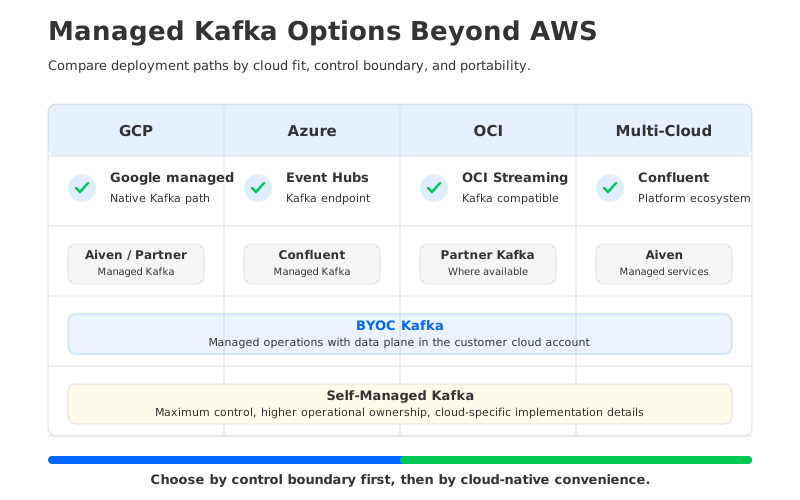
The strongest change for Google Cloud users is that Google offers a native Managed Service for Apache Kafka. The service runs open source Apache Kafka, exposes Google Cloud APIs, integrates with Cloud Monitoring and Cloud Logging, and handles broker provisioning, storage management, rebalancing, and automatic maintenance. For a Google Cloud team, that makes "managed Kafka GCP" a direct search.
Azure users have a different default. Azure Event Hubs for Apache Kafka provides a Kafka protocol endpoint on Event Hubs, so Kafka producers and consumers can connect to a managed Azure-native event ingestion service. That is useful when the workload fits the Event Hubs model. It is not the same architectural choice as running a managed Apache Kafka cluster, and Microsoft documents several key differences between Event Hubs and Apache Kafka.
OCI users usually start from OCI Streaming with Kafka compatibility. Oracle describes OCI Streaming as compatible with most Kafka APIs, allowing Kafka applications to send and receive messages with configuration changes rather than a full rewrite. That can be attractive when event streaming is close to database, integration, or application workloads already living on OCI.
The cross-cloud option is the commercial Kafka platform route. Confluent Cloud is available on AWS, Google Cloud, and Azure, with a broader data streaming platform around Kafka. Aiven on Google Cloud offers fully managed Apache Kafka and BYOC options on Google Cloud. These vendors reduce reliance on one cloud provider's native service, while adding their own control plane, pricing model, and operational conventions.
| Option | Where It Fits | What To Verify |
|---|---|---|
| Cloud-native managed Kafka | Teams that want the cloud provider to operate Apache Kafka in the same account and ecosystem | Kafka version policy, broker configuration boundaries, networking, observability, and scaling model |
| Kafka-compatible cloud service | Teams that want a managed event service with Kafka client compatibility | API coverage, topic semantics, consumer behavior, quotas, and migration limits |
| Third-party fully managed Kafka | Teams that value a mature Kafka ecosystem across multiple clouds | Data location, private networking, egress path, control-plane dependency, and cost model |
| BYOC Kafka | Teams that want managed operations while keeping data plane resources in their cloud account | Who owns infrastructure, who can access data, deployment automation, and cloud coverage |
| Self-managed Kafka | Teams that need maximum control or already have strong Kafka operations | On-call load, upgrade discipline, storage planning, scaling operations, and security ownership |
The table is not a ranking. It is a boundary map. The right answer depends on whether the team is optimizing for cloud-native integration, Kafka fidelity, data control, operational effort, or portability across clouds.
2GCP: Native Kafka, Third-Party Platforms, or BYOC
For Google Cloud users, the native managed Kafka service is the most straightforward starting point. It keeps Kafka close to Google Cloud IAM, VPC networking, Cloud Monitoring, Cloud Logging, and infrastructure-as-code workflows. If the team is committed to Google Cloud and wants managed Apache Kafka rather than a Kafka-compatible event service, this is the option to evaluate first.
That evaluation should still be architectural, not checkbox-driven. A managed service chooses which Kafka configuration knobs stay customer-controlled and which become service-managed. It also defines how capacity is sized, how networking is exposed to clients, how maintenance is scheduled, and how logs and metrics are surfaced. Those boundaries may be acceptable; the point is to understand them before migrating production topics.
Third-party platforms on Google Cloud change the tradeoff. Confluent Cloud brings a broad streaming ecosystem, managed connectors, governance features, and multi-cloud availability. Aiven provides managed open source data services and marketplace access on Google Cloud. Those choices may make sense when the platform team wants a Kafka experience not tied entirely to the native cloud service.
BYOC sits between the two. The vendor automates more of the lifecycle, but the data plane runs in the customer's cloud account or VPC. For Kafka on Google Cloud, that matters when the buyer wants managed operations without turning retained event data, metadata, or private networking into opaque vendor infrastructure.
3Azure: Kafka Endpoint, Partner Kafka, or Your Own Runtime
Azure has a strong managed event ingestion service in Event Hubs. Its Kafka endpoint can reduce migration friction for applications that already speak Kafka protocol, especially when the target architecture is Azure-native event ingestion rather than a full Kafka operations model. The practical benefit is clear: the team does not operate brokers or disks.
The catch is also clear: Event Hubs is not Apache Kafka packaged as a managed cluster. That difference can be fine for telemetry ingestion, integration pipelines, and workloads that fit Event Hubs semantics. It deserves more scrutiny for workloads that depend on specific Kafka broker behavior, administrative APIs, or connector assumptions.
Confluent Cloud and other managed Kafka vendors give Azure teams another path. They can provide a more Kafka-centered experience while removing much of the operational burden. The tradeoff shifts toward private connectivity, data movement, governance, commercial terms, and platform dependency.
Self-managed Kafka on Azure remains viable for teams with strong platform engineering. Kubernetes, virtual machines, and managed disks can all host Kafka. But self-managed Kafka means the team owns patching, broker failures, partition reassignment, capacity planning, monitoring, and incident response. That is a heavy default for a shared enterprise streaming platform.
4OCI: Kafka Compatibility Is Useful, but Portability Still Needs Design
OCI Streaming's Kafka compatibility gives Oracle Cloud users a practical bridge for Kafka clients. For teams anchored in OCI, that can keep event streaming close to Oracle applications, databases, and integration services. Compatibility lowers application migration effort, but it does not make every operational or semantic assumption portable.
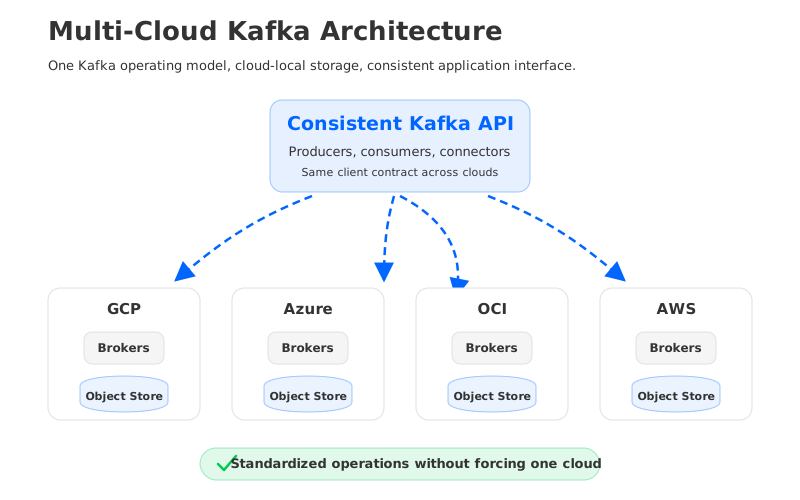
OCI is also where multi-cloud strategy often becomes concrete. A company may use OCI for Oracle workloads, GCP for analytics, Azure for Microsoft-centered applications, and AWS for other infrastructure. If each cloud uses a different streaming primitive, the platform team must normalize more than topics and schemas; it must normalize operations, networking, access control, monitoring, and recovery.
This is where "Kafka beyond AWS" becomes a platform architecture question. The harder problem is giving internal teams one reliable way to request topics, monitor lag, scale capacity, handle incidents, and move workloads between clouds without relearning the platform each time.
5The Five Tradeoffs That Matter
A useful managed Kafka evaluation should avoid vendor feature bingo. Many features sound similar until the team maps them to ownership boundaries. A tighter framework scores each option against five tradeoffs.
- Data control. Where do retained logs, metadata, credentials, and network paths live? A SaaS data plane can be acceptable, but regulated workloads often prefer customer-account deployment or at least private connectivity and clear data residency guarantees.
- Network shape. Kafka clients are chatty, and private networking design affects latency, firewall rules, troubleshooting, and egress exposure. A single endpoint model feels different from broker-addressable Kafka clusters, and both models have operational consequences.
- Ecosystem fit. Kafka is more than producers and consumers. Kafka Connect, Schema Registry, Flink, MirrorMaker, monitoring tools, ACL automation, and IaC modules can become part of the platform contract.
- Cost shape. Avoid comparing list prices in isolation. Managed services move cost between infrastructure, vendor fees, networking, storage, operations, and migration overlap. The durable question is which cost grows with traffic and which cost stays provisioned.
- Cloud portability. A single-cloud native service can be excellent inside that cloud. A multi-cloud platform must also ask whether the same operating model, automation, and failure procedures work across GCP, Azure, OCI, and AWS.
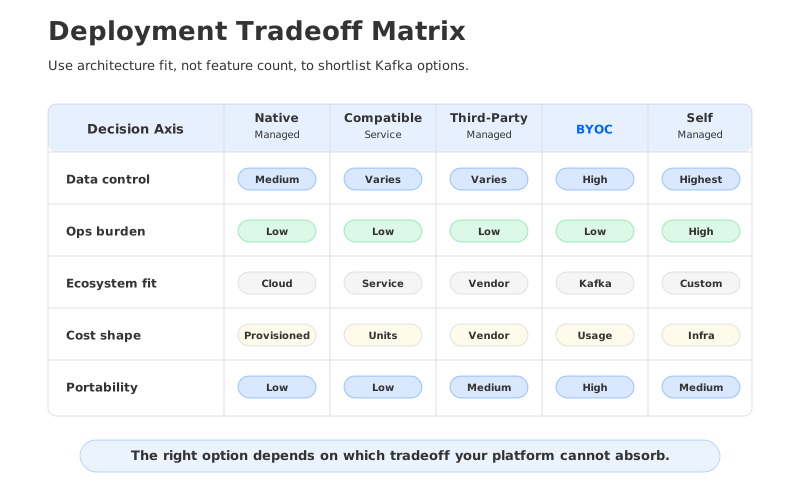
These tradeoffs explain why teams reach different answers. A Google Cloud-only team with standard Kafka workloads may prefer Google's managed Kafka. An Azure application team may prefer Event Hubs when it wants Azure-native ingestion and does not need full Kafka cluster semantics. A multi-cloud platform team may care more about a consistent Kafka API, repeatable deployment, and predictable data control.
6Where AutoMQ Fits: Consistent Kafka Across Clouds
AutoMQ BYOC approaches the non-AWS Kafka problem from the portability side. The data plane runs in the customer's cloud environment, while AutoMQ provides a managed operational experience. AutoMQ's public materials describe support across AWS, GCP, Azure, and OCI with a Kafka-compatible architecture built around cloud object storage.
That architecture matters because it changes what is standardized. Traditional Kafka standardizes the client API, but the operations model can still vary by cloud and deployment. AutoMQ keeps the Kafka API while decoupling broker compute from durable storage. Cloud providers still differ in object storage, networking, IAM, and marketplace mechanics; the platform team can still keep the same architecture and operating pattern across those differences.
The Bambu Lab case study is the clearest example for this topic. Bambu Lab needed to standardize streaming across AWS and Google Cloud while staying Kubernetes-native. AutoMQ's case study frames the problem as fragmented multi-cloud Kafka operations, then describes the move to a stateless Kafka architecture across clouds.
That story avoids a common multi-cloud fantasy. Multi-cloud does not mean every workload runs everywhere all the time. More often, it means the platform team needs one operating model for workloads that may land in different clouds for business, data, geography, or ecosystem reasons. Kafka becomes easier to govern when the team can reuse deployment automation, monitoring conventions, scaling procedures, and incident response muscle memory.
7A Practical Selection Path
Start with the cloud boundary, not the vendor name. If the workload is entirely inside Google Cloud and the team wants managed Apache Kafka, evaluate Google Cloud Managed Service for Apache Kafka first. If the workload is Azure-native event ingestion and Kafka clients are the integration requirement, evaluate Event Hubs for Apache Kafka. If the workload sits in OCI and Kafka compatibility is enough, evaluate OCI Streaming.
Then test the uncomfortable cases. What happens when consumers replay after a downstream outage? What happens when traffic spikes and capacity has to move? What happens when a business unit asks for the same platform in another cloud? What happens when the security team asks exactly where event data, credentials, and metadata live?
For single-cloud workloads, a native managed service can be the most operationally natural answer. For multi-cloud platform teams, consistency may be worth more than native convenience. That is where BYOC and cloud-portable Kafka architectures enter the shortlist.
Kafka beyond AWS is no longer a blank space. GCP, Azure, OCI, and third-party platforms all give teams credible ways forward. The decision that matters in 2026 is whether you want a Kafka service for one cloud, or a Kafka operating model your team can carry across clouds.


