
Table of Contents
Table of Contents
Managed Kafka on GCP and Pub/Sub both sound like managed messaging. That similarity disappears once you look at the abstraction applications depend on. Managed Service for Apache Kafka gives you a Google-operated Apache Kafka cluster, so the design center is Kafka API compatibility, topics, partitions, consumer groups, offsets, and the Kafka ecosystem. Pub/Sub gives you a serverless Google Cloud messaging service built around topics, subscriptions, acknowledgments, and push or pull delivery.
That difference matters more than the console page where you create the resource. If teams already built around Kafka clients, Kafka Connect, Kafka Streams, Flink Kafka sources, offset reset workflows, and partition-aware ordering, managed Kafka preserves that contract while removing much of the broker administration. If teams want Google Cloud-native event fan-out without cluster capacity planning, Pub/Sub can be the cleaner fit.
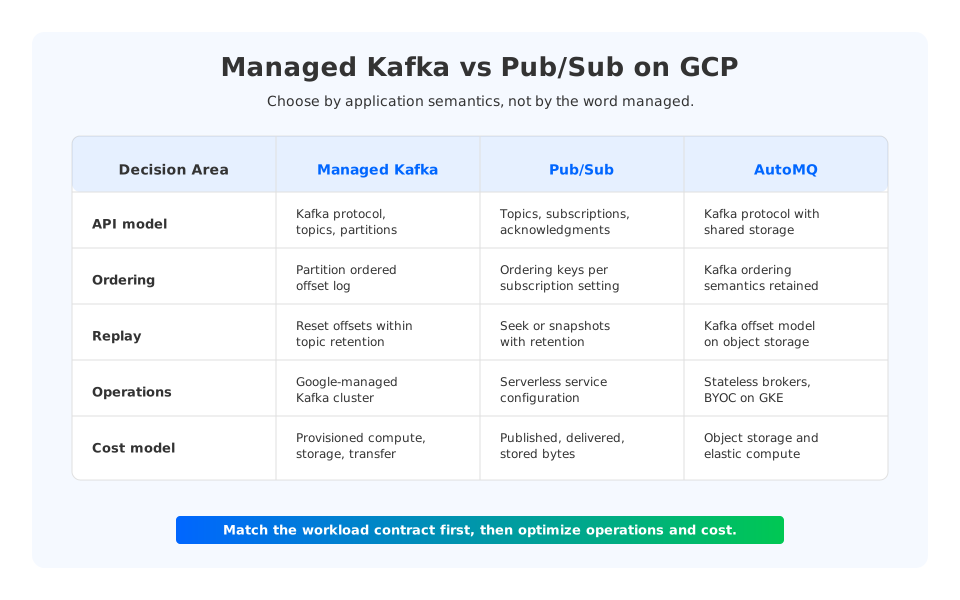
1Quick Recommendation
Choose managed Kafka on GCP when Kafka semantics are part of the application contract. That usually means existing Kafka producers and consumers, explicit partitioning, consumer groups that track offsets, replay by offset or timestamp, or tools that assume the Kafka protocol. Google Cloud's Managed Service for Apache Kafka runs open source Apache Kafka and is positioned for application code compatibility, while automating broker provisioning, storage management, rebalancing, patching, monitoring, and logging.
Choose Pub/Sub when the workload is a cloud-native messaging pattern and Kafka compatibility is not a constraint. Pub/Sub is attractive when teams want serverless fan-out, publisher/subscriber decoupling, Google Cloud integration, and usage-based pricing without sizing broker CPU, memory, or storage.
- Use managed Kafka when you need Kafka protocol compatibility, partition-aware processing, offset control, or Kafka ecosystem portability.
- Use Pub/Sub when you need serverless Google Cloud messaging, many independent subscriptions, push delivery, and a managed ack-based consumption model.
- Evaluate AutoMQ when you need Kafka compatibility on GCP but also want to examine a shared-storage architecture that reduces broker state and changes the operational economics of Kafka-style streaming.
This is a workload fit question. A payments ledger, CDC pipeline, fraud feature stream, or Kafka Connect estate has different constraints from a notification bus, workflow trigger, or application event fan-out service.
2API and Ecosystem Compatibility
Kafka compatibility is the first gate because it determines whether the migration is an infrastructure project or an application rewrite. With managed Kafka on GCP, producers and consumers continue to speak the Kafka protocol. Topic administration, client configuration, ACLs, Kafka Connect, and consumer group tooling remain part of the picture. Google removes a large amount of cluster work, but the application-level contract is still Kafka.
Pub/Sub uses a different contract. Applications publish messages to topics, receive messages through subscriptions, and acknowledge processing through Pub/Sub's delivery model. The service integrates with many Google Cloud products, but a Kafka client cannot point at Pub/Sub and behave as if it connected to a Kafka broker. If your architecture depends on Kafka Streams state stores, Connect connector behavior, or consumer group offset tooling, that difference turns into engineering work.
| Decision point | Managed Kafka on GCP | Pub/Sub |
|---|---|---|
| Client protocol | Apache Kafka clients and tooling | Pub/Sub APIs and client libraries |
| Core abstraction | Kafka cluster, topics, partitions, offsets, consumer groups | Topics, subscriptions, messages, acknowledgments |
| Ecosystem fit | Kafka Connect, Kafka Streams, Flink Kafka connectors, Kafka admin tools | Google Cloud serverless and application integration patterns |
| Migration shape | Often infrastructure and networking oriented | Often application and semantic adaptation oriented |
Managed Kafka still asks teams to reason about partitions, replication, retention, and consumer lag. Pub/Sub asks teams to reason about subscription backlog, ack deadlines, redelivery, message filters, and delivery endpoints.
3Ordering, Replay, and Consumer Semantics
Kafka's ordering model is partition based. Records in a partition have ordered offsets, and consumers in a group divide partitions among themselves. That model gives platform teams a concrete handle for replay, backfill, lag measurement, and deterministic processing boundaries. If a team needs to rerun a job, it can reset offsets to an earlier position, subject to retention.
Pub/Sub ordering is based on ordering keys and subscription settings. Google Cloud documents that messages with the same ordering key can be delivered in publish order when ordering is enabled. Pub/Sub replay uses seek to alter acknowledgment state, and replaying acknowledged messages requires message retention on the topic or retaining acknowledged messages on the subscription. That is powerful, but it is not the same mental model as Kafka offsets.
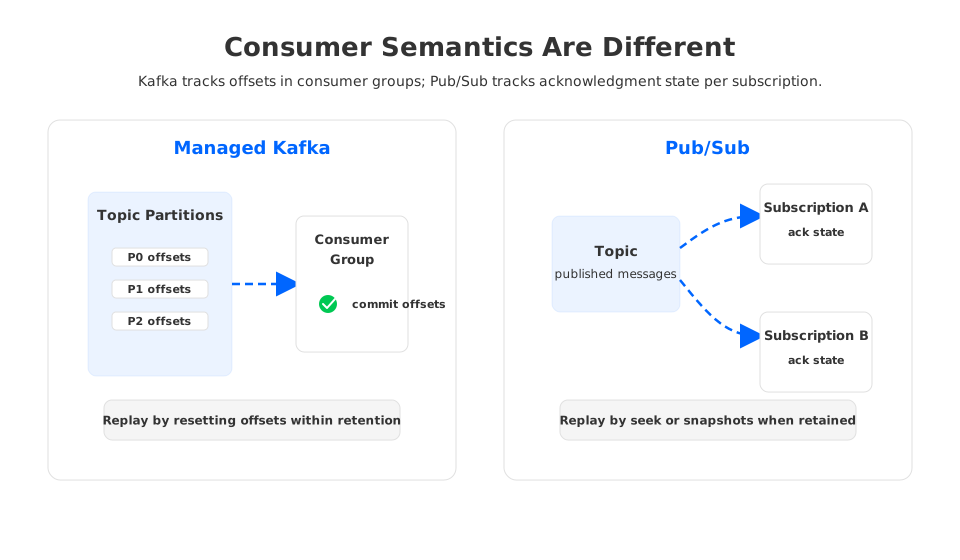
This semantic difference shapes incidents. In Kafka, an SRE asks which consumer group, topic partition, committed offset, and lag window are involved. In Pub/Sub, the equivalent conversation is about subscription backlog, acknowledgment state, ack deadlines, redelivery, and whether seek or snapshots are configured.
The distinction is visible in three workload patterns:
- Entity-ordered streams: Kafka fits naturally when a partition key maps to an entity and downstream jobs rely on ordered offsets. Pub/Sub can provide ordering by key, but the design should account for ordering-key throughput and redelivery behavior.
- Backfill and reprocessing: Kafka gives teams offset reset workflows over retained logs. Pub/Sub supports replay through seek and snapshots, provided retention settings were configured before the incident.
- Multiple independent consumers: Kafka consumer groups split work within a group, while separate groups each maintain their own offsets. Pub/Sub subscriptions deliver copies of messages to independent subscriber applications, with acknowledgment state tracked per subscription.
If application logic has already encoded Kafka's offset model, managed Kafka is usually the lower-risk path. If the logic only needs reliable event delivery and independent subscribers, Pub/Sub can remove a lot of cluster thinking.
4Operational Model and Scaling
Managed Kafka on GCP reduces the toil of running Kafka, but it does not make the Kafka model disappear. Google Cloud's service asks you to size or scale the cluster by total vCPU count and RAM size. It automates broker provisioning, storage management, and rebalancing across three zones. The service also handles TLS, authentication options, encryption at rest, patching, Cloud Monitoring metrics, and Cloud Logging exports.
That is strong for teams that want Kafka without owning every broker lifecycle task. It still keeps capacity planning in the platform team's hands. Throughput, consumer bandwidth, retention, replication, vCPU, memory, storage, and inter-zone transfer still matter.
Pub/Sub shifts more scaling into the service. You do not provision brokers for a topic. You publish and subscribe through managed APIs, and teams focus on delivery contracts, subscription configuration, and downstream processing rather than broker placement.
The trade-off is control. Kafka gives operators familiar knobs for partitioning, offset movement, consumer group behavior, and ecosystem integration. Pub/Sub gives operators fewer infrastructure knobs, which is a feature when the workload matches the service and a constraint when it does not.
5Cost and Retention Model
Cost comparison is tricky because the services charge for different work. Managed Service for Apache Kafka pricing includes vCPU and RAM, storage, networking, Connect clusters, and Private Service Connect access. Google Cloud's pricing page also notes that for clusters with utilization above 20%, inter-zone data transfer can become the largest component of total cost because of replication and client-to-broker traffic.
Pub/Sub pricing is usage based: publishing and delivery throughput, data transfer across zone or region boundaries, and storage for retained messages. The public pricing page lists a message delivery price of $40 per TiB after the free monthly allowance. That can be easy to start with, but high-throughput fan-out grows with delivered bytes and backlog.
| Cost dimension | Managed Kafka on GCP | Pub/Sub |
|---|---|---|
| Capacity basis | Provisioned cluster vCPU, RAM, storage, and related networking | Published, delivered, transferred, and stored bytes |
| Retention basis | Kafka topic retention and storage tiers configured on the cluster | Topic retention, subscription retention, snapshots, and backlog storage rules |
| Scaling risk | Over-provisioning for peaks or under-provisioning during spikes | Usage growth across publish, delivery, storage, and transfer dimensions |
| FinOps question | How much Kafka capacity and replication traffic does this workload need? | How many bytes are published, delivered to each subscription, retained, and transferred? |
Model the workload before choosing. Estimate publish throughput, fan-out, retention, replay requirements, message size, regional placement, and peak-to-average ratio. For Kafka, model replicas, partition count, consumer locality, and cross-zone traffic. For Pub/Sub, model delivery to each subscription and storage settings.
6Where AutoMQ Fits for Kafka-Compatible GCP Workloads
There is a third question hiding behind "managed Kafka or Pub/Sub": do you need Kafka compatibility, or do you need the traditional Kafka storage architecture? Those are not the same thing. Many teams need the Kafka protocol because applications, connectors, and runbooks already depend on it. Fewer teams explicitly want broker-local data movement, slow partition reassignment, and capacity planning tied to stateful disks.
This is where AutoMQ enters as a Kafka-compatible cloud-native streaming option rather than a Pub/Sub replacement. AutoMQ keeps Kafka protocol compatibility while moving Kafka's storage layer to shared object storage and making brokers stateless. On GCP, AutoMQ BYOC supports deployment on GKE and can use GCS buckets for message data. That architecture is relevant for teams that want Kafka semantics but are questioning the cost, elasticity, and recovery behavior of broker-local storage.
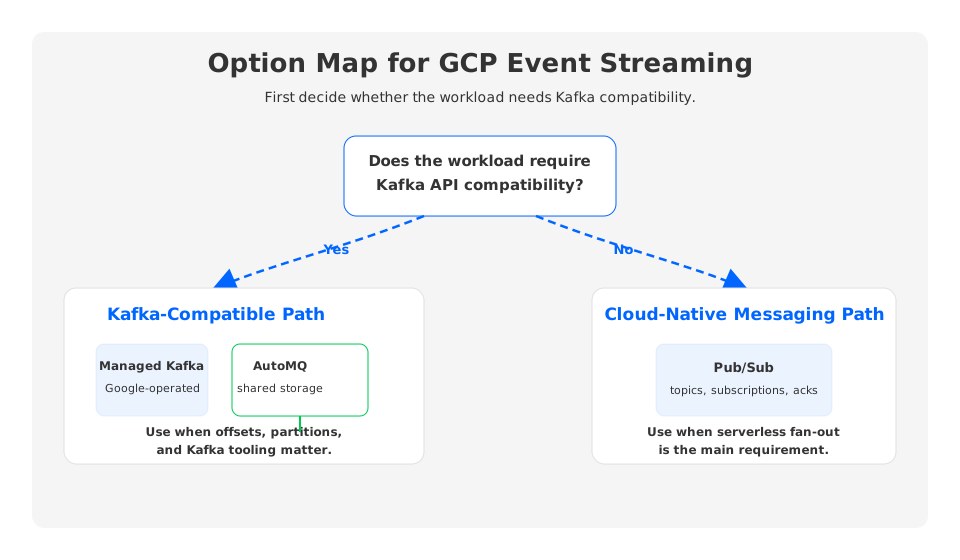
When durable data is tied to brokers, scaling and recovery tend to involve data movement, replica placement, and storage balancing. When brokers are stateless and durable data lives in shared storage, compute changes become closer to service capacity changes. Teams evaluating managed Kafka on GCP should separate two decisions:
- Do applications require Kafka API and ecosystem compatibility?
- Does the platform require the classic broker-local storage model, or would shared storage fit better?
- Does the operating model need to keep data in the customer's cloud account and VPC while reducing Kafka-specific infrastructure work?
AutoMQ is most relevant when the answer to the first question is yes, and the team wants a different answer to the second and third questions. Pub/Sub remains the cleaner choice when Kafka compatibility is not required and the workload maps naturally to Google Cloud's topic/subscription model.
7Workload-Based Decision Guide
Start with the contract that downstream systems already depend on. If consumers commit offsets, operators reset offsets during incidents, and pipelines use Kafka Connect or Flink Kafka connectors, managed Kafka on GCP is usually the safer baseline. It preserves the ecosystem while removing many self-managed Kafka tasks.
If the workload is application event fan-out, workflow triggering, notifications, or loosely coupled microservice messaging, Pub/Sub often wins on simplicity. Each subscriber gets its own subscription state, push or pull delivery, and Google Cloud integration without a broker fleet. The team still needs careful retry, idempotency, and retention design.
If the workload is a high-throughput event stream with Kafka compatibility requirements and cost or elasticity pressure, add AutoMQ to the evaluation. The useful comparison is not "AutoMQ vs Pub/Sub" but "which Kafka-compatible architecture should run this GCP workload?" Broker state, storage model, partition reassignment, recovery, and data-plane ownership matter as much as whether the control plane is managed.
A pragmatic selection pattern looks like this:
| Workload | Better starting point | Why |
|---|---|---|
| Existing Kafka estate moving to Google Cloud | Managed Kafka or AutoMQ | Kafka clients, offsets, connectors, and runbooks remain relevant |
| New Google Cloud application event bus | Pub/Sub | Serverless topic/subscription model fits cloud-native fan-out |
| CDC and stream processing with partition-aware ordering | Managed Kafka or AutoMQ | Kafka partitions and consumer groups give explicit processing boundaries |
| Lightweight notifications and workflow triggers | Pub/Sub | Ack-based delivery and push/pull subscriptions reduce platform overhead |
| Kafka-compatible workload under storage and scaling pressure | AutoMQ evaluation | Shared storage and stateless brokers change the operating model |
The final decision should include a proof of concept with production-like message size, fan-out, retention, and failure scenarios. Replay, consumer recovery, IAM boundaries, regional design, cost under fan-out, and day-2 operations expose the real fit.
To evaluate Kafka-compatible shared storage on GCP, review the AutoMQ GKE deployment guide and compare it against your managed Kafka baseline with the same workload assumptions.
8References
- Managed Service for Apache Kafka overview, Google Cloud
- Managed Service for Apache Kafka pricing, Google Cloud
- Pub/Sub overview, Google Cloud
- Pub/Sub message ordering, Google Cloud
- Replay and purge messages with seek, Google Cloud
- Pub/Sub pricing, Google Cloud
- Apache Kafka consumer group tooling, Apache Kafka documentation
- AutoMQ stateless broker documentation
- Deploy AutoMQ to Google Cloud GKE
9FAQ
9.1Is Pub/Sub a replacement for Kafka on GCP?
Pub/Sub can replace Kafka for some messaging workloads, but it is not a drop-in Kafka replacement. If applications depend on Kafka clients, partitions, consumer group offsets, Kafka Connect, or Kafka Streams, a managed Kafka service or another Kafka-compatible platform is usually a closer fit.
9.2When should I choose managed Kafka on GCP instead of Pub/Sub?
Choose managed Kafka when Kafka compatibility is a requirement, not a preference. Common signals include existing Kafka applications, offset reset runbooks, partition-aware stream processing, connector estates, or multi-cloud portability requirements that assume Kafka APIs.
9.3When is Pub/Sub the better fit?
Pub/Sub is often the better fit for Google Cloud-native event fan-out, application messaging, workflow triggers, and services that benefit from serverless operations. It is especially useful when each downstream system can own a subscription and process messages through an acknowledgment-based model.
9.4Does managed Kafka on GCP remove all Kafka operations?
No. It removes a large amount of broker administration, including provisioning, storage management, rebalancing, patching, and observability integration. Platform teams still need to design topics, partitions, retention, client behavior, capacity, networking, and cost controls.
9.5Where does AutoMQ fit in this comparison?
AutoMQ fits when the workload requires Kafka compatibility but the team wants to evaluate a cloud-native shared-storage architecture. It is not a Pub/Sub substitute for generic messaging. It is a Kafka-compatible option for teams that want to reduce broker state, improve elasticity, and keep data-plane resources in their cloud environment.


